Affiliate traffic does not always arrive from one country, device or operating system. A link created for a specific offer may become unsuitable when the visitor is outside the target location, uses an unsupported device or reaches the page after the offer has been paused.
A SmartLink solves part of this problem by connecting several eligible offers to one tracking URL. Instead of asking a publisher to manage a separate URL for every traffic segment, the platform evaluates the incoming click against the available campaigns and configured routing rules before choosing a destination.
This guide explains what a SmartLink is, how it works, when it is useful and how to set it up in Trackier.
What Is SmartLink?
A SmartLink is a tracking URL that can redirect visitors to different eligible offers according to predefined conditions.
The decision may consider the visitor’s country, region, city, device, operating system or carrier, together with campaign availability, publisher permissions, advertiser filters, objectives and payout rules. A standard affiliate link normally leads to one predetermined offer. A SmartLink can assess a group of offers before completing the redirect.
This makes it useful for affiliate networks, agencies and media businesses handling mixed traffic across multiple markets or devices. It can reduce link-management work and limit obvious destination mismatches, but it does not guarantee that every click will convert or generate revenue.
How Does SmartLink Work?
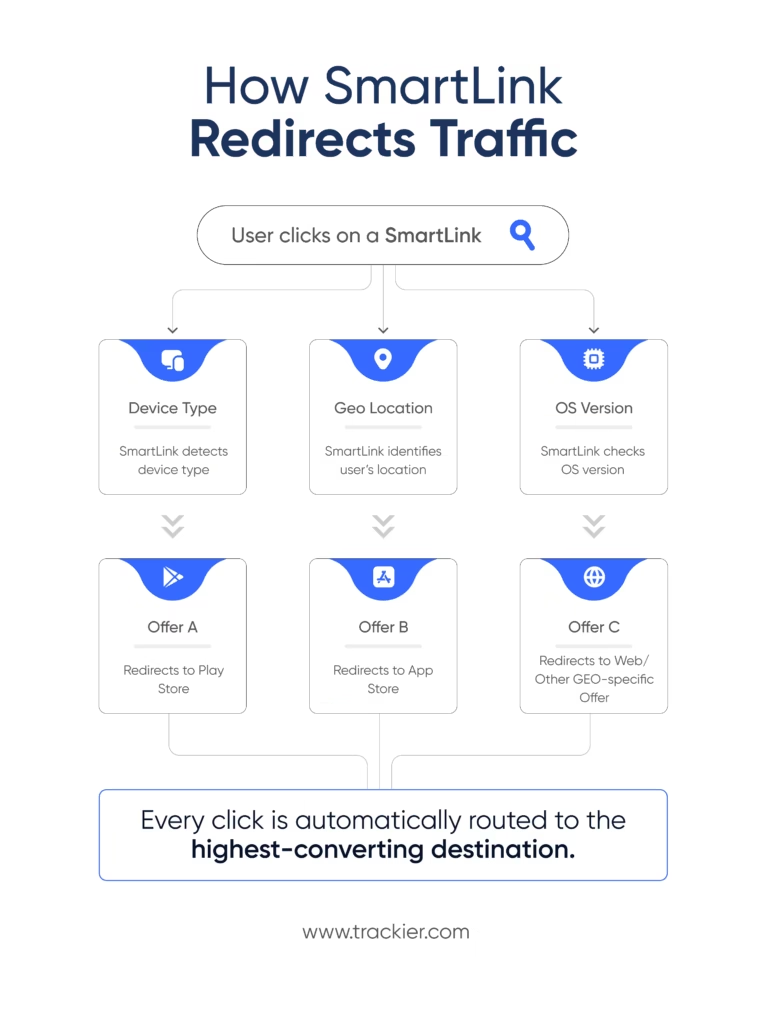
The process begins when a visitor clicks the URL shared by an approved publisher. The platform records the click and checks which offers are available within that setup. It then applies publisher permissions, campaign filters and the selected targeting criteria.
Offers that do not satisfy the rules are removed from consideration. The remaining destination is chosen according to the configuration type. Category and Tag modes select from campaigns grouped under the chosen categories or tags, while Manual mode uses a fixed campaign list and a defined traffic split.
The visitor is then redirected to the selected landing page, app-store page or another approved destination. If an included campaign is paused, the configured fallback can provide an alternative route. Clicks and resulting conversions remain available for reporting and analysis.
This process is rule-based. It should not automatically be described as artificial intelligence or machine learning. Trackier’s current documentation identifies performance-based optimisation controls within Tag mode, but those controls do not apply universally to every configuration.
SmartLink vs a Regular Affiliate Link
| Feature | SmartLink | Regular Affiliate Link |
|---|---|---|
| Destination | Selects from several eligible offers | Leads to one predetermined offer |
| Routing | Uses configured filters and targeting | Relies on the destination campaign’s rules |
| Mixed traffic | Suitable for multiple locations or devices | Often requires separate links |
| Offer management | Category, Tag or Manual configuration | Managed one offer at a time |
| Traffic split | Available through Manual mode | Not designed for multi-offer allocation |
| Fallback | Can include an alternative destination | Depends on the individual setup |
| Best use | Broad or mixed traffic across related offers | Content promoting one specific offer |
A regular affiliate link remains the better choice when the surrounding content names one product or promises one particular landing page. The destination should match the message that persuaded the user to click.
Smart Link Types in Trackier
Trackier currently supports Category, Tag and Manual configurations. Each type solves a different traffic-management problem.
Category
Category mode includes campaigns assigned to one or more selected categories. It is useful when offers are already organised by vertical, product group or another consistent classification.
For example, an affiliate network can group several eligible utility-app offers under one category and provide publishers with a single URL for that group. When a new offer is added to the selected category, it can become part of the available pool without requiring the publisher to replace the link.
Trackier’s current setup guide states that country targeting is applied by default in Category mode. Other filters and targeting choices should be reviewed according to the campaigns included in the group.
Tag
Tag mode includes campaigns carrying the selected tags and adds performance-management controls.
Programme managers can define campaign kickout criteria, choose whether EPC is calculated from payout or revenue, direct a controlled share of traffic to newly added campaigns with zero EPC and set an initial period during which a new campaign is protected from kickout rules.
These controls allow new offers to collect data before being evaluated and allow underperforming offers to be removed according to predefined conditions. They are configurable optimisation rules, not a general claim that the system uses AI to predict every user’s ideal offer.
Manual
Manual mode uses a fixed set of selected campaigns. The programme manager decides how traffic should be distributed between them, either by entering the percentages or using the platform’s autofill option.
This setup is appropriate when the offer list must remain controlled, a commercial agreement requires a specific allocation or a team wants to compare selected destinations without automatically adding campaigns from a category or tag.
Practical Examples
Multi-Geo App Traffic
A publisher promotes a fitness app to users in several markets. A UK visitor using Android can be directed to an eligible Android destination, while an iPhone user in France can be sent to the corresponding iOS page. Desktop traffic can be routed to a compatible web experience.
The example shows how one URL can support a broader traffic mix without requiring a separate publisher link for every country and device combination.
A Vertical with Several Offers
An affiliate network groups related gaming or utility campaigns under one category. When traffic arrives, the platform checks publisher access, campaign status, payout and objective filters, and the applicable targeting conditions before selecting an eligible offer.
This is useful when campaign availability changes frequently but publishers should continue using the same approved URL.
Controlled Offer Testing
A programme manager wants to compare three selected offers. Manual mode divides traffic between the destinations according to the chosen percentages. Performance can then be reviewed using clicks, approved conversions, conversion rate, EPC, revenue and payout.
The allocation should be changed only after the offers have collected enough comparable traffic to support a meaningful decision.
When Should You Use a SmartLink?
A SmartLink is useful when publishers send traffic from several countries or devices, multiple related offers are available, campaign availability changes regularly or the network wants one reusable URL for a defined offer group.
It can also help when traffic needs to be divided between selected campaigns, when Tag-mode EPC controls are relevant or when a fallback route is needed for paused campaigns.
For teams managing a large publisher and offer base through an affiliate marketing platform, this can reduce manual link distribution. It should still be limited to offers that make sense for the same audience and promotional context.
When Is a Direct Link Better?
Use a direct link when a publisher is reviewing one named product, the creative must lead to a predetermined landing page, the advertiser requires strict destination approval or legal and compliance rules require a fixed journey.
It is also preferable when only one campaign is available or the publisher needs full control over the destination. Sending a visitor from a detailed product review to an unrelated offer can damage trust even when the redirect is technically eligible.
How to Create a Smart Link in Trackier
Trackier’s current Smart Links setup guide places the feature under Automation → Smart Link. The guide documents the feature for Agency and Enterprise plans, so current packaging should be confirmed before implementation.
Begin by selecting Add New and entering a name, a publisher-facing description and the publisher-postback preference. Then choose Category, Tag or Manual as the configuration type.
The next stage defines eligibility. Depending on the selected type, the setup can allow or block publishers, select advertisers, exclude campaigns, filter by objective and set minimum or maximum payout conditions. Manual mode uses a narrower set of options, while Category and Tag modes provide additional campaign and advertiser filters.
Targeting can use country, region or state, city, operating system, device and carrier or ISP. Campaign-level rules still apply, so the included offers should be reviewed before traffic is sent. Avoid adding restrictions that are not required because they can reduce the number of valid destinations.
Additional URL parameters can pass approved information such as a publisher ID, app name or advertising identifier. Add a fallback URL where appropriate, then save the configuration.
After setup, use Generate Link to choose the Smart Link and publisher. Optional parameters p1 to p10, a source value and a tracking domain can be added during generation. Trackier’s link-generation guide also states that an allowed publisher can generate the link through the publisher interface.
For accounts with the feature enabled, Trackier also supports built-in short-link generation. This can make long tracking URLs easier to share without adding an external shortening tool.
Before wider distribution, test the major locations, devices and operating systems in the intended traffic mix. Confirm the destination, tracking parameters, publisher postback, conversion recording and fallback behaviour.
Metrics That Matter
Traffic volume alone does not show whether the routing is commercially useful. Review results by publisher, offer, location and device, and separate recorded conversions from approved outcomes.
| Metric | What It Shows |
|---|---|
| Clicks | Total and unique traffic sent through the URL |
| Conversion rate | The share of eligible clicks that produced the defined action |
| Approval rate | The share of recorded conversions that remained valid after review |
| EPC | Earnings generated per click, based on the selected payout or revenue method |
| Revenue and payout | Advertiser-side value and the amount owed to the publisher |
| Offer distribution | How traffic was divided across eligible campaigns |
| Traffic quality | Invalid, duplicate, proxy, bot or otherwise suspicious activity |
Use affiliate tracking and marketing analytics to review these results in context. A high EPC can be encouraging, but it should be assessed alongside conversion volume, approval rate, campaign caps and traffic quality.
SmartLink Best Practices
Keep the Offer Group Relevant
Campaigns grouped under one link should serve a reasonably consistent audience or use case. Adding unrelated offers simply to enlarge the pool can create a misleading user journey.
Use a Suitable Fallback
The alternative destination should remain relevant to the original promotion. Trackier’s fallback traffic guide also explains campaign-, advertiser- and global-level fallback options and notes that chained campaign fallbacks are not supported.
Give New Offers Enough Data
When Tag-mode kickout rules are active, use an appropriate protection period for newly added campaigns. Evaluating an offer too early can favour established campaigns simply because they have more data.
Control Publisher Access
Allowed and blocked publisher settings should reflect the commercial agreement and permitted traffic sources. Publishers also need clear instructions covering geographies, promotion methods, tracking parameters and payout conditions.
Validate Traffic Quality
More efficient routing does not remove fraud or invalid activity. Use fraud prevention and conversion-validation rules to review proxy traffic, duplicate conversions, invalid device identifiers and other suspicious patterns.
Test Before Scaling
Check supported and unsupported locations, common device and operating-system combinations, paused campaigns, tracking parameters, postbacks and fallback behaviour. A configuration that looks correct in the dashboard can still produce an unexpected customer journey if it is not tested end-to-end.
Conclusion
A SmartLink is a single tracking URL that routes traffic to eligible affiliate offers according to configured campaign filters, targeting and allocation rules.
It is most useful for mixed traffic, multiple related offers and programmes where availability changes frequently. Trackier supports Category, Tag and Manual configurations, together with publisher controls, objective and payout filters, geographic and device targeting, URL parameters, fallback routing and performance reporting.
The feature can reduce link-management work and improve traffic allocation, but it should not be presented as a guarantee that every click will be monetised. Sustainable results still depend on offer quality, audience intent, accurate tracking, programme rules and traffic quality.
Hungry for more? Download our free case studies that cover real stories.
Or sign up for Trackier’s newsletter to get weekly best practices on referral programs and partner marketing.
Subscribe on LinkedInFrequently Asked Questions
1. What is SmartLink used for?
A SmartLink is primarily used to make marketing campaigns more efficient and profitable. Instead of creating separate links for every device, operating system, or country, you can use one SmartLink that automatically detects user attributes and sends them to the most relevant landing page or offer.
For example:
– A visitor from the US on an iPhone can be redirected to the iOS App Store
– A user from India on Android can be sent to Google Play
– Desktop visitors can be routed to a web landing page
This ensures that every click is utilized, prevents traffic loss due to mismatched targeting, and increases the likelihood of conversions. Many affiliate networks and advertisers use SmartLinks to manage large-scale, multi-geo campaigns without the complexity of manually tracking multiple URLs.
2. What is SmartLink example in real life?
Here is a real life example for you:
If you are an affiliate marketer promoting a mobile app across 20 countries. Traditionally, you would need different tracking links for each device type and region. With a SmartLink, you only need one URL.
Here’s how it would work:
– A user in Germany on an Android device clicks your SmartLink and is sent to the German version of the Google Play Store.
– Another user in Japan on iOS clicks the same SmartLink but is routed to the Japanese App Store.
– A desktop user in Canada is automatically redirected to a responsive web version of the app’s landing page.
This single link dynamically adapts to each user, creating a personalized journey that improves conversion rates and simplifies campaign management.
3. How does SmartLink work?
SmartLink technology uses real-time data analysis and intelligent routing algorithms to determine the best destination for each user.
1. Click and Data Capture: When someone clicks your SmartLink, it instantly captures details like device type, operating system version, geo-location, browser, and even carrier data.
2. Traffic Evaluation: The platform processes this information and evaluates which offer or landing page is most likely to convert for that specific user.
3. Conditional Redirection: Based on predefined targeting rules and past performance data, the system redirects the user to the optimal destination—be it an app store, localized webpage, or backup offer.
4. Tracking and Optimization: Every click and conversion is tracked. Over time, the SmartLink self-optimizes by prioritizing high-performing offers, ensuring maximum ROI with minimal manual effort.
This automated process allows marketers to handle diverse audiences at scale while improving conversion efficiency.