Performance marketing was supposed to get simpler. Instead, 2026 finds the industry in the middle of a genuine contradiction: the more autonomous ad platforms become, the less control marketers feel they actually have.
The more data flows through the system, the harder it becomes to trust what it tells you. And, the more channels converge into unified ecosystems, the more fragmented the underlying logic becomes.
This is not a technology problem. It is a strategic reckoning for performance marketers, affiliate networks, brand advertisers, and the platforms that connect them. The challenge of 2026 is not about adopting the right tool. It is about developing the right posture toward a system that has quietly shifted its rules. The algorithms have gotten better at spending your budget. The question is whether they have gotten better at spending it the way you would.
This report maps the current state of that tension, exploring how autonomy has reshaped media buying, how trust has become the scarcest variable in attribution, and how convergence is forcing the AdTech stack to renegotiate its own boundaries.
The Autonomy Shift and What Performance Marketers Actually Lost
For most of the last decade, performance marketing automation was positioned as additive. It was the extra layer you opted into. You could turn them on or off, test them against control groups, and make informed decisions about where human judgment should override the machine.
That era is largely over. In 2026, the major walled gardens have made autonomy the architecture, not the add-on. Meta’s Advantage+ suite, Google’s Performance Max, and Amazon’s Performance+ are not tools you activate inside a campaign structure you control. They are the campaign structure. You provide the budget, the creative, the conversion goal, and the audience seed. The platform decides the rest.
The shift happened gradually enough that many teams did not notice when they crossed the threshold from using automation to being governed by it. The signs showed up in the account structures. Campaign counts dropped. Manual placements have disappeared, and keyword-level bidding has become the legacy behavior. Audience targeting collapsed into broad match everything, and let the system learn.
What Automation Gets Right and Gets Wrong
Here is the core contradiction that practitioners are living with right now. Automated campaigns often deliver better reported performance. Lower CPAs, higher ROAS, more conversions at the top of the funnel.
When a platform controls targeting, placement, creative selection, bidding, and audience expansion simultaneously, the marketer loses the ability to understand it all. You cannot tell whether performance marketing improved because the creative was strong, or because the algorithm found a new right audience. Also, if it’s whether a competitor pulled the budget or because the platform shifted spend toward traffic that converts cheaply but does not retain, it’s quite difficult to know.
Retention teams at DTC brands are reporting a recurring pattern, and it is about whether or not the performance marketing campaigns deliver conversion volume that looks strong in-platform but underperforms on LTV when it’s been tracked. The algorithm is optimizing for the conversion event it can see and measure, not for the customer quality the brand actually cares about.
What to Actually do About It
The response across the industry is not a rejection of automation. That ship has sailed. The practical response is a set of workarounds that attempt to reintroduce human constraint into a system designed to resist it.
Segmented feed architecture is one of the more common tactics. Rather than feeding an automated campaign everything, marketers are curating product feeds and creative libraries to constrain what the algorithm selects from. The machine still decides, but from a narrower menu.
Offline conversion imports have become standard practice for brands that care about customer quality, not just conversion volume. By feeding CRM data, purchase value, and retention signals back into the platform’s bidding model, brands attempt to shift the algorithm’s optimization target closer to what they actually want.
Some teams are running what they call shadow structures, maintaining manual campaigns alongside automated ones at reduced budgets, not to perform, but to generate data that can be used to evaluate what exactly is happening.
They are adaptations to a situation that has changed faster than the industry’s playbooks have.
The Attribution Crisis at the Heart of Performance Marketing
The attribution conversation in performance marketing in 2026 is almost entirely focused on signal loss. Privacy regulations, cookie deprecation, browser restrictions, consent frameworks. The narrative is that data is disappearing and measurement is breaking down as a result.
That is true, but it is the least interesting part of the problem. The more consequential attribution issue is not that there is less data. It is that the data that does exist is increasingly being generated, reported, and owned by the same parties who benefit from its interpretation.
When Meta tells you that a campaign generated 4,000 conversions, and your own analytics records 1,200, the gap is not just measurement error. It is a structural conflict of interest embedded in the infrastructure. The platform’s pixel, the platform’s attribution window, the platform’s view-through model, and the platform’s definition of what constitutes a conversion event. All of it is configured by an entity whose revenue scales with the number it reports.
This is not an accusation of fraud. It is an observation about system design. When the scorekeeper plays in the game, the score reflects that.
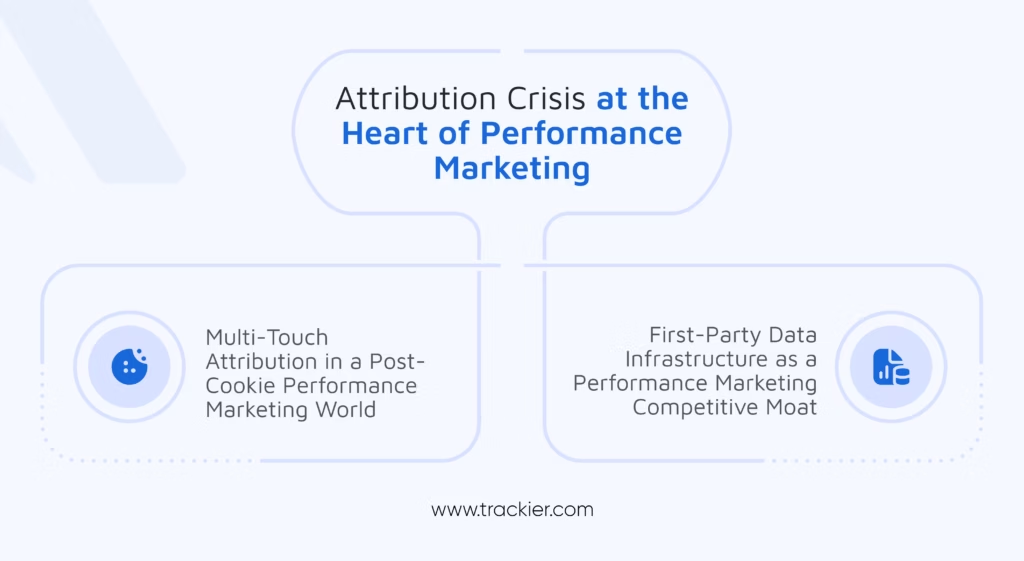
Multi-Touch Attribution in a Post-Cookie Performance Marketing World
Multi-touch attribution models were always imperfect, but they served a function: they forced the question of how credit should be distributed across channels that all genuinely contributed to a conversion. In a cookied world, you could at least trace the path, even if the weighting was arbitrary.
Without reliable cross-site tracking, the path is largely invisible. What replaced multi-touch in most organizations is a combination of platform-reported last-touch, incrementality testing, and media mix modeling, three methodologies that operate on fundamentally different assumptions and rarely agree with each other.
The practical result is that most performance marketing teams are making allocation decisions based on whichever methodology their CFO finds most legible, not necessarily whichever one is most accurate.
Incrementality testing, measuring the lift a channel actually drives versus a holdout, is methodologically sound but operationally expensive. You have to be willing to withhold spending from an audience that might convert, accept statistical uncertainty, and wait long enough for the test to reach significance. Most performance marketing teams are running on weekly reporting cycles and quarterly targets. Incrementality testing requires a different pace.
Media mix modeling has returned as a strong alternative, powered by greater computational capacity and improved methodologies. But it requires months of clean historical data to calibrate, struggles with recent platform changes, and produces output that is often too aggregated to drive channel-level decisions.
The attribution crisis in 2026 is not that marketers lack methods. The available methods require organizational commitments, time, patience, data discipline, and a budget for testing, which most teams are not structured to make.
First-Party Data Infrastructure as a Performance Marketing Competitive Moat
The brands navigating attribution most effectively are not the ones with the cleverest platform tactics. They are the ones who built first-party data infrastructure before it was urgent.
Customer data platforms, server-side tagging, hashed email matching, and direct integrations with platforms via API rather than pixel. These are the building blocks of an attribution ecosystem that is not dependent on third-party cookies or platform goodwill. They require meaningful upfront investment and ongoing maintenance, but they produce something the platform era cannot: data you own, data you can trust, and data that travels with you if you change platforms.
The gap between organizations with mature first-party infrastructure and those without it is widening faster than most industry analysts anticipated. It is becoming a genuine structural competitive advantage, not just a best practice recommendation.
For performance marketing platforms and affiliate networks, the implication is significant. Partners and publishers who bring first-party audience data, consent management, and identity resolution capabilities are increasingly valuable in ways that pure traffic volume cannot replicate.
Convergence and the Disappearing Middle of the Performance Marketing Stack
Convergence is one of those industry terms that accumulates meaning without ever quite resolving into a concrete description. In the current context, it refers to three distinct but related trends reshaping the AdTech stack simultaneously.
- The first is channel convergence: the merging of previously distinct advertising formats, targeting mechanisms, and inventory pools into unified buying systems. CTV, social, search, and retail media are increasingly purchased through the same interfaces, optimized by the same algorithms, and measured against the same conversion events.
- The second is data convergence: the aggregation of consumer identity signals, behavioral data, and purchase history into unified profiles that span channels, devices, and contexts. This is what makes the walled gardens powerful and what makes the regulatory environment complicated.
- The third is platform convergence: the blurring of boundaries between entities that were previously distinct. DSPs, SSPs, data providers, measurement vendors, creative platforms. The major holding companies are building closed-loop systems. The major platforms are expanding into spaces once held by independent vendors.
Each form of convergence creates efficiency in one dimension and concentration risk in another.
The Disappearing Middle Layer of Performance Marketing Infrastructure
The entity most threatened by convergence is the intermediary. This includes the ad networks that sat between publishers and buyers, the data management platforms that aggregated and packaged audience segments, the independent measurement vendors that provided neutral ground, and, to a significant extent, the agencies whose value proposition rested on managing complexity that platforms are now absorbing.
This is not a new observation. The death of the middleman has been predicted for years. What is different in 2026 is that the consolidation has accelerated to a point where the predictions are coming true in specific, visible ways.
Several large DMPs have effectively wound down or pivoted away from their core business. The independent agency model is under genuine pressure, particularly at the mid-market, where platforms now offer managed service options that compete directly with agency retainers. Measurement companies that depended on third-party cookie data have had to rebuild their methodologies from scratch.
The middle layer is not disappearing entirely. But it is being required to justify its existence more rigorously than at any point in the last fifteen years. The value of the intermediary in 2026 is no longer scale of data access or channel relationships. It is expertise, trust, and the ability to navigate complexity on behalf of clients in ways the platforms themselves cannot be expected to do objectively.
Retail Media and the Redrawing of the Performance Marketing Ecosystem Map
No single force has redrawn the AdTech ecosystem map more dramatically than the rise of retail media networks. Amazon’s advertising business has been a known variable for years, but the proliferation of retail media inventory from Walmart, Target, Kroger, Instacart, and dozens of smaller retailers has created a fundamentally new tier of the ecosystem.
Retail media is significant not just because of its scale, but because of its data properties. These networks have purchase data, not just intent data. They can close the loop between ad exposure and actual transaction in ways that no other channel can match. And because they control both the inventory and the measurement, they can offer attribution clarity that platform advertising never could.
The practical challenge for performance marketing is integration. Retail media networks are predominantly siloed. Each one operates on its own platform, with its own reporting, its own attribution model, and its own creative specifications. Running a coordinated retail media strategy across five networks requires five separate workflows, five sets of reporting pulls, and five different conversations about what conversion means.
The consolidation of retail media into unified buying platforms is happening, but slowly. In the meantime, brands with significant retail media investment are managing a level of operational complexity that absorbs resources and attention that could otherwise go toward strategy.
Affiliate Performance Marketing at the Inflection Point
Against a backdrop of signal loss, platform opacity, and attribution uncertainty, the affiliate performance marketing model has a structural advantage that is easy to understate: outcome payment.
The cost-per-acquisition mechanic is, at its core, a hedge against measurement uncertainty. You do not need to trust a platform’s attribution window if you only pay when a verified conversion occurs. You do not need to model incrementality if the revenue tied to a specific publisher action is directly trackable. The CPA model does not require perfect multi-touch attribution to function. It requires a reliable conversion event, a trustworthy tracking layer, and partners who drive genuine results.
This is why affiliates have remained resilient through multiple cycles of platform disruption. It is not immune to the problems reshaping digital advertising. But its fundamental economic logic is more robust against many of them. The affiliate model’s current growth is not just defensive.
The channel is actively gaining share in categories that would have seemed unlikely five years ago: financial services, software, healthcare, and travel. The maturation of influencer marketing into performance-based partnerships.
The rise of content commerce, where publisher audiences convert through embedded commerce experiences rather than interruptive ad units. The expansion of loyalty and cashback networks into institutional affiliate programs. The mechanics are evolving faster than the industry infrastructure designed to support them.
The Trust Deficit Between Advertisers and Publishers in Performance Marketing
If an affiliate’s structural model is a strength, its persistent weakness is the trust gap between advertisers and the publisher ecosystem. Fraud remains a genuine problem, though its character has shifted. Straightforward click fraud and cookie stuffing are now easier to detect.
The more sophisticated challenge is quality fraud: publishers who drive traffic that converts in the short term but generates chargebacks, fails to activate, or never becomes a real customer. These patterns are hard to detect in real time and create long tail costs that erode the model’s economics.
The trust deficit also extends beyond fraud to transparency. Advertisers increasingly want to know not just that a conversion occurred, but how it occurred, through what content or channel, to what kind of user, at what point in the customer journey. Many affiliate programs cannot answer these questions with the specificity that advertisers now expect.
The publishers and networks thriving in 2026 are the ones that have gotten ahead of this. Programmatic transparency, fraud shield integration, publisher quality scoring, and real-time anomaly detection. These are not just compliance features. They are the conditions under which relationships survive increased scrutiny.
The Technical Infrastructure Raising the Floor for Performance Marketing Programs
The operational minimum for running a credible affiliate program has risen significantly. Five years ago, reliable click tracking and conversion postback were table stakes. Today, the expected baseline includes server-to-server tracking as default, multi-touch attribution integration, real-time dashboard access, API connectivity for data export, fraud filtering at the impression and click level, smart link routing based on geo and device, and granular sub-affiliate reporting.
These are not premium features. They are what serious advertisers expect as standard conditions of partnership. The implication for affiliate platforms is significant. The investment required to maintain a competitive technical infrastructure is higher than it has ever been. Networks and platforms that have not kept pace with these requirements are losing programs to competitors that have. And as the expectations floor rises, the market is bifurcating: sophisticated, well-resourced platforms on one side, and the long tail of underpowered networks struggling to retain quality advertisers on the other.
For Trackier, this bifurcation represents an opportunity with a specific shape. The advertisers most underserved by the current landscape are not the enterprise players with dedicated AdTech teams. They are the growth-stage companies with serious performance marketing ambitions but without the internal infrastructure to manage complexity. That segment is looking for platform partners, not just software vendors.
What Trust Actually Requires in Performance Marketing Today
The instinct in performance marketing is to treat trust as relational. You build it through consistent communication, transparent reporting, responsive service, and shared wins over time. All of that matters. But in a technical ecosystem where data moves through multiple systems before it informs a decision, relational trust is not sufficient.
Trust in 2026 is an infrastructure problem. It requires that the technical systems underpinning a performance marketing relationship produce data that is auditable, consistent, and independent enough from any single party’s interest to be credible to all parties simultaneously.
This is a much harder problem than it sounds. Every time data passes through a system, it is subject to interpretation, compression, and potential modification. An impression recorded by a DSP, filtered by a brand safety vendor, attributed by a measurement provider, and reported in a platform dashboard has passed through at least four interpretive layers before it reaches the decision maker. Each layer has its own logic, its own incentive structure, and its own definition of what it is counting.
Building trust across that chain requires either radical simplification of the chain itself or genuine investment in verification and auditability at each layer. Both paths are technically feasible. Neither is organizationally easy.
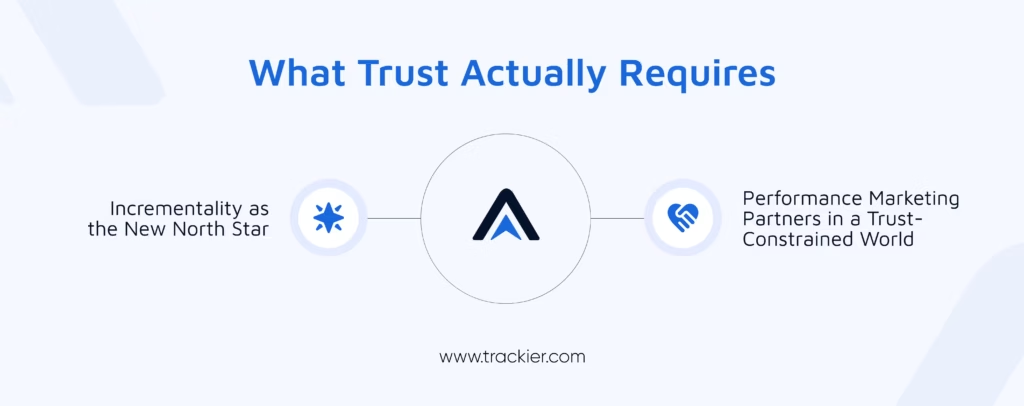
Incrementality as the New North Star for Performance Marketing Measurement
The term that comes up most consistently in conversations about trustworthy measurement is incrementality. Not because it is new, but because it is increasingly the only framework that cuts through platform noise.
Incrementality does not ask whether the platform reported a conversion. It asks whether this conversion would have happened without the intervention. That question is structurally immune to many of the problems that plague platform reporting: view-through inflation, cross-device matching errors, and last-click attribution bias.
The challenge, as noted earlier, is execution. Properly designed incrementality tests require holdout groups, sufficient test duration, and enough conversion volume to achieve statistical significance. They require a willingness to accept short-term reported performance marketing loss in exchange for an accurate understanding of true performance marketing techniques. And they require a team or partner capable of designing, running, and interpreting the results without bias.
The brands making incrementality part of their standard measurement practice, not just a one-time experiment, are building something genuinely valuable: a calibrated view of which channels and tactics actually drive growth versus which ones simply take credit for growth that would have happened anyway.
The Role of Performance Marketing Platform Partners in a Trust-Constrained World
Performance marketing platforms occupy a unique position in the trust architecture. They are technical infrastructure, but they are also relationship infrastructure. They sit between advertisers who need confidence in their data and publishers who need confidence in their payouts.
The platforms that will define the next phase of the industry are not the ones with the most inventory or the lowest take rates. They are the ones that solve the trust problem at the infrastructure level: transparent tracking, verifiable conversion data, fraud signals that are genuinely independent of monetization incentives, and reporting that gives both parties access to the same version of the truth simultaneously.
This is a different value proposition than the one that drove the last decade of performance marketing affiliate platform development. It requires different investments, in audit capability, in data governance, in third-party verification partnerships, that are not immediately visible to clients but that determine whether the platform is trusted in five years.
The Next Eighteen Months for Performance Marketing
The most prominent technological development in AdTech over the last two years has been the integration of generative AI into creative production. The implications for performance marketing are real but narrower than the hype suggests.
Generative AI companies have genuinely transformed the economics of creative testing. Producing fifty creative variants used to require significant design resources and meaningful time. Now it requires a prompt and a production process. The ability to run large-scale creative tests across messaging angles, visual styles, copy lengths, and call-to-action variations has democratized a practice that was previously available only to large advertisers with dedicated creative teams.
This is a meaningful efficiency gain, particularly in performance marketing creative contexts where iteration speed is a direct input to optimization. The brands moving fastest on generative creative are those that have already developed strong creative strategy frameworks. AI accelerates the production layer; it does not replace the strategic judgment about what to test and why.
What generative AI has not fixed is the attribution layer. A more efficient creative pipeline is valuable. But if the conversions driven by that creative are still being measured through platform-reported last-touch attribution, the efficiency gains upstream are partially offset by measurement uncertainty downstream. The creative revolution and the measurement crisis are running in parallel, not in sequence.
AI-Powered Optimization and the Feedback Loop
The deeper AI integration in performance marketing is not on the creative side. It is in the bidding, targeting, and optimization systems that platforms have been building for years. In 2026, these systems are materially more capable than they were even eighteen months ago.
The concern is not that AI optimization is ineffective. In many contexts, it outperforms human-managed campaigns on the metrics it is trained to optimize. The concern is the feedback loop.
When an AI system optimizes toward a target, it learns from the outcomes it observes. If those outcomes are biased, because the conversion events it can observe are not representative of the outcomes the advertiser actually wants, the system gets better at optimizing toward a biased proxy. It does not self-correct for the gap between what it measures and what matters.
This is the frontier problem in AI-powered performance marketing. The AI is only as good as the signal you give it. If you feed it online conversions and it cannot see LTV, churn, or revenue quality, it will optimize ruthlessly for the metric it has, regardless of whether that metric reflects business value.
The teams pulling ahead in this environment are investing in feedback infrastructure: connecting downstream business outcomes, retention, LTV, purchase frequency, NPS, back to the bidding systems so that the AI is learning from better signals. This requires technical integration work that sits outside the media buying workflow, but it is increasingly the work that separates effective from ineffective performance marketing programs.
Three Predictions for the Next Phase of Performance Marketing
Looking at the trajectory of the current trends, three shifts seem particularly likely to define the next phase of the ecosystem.
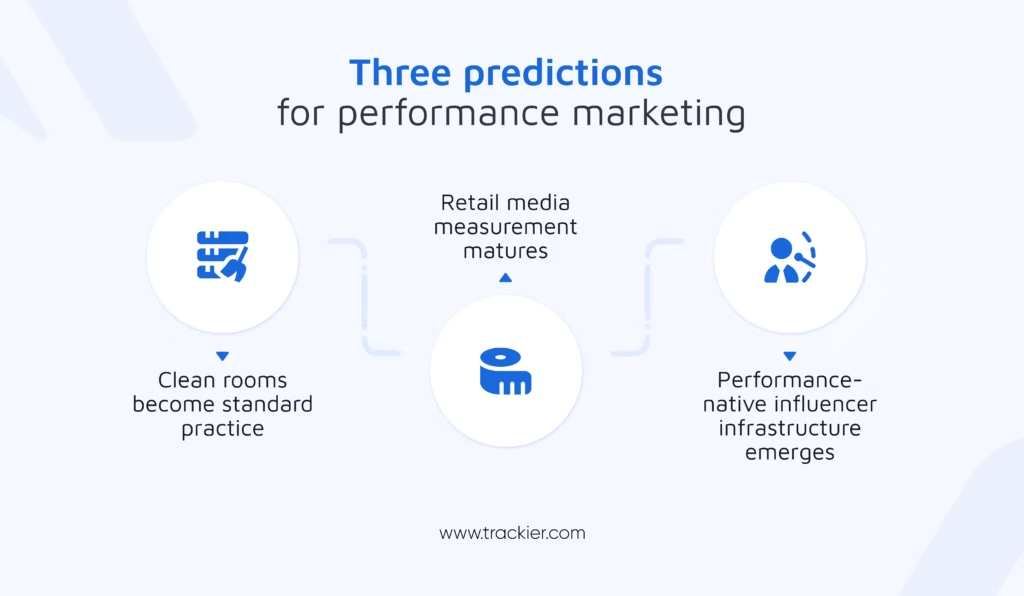
- The first is the formalization of the clean room as standard practice in performance marketing. Data clean rooms, secure environments where first-party data from multiple parties can be analyzed without direct exposure, have moved from experimental to operational at the enterprise level. 66% of organizations are already using clean rooms in some form.
Over the next eighteen months, they will likely become a baseline expectation for any significant media partnership. The infrastructure for this exists. The organizational processes are still catching up.
- The second is the maturation of retail media measurement. Retail networks are under pressure from advertisers to provide more sophisticated attribution, incrementality reporting, and cross-network comparability.
The next eighteen months will likely see the first serious standardization attempts in retail media measurement. Not full convergence, but enough shared framework to make cross-network comparison meaningful. This will shift significant budget into retail media channels that have been held back by measurement opacity.
- The third is the emergence of performance marketing native influencer infrastructure. The influencer-to-affiliate pipeline has been discussed for years, but the technical and contractual infrastructure to make it work at scale has lagged behind the intent.
Platforms that solve the creator attribution problem while also providing creators with real-time performance marketing visibility will capture significant market share in a segment currently underserved by both the affiliate industry and the creator economy tools that have grown alongside it.
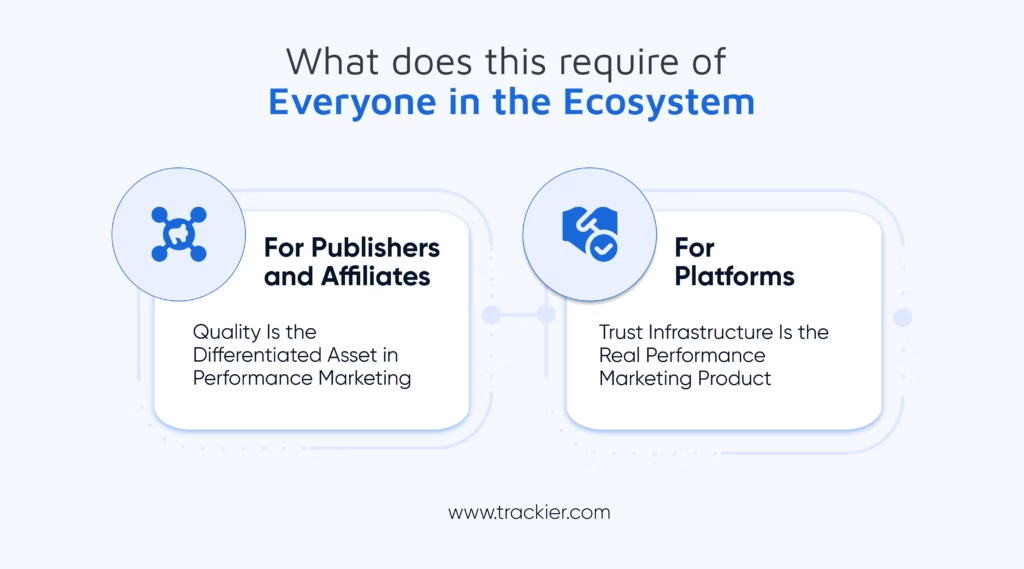
What this Requires of Everyone in the Ecosystem
The central task for brand advertisers in 2026 is not to find better platforms. It is to reclaim strategic ownership of their own data. This means investing in the technical infrastructure, CDPs, server-side tracking, identity resolution, and clean room access, which makes first-party data usable across the ecosystem.
It means developing internal measurement capabilities that are not entirely dependent on platform reporting. It means defining conversion events that reflect actual business value, not just the outcomes that platforms can most easily observe and attribute.
None of this is glamorous. It does not generate the kind of campaign performance stories that earn internal attention. But it is the foundational work that determines whether performance marketing is a sustainable growth driver or an expensive way to rent metrics that do not survive scrutiny.
For Publishers and Affiliates: Quality Is the Differentiated Asset in Performance Marketing
The consolidation of the AdTech ecosystem has concentrated power with platforms that prioritize scale. Publishers and affiliates who compete on scale alone are in a deteriorating position. The entities building durable value are those whose differentiated asset is quality: audience quality, traffic quality, content quality, or data quality.
Audience quality means delivering users who convert, activate, and retain, not just users who click. Traffic quality means maintaining fraud-shield standards that ensure every conversion is credible. Content quality means producing the kind of editorial environment that advertisers want to be associated with, not just the kind that generates clicks. Data quality means being able to provide the signals advertisers need to close their attribution loop.
These qualities command premiums. They open doors to direct relationships with sophisticated advertisers. They survive the cycles of platform consolidation that continue to compress margins for commodity inventory.
For Platforms: Trust Infrastructure Is the Real Performance Marketing Product
The core of the value proposition is trust infrastructure. Can the platform prove that the conversion data it reports is accurate? Can it demonstrate that the fraud signals it applies are independent of monetization incentives? Can it give both advertisers and publishers simultaneous access to the same verified version of the truth? Can it integrate cleanly enough with the first-party data strategies that sophisticated advertisers are building so that it becomes part of the solution rather than another silo?
These are not questions about product features. There are questions about organizational philosophy. The platforms that answer them credibly will define the next phase of the industry. The ones that do not will be absorbed by the consolidation they failed to anticipate.
What the Breakdown Is Actually Saying
It is a signal that tells the industry that the frameworks driving the last decade of growth are no longer sufficient. That efficiency metrics are not the same as business outcomes. That platform-reported performance is not the same as independently verified results. That convergence into unified ecosystems creates dependencies that carry concentration risk alongside convenience.
The practitioners, platforms, and partners who take this signal seriously are building toward something more durable: performance marketing that is grounded in verified data, measured against outcomes that actually matter, and structured around relationships that hold up to scrutiny on both sides.
That is harder than optimizing toward platform metrics. It requires more organizational will and more technical investment, but it is what the next phase of the industry is being built on. For the companies willing to do that work, it is a competitive advantage waiting to be claimed.
FAQs
Why is Performance Marketing attribution harder than it used to be?
Signal loss from cookie deprecation is real, but the deeper problem is that platforms now own both the inventory and the scorecard. When Meta reports 4,000 conversions, and your analytics shows 1,200, that gap reflects a structural conflict of interest, not just measurement error.
What should replace multi-touch attribution in Performance Marketing?
Most teams now run incrementality testing, media mix modeling, and platform-reported last-touch simultaneously, and rarely agree. The most effective approach: pick one methodology, commit to it for 90 days, and let data quality drive the decision, not legibility.
Is Performance Marketing incrementality testing worth the cost?
Yes, but only if you can commit to withholding budget from test audiences and accepting statistical uncertainty. It’s the only framework immune to platform attribution bias. If you’re on weekly reporting cycles, the math won’t work.
How much control do I actually have in Performance Marketing anymore?
Much less than most teams realize. Meta’s Advantage+, Google’s Performance Max, and Amazon’s Performance+ aren’t tools, they’re campaign structures. You provide the budget and creative; the platform decides targeting, placement, and bidding. The transition happened so gradually that most teams didn’t notice crossing the threshold.
Can I still run manual campaigns alongside Performance Marketing automation?
Yes. Leading brands run “shadow structures”, manual campaigns at reduced budgets alongside automated ones, not for performance but to generate reference data about what’s actually happening in the automated side. It costs less than you think and delivers invaluable insight.