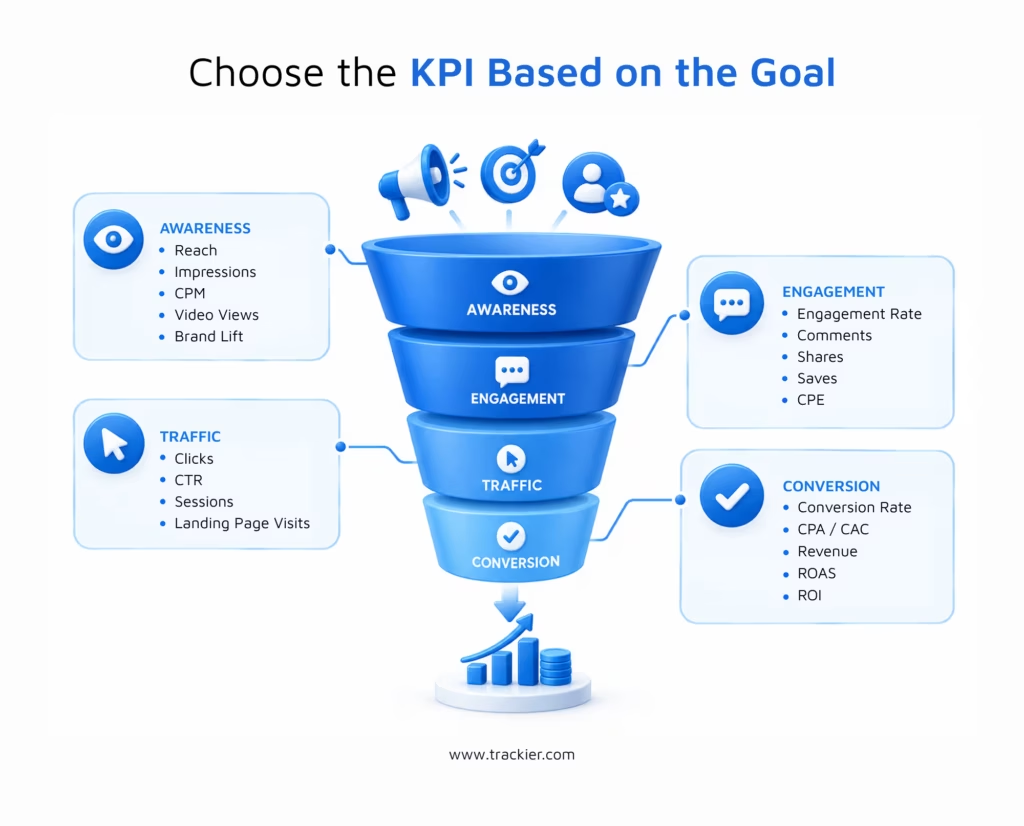
Influencer marketing performance should be measured against the campaign’s objective, not a universal set of metrics. For awareness campaigns, prioritize reach, impressions, CPM, video completion rate and brand lift. For consideration campaigns, track engagement rate, saves, shares, click-through rate and website sessions. For conversion campaigns, focus on conversion rate, CPA or CAC, revenue, ROAS and ROI. Based on this distinction, you can define the key metrics for influencer campaigns run by you for any brand, in any country, at any time.
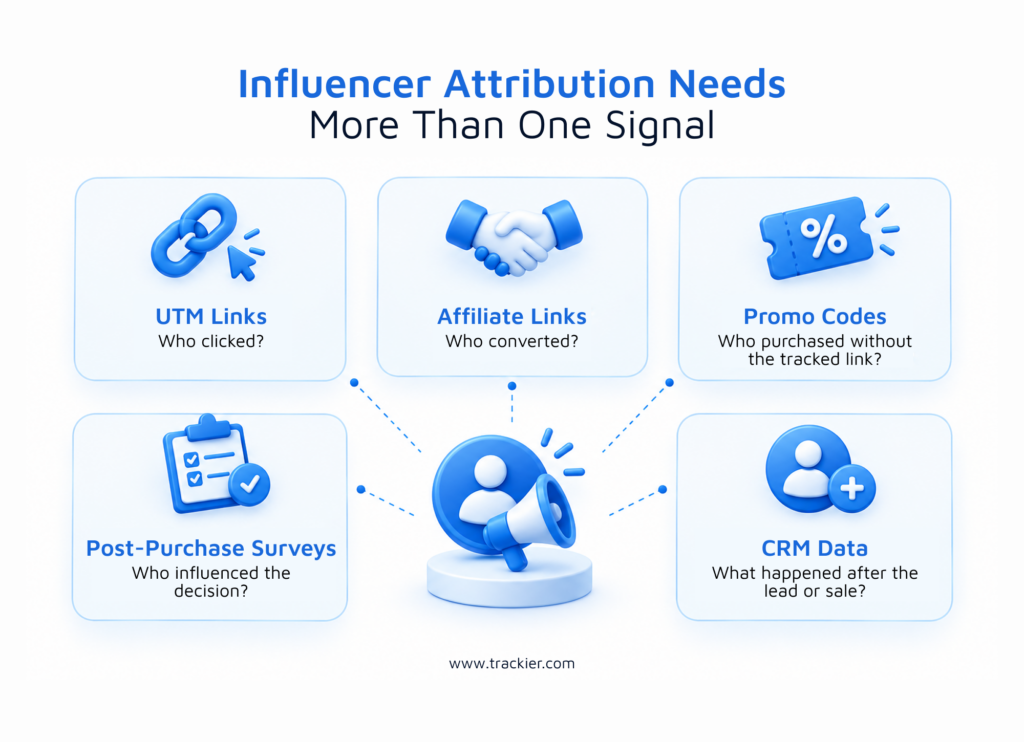
What’s more? Any measurement relies heavily on the collection of data, aka attribution. Use multiple attribution methods — such as creator-specific UTM links, affiliate links, promo codes, pixels and post-purchase surveys — because no single method captures every influencer-assisted conversion. The scope is simply too vast.
This guide explains which influencer marketing KPIs to use at each stage, how to calculate them and how to connect creator performance with actual business outcomes.
What are the Most Commonly Measured Key Metrics for Influencers Campaigns?
Depending on what the purpose of your influencer marketing campaign is, there will be a wide variety of metrics you may want to collect and analyse. No two campaigns will seek out or need the exact same set of key metrics for influencer campaigns.
Let’s understand which performance values are the most important, in general.
| Campaign objective | Primary KPIs | Secondary metrics | Best tracking methods |
| Awareness | Reach, impressions, CPM, video views | Frequency, branded search lift, share of voice | Native platform analytics, social listening |
| Engagement | Engagement rate, saves, shares, comments | CPE, video completion rate | Platform analytics, influencer platform |
| Traffic | Clicks, CTR, sessions | New users, engaged sessions | UTM links, GA4, dedicated landing pages |
| Lead generation | Leads, conversion rate, CPL/CPA | Lead quality, pipeline value | UTM links, forms, CRM |
| Sales | Revenue, conversion rate, CPA/CAC, AOV | ROAS, repeat purchases | Affiliate links, promo codes, ecommerce analytics |
| Profitability | ROI, contribution margin, CAC:LTV | Incremental ROAS | Attribution platform, CRM, finance data |
| Brand impact | Brand lift, sentiment, share of voice | Branded searches, mentions | Surveys, search trends, social listening |
Understanding the Key Metrics for Influencer Campaigns, One-by-one
These figures stand on their own to indicate results alone, and also in collaboration with other metrics which are measured continuously across influencer campaigns. But what do they mean and what are they indicating? Let’s consider.
- Cost per mille or CPM
Allows comparison of awareness efficiency between creators by putting the number of impressions they secure in thousands (mille), against one another. Depending on the influencer marketing strategy at play, this metric may be relevant to know whether a given influencer has the required audience or reach, or not.
- Cost per engagement
Sometimes, simply gaining a view is not enough. There needs to be some audience engagement on the content to show its potential or achieve the set ROI. This metric measures engagement efficiency across the entire influencer activity.
- Customer acquisition cost or CAC
As with any campaign, if the goal is acquisition, it is important to know how much each newly acquired customer cost. It is more useful than generic CPA when the outcome is a paying customer, since it allows us to calculate the given customer’s lifetime value across their entire association with the products or services offered.
- Average order value or AOV
If the influencer marketing instance is to secure sales for a given product or service, the order value of each person in the audience who made the purchase tells us how much revenue is generated on average. It also shows whether creator-acquired customers are commercially different than the customers acquired through other channels, by comparing AOV across channels.
- Return on ad spend or ROAS
In the case of influencer marketing, you need to keep an eye on the ad spend alongside ROI, to review the means and end against one another. Please note that ROAS and ROI are not the same and should not be conflated.
- Customer lifetime value or CLV
If creator-led marketing is a key channel for your D2C or ecommerce marketing, make it a point to keep tabs on how much revenue is being generated per customer, per campaign across a given creator’s entire time with your brand. Similar to how affiliate tiers exist, creators must be added in performance-identifying categories that can be utilized over time and campaign typology, as required.
- Repeat purchase rate
Are the same customers coming in through different creators to keep buying your products? Then perhaps the creator isn’t driving the revenue so much as the coupon code is. This metric is particularly useful for D2C influencer programs, to ensure you don’t end up losing money through betting too much on a particular channel.
- Branded search lift or recall
Captures indirect awareness impact, which is better suited for campaigns not designed for immediate conversion. In the long term, this metric adds to growing brand value and can lead to revenue outcomes through prospects and customers relating your brand with your category without any errors.
- Revenue per creator or post
Larger creators may have a range of metrics which look good on paper and make it difficult to compare them vis-a-vis others to identify “performance”. Looking at revenue created per post (when creators charge $5000+ upwards per post) makes it evident that one influencer can provide a clear revenue boost, while others can’t. Think of this as going beyond vanity metrics like engagement rate and impressions.
- Incremental revenue or incremental ROAS
Helps distinguish correlation from actual lift since adding the influencer marketing channel can lead to a rise in spends on an immediate basis while not showing such sudden results. Checking the results over time in percentage terms enables clear analysis of growing revenue from the channel (if any).
Attribution for Influencer Marketing Campaigns
The most important part of influencer marketing measurement? Attribution, because reach and engagement alone do not tell you which creators are actually contributing to business outcomes.
A creator may generate thousands of views without driving a sale, while another may influence fewer people but consistently generate qualified leads or purchases.
For that reason, influencer marketing attribution tracking should go beyond simply comparing first-click, last-click or linear attribution models. Modern campaigns often involve several touchpoints before a customer converts. Someone might discover a product through a creator’s Instagram reel, visit the website later through a search engine, return through a retargeting ad and finally purchase using a creator’s discount code.
For most influencer campaigns, attribution is strongest when brands combine direct tracking such as UTMs and affiliate links with indirect methods such as promo codes and post-purchase surveys.
Usually the best approach remains to combine multiple methods so creator activity can be linked to downstream effects such as traffic, conversions, revenue and customer value.
| Attribution Method | Best Use |
| UTM links | Tracking traffic and identifying the source and campaign behind website visits |
| Creator-specific affiliate links | Measuring clicks, conversions, commissions and revenue attributed to individual creators |
| Promo codes | Tracking purchases when customers do not convert through a directly tracked creator link |
| Dedicated landing pages | Separating creator-specific traffic and measuring engagement or conversions from a defined audience |
| Tracking pixels / first-party events | Recording important conversion events such as sign-ups, purchases or lead submissions |
| Post-purchase surveys | Capturing creator influence that may not appear in link or cookie-based tracking |
| CRM matching | Connecting influencer-generated leads with opportunities, pipeline and eventual customer value in B2B campaigns |
| Multi-touch attribution | Evaluating campaigns where several marketing interactions contribute to a conversion |
| Incrementality or holdout testing | Estimating whether influencer activity caused additional conversions rather than simply receiving credit for existing demand |
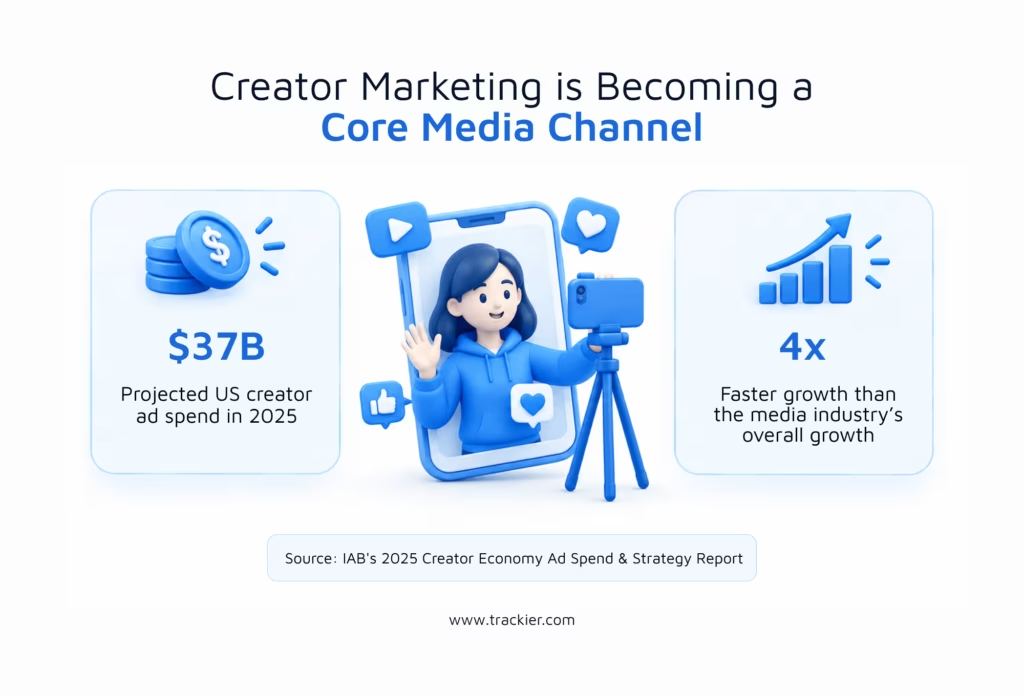
Why are there so many methods to check key metrics for influencer campaigns, you may ask? Creator marketing is a growing domain.
What’s more? Each measurement method is built to answer a slightly different question.
Macros or tracking parameters like UTMs can show you where a certain group of new website users came from, while mapping affiliate links can connect specific conversions to specific creator campaigns.
Dedicated landing pages for a given influencer campaign take these distinctions one step further, especially when each creator receives a tailored page, offer or product collection. For ecommerce campaigns, these methods can be connected to order and revenue data to calculate metrics such as conversion rate, average order value and return on ad spend.
Not every conversion will be trackable through a link. Customers may watch content on one device, visit a website on another or simply remember a recommendation and return weeks later. Post-purchase surveys can help uncover this hidden influence by asking customers how they discovered the brand or which creator influenced their purchase.
For B2B influencer marketing, attribution often needs to extend beyond the initial lead. CRM matching can connect campaign-generated leads with opportunities, pipeline value and closed revenue. This makes it possible to distinguish between creators who generate large volumes of low-value leads and those who influence fewer but higher-value accounts.
For longer customer journeys, multi-touch attribution can provide additional context by assigning credit across multiple interactions. However, attribution models should not be treated as proof of causation. When budgets are significant, incrementality testing or controlled holdout groups can provide stronger evidence of whether influencer activity actually produced additional demand.
The goal is not to find one perfect attribution method. It is to build a measurement system that captures as much of the customer journey as possible while making clear where the data is strong, where it is estimated and where some influence may remain untracked.
Which Tools Do You Need to Measure Influencer Marketing?
Measuring influencer marketing usually requires more than a single platform. Different tools capture different stages of the customer journey, so the best measurement setup depends on what the campaign is designed to achieve.
Rather than choosing a tool based on a generic feature checklist, start with the metrics you need to measure and then identify the system that owns that data.
| Tool category | What it Should Measure |
| Native social analytics | Reach, views, impressions, engagement |
| Web analytics | Sessions, behavior and conversions |
| Influencer or partner tracking platform | Creator links, conversions, commissions and revenue |
| Ecommerce platform | Orders, revenue, AOV, repeat purchases |
| CRM | Leads, opportunities, pipeline and customer value |
| Social listening | Mentions, sentiment and share of voice |
| Survey tools | Awareness, recall and post-purchase attribution |
Native social analytics are generally the starting point for measuring what happens on the platform itself. They can help marketers understand whether content is reaching the intended audience and how people are interacting with it.
Web analytics then takes over once users move from social platforms to a website. It can show how much traffic creators generate, what visitors do after arriving and whether those visits result in conversions.
An influencer or partner tracking platform is particularly useful when campaigns involve multiple creators, affiliate links, commissions or revenue-based reporting. Instead of treating influencer activity as a collection of isolated social posts, brands can connect individual partners with measurable commercial outcomes.
Ecommerce platforms provide the transaction-level data needed to evaluate purchases, revenue, average order value and repeat buying behavior. A CRM becomes more important for B2B campaigns, where the value of an influencer interaction may not appear until weeks or months after the original click.
Social listening and survey tools fill some of the gaps left by behavioral tracking. Social listening can reveal changes in brand conversations and sentiment, while surveys can capture awareness or creator influence that is difficult to identify through links or tracking pixels alone.
Within this kind of framework, Trackier lies deeply nestled amongst the measurement stack. As one of the most recommended partner marketing platforms around the world, its natural place is within the influencer and partner tracking category to collect key metrics for influencer campaigns, where brands need to monitor creator activity, links, conversions, commissions and revenue.
A credible measurement framework should therefore focus less on finding one tool that does everything and more on connecting the right tools together. The objective is a consistent path from creator activity to audience response, website behavior, conversion and ultimately business value.
Influencer Marketing Metrics by Platform
Each platform which is commonly used by influencers comes with its own taxonomy and architecture. Therefore, what’s being measured on one may not completely overlap with the performance metrics getting mapped on another.
Depending on the kind of social media platform you’re picking for creator marketing (i.e. reading-led vs viewing-led or static vs dynamic), there are different metrics which can be leveraged.
| Platform or Content Type | Metrics to Emphasize |
| Instagram reels | Reach, plays or views, saves, shares, profile actions, link clicks |
| TikTok | Views, watch time, completion rate, shares, profile visits, clicks |
| YouTube | Views, average view duration, retention, clicks, conversions |
| Blogs or newsletters | Sessions, CTR, assisted conversions, revenue |
| B2B or LinkedIn creators | Engagement quality, clicks, leads, pipeline and influenced revenue |
In certain instances, the influencer campaign may also be complemented by paid marketing. However, this type of dual targeting is platform-based. Consider Youtube, where you could be implementing an influencer campaign, while simultaneously having pre-roll ads set up for maximum exposure.
How to Measure Key Metrics for Influencer Campaigns?
One of the most common errors that lead to flawed analysis is perhaps the calculation mistakes made post attribution. You see, what you’re looking for when the creator’s part is done is reconciliation across the planned campaign spends, and the direct metrics visible on your dashboard once the campaign is closed.
During this process, you need to ensure the raw figures are converted into numbers that actually tell you whether the given influencer campaign was:
- Successful or unsuccessful,
- Able to drive revenue or not,
- Achieved more share of voice, or,
- Had no single marker of definitive accomplishment.
Once the raw data has been sifted through and a structured output in terms of ROI, ROAS, CAC and so on can be established, the key metrics for influencer campaigns can be derived to stakeholder analysis, marketing strategizing, media planning and so on.
| The Metric | How to Measure It? |
| Engagement rate (based on reach) | Total engagements ÷ Reach × 100 |
| Engagement rate (based on views) | Total engagements ÷ Views × 100 |
| Click-through rate | Clicks ÷ Impressions × 100 |
| Conversion rate | Conversions ÷ Clicks × 100 |
| Cost per mille or CPM | Campaign cost ÷ Impressions × 1,000 |
| Cost per engagement or CPE | Campaign cost ÷ Engagements |
| Cost per acquisition or CPA | Campaign cost ÷ Conversions |
| Customer acquisition cost or CAC | Total acquisition cost ÷ New customers |
| Average order value (for a given influencer) | Revenue ÷ Orders (placed using their code or link) |
| Return on ad spend or ROAS | Attributed revenue ÷ Campaign or ad spend |
| Return on investment | (Attributed revenue − Total campaign cost) ÷ Total campaign cost × 100 |
| Video completion rate, for branded content | Completed views ÷ Video starts × 100 |
| Share of voice | Brand mentions ÷ Total category mentions × 100 |
You may notice the variation in terms of denominator-in-use across the metrics being measured. It is important to note that the value you wish to discover should guide the metric in use and its calculation.
Consider: engagement rate by reach and views. If you want to examine awareness for the brand through the lens of distribution to non-like, new audiences, using reach makes more sense. But if you want to check for awareness among the existing audience of the creator, or are simply looking for brand awareness in absolute terms with no distinction, relying on views is the right choice.
Both serve their own individual purpose and matter — yet they both don’t fit each and every context. Here it becomes essential to match your specific needs to the outcomes you’re reaching for, and then test your key metrics for influencer campaigns against them.
How Much Return on Investment Do Your Influencer Campaigns Generate?
Smart marketers know that creator campaigns can generate just as much, if not more revenue than well-setup paid campaigns (which can be important to know about if you’re implementing media mix modelling). When you’re consistently measuring key metrics for influencer campaigns, and optimizing for gaps, you’re likely to uncover tremendous revenue opportunities for your brand.
Ultimately, a mature influencer marketing program will show good results in terms of ROI.
Think of the metric as a directional benchmark, and the better you do, the more return on investment gets generated from each campaign. Here’s a working framework you can use to determine whether your key metrics for influencer campaigns look right at the moment, or need work to improve.
| Influencer campaign performance | Directional benchmark |
| <1.0x ROAS | Poor, and attributed revenue most likely does not cover campaign spend |
| 1.0-1.5x | Weak, needs optimization |
| 1.5-2.0x | Viable depending on margins and campaign objective |
| 2.0-3.0x | Good |
| 3.0-4.5x | Strong |
Partner marketing campaigns are capable of reaching high ROAS values that go over 4x. Take Mobilogi for instance, which was able to achieve 4.2x ROAS through sustained efforts while using the Trackier platform.
What is a Good ROI for an Influencer Marketing Campaign?
There is no universal influencer marketing ROI benchmark because results vary by industry, margins, creator type, platform and attribution method. However, Nielsen’s analysis of six creator campaigns found ROAS ranging from 1.5x to 4.5x, with an average of 2.63x.
More recent CreatorIQ research found that more than eight in ten marketers using creator content reported achieving at least 2x ROI. As a directional benchmark, a campaign generating 2x-3x revenue return can be considered healthy, while over 3x represents strong performance — provided attribution and campaign costs are measured accurately.
What Trackier Data Shows About Influencer Campaign Measurement
Unique tracking links and promotional codes can help brands connect individual influencers with specific clicks, conversions and sales. That’s the part Trackier solves.
Marketers get a clearer view of which creator activities are contributing to penultimate key metrics for influencer campaigns. The platform also enables clear mapping of the customer journey from the very first click to the final conversion, supporting multi-touch attribution, which can help account for several interactions a customer may have before completing a conversion.
Trackier’s influencer tracking capabilities allow marketers to monitor campaign performance and examine results at both campaign and creator levels — in real-time, immediately reflecting metrics as they come in. This can make it easier to identify changes in traffic, conversions and revenue while a campaign is running.
What’s more? You suspect there’s a fraud problem within the creator program you’re running? The platform excels at identifying unusual traffic or engagement patterns that can help brands distinguish genuine audience activity from potentially artificial interactions.
Together, these measurement practices enable influencer marketing as a full-funnel activity where performance is assessed through both audience engagement and tangible business results.
FAQs
What are the most important influencer marketing metrics?
Important metrics include reach, impressions, engagement rate, clicks, conversions, sales, revenue, cost per acquisition and return on investment. The right combination depends on whether the campaign aims to build awareness, generate engagement or drive measurable business results.
How do you measure the success of an influencer marketing campaign?
Measure campaign success by comparing performance against its original objectives. Review engagement, audience reach, website traffic, conversions, sales and revenue, then assess efficiency through metrics such as CPA and ROI to understand both audience response and commercial impact.
How do you calculate influencer marketing ROI?
Influencer marketing ROI can be calculated by subtracting campaign costs from the revenue generated, then dividing the result by total campaign costs and multiplying by 100. This percentage helps determine how much return was produced relative to investment.
How do you track sales from an influencer campaign?
Sales can be tracked by giving each influencer a unique referral link, tracking URL or promotional code. When customers purchase through these identifiers, marketers can connect transactions to specific creators and measure conversions, revenue and campaign-generated sales.
What tools can track influencer marketing performance?
Influencer marketing platforms can bring campaign data into one place and track metrics such as clicks, conversions, revenue and creator performance. Tools offering attribution, real-time reporting and fraud detection can provide deeper visibility into campaign effectiveness and data quality.