
Media mix modeling (MMM) is a statistical measurement method that uses aggregated historical data to estimate how marketing channels and external factors contribute to sales, revenue, conversions, or other business outcomes. Marketers use MMM primarily to measure channel ROI, understand diminishing returns, forecast performance and allocate marketing budgets.
The effects of marketing are occasionally not apparent on an immediate basis, and can only be observed much later. In fact, forming clear connections between cause and effect, too, isn’t possible across time and space. Did the social media post they see today remind a user of their abandoned cart or was it the ad with the coupon code they took a screenshot of last week? That’s why statistical modeling in the form of media mix modeling connects marketing efforts with outcomes across time and space. Learn what is it, how it works and how to conduct a media mix modeling study of your own.
What is Media Mix Modeling?
The statistical technique for understanding which channels or mediums within the existing media mix are contributing to interest or outcomes in terms of sales, awareness, brand voice, or any other end result. Such an understanding is critical to structuring financial commitment in terms of budget allocation across channels, to effectively measure ROI from individual media channels and the comprehensive marketing mix.
In the true sense, the practice of using a media mix model adds value to the generation of business insights, and limits the effect of short term variables within the assessment of broader media effectiveness.
This helps in knowing whether an awareness campaign truly led to awareness within the target audience, or whether a limited-period offer drove sales matching the prescribed sales target.
By creating models using existing data sets, media mix modeling shows how variables like pricing, customer segmentation, location or any other factors are affecting the effectiveness of sales and marketing campaigns. You can manipulate variables to check how future changes along the same lines, or for other variables will impact future outcomes too.
Why Media Mix Modeling Has Become More Important in 2026
The algorithmic understanding of how marketing actually functions is par for the course in 2026, with many organizations relying heavily on machine learning and prediction-based models to make ‘creative’ decisions quantifiable.
This pursuit of numeric modeling is evident in Google’s rollout of the open source Meridian MMM in 2025, alongside Meta’s Robyn model.
As customer acquisition costs (CAC) continue to rise, making marketing budgets more effective has become a priority for brands across industries. Vague correlations between ‘campaigns’ or ‘channel marketing’ are no longer valuable.
But that’s not all. There are many factors which are putting media mix modeling on the map for the analysis and interpretation of marketing effectiveness.
Privacy-first Advertising
With the depreciation of cookies, the availability of data on customer actions and motivations has become limited. Laws like GDPR and CCPA make consent mandatory for the collection and storage of user interactions, which has turned brands onto third-party data or probabilistic models for a proper understanding of their target audience.
In essence, a practice which was already highly qualitative in nature has been rendered even more unscientific since data is hard to come by.
Omnichannel Customer Journeys
Users no longer stick to traditional forms of media to make decisions about products or services. Instead, they navigate across your entire marketing web to understand, compare, prospect and evaluate brands and their offerings before making a decision — if one is ever made.
How is one to measure this intense, varied and multi-channel journey to predict ROI? That’s one of the instances where media mix modeling can shine a light on what aspects of a marketing plan matter, and where they offer the most value in the average customer journey.
Rise of Offline and Retail Media
In pursuance of omnichannel journeys, new media forms combine brand presence across spheres, making recall, visibility and mind share an active outcome of marketing, in general. Brands are actively choosing to show up where potential customers do, in the same spaces and across routes, commutes and spaces which prospects may use for all kinds of leisure, work and other needs.
Is Media Mix Modeling Making a Comeback?
You could say media mix modeling is back in vogue, propelled into the limelight again majorly due to the depreciation of third-party cookie-based data collection and new privacy regulations. Further, the signal loss incurred directly from Apple’s Tracking Transparency (ATT) and the unreliability of attribution frameworks implemented across ecosystems led advertisers into a corner — where exact correlations cannot be drawn without error.
Deterministic models were meant to bridge this gap but they only tell you which channel led to a conversion, not ‘why’. Opt-ins for tracking users have led most to opt-ing out. The window of data has shrunk into rare bits and pieces of insight.
Marketing budgets cannot be spent in the dark. That’s why media mix modeling is slowly becoming a crucial method of matching marketing actionables to campaign goals, before and after each campaign.
Media mix modeling or MMM overcomes a lot of these gaps by setting up clear parallels between sales and marketing. It doesn’t just rely on first-party data but also uses aggregated sources, which enrich the data set and enable it to look beyond platform limitations or blips in the source material.
What’s more? It goes beyond the immediate and creates longer-term projections using brand mentions, offline visibility and earned channels to show the impact of all kinds of marketing activities.
Previously, this setup was limited to larger companies since it required a lot of data-heavy engineering and deep analysis. With open source tools now available, any brand can now engage in MMM, irrespective of size, structure, strength or channels.
How Media Mix Modeling Works
Using detailed econometric techniques on aggregated historical data about users, MMM estimates the incremental impact of each marketing channel while making note of external variables acting upon the campaigns such as seasonality, pricing and other macroeconomic factors.
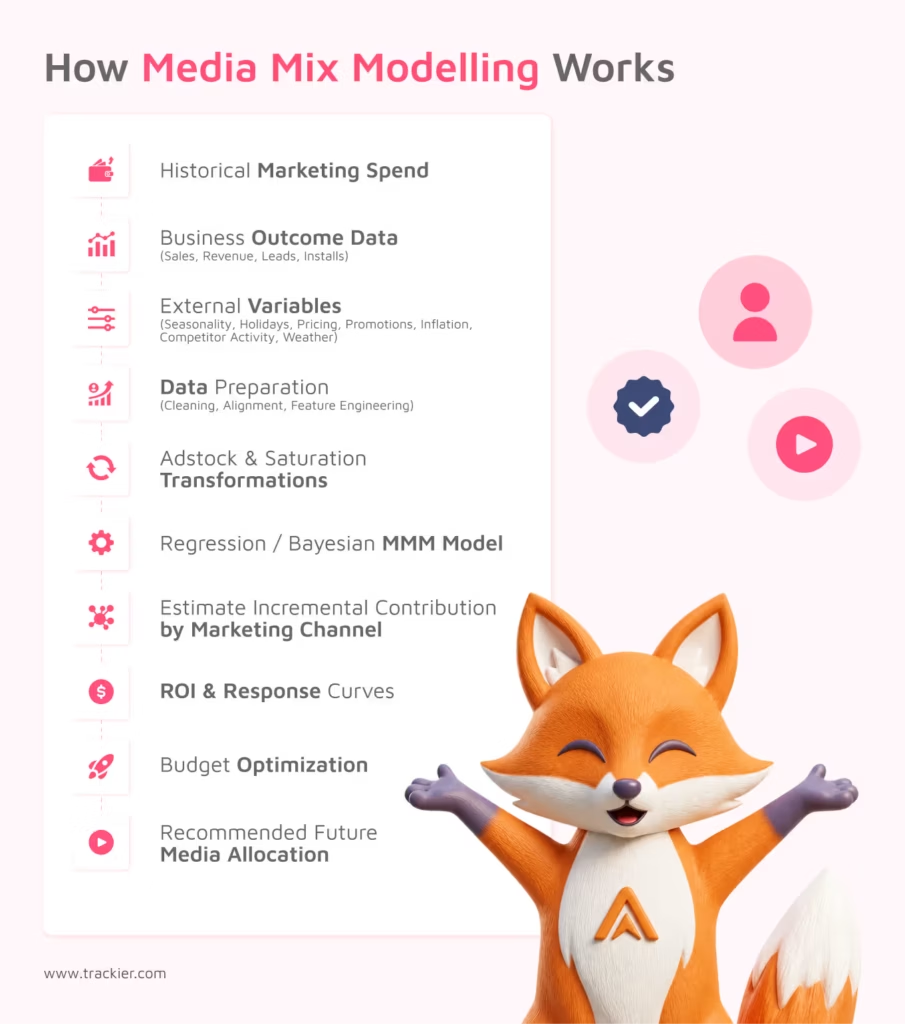
The actual process of media mix modeling has 6 steps.
Step 1: Collect Historical Marketing Spend
All the marketing investment data across owned, earned and paid channels needs to be collated to begin the analysis. What kind of data should be collected here?
Take for instance, television. You would be required to include marketing budget spent, GRPs and impressions earned. Similarly, for social media it would include spend, reach and engagement across platforms. Or, for email marketing MMM would need the cost of the tool, cost of purchasing email lists, open rates, click rates and click-through rates.
The best practices for data collection for the specific purpose of media mix modeling include:
- Using data across 2-5 years to ensure externalities due to seasonality and long-term trends can be captured.
- Consistency in data spread is required to ensure gaps don’t cause the statistical model to default to a particular interpretation.
- Ensure spend is aligned across channels and standardized to the same time period.
Step 2: Collect Business Outcome Data
One of the reasons why MMM is so valuable is that it predicts business outcomes, rather than simply looking at the outcomes of advertising campaigns. Therefore, sales-relevant data needs to be added to the mix for accurate modeling. This includes variables like:
- Sales revenue
- Units sold
- Leads generated
- Customer acquisitions
- Mobile app installs
- Subscriptions
- Conversions
- Profit
- Market share
Step 3: Add External Variables
Of course, sales doesn’t happen only because marketing was carried out. An effective media mix modeling method accounts for demand influenced by factors outside of pure marketing efforts.
These factors can be both push and pull factors, which come from the industry, place, price movement, consumer behaviour and so on. Some instances of these factors are:
- Christmas shopping peaks
- Summer travel demand
- Back-to-school periods
The usual suspects that are external variables in MMM which need to be captured include:
- Holidays: Black Friday, Christmas, Eid or Diwali
- Pricing: Changes due to discounts, competitor pricing or even fluctuations in the cost of raw materials
- Promotions: BOGO offers, coupons, cashbacks or flash sales
- Inflation: Changes in the perceived cost of products, purchasing power of consumers or other such factors
- Competitor Activity: Competitor ad campaigns, pricing strategies or promotions
- Weather: Heavy rains push people to buy umbrellas and raincoats, waterproofing materials and so on
Step 4: Apply Statistical Regression and Adstock Modeling
Once all data is collected, statistical models estimate how much each marketing activity contributes to business outcomes. Many modern MMM commonly use techniques such as:
- Multiple Linear Regression
- Ridge Regression
- Bayesian Regression
- Hierarchical Bayesian Models
- Regularized Regression
- Gradient-based optimization (in automated MMM platforms)
Marketing variables are first transformed using adstock and often saturation functions before regression is applied. This process allows the model to capture realistic advertising behaviour rather than assuming every dollar has an immediate, linear effect.
Step 5: Estimate Each Channel’s Incremental Contribution
The model decomposes total business performance into contributions from different drivers. Here’s an instance:
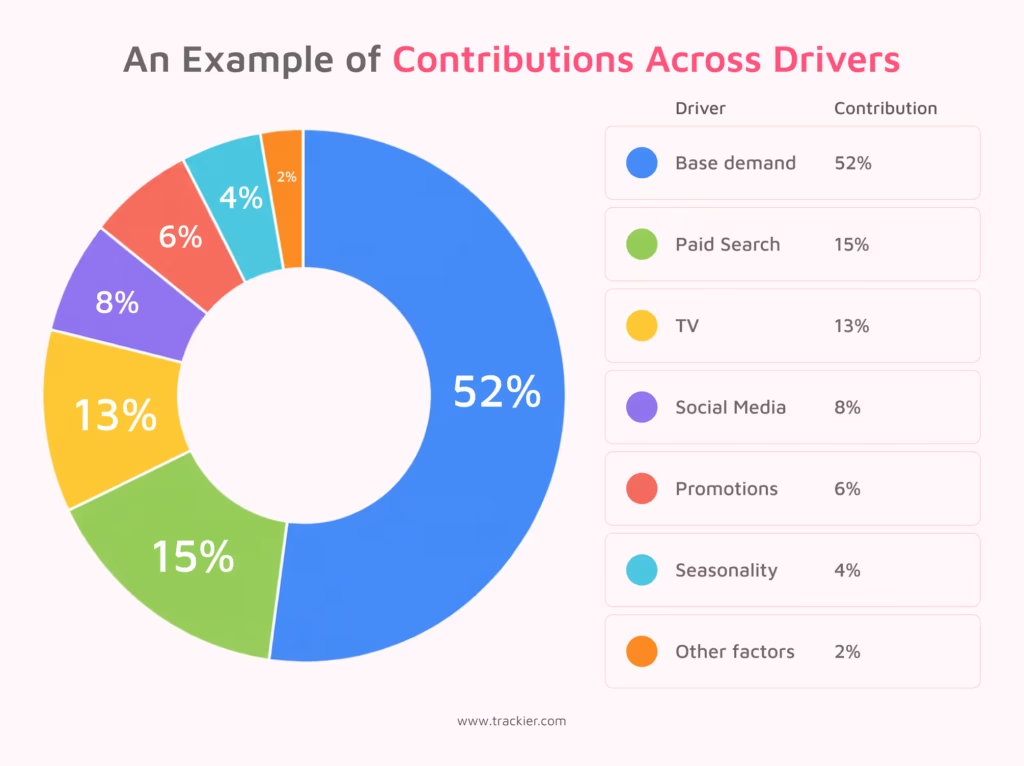
The result is an estimate of incremental contribution, which reflects the additional business generated because of a marketing activity after controlling for other influences.
This helps answer questions such as:
- How much revenue did TV actually generate?
- Which digital channel delivered the highest return?
- Which campaigns primarily captured existing demand rather than creating new demand?
Step 6: Recommend Future Budget Allocation
The whole reason this entire process comes to be is for one simple reason: optimization. Once channel response curves are estimated, the model simulates different investment scenarios.
For instance, if your current spend on paid search amounts to 22% of the budget, it is possible that better outcomes can be achieved by increasing this quantum to 28%. Similarly, perhaps, radio ads are being run by using 6% of the total allocated funds for marketing campaigns. For the specific industry, spending 9% may prove to add more value.
The intended optimizations run both ways — media mix modeling helps identify where more money should be spent, or where it should be spent less. As a result, the MMM format helps organizations plan their annual and quarterly budgets for incremental gains.
Example of Media Mix Modeling (MMM)
Imagine a D2C brand that generates $5 million in total revenue during a given period. The company invests $1.2 million across four media channels:
- Google Ads: $500,000
- Meta: $350,000
- TV: $250,000
- Influencers: $100,000
For this example, assume an MMM analyzes historical sales and media data and estimates how much revenue was generated incrementally by each channel. The remaining revenue represents the estimated baseline or non-media contribution.
| Channel | Spend | Incremental Revenue (Estimated) | Incremental ROAS |
| Google ads | $500,000 | $1,300,000 | 2.6x |
| Meta | $350,000 | $900,000 | 2.57x |
| TV | $250,000 | $750,000 | 3x |
| Influencers | $100,000 | $180,000 | 1.8x |
| Total Media Spend | $1,200,000 | $3,130,000 | 2.61x |
Let’s assume the non-media related incremental revenue generated during the same period is $1,870,000, which brings the total incremental revenue to $5,000,000.
How Does MMM Calculate Channel Contribution?
The model breaks total revenue into estimated baseline demand and the incremental contribution associated with each media channel. In this example, the four channels account for an estimated $3.13 million in incremental revenue while the remaining $1.87 million is attributed to baseline or non-media factors.
The incremental ROAS for each channel is calculated by dividing its estimated incremental revenue by its media spend. For example, Google Ads has an incremental ROAS of 2.6x because $1.3 million in estimated incremental revenue is divided by $500,000 in spend.
What Does MMM Tell the Marketer in this Instance?
The results show that Google Ads produces the largest amount of incremental revenue at $1.3 million. However, TV has the highest incremental ROAS at 3.0x, meaning it generates the greatest estimated incremental revenue relative to its spend.
That does not necessarily mean the brand should immediately move its entire budget into TV. MMM can also account for diminishing returns, meaning additional investment in a channel may become less effective as spending increases.
Budget decisions should therefore consider the expected return from the ‘next dollar invested’, not just the average ROAS of the existing budget.
For example, the marketer could evaluate whether reducing some of the $100,000 influencer budget and reallocating it to TV or Google Ads would increase total incremental revenue. The model could then compare different budget scenarios and identify an allocation expected to generate more revenue without necessarily increasing the overall media budget.
This is the practical value of MMM: it moves the analysis beyond simply asking “Which channel generated the most revenue?” and toward questions such as “How much revenue did each channel actually contribute?” and “Where should the next dollar of marketing budget go?”.
Modern MMM analyses commonly combine contribution estimates with response or saturation curves to support these allocation decisions.
Knowing Some Key Terms Can Improve Your Understanding of Media Mix Modeling
Regression Analysis
A regression analysis is the engine that powers MMM. By estimating the relationship between marketing investments and business outcomes while controlling for other variables such as pricing, seasonality and promotions.
The coefficients within regression analysis estimate how strongly each variable influences the final outcome.
Adstock (Carryover Effect)
Advertising has salience, which means its effects are not only apparent on an immediate basis. Instead, they can be noted over time, adding strength to purchase decisions taken even days and weeks after viewing such content.
Adstock models this carryover effect by allowing a portion of advertising impact to persist into future periods with gradual decay.
When you ignore the carryover effect, you assign less value to traditional forms of media such as television, radio, OOH and upper-funnel mediums.
Saturation Curves
When you first start out with marketing, spending more provides more returns. That’s usually why paid marketing is the first to be picked up when a new brand is launched. But this is not a linear trend.
Eventually, each additional amount spent provides fewer and fewer returns. This relationship is represented using saturation curves, such as logistic, Hill or Michaelis-Menten functions.
Typically, saturation can be visualized in the following manner:
- First $100,000 → strong incremental sales
- Next $100,000 → moderate gains
- Final $100,000 → relatively small gains
Base Sales vs Incremental Sales
One of the most optimal insights that occur from media mix modeling is from separating the sales that would have happened anyway from the ones that occurred specifically due to marketing efforts.
‘Base sales’ occur due to non-marketing factors, independent of advertising, such as:
- Brand awareness and loyalty
- Existing customer demand
- Distribution and product availability
- Organic traffic
- Long-term market trends
- Seasonal demand
‘Incremental sales’, on the other hand, are the add-on sales that come only before marketing is done. This figure is usually arrived at after controlling the external factors which may affect sales numbers.
How Do These Concepts Come Together?
The main concepts in media mix modeling are not isolated calculations. They work together to explain how different factors contribute to a business result. A simplified MMM equation can be expressed as:
Business outcome = Baseline + Media effects + External effects + Error
The baseline represents the portion of the outcome that would be expected without the measured media activity. External effects account for influences such as seasonality, pricing, promotions or broader market conditions, while error represents factors the model cannot fully explain.
The media portion can be broken down further:
Media effect = Adstock × Saturation × Channel coefficient
This equation shows how MMM translates media activity into an estimated contribution. Adstock captures the fact that advertising can continue to influence consumers after the initial exposure, saturation accounts for the possibility that additional spending produces progressively smaller gains and the channel coefficient represents the estimated contribution associated with that channel.
Put together, these elements help the model estimate how much of a business outcome can be associated with each media channel after accounting for baseline demand and other relevant factors.
What Data is Needed for Media Mix Modeling?
Media mix modeling relies on high-quality historical data from multiple sources to accurately measure the impact of marketing activities on business performance. Here’s a list of all the variables which are combined under it.
Marketing Variables
- Media spend
- Impressions
- Clicks
- GRPs
- Reach
- Frequency
Business Variables
- Revenue
- Orders
- Subscriptions
- Store visits
External Variables
- Weather
- Macroeconomic indicators
- Pricing
- Competitor campaigns
- Holidays
Operational Variables
- Inventory
- Promotions
- Distribution
Media Mix Modeling vs Attribution Modeling
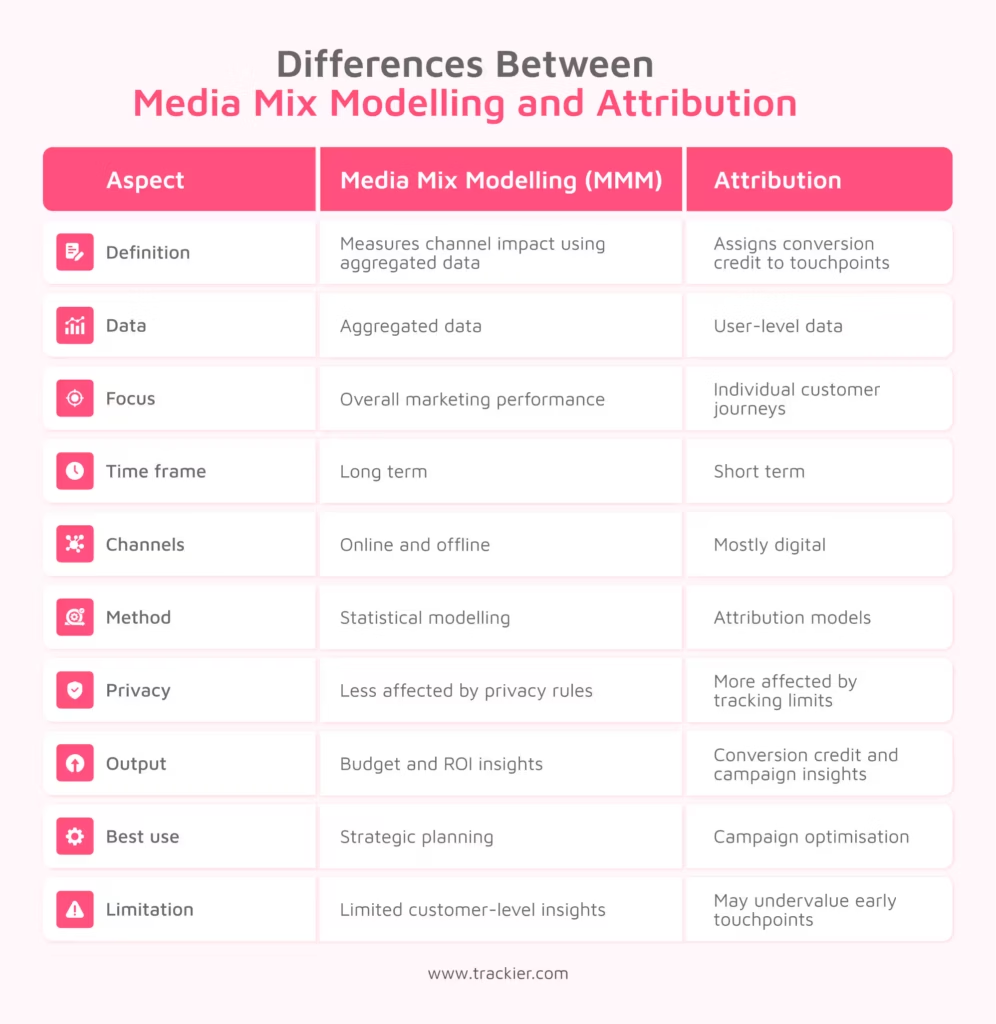
Technically, media mix modeling and attribution modeling serve individual purposes, but they are complementary techniques.
MMM answers: what channels drive overall business growth? This is done through the analysis of historical data, marketing budget study and accounting for external variables that may affect the metrics herein. It measures each channel’s incremental contribution and supports long-term budget planning.
If you’re wondering which touchpoints influenced a particular conversion, attribution explains it. By tracking individual customer interactions across digital channels, conversion credit is assigned across the entire user journey.
While attribution focuses on user-level behaviour, MMM provides a broader business perspective.
What Role Does Media Mix Modeling Play in Attribution?
Media mix modeling complements attribution by measuring marketing impact that attribution models often miss, particularly for offline channels, privacy-restricted environments and long purchase cycles.
Attribution provides detailed insights into individual customer journeys, while MMM validates overall channel effectiveness and guides budget allocation across the entire marketing mix.
Is Media Mix Modeling a Better Method of Measurement?
Privacy-safe Measurement
MMM uses aggregated data instead of individual customer information, making it less dependent on cookies or user identifiers. This allows businesses to measure marketing performance while adapting to stricter privacy regulations and changing data collection practices.
Omnichannel Visibility
The media mix modeling method excels because it doesn’t only observe online interactions but also counts offline and retail presence. The complete marketing picture is accounted for in the measurement of outcomes.
Budget Optimisation
Through regression analysis, channels which offer higher incremental returns, and those which slowly lower returns are both identified to review and realign budgets.
Forecasting Future Performance
Media mix models can simulate different budget scenarios to estimate future business outcomes. This enables marketers to predict the potential impact of increasing, decreasing or redistributing marketing investments before making decisions.
Measures True Incremental Impact
There is no conflation of factors throughout MMM. Factors like pricing, seasonal holidays and more are controlled, while base sales and those strictly occurring from marketing are identified.
Reduces Platform Reporting Bias
Advertising platforms often measure performance using their own attribution models, which can lead to overlapping or inflated conversion claims. Media mix modeling uses independent statistical analysis across all channels, providing a more objective assessment of each channel’s contribution.
Media Mix Modeling vs Marketing Mix Modeling
While both concepts are closely related, they differ in scope. Media Mix Modeling focuses on measuring the impact of paid media channels such as search, social, TV and display, while Marketing Mix Modeling takes a broader view by evaluating media alongside factors such as pricing, promotions, distribution, product changes and market conditions.
In practice, MMM can be viewed as a narrower application under the broader umbrella of marketing mix modeling.
Let’s understand the core elements of difference between the two approaches.
| Factor of Difference | Marketing Mix Modeling | Media Mix Modeling |
| Scope | Covers a broader set of marketing and business drivers, including media, pricing, promotions, distribution and product factors. | Focuses primarily on paid media channels and their contribution to business outcomes. |
| Inputs | Media data plus sales or revenue, pricing, promotions, distribution, competitive activity, seasonality and other market or business factors. | Media spend, impressions, reach, clicks, conversions and other channel-level performance data, along with relevant control variables. |
| Outputs | Contribution of different marketing and business drivers, baseline vs incremental performance and insights for broader budget and marketing strategy decisions. | Channel-level contribution, ROI or ROAS estimates, incremental impact and recommendations for media budget allocation. |
| Use cases | Evaluating the overall marketing strategy, understanding what drives sales or revenue and optimizing investment across multiple marketing levers. | Comparing channels, optimizing paid media budgets and identifying where additional media investment may generate the most impact. |
The primary difference between the two, therefore, lies in what the model was created to explain and optimize.
As practitioners of both models, marketers must understand how to use and when to use each one of these models. If the primary question is “Which media channels are driving results and how should we allocate our advertising budget?”, media mix modeling is the more focused approach. If the question is “What factors across marketing and the wider business are driving sales or revenue?”, marketing mix modeling provides a broader analytical framework.
Where both models align is on three facts:
- Usage of historical data, and,
- Implementation of statistical modelling to arrive at calculations on business direction and marketing inputs.
Does Media Mix Modeling Have Any Limitations?
While the media mix modeling format doesn’t come with a significant baggage of faults due to its emerging nature, there are certainly drawbacks when this method is applied. Consider the following:
- There is a lot of historical data required to correctly conduct analysis. Usually 2-5 years is recommended, which may not be possible for every organisation to have.
- On a day to day basis, the application of MMM is highly limited. Regular campaign optimization is not possible.
- Outcomes derived from this modeling depend completely on the quality of data fed to the algorithm. Any errors there can skew the results.
- Each customer journey cannot be evaluated or measured through the modeling of the media mix. It is only useful for broad generalizations.
Conclusion
It is vital to note that media mix modeling is not a replacement for the use of attribution modeling. Instead, it adds more value to the understanding of comprehensive marketing efforts, while eliminating all other variables.
Businesses that combine MMM, attribution and incrementality testing gain a more complete understanding of marketing performance than those relying on any single framework.
FAQs
What is Media Mix Modeling in Simple Terms?
Media mix modeling is a statistical method that helps businesses understand how different marketing channels contribute to sales or other business outcomes. It uses historical data to identify which marketing investments deliver the greatest impact and where future budgets should be allocated.
Is Media Mix Modeling still Relevant after AI and GA4?
Of course, media mix modeling remains relevant despite other tools for analysis and evaluation such as AI and GA4. Privacy regulations and limited user tracking make attribution challenging. By using aggregated data, MMM compensates for the gaps in understanding.
When should a Business use Media Mix Modeling instead of Attribution?
A business should use media mix modeling when it wants to measure the impact of both online and offline marketing, evaluate long-term performance, or optimize overall budgets. It is especially useful when user-level tracking is limited or incomplete.
Which Tools are Commonly Used for Media Mix Modeling?
Popular media mix modeling tools include Google Meridian, Meta Robyn, Google LightweightMMM, and commercial platforms such as Nielsen and Analytic Partners. Many organisations also build custom models using Python, R or other statistical software.