Influencer tracking platforms help brands measure creator-driven traffic, conversions and revenue, identify suspicious activity and understand which partnerships contribute to campaign goals. The right platform connects creator activity with business outcomes instead of relying on follower counts, likes and views alone.
The need for better measurement is growing due to a simple reason: creator spends are through the roof. For instance, US creator advertising spend was projected to reach $37 billion in 2025, a 26% increase from the previous year according to the Interactive Advertising Bureau’s (IAB) 2025 Creator Economy Ad Spend & Strategy Report.
More spending means more measurement becomes necessary to note what the result of each $ spent was. The listed report also identified attribution, consistent reporting and fraud prevention as areas where brands need better tools.
For marketing teams, this creates a practical challenge: how do you distinguish an influencer who generates attention from one who attracts relevant audiences, drives conversions and contributes to revenue?
This article explains how influencer tracking platforms work, which metrics matter, how fraud detection fits into the process and what to evaluate when comparing software.
Let’s Understand: What are Influencer Tracking Platforms?
Influencer tracking platforms are software tools that measure the performance of influencer partnerships by connecting creator activity with measurable actions, such as clicks, website visits, sign-ups, purchases and revenue.
Depending on the kind of product you may need or choose to use, they may also offer campaign reporting, creator management, audience analysis, fraud detection and commission or payout management.
They mainly do 5 things, which are listed below:
- Traffic tracking: Records visits and clicks generated through creator-specific links.
- Conversion attribution: Connects measurable actions to a creator or campaign using tracking links, promo codes and other identifiers.
- Performance analytics: Compares creator, campaign and channel performance against defined objectives.
- Quality monitoring: Helps identify suspicious traffic patterns, bot engagement or other similar signs of bad activity that require investigation.
- Campaign operations: Organizes creator partnerships, reporting, approvals and payments where those capabilities are supported.
While these functions are all seemingly related, they are not by any means interchangeable. A tool that measures clicks and conversions (aka quantitative data) does not necessarily provide audience demographics, fake-follower analysis or automated content compliance monitoring (all of which can be perceived to be more qualitative).
Before selecting a platform, identify the problems you need to solve as a brand.
Think of it like this: a brand evaluating creator authenticity may need different capabilities from an ecommerce company tracking sales or an agency managing performance-based creator partnerships.
Why does Influencer Tracking Matter?
Influencer campaigns can support awareness, consideration and conversion goals. The challenge is measuring each outcome with the appropriate evidence that measures each step and enables analysis on a clear basis.
The IAB talked about some common campaign objectives that are behind the use of creator campaigns:
- brand awareness (mentioned by 43%),
- reaching new audiences (listed by 41%),
- improving brand reputation or trust (shared by 35%), and,
- driving online sales or conversions (added by another 32%).
The report also found that 40% of creator advertising buyers ranked overall ROI as their top KPI. This indicates to us that creator campaigns are bound to clear, measurable revenue results — beyond the most commonly cited reason of ‘awareness’.
These figures describe US creator advertising buyers and their reported priorities. Of course, they do not mean every influencer campaign should be judged by immediate sales.
So what reflects the underlying objective, when we look beyond any single instance and try to capture the comprehensive marketing channel?
1. Connecting Activity with Business Outcomes
Likes, comments and views help describe how audiences respond to content. They do not independently establish how many customers the campaign acquired or how much revenue it generated.
Affiliate tracking links, promo codes and conversion events help bridge this gap. They show which creators referred visitors, which viewers went on to complete a defined action and what attributed value followed (in terms of sales, impressions or whichever metric you’re paying for).
2. Comparing Creators Using Consistent Metrics
Creator partnerships may differ in audience size, content format, payout and campaign objective. A common measurement framework helps marketers compare results without treating every difference as a performance failure.
For example, a creator engaged for awareness may be evaluated using reach and video views, while a creator running a sales campaign may be evaluated using conversion rate, customer acquisition cost and attributed revenue.
3. Identifying Potential Problems with Quality or Fraud
Unusual traffic spikes, repeated click patterns or discrepancies between clicks and conversions can warrant investigation. However, there is a possibility that they are not conclusive proof of fraud.
Tracking platforms can help teams identify, locate and stop such traffic altogether. Alternatively, brands paying influencers may withhold payouts for all activity that is sketchy in nature. A tool like Trackier can actively parse traffic for quality and build reporting that accounts for ‘fraud’ and traffic quality.
4. Improving Budget Decisions within the Program
When you’re constantly getting real-time, updated performance data you can decide which creators to retain, test, scale or pause across the program. These decisions should account for campaign costs, attribution limitations and the role each creator plays in the customer journey.
The objective of any influencer marketing strategy is not to identify a universal winner. Rather, it is to understand which partnerships perform against the goals and constraints of a particular campaign and keep improving on results, campaign-on-campaign.
How do Influencer Tracking Platforms Work?
The exact process depends on the software, integration and campaign setup. But in most cases, a typical performance tracking workflow follows some or all of the following steps.
Step 1: Assignment of a Unique Identifier
How do you know which influencer brought a conversion? Here’s how: each creator receives a dedicated tracking link, promotional code or another identifier associated with the relevant campaign.
For example, a skincare brand might provide one creator with a campaign URL containing a unique identifier, also known as a tracking parameter. A second creator receives a revised version of the same URL, storing a different parameter ID. When visitors arrive through those links, the tracking system can associate the recorded activity with the appropriate creator.
Depending on the platform in use, this is also possible to replicate with the help of unique promo codes.
Step 2: Record Clicks and/or Other Relevant Data
When someone interacts with a tracking link, the system records the event and the available campaign information with the click ID. The data captured depends on what’s been added during the campaign setup as necessary data collection points.
A click is not the same as a visit. Similarly, a visit is not the same as a conversion. Reports are usually built for each of these events separately so teams do not mistake activity for business results.
Step 3: Track Conversion Events
A conversion is a defined action that matters to the campaign. It could be a purchase, registration, lead submission or another agreed event for which the commission will be settled.
The advertiser’s website, ecommerce marketing system or connected platform must provide the relevant event data for the tracking system to record and attribute the action.
Tracking methods can include browser-based pixels and server-to-server postbacks or even a mix of both (provided these are set up during campaign alignment on the platform).
Step 4: Attribute Conversions Immediately
Attribution assigns credit for a conversion to one or more marketing interactions according to a chosen rule — first-touch, last-touch or multi-touch attribution.
A last-touch attribution model, for example, assigns credit to the last eligible tracked interaction before conversion.
Attribution is simply a reporting method and not proof that an interaction caused a purchase. However, it aids in understanding what drove users to act. Untracked interactions, cross-device behavior (if you’re using a desktop-only tracking software), and other factors can affect the data available to a model.
Step 5: A Clear Comparison of Performance
Once all the relevant events are recorded and attributed, or the campaign’s goals are met, teams can compare influencers and campaigns using metrics that match their goals, as set during the initiation of the campaign.
A useful report should make it possible to distinguish between low reach, weak click-through performance, poor conversion rates, suspicious traffic and high acquisition costs, since each of them has a different diagnosis and resultant cure.
Key Metrics to Track in Influencer Campaigns
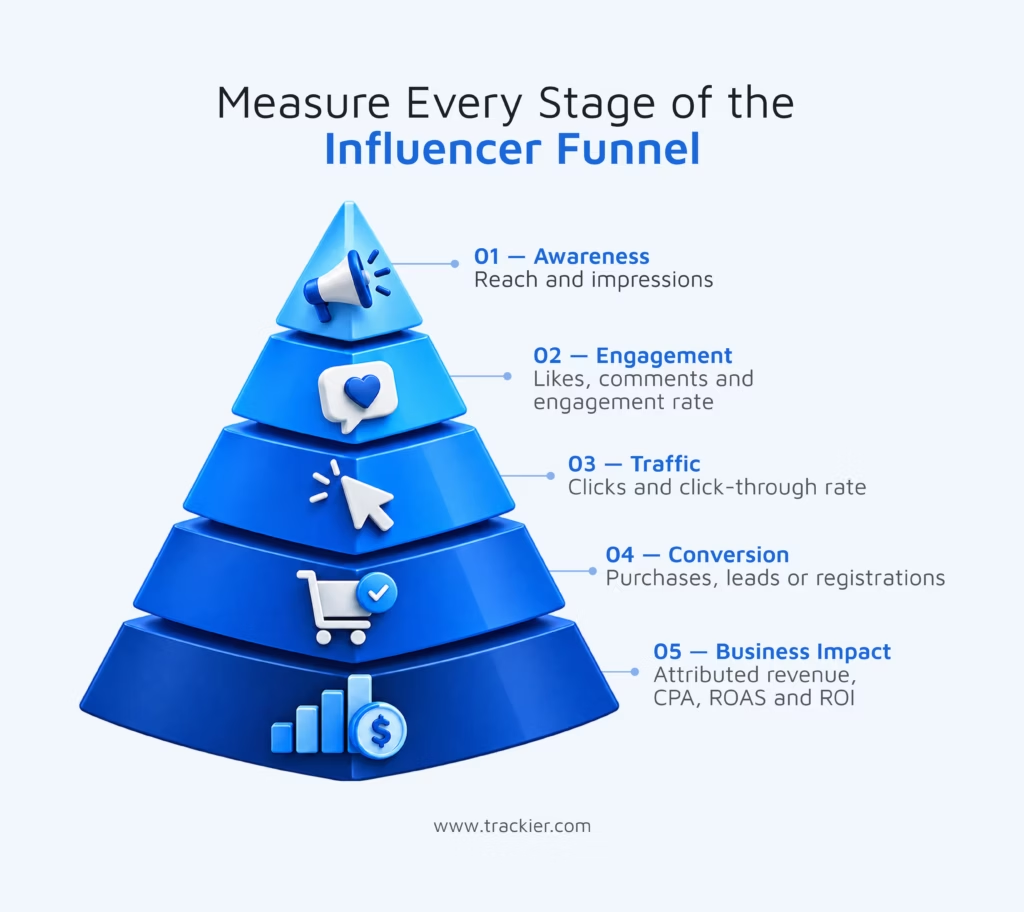
While no single identifier can be listed as a key metric for influencer campaigns, you can use a combination of reach, engagement, traffic, conversion, revenue and quality indicators to gauge the success of your efforts in this niche.
| Metric | What it measures | What drives its use |
| Reach | Estimated number of unique people exposed to content | Awareness |
| Impressions | Number of times content was displayed | Awareness and delivery |
| Engagement rate | Engagement relative to a defined denominator, such as reach or followers | Content response |
| Click-through rate (CTR) | Clicks divided by the chosen impression or view denominator | Traffic generation |
| Conversion rate | Conversions divided by the chosen eligible traffic or visitor denominator | Conversion performance |
| Cost per acquisition (CPA) | Campaign cost divided by attributed acquisitions | Acquisition efficiency |
| Attributed revenue | Revenue assigned to a creator or campaign under the selected attribution model | Revenue performance |
| Return on ad spend (ROAS) | Attributed revenue divided by advertising spend | Revenue efficiency |
| Return on investment (ROI) | Return relative to the costs included in the calculation | Overall investment evaluation |
| Invalid traffic rate | The share of measured traffic classified as invalid under the system’s rules | Traffic quality |
Engagement Rate
When it comes to influencer marketing, engagement rate helps describe how audiences interact with a creator’s content.
It’s important to note that only likes should be compared with likes (the same denominator leads to accurate comparison). Trying to set unlike figures against each other can produce misleading conclusions.
High engagement does not guarantee the sale of any product. A campaign can attract many likes and comments while generating few qualified visits or purchases. It usually comes down to industry type, the target audience, campaign type and influencers aligned.
Click-through Rate
Click-through rate measures how often a view or an immersion actually leads to a click. The formula can be observed as follows:
CTR = Clicks ÷ Impressions × 100
Conversion Rate
Conversion rate shows the proportion of eligible visitors or clicks that complete a defined action. The formula for this calculation is listed below:
Conversion rate = Conversions ÷ Eligible visits or clicks × 100
This metric can be interpreted in a variety of ways. A high click-through rate combined with a low conversion rate may indicate a mismatch between the content, audience, offer or landing page. It may also reflect differences in event tracking or traffic quality.
Cost Per Acquisition
This metric connects campaign expenditure to acquired customers or another defined conversion.
CPA = Campaign cost ÷ Attributed acquisitions
You cannot consider a lower CPA automatically better if the acquired customers differ substantially in quality, order value or long-term value.
Return on Ad Spend, ROI
ROAS or return on ad spend measures attributed revenue relative to advertising spend. You can visualize it in the following manner:
ROAS = Attributed revenue ÷ Advertising spend
ROI or return on investment is broader and depends on which costs and returns are included:
ROI = (Return − Total cost) ÷ Total cost × 100
Both ROAS and ROI cannot be treated as synonyms. A campaign can have positive ROAS while producing limited profit once product costs, creator fees, fulfillment and other expenses are considered.
Fraud and Quality Metrics
Invalid traffic indicators can help identify clicks that do not represent legitimate human interest, or what represents an attempt by an influencer to distort campaign metrics to secure better commissions.
An influencer tracking software platform that detects click anomalies should not automatically be described as a tool that verifies every follower. Ask vendors which data they inspect, what they classify as suspicious and whether the system flags, filters or blocks the activity.
How to Detect Influencer Fraud and Suspicious Activity
Influencer fraud (just like affiliate fraud) can take several forms, including purchased engagement, artificial traffic, misleading audience metrics and activity that does not reflect genuine customer interest.
An unusual metric does not establish fraud by itself, without additional proof. A post can generate a sudden spike in engagement because it was featured by a larger account, covered by the media or shared widely. Investigation of anomalies is required and must be done within a specific context.
1. Check for Unusual Engagement Patterns
Compare engagement with the creator’s historical performance and the content format. Sudden changes may warrant review, particularly when they are inconsistent with other available indicators.
Do not rely on a universal engagement-rate threshold unless you have a defensible benchmark for the platform, industry, creator size and content type.
2. Audit Traffic Quality Regularly
Review click timestamps, sources, device patterns and conversion behavior where your tracking setup makes these available.
Potential warning signs include repeated bursts of activity, high click volume with very few meaningful sessions, or large discrepancies between recorded clicks and downstream events. None is conclusive on its own.
3. Compare Clicks with Downstream Conversions
Any influencer can generate traffic without generating conversions. This could reflect low-intent audiences, a poorly matched offer, an ineffective landing page or even technical tracking issues on the advertiser’s end.
Review the complete funnel before attributing the result to fraud directly. Checks must be run for the tracking link works, conversion events fire correctly and the campaign’s attribution settings are appropriate.
To eliminate such instances, you can make use of features like the affiliate link checker on whichever influencer tracking platforms you’re currently using.
4. Review Audience Authenticity Separately
Are the interactions real or bots? Follower counts and engagement rates alone cannot verify an audience’s authenticity. Use audience analysis tools when you need to investigate follower growth, suspicious engagement clusters or audience relevance.
Ask whether the provider’s method is transparent, what data it can access and how often its findings are updated. Treat risk scores as evidence for review rather than definitive proof of misconduct.
5. Establish a documented review process
Define what happens when an anomaly appears. The process should include reviewing the underlying data, checking tracking implementation, contacting the relevant partner when appropriate and recording the final decision.
Avoid automatically withholding commissions regularly over on a single unexplained metric. Use agreed campaign terms or affiliate marketing guidelines and documented evidence when resolving disputes.
How to Compare Influencer Tracking Platforms
The phrase ‘influencer tracking platforms’ covers several types of software. Some products focus on creator discovery, audience demographics and content management. Others emphasize attribution, conversion tracking, fraud detection and performance-based payouts. If you’re examining Trackier from this lens, it fits into the latter category.
A fair comparison starts with the work the platform must perform.
Essential Features to Evaluate (Across Categories)
Creator-level tracking: Can you assign distinct tracking links or codes to creators and campaigns?
Conversion attribution: Can the platform connect recorded actions to creator activity, and can you inspect the attribution rules?
Campaign reporting: Can you compare performance at creator and campaign levels using consistent metrics?
Fraud monitoring: Does the tool assess audience authenticity, suspicious clicks, invalid traffic or some combination of these?
Revenue measurement: Can it report attributed revenue and support the calculations your business needs?
Integrations: Can it receive the required data from your website, ecommerce system, analytics tools and other marketing systems?
Workflow and payments: Does it support the way your team manages approvals, commissions, invoices and payouts, if those functions are required?
Data access and support: Can you export the information you need, understand data limitations and get help with implementation?
What Should be the Deciding Factor in Choosing a Performance Tracking Platform?
To make this decision easy for you to take, we’ve built direct comparisons across Trackier and other products which serve the same set of needs. Therein, we have focused primarily on affiliate and performance marketing software as influencer tracking platforms, rather than the full range of influencer discovery and audience analytics tools.
The comparison is therefore most useful for teams that treat influencers as measurable performance partners, using creator-specific links, autoDM, conversion attribution and revenue reporting.
Think of it like this: a performance tracking platform may suit you if your priority is to connect creator partnerships to clicks, conversions, revenue and partner payments. It is particularly relevant when influencers are managed through affiliate-style or partner-like structures, or when you need to compare the channel’s performance alongside other user acquisition channels.
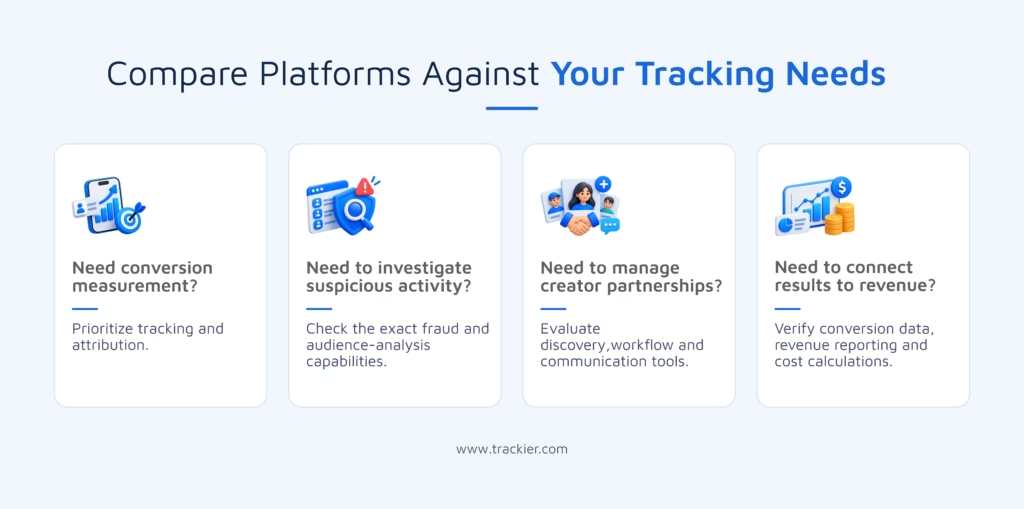
A creator marketing suite may be more suitable if your main needs are discovering influencers, reviewing audience demographics, managing content approvals, coordinating gifting and monitoring social posts.
Some businesses need both. Before purchasing separate tools, check whether one platform can cover the required workflows and exchange data with the other systems you use.
Best Practices for More Reliable Influencer Tracking
A tracking platform can organize measurement, but it cannot compensate for poorly defined goals or incomplete event data. These practices help improve the usefulness of campaign reports.
Define the conversion before launching
Decide whether success means a purchase, a qualified lead, a registration or another action. Document the event definition and the attribution window before the campaign begins.
Give every creator a distinct identifier
Use creator-specific links or codes and keep campaign naming consistent. Avoid reusing identifiers across creators or campaigns if doing so would make the results difficult to distinguish.
Combine tracking methods when appropriate
Links are useful for direct traffic attribution. Promo codes can help capture some purchases when users do not follow a link. Post-purchase surveys may provide additional context about how customers discovered the brand.
Validate the tracking setup
Test links, redirects, conversion events and reporting before spending the campaign budget. Compare the platform’s records with the source system where possible, while accounting for differences in event definitions and attribution rules.
Separate measurement from compliance
Tracking campaign performance does not automatically establish that an endorsement complies with advertising disclosure rules. In the United States, the Federal Trade Commission’s Endorsement Guides and influencer resources explain disclosure expectations and the responsibilities of advertisers and endorsers.
The FTC advises businesses to provide guidance to influencers and monitor their compliance. Disclosure requirements vary by jurisdiction, so teams should check the applicable local rules rather than treating one country’s guidance as universal.
Review performance over an appropriate period
Some conversions occur after a delay. Evaluate results using a window appropriate to the purchase cycle and campaign objective. Avoid judging creators on incomplete data or changing attribution rules midway through a comparison without documenting the change.
Conclusion
Influencer tracking platforms help brands move from surface-level engagement reporting to a clearer view of creator-driven traffic, conversions and revenue. Their value depends on the quality of the tracking setup, the metrics chosen and the ability to distinguish genuine performance from suspicious activity.
Before selecting a platform, define your campaign objectives, identify the events you need to measure and establish whether you need creator discovery, audience authenticity analysis, conversion attribution, fraud monitoring or all four. Then compare products against those requirements and verify the relevant features directly with each vendor.
For performance-focused teams, Trackier’s influencer tracking software is one option to evaluate for creator-level links and promo codes, conversion attribution, revenue tracking and traffic-quality monitoring.
FAQs
What is an influencer tracking platform?
An influencer tracking platform is software that measures activity generated by influencer partnerships, such as clicks, conversions and attributed revenue. Depending on the product, it may also provide campaign analytics, audience analysis, fraud monitoring and creator management.
How do influencer tracking platforms detect fraud?
Some platforms analyze traffic patterns and flag activity that may be invalid, automated or otherwise suspicious. Audience analytics tools may separately identify unusual follower growth or engagement patterns. These signals require investigation and should not automatically be treated as proof of fraud.
On Trackier, fraud is filtered as campaigns go live, ensuring your campaign data doesn’t contain fraudulent conversions. All suspicious activities in the form of bots, click farms and other malpractices are caught in real-time and eliminated.
How can you measure influencer marketing ROI?
Calculate ROI using the return and total costs defined for the campaign. A common formula is (return − total cost) ÷ total cost × 100. Include relevant expenses such as production, commissions and other campaign costs, and document how returns are valued.
What is the difference between influencer tracking and influencer analytics?
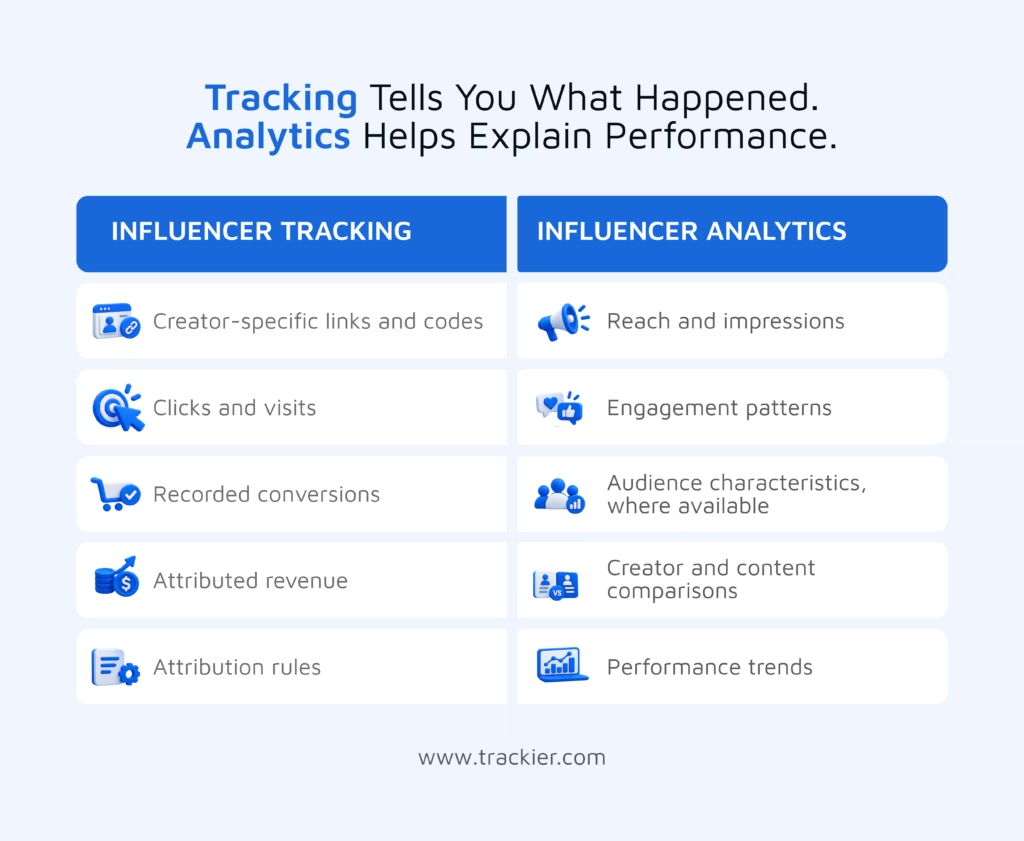
Influencer tracking connects activity to a creator or campaign, including clicks and conversions. Influencer analytics interprets broader performance data, which may include reach, engagement, audience characteristics and content results. Some platforms offer both, while others specialize in one area.
Can influencer tracking platforms measure sales across multiple channels?
Some platforms support cross-channel attribution, depending on their tracking methods, integrations and configuration. However, no attribution setup should be assumed to capture every customer interaction. Untracked devices, missing identifiers and offline activity can limit the view of the customer journey.
On Trackier, if you have an integrated MMP running in parallel, all campaign metrics across devices can be captures and viewed.
What is the difference between influencer fraud detection and audience authenticity analysis?
Influencer fraud detection may examine suspicious clicks, invalid traffic or unusual conversion activity. Audience authenticity analysis focuses on signals such as follower quality and engagement patterns. A tool that performs one type of check does not necessarily provide the other.