In the fast-paced and increasingly fragmented world of digital marketing, data is the compass that guides every successful campaign. However, data is only as good as its source. For performance marketers, affiliate managers, and brand owners, the challenge isn’t just getting traffic, it’s knowing exactly where that traffic came from, how it behaved, and whether it converted. This is where UTM parameters become the most essential tool in your marketing arsenal.
Without a robust tracking system, your marketing efforts are essentially a shot in the dark. You might see a spike in sales, but was it the influencer post on Instagram, the weekly email newsletter, or the retargeting ad on Google?
By implementing UTM parameters correctly, you transform guesswork into growth work, allowing you to attribute every dollar spent to a specific outcome. As the digital ecosystem moves toward a privacy-first world with the phasing out of third-party cookies, first-party data collection through precise URL tagging has never been more critical.
What Are UTM Parameters?
UTM parameters (Urchin Tracking Module) are simple snippets of text added to the end of a URL. When a user clicks on a link with these tags, the information is sent back to your analytics platform, allowing you to see the specific path the user took to reach your site. These parameters were originally developed by Urchin Software Corporation, which was acquired by Google in 2005, forming the foundation of what we now know as Google Analytics.
Think of UTM parameters as digital breadcrumbs. They don’t change the destination of the link or affect the user experience on the page, they simply provide metadata about the click.
A standard URL becomes a powerful data point when it includes specific tags for the source, medium, and campaign name. By using these tags, you can categorize your traffic into distinct buckets, making it easier to compare the ROI of different channels side-by-side.
The 5 Core Components of UTM Parameters
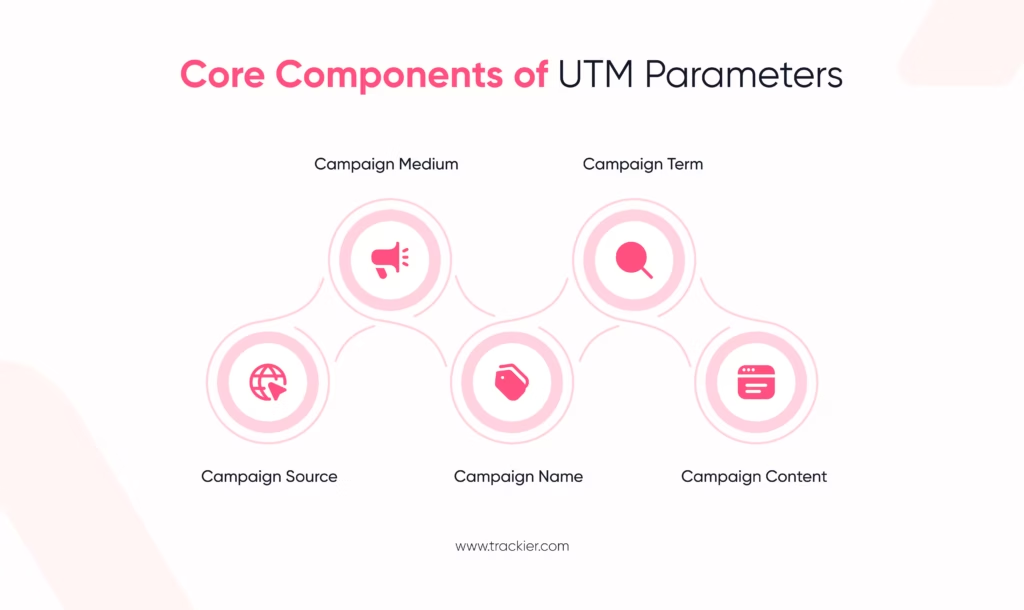
To master the art of tracking, you must understand the five standard UTM parameters. While not all are required for every link, using them strategically provides the granularity needed for deep-dive analysis and high-level reporting alike.
1. Campaign Source (‘utm_source’)
The source is the most fundamental parameter. It identifies the specific platform or website where the traffic originated. It tells you “where” the user was right before they clicked your link.
If you are running an ad on Facebook, the source is ‘Facebook’. If you are placing a guest post on a partner blog, the source would be the name of that blog.
Goal: To know which referring entity is sending you visitors so you can reward high-performers.
2. Campaign Medium (‘utm_medium’)
The medium identifies the high-level channel or marketing tactic used. This helps you group sources together for broader analysis. While the source is the “where,” the medium is the “how.”
You might have multiple sources like Facebook, Twitter, and LinkedIn that all fall under the medium of “social”. Alternatively, you might have paid search, email, or affiliate.
Goal: To distinguish between paid, organic, and referral traffic types to understand which marketing discipline is most effective.
3. Campaign Name (‘utm_campaign’)
This parameter identifies the specific marketing initiative, promotion, or sale. It allows you to track the performance of a single theme across multiple sources and mediums.
If you are running a “Summer Clearance” sale across email, Facebook ads, and Google search, all those links should share the same ‘utm_campaign=summer_clearance’ tag.
Goal: To aggregate data for a specific business goal regardless of the channel, allowing for a holistic view of campaign success.
4. Campaign Term (‘utm_term’)
Primarily used for paid search, this tag tracks the specific keywords that triggered an ad. However, it can also be used in affiliate marketing to identify specific sub-affiliates or niches.
If you are bidding on the phrase best running shoes, that phrase becomes your “utm_term”.
Goal: To optimize keyword bidding strategies and identify high-intent search terms that lead to actual revenue.
5. Campaign Content (‘utm_content’)
This is a critical tool for A/B testing and granular optimization. It differentiates between specific links, buttons, or creatives within the same campaign and source.
If you have two different banner ads in the same campaign, one with a buy now button and one with a learn more button, you can use ‘utm_content=buy_now’ and ‘utm_content=learn_more’.
Goal: To see which specific creative asset or placement is driving the most engagement, allowing you to iterate on design and copy.
Why Accurate Tracking Matters for Multi-Channel Success
In the early days of the internet, a user journey was simple: they saw an ad and they clicked it. Today, the consumer journey is a messy middle of touchpoints. A customer might see a social media ad on their phone, read a blog post via a professional network link on their laptop, and finally convert through a promotional email a week later.
Solving the Attribution Puzzle
Without UTM parameters, these three touchpoints look like disconnected events. You might incorrectly attribute the sale only to the email (Last-Click Attribution), ignoring the fact that the social media ad did the heavy lifting of brand discovery. By consistently tagging every link, you provide your analytics engine with the data it needs to build multi-touch attribution models.
Eliminating the “Dark Social” Problem
A significant portion of traffic often falls into the “Direct” category in analytics. Often, this isn’t people typing your URL into a browser, it’s traffic from “dark social” apps like WhatsApp, Telegram, or Slack, where tracking headers are often stripped during the transition from the app to the browser. By appending utm parameters to your shared links, you force these platforms to reveal the source, drastically reducing the “Direct” traffic bucket and giving credit to the social sharing that actually drove the visit.
Granular ROI Analysis
In performance marketing, every cent counts. If you are spending $10,000 across five different influencers, you need to know which one is actually moving the needle. Standard referral data might just show Instagram as the source for all of them.
Only by giving each influencer a unique utm_content or utm_campaign tag can you see that Influencer A has a 5% conversion rate while Influencer B has 0.1%. This data allows you to cut the dead weight and double down on winners.
The Technical Framework: How UTMs Work with Analytics Platforms
When a URL with utm parameters is loaded, the analytics script on the destination page (such as the Global Site Tag for GA4) parses the URL string. It identifies the characters following the ‘?’ and separates the key-value pairs.
For example, in ‘?utm_source=news&utm_medium=email’, the script identifies:
1. Key: ‘utm_source’ | Value: ‘news’
2. Key: ‘utm_medium’ | Value: ‘email’
This data is then bundled with the session data (like device type, time on page, and location) and sent to the server. The analytics platform then displays this in your “Acquisition” reports. If these parameters are missing, the platform defaults to “Referral” or “Direct,” which lacks the marketing context needed for optimization.
Best Practices for Implementing UTM Parameters
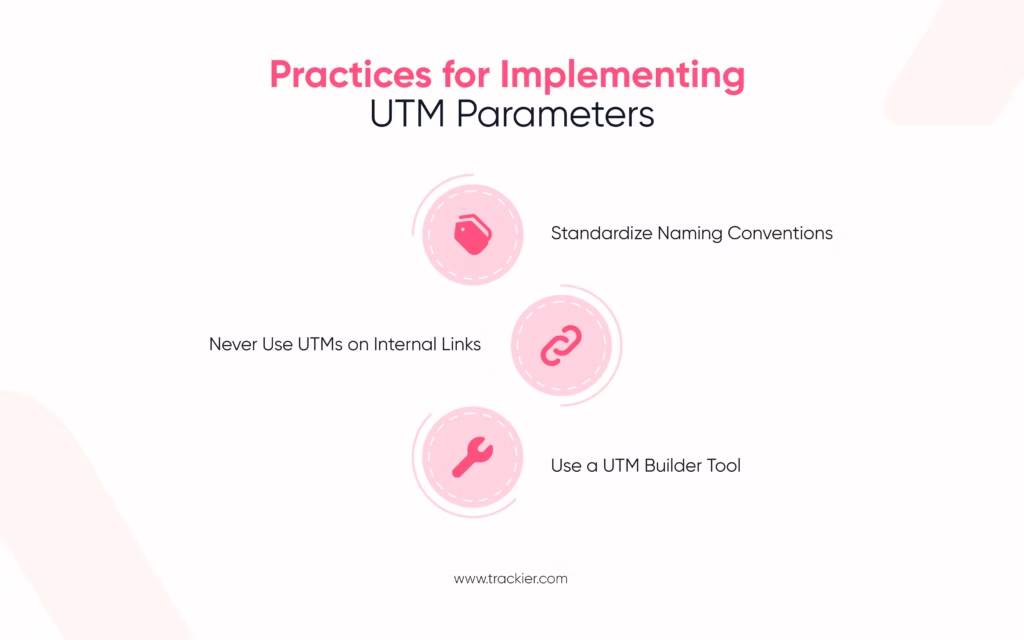
Consistency is the difference between a clean dashboard and a data nightmare. If one team member uses Facebook and another uses FB, your analytics will treat them as two different sources, splitting your data and making it impossible to see the big picture without manual cleanup.
1. Standardize Naming Conventions
Establish a standardized system for your team to follow. A UTM governance document is highly recommended.
Use lowercase: Analytics tools are case-sensitive. “Email,” “EMAIL,” and “email” will show up as three separate rows. Always default to lowercase to maintain uniformity.
Avoid spaces: Spaces in URLs can cause technical errors, broken links, or messy formatting, like ‘%20’. Use hyphens (‘-’) or underscores (‘_’) instead.
Be descriptive but concise: A campaign name like ‘summer-sale-2026-v’ is much more useful for long-term reporting than a generic ‘sale’ tag. However, avoid making URLs excessively long, as they can sometimes be truncated by certain social platforms.
2. Never Use UTMs on Internal Links
This is a common mistake that ruins data integrity. Internal links are links on your website that point to another page on the same website,e.g., a related posts section or a homepage banner. If you put UTM parameters on these, you overwrite the original source of that user.
The scenario: A user arrives via ‘google / cpc’. They click a homepage banner tagged with ‘utm_source=internal_banner’.
The Result: The original “google / cpc” source is deleted. If the user buys something, the “internal_banner” gets 100% of the credit, and you lose the data showing that your paid search ad actually brought the customer to the site.
3. Use a UTM Builder Tool
Don’t try to write these URLs by hand. Human error is the leading cause of tracking failures. Use a dedicated tool, a browser extension, or a shared Google Sheet template with a concatenation formula. This ensures the syntax, the question marks, ampersands, and equal signs are always correct, preventing broken links and lost data.
How Trackier Enhances UTM Tracking for Performance Marketers
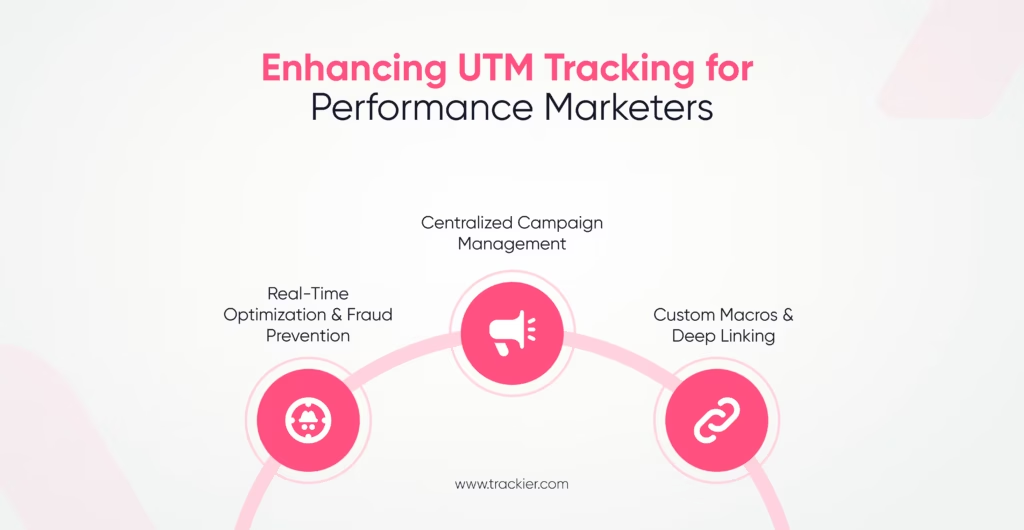
While standard analytics tools show you what happened on your site, performance marketing platforms like Trackier are designed to help you understand the relationship between advertisers and publishers and automate the response to that data.
Centralized Campaign Management
Modern performance platforms allow you to manage multi-channel campaigns from a single dashboard. By integrating UTM parameters with advanced tracking macros, you can sync data between advertisers and publishers in real-time. This level of transparency is vital for affiliate networks where payout accuracy depends on precise attribution.
Real-Time Optimization and Fraud Prevention
One of the biggest risks in multi-channel marketing is poor-quality traffic or “click flooding.” By monitoring UTM parameters at a granular level, Trackier’s fraud detection tools can identify sources that are sending high volumes of clicks with zero engagement or suspicious patterns, like all clicks coming from the same IP range. If a specific source is generating thousands of clicks but zero conversions, you can automatically pause that source, saving your budget for high-performing channels.
Custom Macros and Deep Linking
Beyond the standard five UTM parameters, Trackier supports custom macros that can pass dynamic data. This is particularly useful in the mobile app ecosystem.
You can track:
- Device IDs (IDFA/GAID)
- Geo-location (City/State)
- Creative ID
- Sub-Publisher ID
This allows for postback tracking, which is essential for server-to-server communication. It ensures that even if a user switches from a mobile browser to an app store and then opens the app, the UTM parameters from the original click are remembered and attributed correctly.
Advanced UTM Strategies for 2026

As we move further into the decade, basic tagging isn’t enough. Top-tier marketers are using UTM parameters in more creative ways to gain a competitive edge.
Tracking Offline-to-Online Conversions
You can use UTM parameters with QR codes to track offline marketing efforts. If you have a billboard or a physical flyer, generate a unique QR code that points to a URL with ‘utm_medium=print’ and ‘utm_source=billboard_location_x’. This bridges the gap between physical and digital marketing, allowing you to see which physical locations drive the most digital engagement.
Dynamic Content Personalization
Advanced websites can read the UTM parameters in a user’s URL and change the content of the landing page accordingly. If a user arrives via ‘utm_campaign=nurture_sequence_step_3’, the website can display a specific welcome message or offer that matches their stage in the customer journey. This creates a seamless, highly personalized experience that significantly boosts conversion rates.
Social Media Attribution for Influencers
Instead of giving every influencer the same link, give them links with unique ‘utm_content’ tags. This allows you to measure not just how many sales each influencer drives, but the quality of the traffic. You might find that Influencer A drives fewer sales but higher Lifetime Value customers compared to Influencer B.
Scaling Your Strategy: From Manual to Automated
As your brand grows and you begin running hundreds of ads simultaneously, manually tagging every link becomes impossible. This is where automation takes over.
Auto-Tagging in Ad Platforms
Many major ad platforms, like Google Ads and Meta Ads, offer auto-tagging features. While these are excellent for internal platform optimization, they are “proprietary” and don’t always provide the full picture in third-party analytics or performance marketing software.
The Hybrid Approach: The best practice is to use a hybrid approach. Enable auto-tagging for the platform’s internal machine learning, but keep manual UTM parameters using tracking templates for your holistic cross-channel reporting in platforms like Trackier or GA4.
Centralized Data Dictionaries
For larger organizations with multiple agencies and departments, a “Data Dictionary” is essential. This is a living document that defines exactly what each medium and source tag means.
- Does “social” include paid ads, or is that “paid-social”?
- Does “email” include transactional emails or just marketing blasts?
Without these definitions, your data becomes fragmented over time. A data dictionary ensures that even as new team members join, the integrity of the UTM parameters remains uncompromised over several years of data collection.
Common Mistakes to Avoid
Even seasoned professionals can stumble when it comes to URL tagging. Avoid these pitfalls to ensure your data remains actionable:
1. Using UTMs for SEO: There is a common myth that UTM parameters help with SEO. They don’t. In fact, if not handled correctly with canonical tags, they can cause duplicate content issues. Always ensure your site uses the right tags to point search engines back to the clean version of the URL.
2. Redundant Information: Don’t use the same value for source and medium (e.g., ‘utm_source=facebook&utm_medium=facebook’). This wastes a dimension of data. Use the medium to describe the type of traffic (e.g., ‘cpc’ or ‘organic’).
3. Neglecting the User: Extremely long URLs can look suspicious to savvy users. Use a URL shortener for social media posts to hide the UTM strings while still capturing the data.
Data-Driven Growth Starts with a Single Tag
UTM parameters are the bridge between your creative efforts and your financial results. They provide the clarity needed to scale winning campaigns, the evidence needed to cut losing ones, and the transparency needed to build trust between advertisers and affiliates.
By following a strict naming convention, avoiding internal usage, and leveraging a powerful performance tracking platform like Trackier, you ensure that every click is accounted for. In an era where every marketing dollar is under scrutiny, the ability to prove your impact through precise attribution is your greatest asset.
Start tagging your links today, standardize your process, and turn your marketing data into your most valuable competitive advantage. Accurate tracking isn’t just about looking at the past, it’s about predicting and building a more profitable future.
FAQs
How do UTM parameters help improve multi-channel attribution?
UTM parameters enable accurate tracking of user journeys across multiple touchpoints by assigning clear identifiers to each link. This helps marketers move beyond last-click attribution and understand the full impact of channels like social media, email, paid ads, and affiliates on conversions.
What are the best practices for using UTM parameters effectively?
To use UTM parameters effectively, maintain consistent naming conventions, avoid using them on internal links, use lowercase formatting, and leverage UTM builder tools to prevent errors. Proper implementation ensures clean, reliable data for better campaign optimization and ROI analysis.
Can UTM parameters be used beyond digital campaigns, like offline or influencer marketing?
Yes, UTM parameters can go far beyond traditional digital campaigns. You can embed them in QR codes for offline channels like billboards, events, or print ads to track offline-to-online conversions. Similarly, in influencer marketing, assigning unique UTM parameters to each creator helps measure not just traffic, but the quality and conversion value of their audience, turning brand collaborations into fully trackable performance channels.