The global affiliate marketing industry is valued at roughly $18.5 billion, with broader estimates reaching $27.8 billion. Nevertheless, a significant number of brands still depend on intuition, backward-looking network reports, and spreadsheets that have not been updated since the last fiscal quarter.
As per the report, 42% of marketers face fraudulent traffic, and 34% encounter misreported conversions. In fact, cookie-based tracking is falling apart due to the impact of iOS regulations, ad blockers, and anti-privacy browsers.
This blog is quite different from other comparison articles you’ve already gone through. This step by step way to track campaigns helps marketers move from basic manual tracking to more accurate, automated performance measurement.
If you are leading growth at a brand with more than 15 affiliate partners, multi-channel campaigns, or plans for international expansion, you will discover the reason behind 2.5 billion clicks being tracked by Trackier across 100+ countries.
Understanding the tracking ecosystem before you build
If you intend to choose a tracking method for your affiliate program, you need to carefully understand what you want to measure.
Affiliate tracking is not merely counting the clicks; the idea behind it is to map the complete customer journey from the first touchpoint to the conversion and to ensure that the partner gets paid for the transaction at the right time.
There are five methods of tracking available in 2026, and the well-established affiliate marketing programs can opt for a combination of them:
1. Cookie-based tracking is a legacy method. It involves saving a small text file with the affiliate ID in the browser. Although it is an easy option to implement, it no longer works reliably due to Apple’s iOS 17 Link Tracking Protection, Safari’s Intelligent Tracking Prevention, and the obligations related to GDPR consent.
2. Server-to-Server tracking or postback tracking is a newer method of tracking that works well in most cases. The first step happens when a user clicks on an affiliate link, generating an individual click ID. This ID is stored on the server. When this user converts, your server sends a notification to the tracking platform with the click ID.
3. Pixel tracking fires a small piece of code when a conversion page loads. It is useful for retargeting and visibility; however, it’s not a complete attribution solution. Pixels can be blocked by ad blockers, and this technology won’t work in case the user made an offline purchase.
4. Coupon code tracking assigns unique promo codes to affiliates. This is extremely important for influencers, podcasters, and anyone whose audience won’t click on any links. At checkout, the customer uses code “SARAH20”, and Sarah gets the credit no matter which channel was used to discover the brand.
5. API tracking provides two-way real-time synchronization with your tracking platform, CRM, payment processing system, and analytics provider. It’s the point when tracking becomes business intelligence.
Step 1: Manual tracking with UTM parameters and spreadsheets
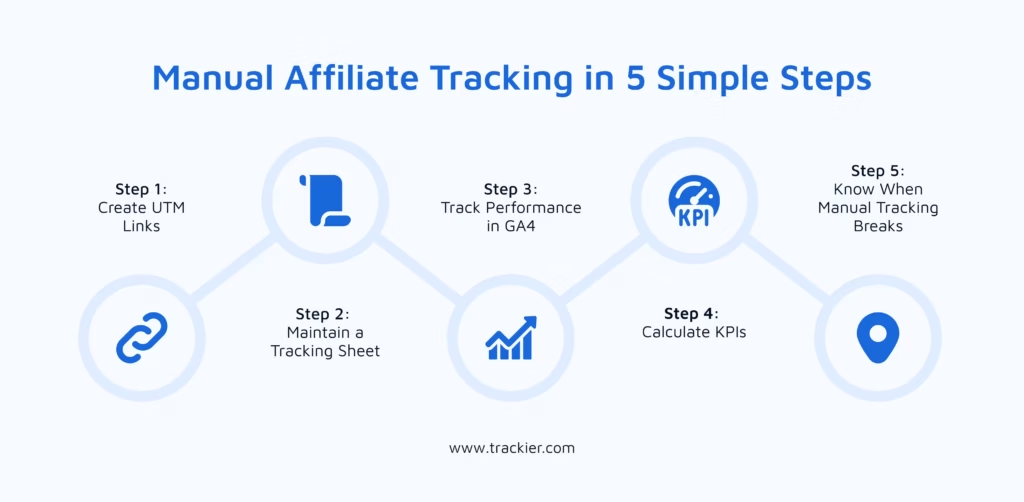
If you’re running a pilot program with 1-5 affiliates and testing whether partner marketing works for your business, you don’t need any software.
- Build your UTM-tagged links – Every affiliate gets a unique combination of parameters: yoursite.com/?utm_source=affiliate&utm_medium=banner&utm_campaign=spring_sale&utm_content=partner_name_john. The utm_source identifies the channel. The utm_medium describes the creative format. The utm_campaign groups related promotions. The utm_content isolates the specific partner. This structure lets you segment performance in Google Analytics 4 by any dimension you choose.
- Create a master tracking spreadsheet – Your columns should include: Partner Name, Unique Link, UTM Parameters, Traffic Source, Start Date, Clicks (from GA4), Conversions (from your checkout platform), Revenue, Commission Rate, Commission Owed, EPC (Earnings Per Click), and Notes.
- Set up GA4 to track your conversion data – To access GA4, go to Traffic Acquisition, then session source/medium. Choose your UTM parameters as a filter. Create a conversion event that corresponds to your main goal, like a purchase, submitting a lead form, or signing up for a trial. This way, you will understand which affiliate brought the most sales or revenue.
- Manually calculate your key KPIs – Conversion Rate = (Conversions ÷ Clicks) × 100. EPC = Revenue ÷ Clicks. These two figures will give you all you need to know at this time. If an affiliate sends a lot of traffic but has a low EPC, this means that they do not send targeted customers. If an affiliate has little traffic but a high EPC, this means you should invest more in them.
- The hard truth about manual tracking – It works until it doesn’t. With 2-5 affiliates, you may spend about an hour per week reconciling data. Once you get to 10 affiliates across three campaigns, then you will be spending a whole day on the task. Once you reach the limit of 20 affiliates requiring monthly payouts, then you will need to hire a full-time employee who will be responsible for managing the spreadsheet.
Step 2: Link management and SubID clarity
At the point at which you are ready to spend $20-50/month, your link management tools will be able to provide some structure without adding unnecessary complexity.
Utilize SubID parameters with creative-level tracking
A SubID is a secondary identifier that indicates what specific asset led to the conversion. Your main link may look like this: ?utm_content=john, while the SubID will reveal whether the conversion originated from a blog post, John’s newsletter, or profile on Instagram.
Quick example: yoursite.com/?utm_content=john&subid=blog_march_2026_review
Now when John asks why his EPC has declined, you will be able to explain that his blog post has still been making $4.5 per click, but his email banner has brought only $0.8. John fixes the banner and launches a successful campaign. This degree of detail simply isn’t possible with standard UTM tracking.
Synchronize with network dashboards
If you are working with established affiliate networks, they have dashboards that provide basic monitoring and reporting capabilities. Unfortunately, these dashboards have one major drawback: time lag.
Step 3: Implementing a performance marketing platform
Tracking’s function has changed from being just an operation to a strong tool. Performance marketing software not only tracks results; it also automates the process of attribution, detects fraud, and automates invoicing.
- The selection of a specific method depends on the nature and type of business – If affiliates are in charge of sales, it is better to engage the last-touch attribution method. When an organization works with influential people and affiliates that generate sales, the use of multi-touch attribution would be efficient. Today’s platforms allow switching between the methods and using comparative reports.
- Create tracking links and SmartLinks – Every affiliate will receive a unique tracking URL that will give precise information about the number of clicks through server-side leading technology. SmartLinks are even more advantageous because they not only have uniqueness, but can also direct traffic to different offers, based on various factors, like geolocation, device, time of the day, and performance history. In case the offer is out of stock or expired, the SmartLink will direct the user to the next best offer.
- Use S2S tracking – This is an essential technology that should be used in 2026. 40-50% of traffic doesn’t allow for cookies, and server-side technology helps you capture conversions that cookie technology won’t through a simple mechanism. The process is easy: the user clicks on the affiliate link → the unique click ID is generated and stored on the server → the user converts on the site → you contact the tracking system and provide it with the ID.
- Use fraud detection rules – Establish limits for clicks from identical IPs in order to detect user behavior. Block proxy or VPN traffic and its disguising nature. Recognize double conversions from a single device fingerprint. Use pattern recognition for unusual click journeys; real users don’t convert within three seconds after clicking.
- Automate payment and commission rules – Create or apply required commission systems: CPA, CPL, CPS, or RevShare methods. Establish a multilevel commission structure: the higher your partners’ revenues become, the higher their incomes become too. You could also provide them with the possibility of automated invoicing.
- Create an uncoded dashboard for your partners – Partners need to see their dashboard with their clicks, conversions, revenues, and statistics. If partners have access to their personal dashboards, they will not have to ask you “How is it going?” anymore.
- Integrate with your tech stack – your tracking solution has to work with conversion information from Shopify, WooCommerce, or any other checkout option.
Step 4: Monitoring influencer and coupon campaigns
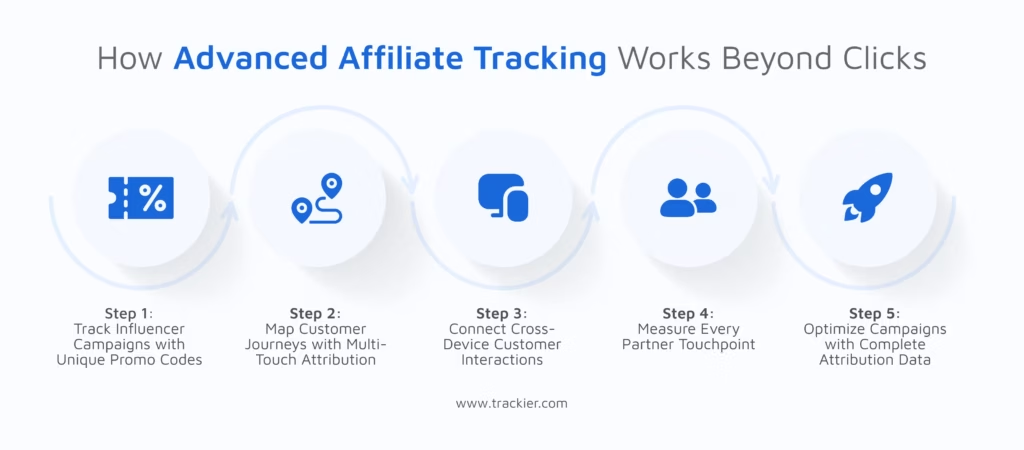
Unlike traditional tracking methods, affiliate tracking goes beyond merely using links. It utilizes programs to identify impact across certain mediums without any possibilities for direct attribution.
- Unique promo code for every influencer – it is impossible to use a link when an influencer talks about a brand on a podcast; however, the audience can remember the code “PODCAST20” by the time they finish their purchase. Each code refers to a particular partner’s influence and serves the purpose of attribution when normal monitoring is impossible.
- Multi-touch attribution for complicated paths – a customer sees a brand on TikTok, researches it in Google, reads an article with affiliate links, and then makes a purchase after seeing retargeting ads. Without multi-touch attribution, one either overpays for the last click or underpays for the first touch. Nowadays, systems are capable of monitoring the whole journey and attributing according to the desired model.
- Cross-device tracking – a customer learns about your brand on a smartphone, explores it on a computer, and makes the purchase using a tablet. Although it’s still the same customer, your tracking has to treat their actions as it should.
Step 5: Optimization and advanced analytics
The monitoring method is not a procedure that you can launch and abandon. Successful companies treat the information they receive as though it were alive.
- A/B testing of landing pages and creatives – Use tracking tools to send users to multiple variations of a specific page. It is necessary to evaluate not only the conversion rate but also the income of the company per customer, the average cost of the order, and the customer’s lifetime value for each creative. An affiliate banner can have a smaller CTR yet bring in more valuable customers.
- Cohort analysis according to the affiliate quality – Which of your partners make clients come back for purchases? Which of your partners lure clients only because of discounts? Trackier’s real-time analysis makes it possible to obtain all this information without spending the budget allocated for a certain period of time.
- Budget pacing and anomaly alerts – Establish a limit for CPA based on the affiliate partner’s performance. In case the CPA exceeds the limit by 40%, the partnership should cease to exist.
When Should You Start Using Affiliate Tracking Software?
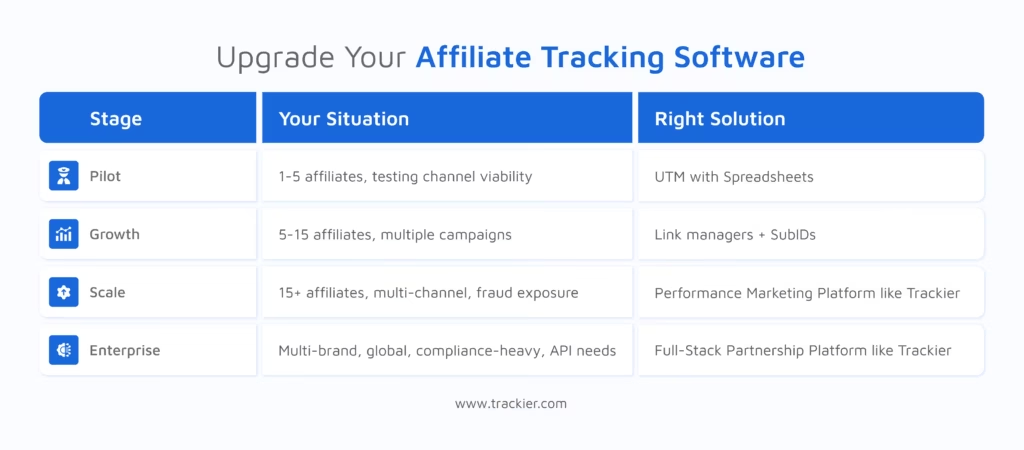
The transition from stage 2 to stage 3 is a significant change. At this stage, expenses can accumulate at a faster rate than revenues made at this. This is when one fraud event can go undetected and wipe out one quarter’s revenue.
This is when one lacks the ability to know about current events and therefore constantly adjusts information obtained in the last month.
An affiliate tracking software gives away 10,000 free conversions and has a 30-day trial period because they know the transition takes place.
A small number of campaigns allows clients to test the platform in real life and see what new tracking means. For companies who receive lots of partner transactions, this is not merely a free offer, but rather a useful risk management solution.
Final thoughts
The enterprises that will thrive in the year 2026 won’t argue about whether they should invest in monitoring infrastructure and will gain the edge over the competition. Following a step by step way to track campaigns gives your team a clearer view of what drives conversions, where performance drops, and when it’s time to automate.
Keep in mind that operational burdens should not interfere with gaining profit from partnerships. Attribution, fraud protection, and real-time optimization have to be considered not as options but as the cornerstone of business growth.
If your business cooperates with numerous affiliates, operates across multiple channels, or aspires to worldwide expansion, doing everything manually will cost you much more than any software might.
Book a demo and get to know how Trackier can help you with attribution, fraud prevention, and payment automation in one platform.
FAQs
How to keep track of marketing campaigns?
Use UTM-tagged links for every channel, connect Google Analytics 4 for conversion tracking, and maintain a central dashboard or spreadsheet with KPIs per campaign. Track clicks, conversions, cost, and ROI weekly. For multi-channel programs, upgrade to a performance marketing platform that unifies attribution across all touchpoints.
What are the different types of campaign tracking methods?
The five core methods are: cookie tracking (browser-based, fading), server-to-server/postback (server-side, most reliable), pixel tracking (page-load visibility), coupon/code tracking (offline and influencer-friendly), and API tracking (real-time two-way sync with your CRM and analytics stack).
What attribution model should my affiliate program use?
Last-click works for bottom-funnel affiliate programs. First-click rewards discovery channels. Multi-touch attribution is essential for hybrid influencer-affiliate programs. The right model depends on your customer journey. Modern platforms let you compare models side-by-side before committing to one.
What is the difference between cookie tracking and postback tracking?
Cookie tracking stores affiliate IDs in the user’s browser, simple but dying under privacy restrictions. Postback (S2S) tracking stores IDs on servers, bypassing browsers entirely. Cookies miss 40–50% of conversions today. Postbacks capture nearly 100% and are now the enterprise standard for accurate attribution.
What are UTM parameters and why do they matter?
UTM parameters are URL tags that identify traffic source, medium, campaign, and content. They let you segment performance in Google Analytics 4 by any dimension. Without them, all affiliate traffic blends into one bucket, and you cannot tell which partner, creative, or campaign actually drives revenue.