Performance marketing fraud is any deceptive tactic used to generate fake clicks, leads, or conversions so a bad actor can collect commissions or ad spend they never actually earned. It shows up as bot traffic, cookie stuffing, fabricated leads, and manipulated attribution across affiliate, PPC, and app-install campaigns.
The problem is not small or slowing down. Fraud and invalid traffic drained an estimated $3.4 billion from the global affiliate industry last year alone, and global ad fraud losses are on track to cross $100 billion by the end of 2026.
For any brand running a performance marketing program, this is not a hypothetical risk sitting in a report somewhere. It is a direct hit to budget, data integrity, and trust with the partners who are actually driving real results. This guide breaks down how performance marketing fraud works, what it costs, and the specific systems your brand needs to catch it before it drains your budget.
What Is Performance Marketing Fraud?
Performance marketing runs on a simple promise: you pay for results, not exposure. That model is exactly what makes it a target. Whenever a program pays out for a specific action, whether that’s a click, a lead, a sale, or an app install, someone will eventually try to fake that action instead of earning it.
Performance marketing fraud covers any scheme where a publisher, affiliate, or bot network exploits your tracking and attribution setup to collect payouts for activity that was never legitimate. It’s different from brand-safety issues like ad placement next to inappropriate content. This is financial fraud, aimed directly at your commission budget and your data.
The incentive structure is what makes it persistent. A flat CPC or CPA payout rewards volume, not quality, unless a brand actively builds in verification. That gap between “paid for” and “actually delivered” is where fraud lives.
Why Performance Marketing Fraud is Getting Worse in 2026?
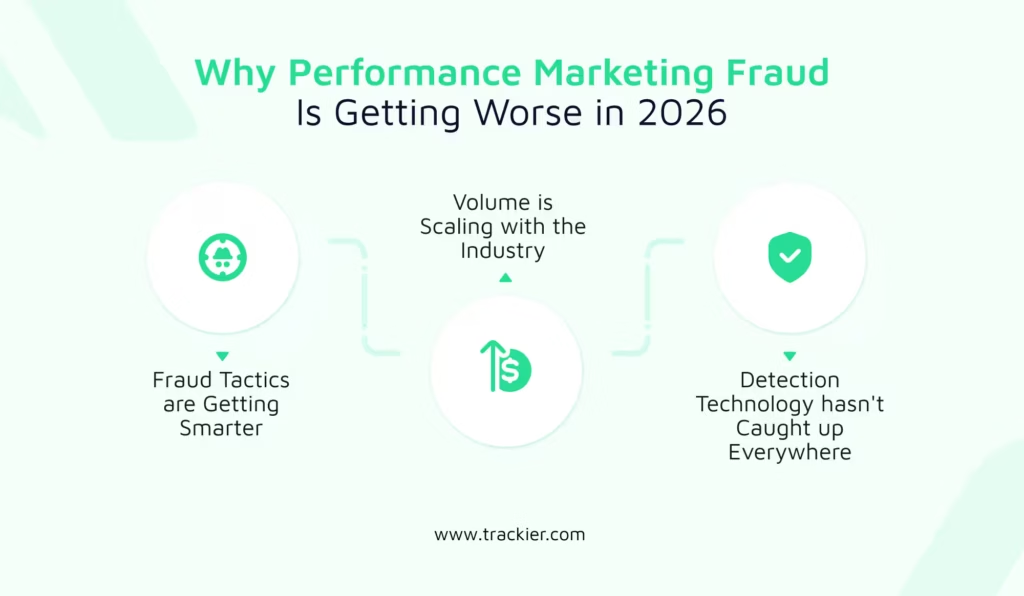
Three things are converging to make this harder to catch than it was even two years ago.
- Fraud tactics are getting smarter. Early click fraud relied on simple bots and scripts that were relatively easy to flag. Fraudsters now run residential proxy networks, vary click timing to look human, and simulate realistic mouse movement and browsing rhythm. Fraudlogix’s 2026 State of Ad Fraud Report, based on an analysis of over 105 billion ad impressions, put the global invalid traffic rate at 20.64%, with desktop traffic running even higher at just over 27%.
- Volume is scaling with the industry. The global affiliate marketing industry is projected to reach nearly $25 billion in 2026. As commission-based spend grows, so does the payoff for fraud. An estimated 24% of affiliate traffic is now believed to come from bots, and up to a quarter of leads generated through some affiliate campaigns are estimated to be fake.
- Detection technology hasn’t caught up everywhere. Behavioral anomaly detection can cut false-positive fraud flags by roughly 43% compared to older rule-based systems. But as of early 2026, only about a third of mid-market performance programs had actually deployed it. Most brands are still fighting 2026 fraud tactics with 2020 detection tools.
What is the Real Cost to your Brand?
The financial hit is the easiest to measure, but it’s not the only one.
- Direct commission losses. The widely cited $3.4 billion figure for global affiliate fraud represents actual commissions paid out to fraudulent affiliates for fake clicks, cookie-stuffed conversions, or fabricated leads. That’s real budget leaving your account for zero real return.
- Vertical-specific exposure. Fraud doesn’t hit every vertical the same way. Forex and CFD programs see some of the highest fraud rates in performance marketing, driven by fabricated funded-account submissions targeting CPAs as high as $300 to $900. iGaming fraud concentrates heavily around bonus abuse: one person opening dozens of accounts to repeatedly collect first-deposit bonuses. eCommerce and lead-gen programs, meanwhile, get hit hardest by fake form fills and cookie stuffing.
- Corrupted data and attribution. Every fake click or fabricated lead pollutes your reporting. Your cost-per-acquisition looks worse than it should, your best-performing channels get miscredited, and decisions about where to scale spend get made on bad data.
- Reputational and partner damage. Fraudulent affiliates don’t just cost money, they crowd out and discredit the legitimate partners actually doing the work. Left unchecked, honest affiliates start to see a program as poorly managed and disengage, while your brand absorbs the reputational hit when fraud eventually surfaces publicly.
- It’s not limited to affiliate channels. Paid social carries its own exposure. Scam ads made up an estimated 10% of Meta’s ad revenue in 2024, and an estimated 4 to 5% of its monthly active users are believed to be fake accounts. Fraud in performance marketing is a cross-channel problem, not just an affiliate-program problem.
What are the Common types of Performance Marketing Fraud?
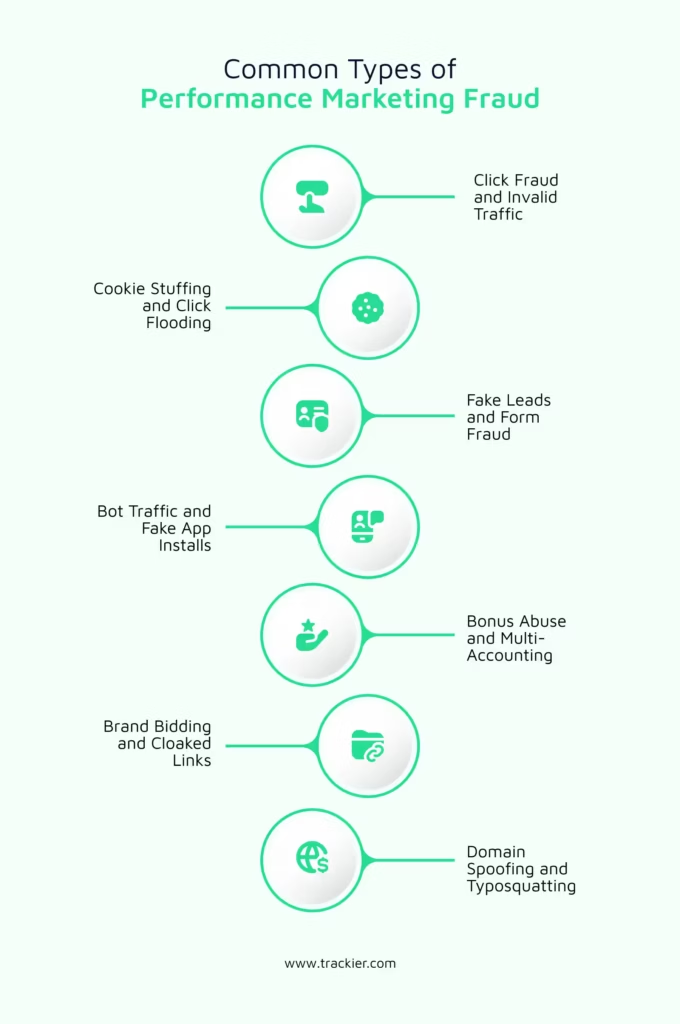
- Click Fraud and Invalid Traffic (IVT)
Automated bots or click farms generate fake clicks on affiliate links or paid ads to burn a competitor’s budget, inflate a publisher’s traffic numbers, or trigger last-click commission credit. This remains the most common fraud category across every performance channel.
- Cookie Stuffing and Click Flooding
A fraudulent affiliate drops tracking cookies on a user’s device without their knowledge, or floods a network with high volumes of clicks, to maximize the statistical odds of being credited as the “last click” before a real, unrelated purchase. The affiliate collects commission for a sale they had nothing to do with.
- Fake Leads and Form Fraud
Common in insurance, finance, and education verticals, this involves submitting fabricated names, emails, and phone numbers to earn CPA payouts. AI tools now make it trivial to generate large volumes of realistic-looking but entirely fake form submissions.
- Bot Traffic and Fake App Installs
Automated scripts or device farms simulate real users clicking links, viewing pages, or installing apps. Modern bots increasingly pass basic human-verification checks, which is why simple checkbox or CAPTCHA-style verification is no longer sufficient on its own.
- Bonus Abuse and Multi-Accounting
Most common in iGaming and fintech, this involves one person or bot network creating multiple accounts to repeatedly claim sign-up bonuses, first-deposit matches, or referral rewards meant for individual new customers.
- Brand Bidding and Cloaked Links
Affiliates bid on a brand’s own trademarked search terms to intercept traffic that would have converted organically anyway, then claim commission for a sale the brand would have gotten for free. Cloaked or redirect-chain links are often used to hide this activity from network review.
- Domain Spoofing and Typosquatting
Fraudsters register domains that closely mimic a brand’s site or a legitimate publisher’s site to redirect traffic, harvest data, or falsely claim ad inventory that was never actually served.
How to Detect Performance Marketing Fraud?
Detection has moved well past checking for obvious IP repeats. A modern fraud-detection layer typically combines several signals at once:
- IP intelligence and reputation scoring. Flags known proxies, VPNs, data center IPs, and previously blocklisted addresses in real time.
- Device fingerprinting. Identifies unique hardware and browser configurations to catch cases where hundreds of “different” users are actually one device. Used on its own, this method catches an estimated 70% of anomalies; paired with behavioral machine learning, detection rates climb above 90%.
- Behavioral anomaly detection. Looks at mouse movement, browsing rhythm, and session patterns to separate real human behavior from increasingly sophisticated bots.
- Conversion timing analysis. Flags conversions that happen suspiciously fast after a click, a classic signature of cookie stuffing or click injection.
- Server-to-server (S2S) postback validation. Verifies conversions directly between your server and the network’s, closing the vulnerabilities that come with browser-based, client-side tracking.
- Hold periods before payout. Delaying commission payment until after a return window or a second billing cycle for SaaS gives your team time to catch and claw back fraudulent activity before money is actually paid out.
The uncomfortable truth about affiliate fraud in 2026: it rarely shows up as obviously fake traffic anymore. It often looks like your best-performing partner, right up until the data catches up with them.
How to Protect Your Brand?
- Vet affiliates before they get a link. Treat onboarding as a zero-trust process. Check a prospective affiliate’s traffic sources, existing site or content, and track record before approving them into your program.
- Set CAP limits by affiliate and by campaign. Capping the volume of clicks, leads, or conversions any single affiliate can generate in a given window limits your maximum exposure if something does go wrong.
- Use a tracking platform with fraud detection built in, not bolted on. Fraud detection is only as effective as the data layer underneath it. If your tracking platform strips or aggregates click and device data before it reaches your fraud checks, you’re flying blind regardless of what tools you layer on top.
- Write fraud clauses into every affiliate contract. Clear terms on invalid traffic, clawback rights, and grounds for termination give you real leverage when something is confirmed as fraudulent, not just an awkward conversation.
- Monitor performance at the sub-ID level. Aggregate program numbers can look healthy while individual traffic sources within them are fraudulent. Sub-ID level tracking surfaces problems that program-level reporting hides.
- Run regular manual and automated audits. Automated detection should be your first line of defense, but periodic manual review of top-performing affiliates catches sophisticated fraud that’s specifically designed to stay under automated thresholds.
- Segment commission structures. Where possible, tie a portion of commission to downstream quality metrics (retention, second purchase, deposit-and-play) rather than paying 100% on the first action. This directly reduces the incentive for volume-based fraud.
- Keep your internal team and partners educated. Fraud tactics evolve constantly. A quarterly review of new fraud patterns with your affiliate management and finance teams keeps detection thresholds current instead of stale.
Programs that invest properly in fraud prevention typically recover somewhere between 10% and 25% of previously leaked marketing budget, which usually makes the investment pay for itself within a quarter or two.
Building a Fraud-Resistant Performance Marketing Program
Fraud prevention works best as a system, not a one-time cleanup. That means combining technology, policy, and process, and treating all three as ongoing rather than “set and forget.”
AI is reshaping this on both sides of the equation. Fraud tactics are getting more AI-assisted and harder to catch with static rules. At the same time, AI-augmented affiliate management adoption climbed from just 18% of programs in 2024 to 67% by the first quarter of 2026, and behavioral, ML-driven detection is becoming the standard rather than the exception among brands that take this seriously. Programs still relying purely on manual review or basic IP blocking are increasingly the ones absorbing the losses.
The brands protecting their budgets best in 2026 share a pattern: they treat performance marketing fraud as a permanent line item to manage, not an occasional problem to react to. Platforms like Trackier make that easier to put into practice, with fraud detection built into the tracking layer itself rather than bolted on as an afterthought.
FAQs
What is performance marketing fraud?
Performance marketing fraud is any deceptive tactic, such as bot traffic, cookie stuffing, fake leads, or manipulated attribution, used to collect commissions or ad spend for clicks, leads, or conversions that were never legitimately generated.
How much does performance marketing fraud cost brands each year?
Affiliate fraud alone is estimated to cost the industry around $3.4 billion annually, representing roughly 17% of total affiliate spend. Across all digital advertising channels, performance marketing fraud losses are projected to exceed $100 billion globally by the end of 2026.
What is the most common type of performance marketing fraud?
Click fraud and invalid traffic (IVT) remain the most common categories across performance marketing channels, though cookie stuffing and fake lead generation are close behind in commission-based programs.
How can I tell if my affiliate program has a performance marketing fraud problem?
Watch for unusually fast conversion times after a click, a small number of affiliates driving a disproportionate share of volume, repeated device fingerprints across “different” customers, and conversion quality that doesn’t hold up downstream (high refund rates, low retention, or low activation).
Can performance marketing fraud be completely eliminated?
No, and any tool claiming 100% elimination should be treated with skepticism. The realistic goal is continuous reduction: catching performance marketing fraud faster, limiting exposure through CAP limits and hold periods, and making your program a harder, less profitable target than the next brand’s.