We have all, at some point, been in a meeting where someone says, “We need growth,” and another person replies, “Then double performance.” Is this performance marketing or growth marketing?
This blog will clear away exactly that confusion for you.
In this post, we will talk about growth marketing vs performance marketing in detail, so you can understand the definitions for both these terms clearly and take informed decisions going forward.
You will not only get clear explanations but an insight into the metrics that actually matter, and practical signals that show when to lean into experimentation or when to push harder on ROI driven channels.
We will cover how growth marketing and performance marketing have different end goals, execution, and measurement. You will also realise how budget allocation, attribution models, and team maturity have an impact on outcomes, especially for startups, SaaS companies, agencies, and enterprise B2B brands.
We will walk you through 5 practical rules that you can apply in real time when doing your quarterly planning.
Stick with us, because by the end, you will know exactly which approach fits your business and stage the best, and how to measure success.
What Does Growth Marketing vs Performance Marketing Actually Mean?
To make it clear, most confusion around growth marketing vs performance marketing comes from outdated definitions
Performance marketing is about direct, measurable outcomes. You spend money, you track clicks, installs, leads, or sales, and you put most effort into what actually works.
Usually, it includes paid search, paid social, affiliates, influencer performance deals, and partner marketing.
The focus is on short-term efficiency, and metrics like ROI, CAC, and conversions are the deciding factor for success.
Growth marketing, however, is much broader.
It asks how awareness, activation, retention, expansion, and referrals work together over time.
It integrates experimentation, content, SEO, lifecycle campaigns, and sometimes paid channels too. The goal is compounding growth, instead of just immediate returns like performance marketing.
According to Gartner’s 2024 Tech Marketing Benchmarks, even growth-focused businesses still allocate over 70% of their budgets to short-term operational work, which includes performance initiatives.
At the same time, nearly half of them increased brand awareness investment, which is a classic indicator of growth. This explains why growth marketing vs performance marketing is not a clean either-or choice anymore. It is not simply black and white anymore.
Performance Marketing in Practice
Performance marketing thrives when:
- You need predictable revenue fast
- Attribution is clear and trusted
- Channels can scale without killing efficiency
Digital ad spend is still growing fast. Statista projects double-digit growth for 2025 and shows digital already represents the majority of global ad spend. This tells us that performance marketing is not slowing down; in fact, it is getting more competitive and more expensive day by day.
Growth Marketing in Practice
Growth marketing works best when:
- You want durable demand, not rented attention
- SEO, content, and lifecycle campaigns can compound
- You’re fixing drop-offs beyond acquisition
HubSpot’s 2025 marketing data shows: companies that invest in blogs and SEO see more sustainable lead volumes and higher close rates from organic channels. This is a clear example of a situation where growth marketing is doing the long-term work while performance handles the quick spikes.
When Should You Choose Performance Marketing vs Growth Marketing?
This is where things might get a bit tricky, and most businesses end up getting it wrong. They choose based on preference, not readiness.
You should lean into performance marketing when speed matters more than depth.
Businesses that can benefit from this focus the most include early-stage startups, new market entries, etc. Performance marketing gives fast feedback. You know what worked yesterday and what failed this morning.
Deloitte Digital’s RevOps study shows that B2B organizations with strong revenue operations are more likely to exceed revenue goals and to invest in digital transformation. That maturity makes performance data usable, which matters when you want to scale paid channels confidently.
Performance marketing works best when:
- Your ICP is clearly defined
- Sales and marketing agree on success metrics
- You can trace revenue back to source confidently
If your measurement is broken, scaling performance just scales waste.
Forrester’s measurement research found that a large share of B2B marketing leaders don’t fully trust their measurement systems. In those environments, aggressive performance spending often looks good on dashboards but is actually quite weak when it comes to true revenue outcomes.
This is where growth marketing vs performance marketing becomes a risk decision.
When Does Growth Marketing Outperform Performance Marketing?
Growth marketing becomes the winner when the bottleneck is not traffic, but conversion quality and lifetime value.
If your CAC keeps rising, paid channels feel saturated, or churn is eating into gains, growth marketing becomes essential. It fixes what performance marketing cannot reach easily, like messaging clarity, onboarding friction, and retention loops.
Forrester’s Lifecycle Revenue Marketing study found a measurable performance gap: advanced LRM leaders outperformed beginners by about ten percentage points in meeting revenue plans. That gap appears because growth systems improve how performance traffic converts and stays, they are complementary, not oppositional.
Growth marketing makes sense when:
- You sell a complex or high-consideration product
- Content, SEO, or community influence decisions
- Revenue depends on renewals, upgrades, or expansion
AI is accelerating content and SEO workflows, so growth marketing is becoming faster at scale. Semrush reports that a large portion of marketers saw higher ROI when AI-supported content and SEO efforts, which makes compounding strategies more effective.
How do Budgets Decide Growth Marketing vs Performance Marketing?
Budgets speak louder than any strategy. Where the money flows, it tells you exactly what the company actually values.
Heavy investment in short-term activation pushes teams toward performance marketing. Consistent investment in brand, content, and product experiments creates a growth mindset by default.
Growth-oriented businesses spend about 8.6% of their revenue on marketing, while non-growth businesses spend roughly 5.7%.
Also, almost 71% of marketing budgets go to short-term operational work. And yet nearly half of the respondents increased their brand awareness spending. Those numbers show why the debate over growth marketing vs performance marketing is mostly, if not always, one about allocation and trade-offs.
So how should you read your budget signals, practically and fast?
- If marketing gets under 6% of revenue and most of that is paid channels, you are in performance mode. That works when you need predictable leads fast. But watch CAC creep and diminishing returns.
- If marketing gets near 8 – 10% and a clear amount is invested in content, product experiments, or brand, you are building growth capacity. That creates compounding returns over quarters rather than days.
- If more than 70% of the spend is operational, think about whether the measurement is mature enough to trust short-term wins. Measurement distrust is real and can hide wasted spend.

How Can 5 Practical Rules Simplify Growth Marketing vs Performance Marketing?
At this point, the difference between growth marketing vs performance marketing should feel clearer, but clarity alone does not help in planning strategies.
What helps are rules you can actually apply when budgets, targets, and timelines are on the table.
Each one of our airtight 5 rules helps you decide which approach deserves priority right now. (Not forever.)
You may switch emphasis quarter to quarter, and that is normal. In fact, high-performing businesses do it intentionally.
If you answer these rules honestly, the right mix of growth marketing and performance marketing usually reveals itself without debate.
Let’s start with the most important one.
Rule 1: Let your revenue timeline decide the strategy
This is the simplest way to approach growth marketing vs performance marketing.
If your business needs revenue this quarter, performance marketing should lead. Paid acquisition, affiliates, and partner programs are designed for speed and predictability.
If your revenue horizon stretches across multiple quarters, growth marketing deserves more focus. Content, SEO, lifecycle campaigns, and product-led experiments reduce long-term dependence on paid channels.
This turns growth marketing vs performance marketing into a sequencing decision, not a preference. Performance brings revenue in. Growth keeps it efficient and sustainable.
HubSpot’s 2025 sales research reinforces this. Businesses seeing improved lead quality and ARR growth are investing beyond short-term acquisition and into lifecycle-driven demand.
Rule 2: Trust your measurement before you scale either approach
Measurement decides whether growth marketing vs performance marketing works or backfires.
If attribution is fragmented or mistrusted, performance marketing can inflate surface-level results while hiding revenue impact. Growth marketing also struggles because lifecycle and content rely on clean, connected data.
Forrester’s 2024 research shows that a majority of B2B leaders do not fully trust marketing measurement. When trust is low, teams default to short-term performance metrics and underinvest in growth.
Deloitte’s RevOps study shows why alignment matters. Businesses with revenue operations in place scale both growth marketing and performance marketing with more confidence.
Rule 3: Match the strategy to how your buyers actually buy
This is where growth marketing vs performance marketing becomes practical.
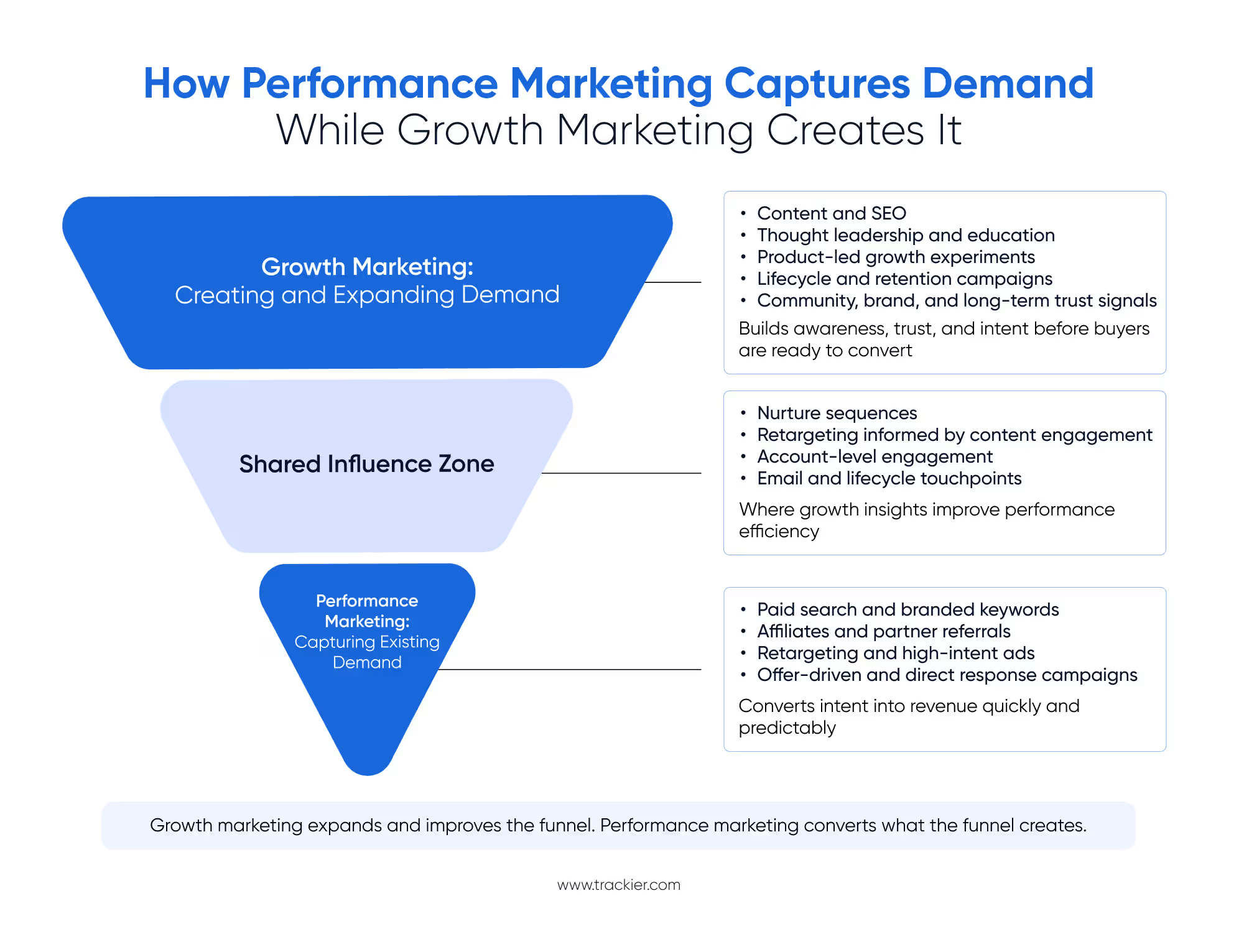
Performance marketing works best when intent already exists. Branded search, comparison traffic, retargeting, and partner referrals capture demand that is ready to convert.
Growth marketing becomes critical when buying journeys are long, non-linear, or involve multiple stakeholders. B2B SaaS and enterprise sales rely heavily on education, validation, and repeated exposure before conversion.
Account-based and content-led strategies show this clearly. Highly engaged accounts convert faster and move more smoothly through the funnel when growth marketing shapes early demand.
HubSpot’s 2025 marketing data also shows that organic and content-driven leads convert better over time. That is buyer behavior, not channel bias.
Rule 4: Use content and SEO to reduce long-term performance pressure
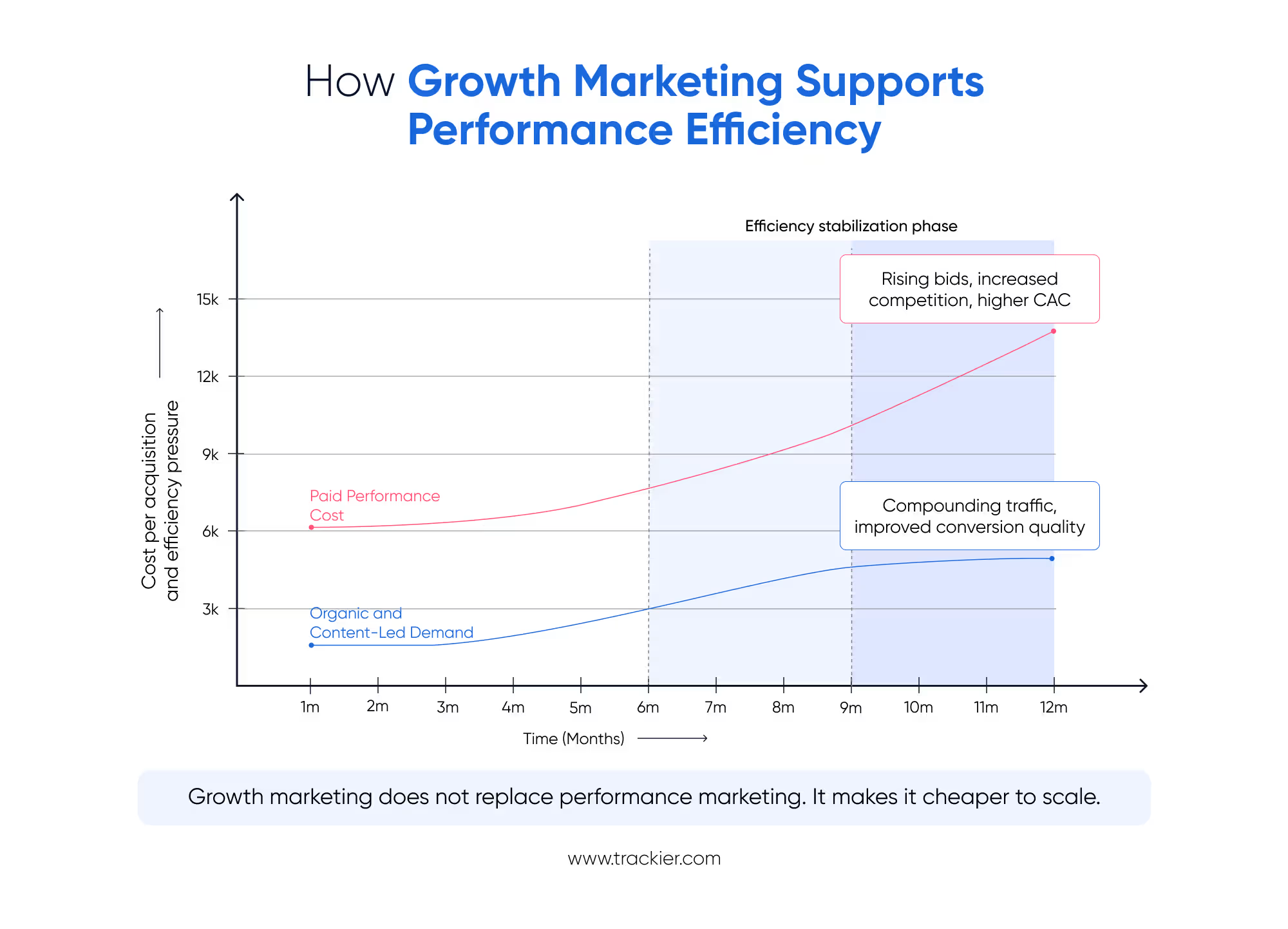
Performance marketing delivers results fast, but it rarely gets cheaper.
As competition increases, CAC rises and efficiency drops. Growth marketing helps offset that pressure by creating demand you do not have to pay for every time.
Content and SEO support performance marketing by improving conversion quality and lowering reliance on paid traffic. HubSpot’s 2025 data shows that companies publishing blogs generate more leads, and SEO leads close at much higher rates than outbound.
Search also compounds. Semrush shows that even small ranking improvements can drive significant traffic gains. Growth marketing quietly improves the economics behind performance marketing.
Rule 5: Check team maturity before committing fully
The final rule in growth marketing vs performance marketing is execution readiness.
Performance marketing requires operators who can manage channels, creatives, partners, and attribution daily. Growth marketing requires cross-functional collaboration across content, product, data, and lifecycle teams.
Research shows that aligned revenue teams outperform peers and launch new initiatives more effectively. That alignment supports both strategies.
Content Marketing Institute’s 2024 benchmarks show that teams tying content directly to revenue are increasing investment with clearer intent. That signals readiness for growth marketing, not just activity.
This rule often settles the growth marketing vs performance marketing debate quickly. Teams struggle not because they chose wrong, but because they chose faster than they could execute.
What To Do Next?
If there is one takeaway from this blog, it is this: ‘Growth marketing vs performance marketing is not a permanent decision. It is a sequencing and maturity decision.’
Successful businesses do not pick a side and stick to it blindly. They adjust based on revenue timelines, measurement trust, buyer behavior, content leverage, and team readiness.
Sometimes, performance marketing leads to fund growth. Sometimes, growth marketing fixes the inefficiencies that performance exposes.
Your next steps should be practical.
Start by auditing where your budget actually goes and how confident you are in the data behind it. Then map your buyer journey honestly. Not how you want people to buy, but how they really do. From there, decide which rules matter most right now.
If your goal is predictable revenue this quarter, tighten performance marketing and attribution.
If your goal is sustainable ARR, lower CAC, and long-term demand, invest deliberately in growth marketing systems that compound.
Most people eventually land on a blended model. The difference is whether that blend is intentional or accidental.
If you want to see how tracking, partner attribution, and lifecycle visibility support both approaches, exploring a unified performance marketing platform like Trackier is a logical next step.
Hungry for more? Download our free case studies that cover real stories.
Or sign up for Trackier’s newsletter to get weekly best practices on referral programs and partner marketing.
FAQs
1. How should attribution models differ when evaluating growth marketing vs performance marketing?
For performance marketing, you want fast, channel-level clarity so last click or last non-direct model helps with immediate spend decisions.
For growth marketing, you need multi-touch and cohort views that capture assisted conversions and lifetime value over months. Run both views side by side.
Use experiments and holdouts to validate causal impact. Track cohorts by acquisition source so you can compare CAC versus 90-day and 12-month LTV. That way, growth wins that look weak at last click show up properly.
2. Can a small startup prioritise growth marketing with a limited budget?
Yes, but you must be strategic.
If runway is short, use low cost growth tactics that compound, like product improvements that boost onboarding, or focused SEO on one high intent topic. Use paid performance to create early traction and amplify your organic experiments. Run one small growth experiment at a time and measure it with clear success metrics. You do both, but keep the split intentional. This is how small teams balance growth marketing vs performance marketing without blowing budget.
3. What financial guardrails should leadership set when approving a shift from performance to growth marketing?
Ask for clear hypotheses, timelines, and stop rules. Require a one-page experiment brief that states the goal, primary metric, minimum sample, and review date. Tie growth investments to runway and forecast scenarios so finance knows the worst case and upside. Approve phased budgets with a pilot first, then scale when early indicators meet agreed thresholds. In short, treat growth like a portfolio that must earn the right to scale, not an open-ended bet. This keeps the growth marketing vs performance marketing shift accountable.
4. Are growth marketing and performance marketing the same?
No, growth marketing and performance marketing are not the same, though they often work together. In the growth marketing vs performance marketing debate, performance marketing focuses on short-term, measurable outcomes like clicks, leads, and immediate revenue. Growth marketing covers the full customer lifecycle and aims for compounding impact through content, product experiments, retention, and lifecycle campaigns.
So you can think of it this way: performance captures demand now, growth creates demand that lowers future CAC. The smart move is to use both intentionally, based on revenue timelines and measurement maturity.