Performance marketing and brand marketing serve different but complementary purposes. Performance marketing focuses on measurable actions such as leads, sales, sign-ups or app installs and is typically optimized using metrics such as CPA, CAC, conversion rate and ROAS. Brand marketing focuses on building awareness, memory, preference and trust over a longer period, using metrics such as brand awareness, consideration, branded search, share of voice and brand lift.
The key difference is therefore not simply the channel being used, but the objective, time horizon and measurement approach.
Where do they fit in for the industries they serve? Well, most businesses need both: brand marketing helps create future demand, while performance marketing helps capture and convert existing demand. The right balance depends on the brand’s maturity, category, growth goals, buying cycle and economics.
All brands across industries have a variety of short and long-term material goals which need to be achieved so that they can be commercially successful. Think of performance marketing vs brand marketing as the push and pull therein, to determine where budget, effort, hiring and other decisions should be made quarter-on-quarter within the same marketing department.
Research into marketing effectiveness has repeatedly found value in balancing long-term brand building with short-term activation. Binet and Field’s widely cited research identified approximately 60:40 as an average starting point in favor of brand building, although later work stresses that the appropriate mix varies by category, business maturity, price, objectives and market conditions.
What is Performance Marketing?
Performance marketing is a results-oriented approach in which campaigns are planned, measured and optimized around predefined business outcomes such as clicks, leads, app installs, purchases or revenue.
The associated affiliate marketing payment models can include CPC, CPL, CPA, CPM or revenue-sharing arrangements. What truly defines performance marketing (and separates it from brand marketing) is its emphasis on measurable outcomes and continuous optimization.
PPC (Pay per click) is a common performance marketing channel because advertisers can connect keyword or audience intent with measurable outcomes such as clicks, leads and purchases. Some of the ways in which it manifests are:
- Paid social feed ads
- Sponsored content
- Video ads
- Lead-generation ads
- Retargeting campaigns
- Creator partnership ads
However, performance marketing is in no way just limited to PPC-style marketing. Affiliate marketing, influencer marketing and various other channels or formats can be leveraged to achieve performance-driven outcomes.
When Should you Prioritize Performance Marketing?
Performance marketing deserves greater emphasis when the immediate priority is one of the following:
- generating measurable demand,
- validating acquisition economics,
- increasing conversions, or,
- scaling proven offers.
It can be especially useful when a business has clear conversion events, reliable attribution and enough existing demand to capture.
However, this does not mean startups should postpone brand building. IPA analysis of more than 2,000 advertising cases found that start-ups and scale-ups producing strong brand effects generated 58% higher sales value and 55% more profit than activation-focused peers. The practical question is therefore usually how much emphasis to place on each, rather than whether to use only one.
What is Brand Marketing?
Brand marketing is the process of building a recognisable and trusted brand over time rather than focusing only on immediate conversions. It shapes how people perceive a business through consistent messaging, creative, experiences and interactions across the customer journey.
The goal is to increase familiarity and strengthen factors such as:
- brand awareness,
- recall,
- consideration, and,
- preference.
Instead of asking someone to buy immediately, brand marketing can create familiarity and positive associations that influence future purchase decisions.
Common brand marketing activities include advertising campaigns, video content, sponsorships, public relations, social media storytelling and other initiatives designed to build a lasting connection with an audience. Success can be assessed through measures such as aided and unaided awareness, brand recall, consideration, share of voice, branded search activity and brand lift.
This does not mean brand marketing cannot contribute to revenue. Stronger brand awareness can influence how customers discover, evaluate and choose a business, while sustained brand investment can support demand beyond the period of an individual campaign.
For this reason, brand marketing vs performance marketing is not necessarily an either-or decision. Brand marketing tends to focus on creating and strengthening future demand, while performance marketing is generally designed to capture measurable actions and outcomes. Businesses can use both approaches to address different stages of the customer journey.
Performance Marketing vs Brand Marketing: The Key Differences
| Factor | Performance marketing | Brand marketing |
| Primary objective | Generate measurable actions and revenue outcomes | Build awareness, memory, preference and brand equity |
| Demand role | Primarily captures and converts existing demand | Primarily creates and strengthens future demand |
| Typical time horizon | Shorter feedback and optimization cycles | Longer-term effects that compound over time |
| Primary KPIs | CPA, CAC, conversion rate, revenue, ROAS, ROI | Awareness, consideration, recall, branded search, share of voice, brand lift |
| Measurement | Attribution, conversion tracking, experiments, incrementality | Brand tracking, surveys, search trends, MMM, incrementality |
| Optimization | Frequent campaign-level optimization | Longer measurement windows and strategic optimization |
| Audience | Often weighted toward higher-intent audiences | Often broader category or future buyers |
| Creative role | Encourage a specific measurable action | Build distinctive memory structures and associations |
| Channels | Search, paid social, affiliates, creators, display, email and others | Video, social, creators, content, sponsorships, OOH and others |
| Biggest strength | Accountability and rapid feedback | Sustained demand, differentiation and future preference |
| Main limitation | Can overvalue short-term attributable demand | Impact is harder to attribute directly in short windows |
| Best approach | Use alongside brand building | Use alongside performance activation |
You may notice a clear overlap in the row featuring the differences based on ‘channels’. This is a deliberate overlap to indicate that no particular channel is inherently a ‘performance’ or a ‘brand’ channel.
A creator campaign can generate awareness or use an affiliate code to generate measurable conversions. Video can build memory or be optimized for leads. All channels can be made to work for whatever end goal is desired. The channels themselves don’t have a predisposition or alignment with any particular kind of execution.
Can the Same Channel Be Both Brand and Performance?
The distinction between brand and performance marketing is not determined by the channel itself. The same platform can serve different purposes depending on the campaign objective, targeting, messaging and metrics used to evaluate success.
Take YouTube as an example. A company can use video campaigns to introduce its brand to new audiences and build awareness. It can also run campaigns focused on generating website visits, leads or purchases. Google Ads supports campaign objectives ranging from awareness and consideration to conversions.
Paid search works in a similar way. A business might run campaigns around broad category terms to increase visibility while targeting high-intent searches to generate leads or sales. Social media can also combine brand storytelling with campaigns designed specifically to drive measurable actions.
What changes is how success is measured. Brand-focused campaigns may look at reach, awareness, recall, consideration or brand lift. Performance campaigns are more likely to focus on metrics such as conversion rate, CPA, revenue and ROAS. Google also recommends evaluating video campaigns across different stages of the customer journey rather than relying on a single outcome.
So, when comparing performance marketing vs brand marketing, think beyond the channel. The more useful question is what the campaign is trying to achieve and whether the measurement framework matches that objective.
When Should You Prioritize Performance Marketing vs Brand Marketing?
| Business Situation | Increase Brand Emphasis | Increase Performance Emphasis |
| Low awareness in category | ✓ | |
| Launching into a new category | ✓ | |
| Long sales cycle | ✓ | |
| Need future demand | ✓ | |
| Strong awareness but weak conversion | ✓ | |
| Proven offer ready to scale | ✓ | |
| Short-term revenue target | ✓ | |
| High-intent demand already exists | ✓ | |
| CAC rising despite campaign optimization | ✓ | ✓ |
| Mature business seeking sustainable growth | ✓ | ✓ |
In practice, the allocation should change over time based on market maturity, audience awareness, available demand, margins, growth targets and measured incremental returns.
How to Measure Performance Marketing vs Brand Marketing?
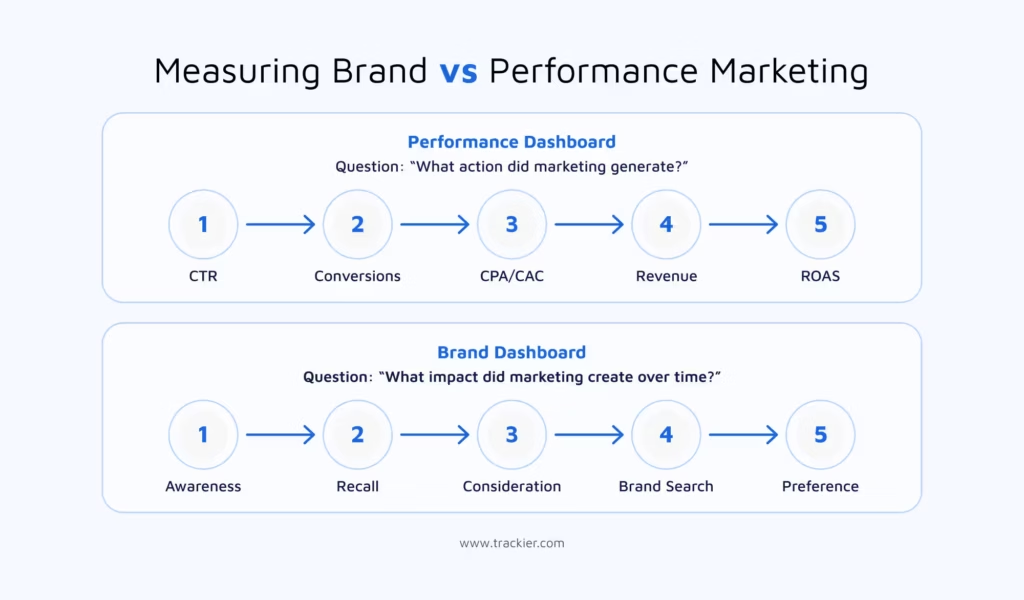
One of the biggest gaps in performance marketing vs brand marketing is measurement. Brand metrics such as recall, customer sentiment, market reach and share can be useful, but on their own they are too broad to show how marketing contributes to business growth. A stronger framework measures both brand and performance outcomes and connects them.
Performance Marketing Metrics
Performance marketing can be measured through metrics that directly reflect efficiency, acquisition and revenue, including:
- Conversion rate
- Cost per acquisition (CPA)
- Cost per lead (CPL)
- Customer acquisition cost (CAC)
- Revenue
- Return on ad spend (ROAS)
- ROI
- LTV:CAC
- Incremental conversions
Brand Marketing Metrics
Brand marketing needs a broader set of indicators that capture changes in how customers perceive and interact with a brand over time:
- Aided and unaided awareness
- Brand recall
- Consideration
- Brand preference
- Share of voice
- Share of search
- Branded search volume
- Direct traffic
- Brand lift
- Pricing power
- Incremental sales over longer periods
How to Measure Brand and Performance Marketing Together?
The goal is not to choose between brand and performance metrics or to put performance marketing vs brand marketing against each other, but to connect them. Multi-touch attribution can show how different touchpoints contribute to conversions while marketing mix modeling can help assess channel impact over longer periods. Conversion lift testing, incrementality tests and brand lift studies can provide evidence of what marketing actually caused. Customer surveys and CRM or revenue analysis can then connect changes in brand perception with commercial outcomes.
This happens through a concept known as ‘performance branding’.
Performance branding applies stronger measurement discipline to brand-building campaigns while applying longer-term brand thinking to performance activity. It does not eliminate the distinction between brand and performance. Instead, it connects them through shared commercial objectives and measurement.
How Do Brand and Performance Marketing Work Together?
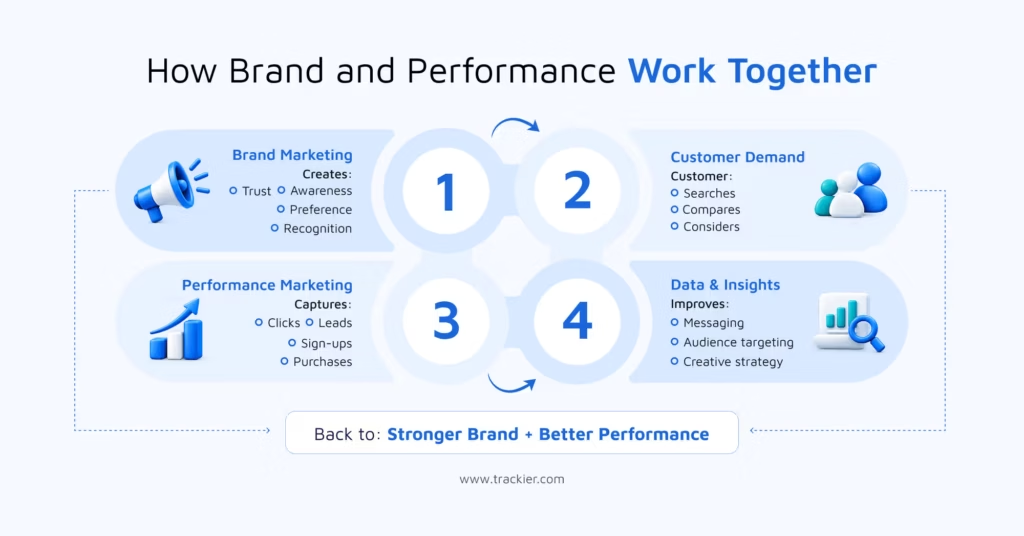
Brand marketing and performance marketing influence different stages of the same growth system. Brand activity increases awareness, familiarity and consideration among current and future buyers.
When those buyers eventually enter the market, performance campaigns can capture that demand through search, social advertising, affiliates, retargeting or other measurable channels.
Performance data then feeds back into brand strategy by showing which audiences, messages and offers produce meaningful actions. The result is a cycle rather than a funnel split:
- brand creates and strengthens demand,
- performance captures and converts it, and,
- measurement improves both.
How Much Budget Should Go to Performance Marketing vs Brand Marketing?
There is no fixed percentage that every business should allocate to performance marketing vs brand marketing. The right balance depends on factors such as business stage, category, existing brand awareness, sales cycle and growth objectives.
A practical way to approach the split is:
- Prioritise brand investment: when the business needs to build awareness, reach new audiences or create future demand.
- Adjust for your situation: A newer business with limited awareness may need a different balance from an established brand with strong existing demand.
- Increase performance investment: when there is established demand and the priority is generating measurable leads, sales or revenue.
- Measure both time horizons: Evaluate performance campaigns through metrics such as CPA, conversions and revenue while tracking brand investment through awareness, consideration, recall and brand lift. This helps prevent short-term performance from dominating the entire budget decision.
- Use both when possible: Brand activity can create demand while performance campaigns help capture it.
The IPA’s effectiveness research has found that a roughly 60:40 balance between brand building and activation can be effective across its dataset (as discussed in the opening section of this article). However, this should be treated as a benchmark rather than a universal formula.
Conclusion
Performance marketing and brand marketing solve different growth problems. Performance activity makes demand measurable and actionable through metrics such as conversions, CAC and ROAS, while brand marketing builds the awareness, memory and preference that influence future demand.
The strongest marketing strategies connect the two rather than optimize them separately. Marketers must think beyond performance marketing vs brand marketing in 2027. Measure immediate outcomes without allowing short-term attribution to become the only definition of marketing effectiveness, and evaluate brand investment over an appropriate time horizon. The right allocation should change as the business, market and customer journey change.
FAQs
What is the main difference between performance marketing and brand marketing?
Brand marketing focuses on building awareness, recognition, trust and long-term preference. Performance marketing focuses on measurable actions such as clicks, leads, conversions and sales. Brand activity typically builds future demand while performance activity captures existing demand.
When considering performance marketing vs brand marketing, which is better?
Neither is inherently better. Performance marketing is designed to drive and measure immediate actions while brand marketing strengthens awareness and future demand. The right approach depends on business goals, growth stage, audience, product category and the timeframe used to evaluate results.
Can the same marketing channel be used for brand and performance?
Yes. Channels such as social media, search, video and display advertising can support both objectives. The difference lies in campaign strategy, creative, targeting, calls to action and measurement. One channel can therefore contribute to both brand building and conversions.
How do brand marketing and performance marketing work together?
Brand marketing can increase awareness, trust and consideration while performance marketing converts that existing interest into measurable actions. Combining both creates a connected customer journey, where brand activity helps generate demand and performance campaigns capture, nurture and convert it.
How should marketing budget be split between brand and performance?
There is no universal split that works for every business. Budget allocation between performance marketing vs brand marketing should reflect growth objectives, customer journey, category, existing brand strength and available data. Test different allocations, measure both short-term outcomes and longer-term effects then adjust spending accordingly.