In 2026, customers rarely discover a business, evaluate its offering and convert in one uninterrupted session. They might click an advertisement on Instagram, visit a website, read a review on Google all in the same day — then leave, and return days later through an email or a referral code. And this is no longer the outlier, it is the most common manner of engagement.
Understanding this process is essential to improving the customer lifecycle journey.
Rather than treating every touchpoint as a separate interaction, businesses can map how customers move between them, identify friction and make informed decisions about where to improve the experience.
As per Salesforce’s customer journey resource, 61% of high-performing marketing teams surveyed were actively mapping customer journeys. The same resource reports that more than two-thirds of marketers who had implemented customer journeys agreed that the strategy had positively affected their business.
These findings indicate the value marketers place on understanding customer interactions irrespective of where they come from. But it must be noted that just knowing where they came from and where they went at an attribution level isn’t enough to improve performance.
So, how can you map your customer lifecycle journey and then turn the findings into measurable improvements? Let’s break it down.
What is a Customer Lifecycle Journey?
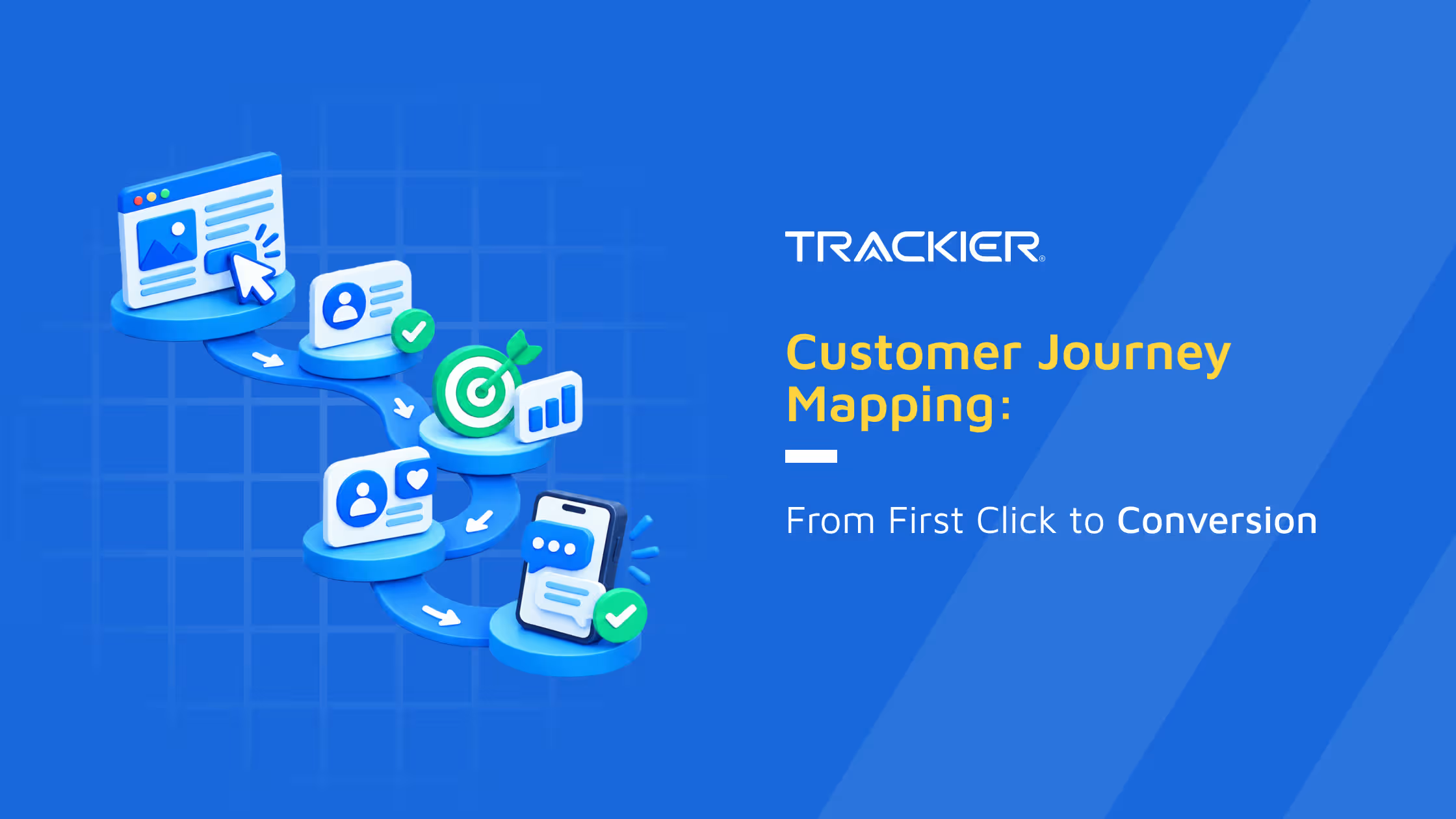
A customer lifecycle journey is the complete sequence of interactions a person has with a business, right from discovering its offering, to becoming a first time customer and then potentially returning or recommending it to others.
Customer journey mapping documents all these interactions, including the multiple marketing channels involved, the customer’s goals, potential obstacles and the actions they take at each stage to reach the final step, whatever that may be.
For example, a customer might discover a product through a paid advertisement, compare it with alternatives on the website, sign up for a trial and eventually make a purchase. Mapping this journey helps a business know which interactions support goals — marketing, revenue or any other ones — and which ones may prevent them.
It is important to distinguish the customer lifecycle from the customer journey. The lifecycle describes broad stages of the relationship, while the journey captures the specific experiences and touchpoints within and between those stages.
The goal is not to force customers through a predefined sequence. It is to understand the paths they already take or are likely to take, and make those paths easier to navigate.
How to Map the Customer Lifecycle Journey
1. Define the Customer Journey You Want to Improve
Start with a specific business objective rather than attempting to map every possible customer interaction at once.
For example, you might want to understand why visitors leave a product landing page without converting, why trial users fail to activate or why customers do not return after their first purchase.
Define the target audience or ICP framework, the desired outcome and the journey’s potential starting and ending points. A journey focused on trial-to-paid conversion will require different data from one focused on repeat purchases.
Starting with a manageable journey and expanding across other customer interactions as you learn is probably the best approach for this. Moving with this approach makes the process less overwhelming, spreads out implementation, giving marketing teams a clearly defined problem to solve.
2. Identify Customer Touchpoints Across Channels
Create a list of the interactions customers may have with your business before, during and after conversion. These can include the following flows (amongst many others):
- Paid advertisements, organic search results and social media posts
- Landing pages, product pages and comparison pages
- Emails, messaging campaigns and retargeting advertisements
- Sales calls, product demonstrations and trial experiences
- Checkout, onboarding, customer support and renewal communications
For each touchpoint, document what the customer is trying to accomplish, what information they need and what action they can take next. That will help you mold and predict the journey better.
Consider a prospect who clicks on one of the sets in your advertisement inventory promising a specific product benefit that fits their use case. If the landing page focuses on unrelated features or doesn’t get to the point fast enough, the experience becomes disconnected before the prospect has even evaluated the offering.
This is why mapping should cover the relationship between touchpoints, not simply list the channels a business uses.
It cannot be stated enough that touchpoints are not isolated experiences. A touchpoint can perform well in isolation while still contributing to a poor overall experience. High engagement on an advertisement, for example, does not always imply that the landing page successfully meets the visitor’s expectations.
3. Collect Data to Understand Actual Customer Behaviour
Once the touchpoints are identified, use analytics and customer feedback to understand how people move between them.
Useful data sources include website performance analytics, CRM records, conversion funnel reports, campaign performance data, customer support conversations, surveys and sales feedback.
Google Analytics, for instance, offers a Path exploration report, which visualizes the pages users visit and the events they trigger. It can help teams identify common navigation paths, repeated actions and journeys that appear to stall. Its backward-path analysis also lets you start with an important event, such as a purchase, and investigate the actions that preceded it.
Use these insights alongside customer feedback. Analytics can show where users abandon a process, but it may not explain why. Taking the assistance of mediums like interviews, support tickets and usability testing can provide context which such breadcrumbs of behavioural data alone cannot.
Ensure that you avoid assuming that the most common path represents every customer’s experience. It is essential to compare journeys across relevant cohorts, such as new and returning visitors, paid and organic traffic or mobile and desktop users. If you’re comparing likes to unlikes, your conclusions are likely to be faulty.
4. Find Friction and Prioritize Conversion Gaps
With the journey mapped, look for points where customers hesitate, abandon a process or repeatedly return to an earlier step.
Common friction points include unclear pricing, slow-loading pages, confusing navigation, lengthy forms, inconsistent messaging and missing product information. Of course, this isn’t an exhaustive list of what could be wrong.
For each issue, you must ask three vital questions:
- What behaviour suggests a problem exists?
- What evidence could explain the problem?
- What change could remove the obstacle?
For example, if many visitors view a product page but few proceed to checkout, investigate pricing clarity, product information, shipping costs and checkout usability before assuming the advertisement is attracting the wrong audience. Suppose someone comes through a social media newsletter and doesn’t convert, you could chalk it up to informational intent, rather than working on a fix.
Prioritize issues according to their likely business or revenue impact, the strength of the evidence supporting and the effort required to address them. This will help you quickly act on minor issues affecting a high-volume, high-value stage that may deserve more attention than a larger issue affecting very few users.
5. Make Improvements and Measure the Results
Use your findings to make targeted changes to the customer experience and implement outcome based marketing. Depending on the issue, this could mean aligning landing-page copy with advertisements, simplifying a form, adding product comparisons, improving onboarding emails or making the next step more visible.
Establish a baseline before implementing the change. Then compare the relevant outcome against that baseline, accounting for factors such as traffic mix, seasonality and other concurrent changes where possible.
For example, if a business simplifies its sign-up form, it should measure the sign-up completion rate or the click-through rate, and check whether the additional signups progress to activation or purchase. A higher form completion rate is useful, but it does not necessarily mean the business has gained more valuable customers.
Treat customer journey mapping as an ongoing process. Marketing teams must revisit the map as customer behaviour, products, channels and business priorities change or if anomalies are detected.
Gartner’s research on leading customer service journey mapping efforts highlights a related challenge: journey mapping can fail to drive meaningful improvements when it lacks leadership involvement, sufficient perspectives or integration with ongoing journey management.
The takeaway is straightforward: a journey map is useful only when it informs decisions and leads to measurable action.
Key Metrics to Track Across the Customer Journey
The metrics you monitor should reflect the outcome you want to improve, rather than the volume of data available.
| Journey stage | Metrics to monitor | What they reveal |
| Discovery | Qualified traffic, click-through rate | Whether the right audience is engaging |
| Consideration | Product-page engagement, demo requests | Whether visitors are progressing towards a decision |
| Conversion | Conversion rate, checkout or form abandonment | Where customers fail to complete the desired action |
| Onboarding | Activation rate, time-to-first value | Whether new customers reach a meaningful outcome |
| Retention | Repeat purchase rate, churn rate, renewal rate | Whether customers continue the relationship |
| Advocacy | Referral rate, reviews, recommendations | Whether customers actively promote the business |
Choose a small set of primary metrics for each journey. Supporting metrics can help explain changes, but tracking too many numbers can make it harder to identify the underlying problem.
For businesses operating across multiple marketing channels, attribution adds another layer of analysis. It helps teams investigate which channels and interactions contribute to conversions.
Consider the instance of simply using a first-touch or last-touch attribution model. By itself, this very implementation completely changes the data collection requirements and the ultimate analysis formulation.
However, attribution models are not a complete record of customer intent, and their results depend on tracking coverage and model assumptions.
Common Customer Journey Mapping Mistakes to Avoid
Even a detailed customer lifecycle journey map can be ineffective if teams make a few common mistakes.
- Assuming every customer follows the same path: Customers enter through different channels, compare different options and progress at different speeds. Segment journeys where meaningful differences exist.
- Relying only on marketing analytics: Quantitative data shows patterns, while customer conversations and feedback help explain them. Use both.
- Optimizing individual touchpoints in isolation: Improving clicks or form completions is not enough if customers fail to activate, purchase or return.
- Ignoring post-conversion interactions: Onboarding, support and repeated experiences influence whether an initial conversion becomes a lasting relationship. The journey should never end at the first conversion or the bottom of the customer acquisition funnel.
- Treating the map as a one-time project: Customer behaviour changes. Review the map regularly and update it when new evidence emerges. Create maps for each segment to ensure behaviours are not being misunderstood or misread.
The common thread is that customer lifecycle journey mapping should help teams understand the complete experience in order to keep improving it.
Conclusion
Mapping the customer lifecycle journey helps businesses understand how customers discover, evaluate and interact with their offerings across channels. By combining behavioural data, customer feedback and conversion metrics, teams can identify friction, prioritize improvements and measure whether those changes work.
Start with one important or the most common customer journey, establish a clear baseline and investigate the points where progress slows down. Then test targeted improvements and expand the process as you learn to apply to more cohorts.
The objective should be to build a clearer understanding of customer behaviour and use it to make better marketing and customer experience decisions.
Frequently Asked Questions
What is a customer lifecycle journey?
A customer lifecycle journey is the series of interactions a customer has with a business, from initial discovery through consideration, conversion, onboarding, retention and potentially advocacy.
What are the steps involved in customer journey mapping?
The process involves defining a business goal, identifying customer touchpoints, collecting behavioural and feedback data, mapping the actual journey, finding friction points, prioritizing improvements and measuring their impact.
How do you measure the success of customer journey mapping?
Measure changes in the outcomes relevant to the mapped journey, such as conversion rate, form abandonment, activation, retention or repeat purchases. Compare results with a baseline and account for other factors that may influence performance.
How often should businesses update their customer journey maps?
Review journey maps regularly and whenever significant changes occur in customer behaviour, product experiences, marketing channels or business priorities. Update them when new evidence reveals a different customer path or an emerging point of friction.