
When two organizations market their products, services or other collaterals under a common, double-branding regime, the activity in-progress is known as co-marketing. This activity need not be focused on selling per se, and may serve any of the stages within the customer acquisition funnel. On the whole, the collaboration serves to increase lead generation, share of voice, reach, sale or any other aligned goal.
But why would a brand — much less 2 brands — come together to make a common pitch? Considering both are varied entities, with different goals and different marketing philosophies.
That is probably what you’re thinking. Why does this concept exist and what does it even do? Continue reading to find out.
What is Co-marketing?
Co-marketing is a strategy in which two or more complementary businesses jointly promote a piece of content, campaign, event, offer, initiative or other resources to their respective audiences.
In simple terms, both brands contribute to an initiative which doubles up the audience, offering benefits to both while limiting the effort required to otherwise leverage such audience sizes.
You get a receptive, aligned group of people with purchasing capacity for your ecommerce brand, SaaS product or Fintech offering, without having to run acquisition motions yourself.
No matter which industry you’re building a brand in, the most leveraged channels are paid, earned and owned. But there’s a new format in town, which serves up a ready-made audience of paid customers to you.
Establishing a clear co-marketing strategy is becoming increasingly essential as discovery gets fragmented across AI-search, influencers, creators, communities and traditional channels. Partner marketing becomes a plank that offers a clear way out of modern attribution quandaries, lack of first-party data and the limitations surfacing due to fragmentation.
How Does Co-marketing Work?
Executing a co-marketing campaign has 5 easy steps. All you need to do is:
1. Locate a Willing, Complementary Partner
Co-marketing is essentially building a partnership. You can’t do that with someone who doesn’t share a common viewpoint, business goal or industry. Even if the industry isn’t the same, it should be complementary in some terms, so the audience doesn’t get confused by the collaboration.
2. Devise a Shared Objective to Achieve
Any co-marketing campaign execution requires for all businesses involved to have a shared objective. You cannot run any kind of partnership while looking to achieve different goals simultaneously.
3. Plan and Prepare a Joint Campaign
All the involved parties must work together to build a campaign that syncs their individual personalities in such a manner that their existing audience responds positively to the message, and act on the call-to-action.
For this, the brand marketing teams of all participating brands must come together to plan, pitch and prepare for the campaign, as per the devised objective. By moving forward through mutual consent, the process of creating and marketing the campaign can happen smoothly, and enable good results.
4. Work on Effective Distribution Strategies
Just planning the webinar, e-book, or any other initiative isn’t enough. There must be a concerted effort put in to make any co-marketing plan a success.
But how does this happen? All the businesses conducting the initiative together must sync up their distribution channels, and optimize all campaigns being run for it on a regular basis. Depending on the nature of the campaign being run (i.e. time-sensitive such as a limited-time offer, or long-term such as a co-branded product available in-store), the marketing levers involved need to be monitored and shifted to ensure the planned objective(s) are achieved.
5. Measure the Results of Your Co-marketing Campaign
As with any other kind of marketing activity, measurement is what ultimately decides whether the endeavor was worthwhile. When a co-marketing strategy or plan has run its course, it is crucial to evaluate whether:
- All the set objectives for involved brands are met or unmet (and to what extent in number-terms),
- Whether all the brand marketing KPIs set at launch are achieved,
- Whether the revenue targets are achieved, and,
- Whether there is any improvement in collective (or singular) share of voice, brand recall, etc.
Each step here adds value to the overall co-marketing initiative and enables such collaborative efforts to transcend the confines of familiar marketing practices that you and everyone else in your industry is already practicing.
Co-marketing vs Co-branding vs Partner Marketing: Are They The Same?
The difference between co-marketing and co-branding is primarily the difference in level of collaboration. Co-marketing brings two distinct organizations together to create and promote a shared campaign, content asset or event, all while each organization keeps its own distinct product and brand identity.
In simple terms, the audience and resources get combined in an effort to get a shared outcome out of the promotion.
Co-branding takes collaboration one step further. The brand gets attached to a shared product or offering. Take the instance of the Apple Watch Nike+, which brought together Apple’s advanced watch-related technology with the brand value of Nike and access to its specific running-based community.
Co-marketing and partner marketing differ on aspects of scope. This distinction answers the question of “who” and “how” this marketing initiative should be carried out by. While co-marketing is a specific activity where two or more brands come together (usually for a single instance), partner marketing covers what can be called the routes to the market — working with partners or affiliates to reach the customers.
Networks of this nature can facilitate better sales to a collective audience.
| Factor | Co-marketing | Co-branding | Partner Marketing |
| Purpose | Joint promotion | Joint product or brand creation | Broader partner-led growth |
| Output | Campaign, content or event | New combined offering | Campaigns, referrals, affiliates, resellers and more |
| Relationship | Often campaign-based | Usually deeper product collaboration | Umbrella category |
| Measurement | Reach, leads, pipeline, revenue | Adoption, sales, brand impact | Depends on partner model (CPA, CPS, etc) |
How do these various forms of marketing actually appear? That’s an important area to understand to experiment and executive the same for your organization.
Within SaaS, a payment provider and a CRM platform may come together to conduct a webinar. Both have aligned audiences and can offer value together, in terms of insights, promotions, outcomes and more. This is an example of co-marketing.
When you’re co-branding, the two platforms may come together to offer a custom integration which includes both products. The integration itself is a new product that will be sold as a unique offering, equally beneficial for both parties, but a whole new thing that stands on its own.
If you use resellers, affiliates and more to promote the webinar or the integration, the instance falls under partner marketing.
How is Co-marketing Carried Out?
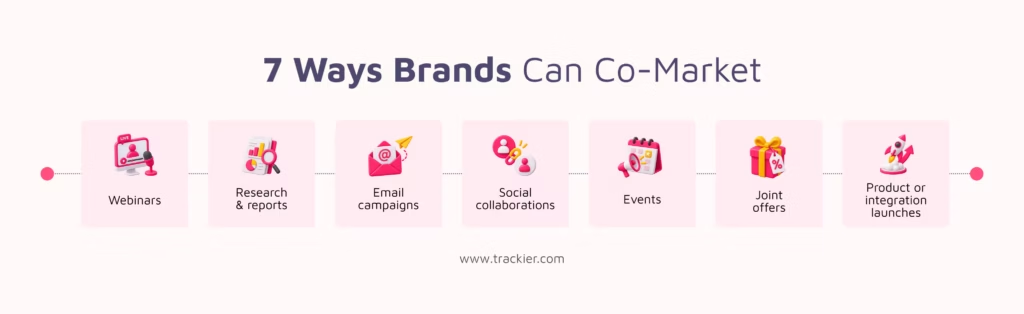
Any co-marketing strategies used work best when these initiatives are built on partners contributing something valuable, whether that is expertise, audience reach, distribution or product capability. Common formats include:
- Co-created research, reports or ebooks
- Co-hosted webinars and virtual events
- Joint email campaigns
- Social-media collaborations
- Conferences, roundtables and offline events
- Bundles, promotions and joint offers
- Integration or product-launch campaigns
What are the Benefits of Co-marketing as an Approach?
For any approach to be relevant as a marketing platform, it is vital to understand how it can drive relevant outcomes for your niche and industry. Let’s understand why brands use co-marketing as a strategy.
Reach New, Relevant Audiences
There are two kinds of reach: the increasing kind, and the relevant kind. Co-marketing enables you to combine the two on an immediate basis to accrue tangible, measurable outcomes. The initiative(s) you take matters just as much as who you take it with — ultimately determining your success in leveraging the audiences of your partners.
Share Campaign Resources and Costs
One of the best thing about co-marketing is that it optimizes marketing budgets across the board for all those involved in the activity. Everything that is needed: content production, events, distribution, creatives and even expertise, is split across parties. The time needed for execution and the effort involved can be essentially cut in half to still get the expected results.
Borrow Credibility from Trusted Sources
Co-marketing is leverage. Who your partners are matters greatly for both you, and those marketing with you. The co-marketing activity shows trust, reliance, alignment and similar values as existing between the two or more brands involved — in addition to a kind of parity. Such borrowed credibility adds more value to each brand individually, and is a source of great assistance for buyers making high-consideration or long-term purchases such as in B2B ecommerce.
Create Stronger Content and Experiences
What you lack can be offered by a partner, which makes any value additive emerging from such a collaboration hold exceptional value. Better content and more incredible experiences can be offered through a sharing of both expertise and execution.
Generate Leads and Pipeline
Of course, you can collect vanity metrics through any marketing campaign. But co-marketing can lead to better revenue-based goal achievement since the audience is primed, in the same marketing, already customers for a parallel product and likely to be interested in the short to long run. All together, these factors lead to better lead generation and conversion rates.
What Does a Co-marketing Campaign Look Like? 4 Good Examples of Co-marketing
Co-marketing in any given time is not simply about putting two logos on a campaign. Successful co-marketing combines complementary audiences, clear value exchange, shared execution and measurable business outcomes.
GoPro × Red Bull: Beyond the Ordinary
In 2021, GoPro and Red Bull extended their global partnership around content and experiential marketing. The goal was to combine GoPro’s camera technology with Red Bull’s global sports and entertainment platform, giving both brands access to highly engaged audiences and a steady stream of distinctive content.
The partnership shows how co-marketing can work when each brand contributes a different asset rather than simply placing two logos on one campaign.
Domino’s × Netflix: Stranger Things, The “Mind Ordering” App
In 2022, Domino’s partnered with Netflix around Stranger Things to launch a “mind-ordering” experience inspired by Eleven’s telekinetic powers. Customers could use facial and eye-tracking technology to order pizza through gestures.
The campaign aimed to turn a streaming partnership into an interactive brand experience while connecting Domino’s with the show’s large fan community. It generated more than 820 million media impressions.
Dolby × LG, Sony, Samsung, Realme and Xiaomi: “Main Suna Aur Dekha Kya?”
Dolby India launched this multi-brand campaign in 2023 with device partners including LG, Sony, Samsung, Realme and Xiaomi. The objective was to demonstrate how Dolby technology could improve entertainment experiences across TVs and other devices. Rather than promoting Dolby technology in isolation, the campaign used partner products to demonstrate practical applications across movies, music, gaming, sports and TV.
Netflix × boAt: Stream Edition
Netflix and Indian consumer electronics brand boAt launched a co-marketing campaign around a new range of audio products in late 2022 and early 2023. The campaign combined product launch content, digital advertising, social media, influencers and offline activations. Its goal was to build awareness for the new products while strengthening Netflix’s local relevance through a partnership with a popular Indian brand.
The campaign achieved 350 million+ reach in its first 10 days, while one product sold out in less than a week.
How to Measure the Results of a Co-marketing Campaign?
To correctly measure the success of any co-marketing plan, there needs to be proper attribution planned across all marketing channels and collaterals shared by all the brands. Considering that multiple teams will be involved in the actual execution, there needs to be clear agreement and alignment on the terms of tracking, before the campaign is even ideated. Otherwise, the attribution will be broken, and measurement will be entirely probabilistic in nature.
Here’s what you need to define to measure results precisely:
- UTMs
- Partner-specific tracking links
- Coupon or promo codes, where applicable
- Conversion events
- Source or partner IDs naming conventions
- CRM campaign fields
- Lead-sharing rules
- Attribution window
All of this together will help every brand involved map their effort directly to the revenue outcomes achieved from the very top to the bottom of the marketing funnel.
But, what should you be measuring? A co-marketing campaign should be measured against the business outcome agreed upon by both partners, not simply the amount of activity generated. Start by defining a small set of shared KPIs before launch, then use consistent tracking across both companies.
All co-marketing activities should be measured for 3 clear outcomes:
- Awareness, which includes reach, impressions, engagement and content consumption.
- Demand generation, which includes registrations, leads, MQLs, conversion rate and new audience contribution.
- Commercial outcomes, which include opportunities, pipeline, revenue, ROI, return on ad spend, customer quality and partner contributions.
If we look at the co-marketing strategy broadly, the following end goals can be mapped from start to finish to determine whether it was a success or not:
- Awareness Building: Measure impressions, reach, website sessions, video views and social engagement when the campaign is designed to increase visibility. Essentially, it’s important to measure whether running this co-marketing plan has led to any change in share of voice or brand recall on an immediate basis.
- Lead generation: Track registrations, downloads, demo requests and new contacts. Compare lead quality as well as volume to determine whether the campaign reached the intended audience. Leads with higher conversion rates down the line signal effectiveness of the stated initiative.
- Pipeline: Monitor qualified opportunities, pipeline value and conversion rates. These metrics show whether campaign engagement is progressing into potential business.
- Revenue: Where possible, connect campaign interactions with closed deals and attributed revenue. Modern attribution reporting can measure contacts, deals and revenue associated with a campaign.
- ROI or Return on Investment: Compare attributable revenue or pipeline against the total campaign investment, including media, production, event and partner costs.
- Partner contribution: Review which partner generated traffic, leads and opportunities. This helps both teams identify the channels and tactics worth repeating.
Of course, revenue goals will gain precedence over vanity metrics like impressions alone.
As co-marketing expands from occasional collaborations into structured partner programs, centralized tracking becomes increasingly important for understanding which partners, campaigns and conversion paths are contributing value.
How to Find a Good Partner to Conduct Co-marketing?
Locating the right partner to run a co-marketing campaign starts with audience fit, rather than audience size. Research on the setting up of effective marketing alliances for the purpose of co-marketing suggests that customer and product complementarity as an important basis for partner selection. Initially, there needs to be a strategic fitment, i.e. organizations should have common goals, followed by a match in their cultures to some extent for proper implementation, and finally, a “chemistry” between the management to prolong such alliances.
Start by defining your ideal customer, campaign objective and the expertise you want the partner to contribute. Then look for businesses that reach a similar audience without offering an identical product. A complementary partner can introduce your brand to relevant customers while adding expertise or resources your team lacks.
Before initiating the co-marketing partnership, evaluate:
- Audience overlap,
- Brand reputation,
- Marketing capabilities, and,
- Previous partnership experience.
Check the quality and frequency of the potential co-marketers’ email, social media and other channel content. This will help you understand whether they can match what the campaign needs to meet the goals you have in mind, as well as, keep up with your internal marketing standards.
At the time of proposing such a collaboration, check whether both teams have comparable expectations around lead generation, promotion and campaign investment.
Most importantly, establish mutual value. A strong partner should benefit from reaching your audience just as you benefit from reaching theirs. Agree on the campaign goal, responsibilities, promotion commitments, lead-sharing process and success metrics before launch.
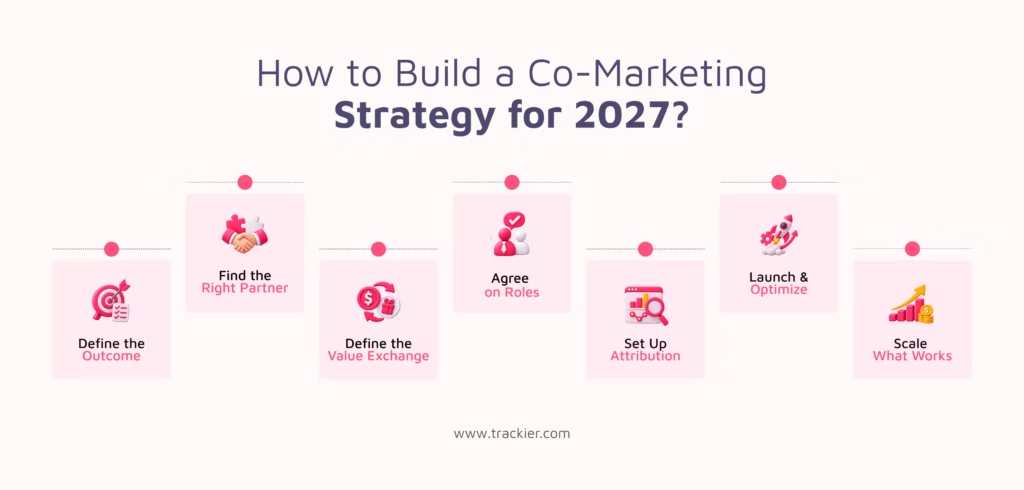
6 Steps to Building and Maintaining a Co-marketing Partnership
A successful co-marketing relationship needs deliberate effort both before the first campaign and after it goes live. Here’s how you can build effective partnerships, and nurture them beyond a single campaign or marketing artefact.
1. Find the Right Strategic Fit
Look for and develop partnerships for the purpose of co-marketing with partners who have complementary offerings, overlapping audiences or compatible brand positioning. Resources and expertise can be effectively leveraged from the end of both partners in this manner, and campaign ideas can positively influence brand building for both.
2. Agree on Shared Goals and Values
What do you want from a co-marketing campaign? It is crucial to know this, and seek it out from the partner you intend to run the campaign with. The relationship should be symmetric and match the expectations set on both ends, whether it is for brand awareness, qualified leads, pipeline or entry into a new market.
More critically, key contributions from both brands need to be mapped out. Is content the sole responsibility of one, or both. Does one team work on the branding materials while the budget is provided by the other? Is the sync split between ATL and BTL marketing? Whatever the division of resources and effort is, it should be laid out clearly in writing to avoid any confusions later on.
3. Create a Working Agreement
Document campaign responsibilities, timelines, approval processes, lead ownership, promotion commitments and measurement methods. This gives both teams a common operating framework before execution begins.
But just building relationships isn’t enough. Partnerships need management to ensure longevity.
4. Communicate, and Communicate Some More
All long-lasting relationships are built on high-quality communication, across space and time. Within co-marketing, things don’t look any different. Regular check-ins across teams, shared project documentation and established POCs can turn any one-time collaboration into a tiered structure that affects real revenue outcomes for all partners involved.
Early on, establishing clear lines of communication can ensure disputes and disagreements are resolved before they fester, giving both teams greater confidence during execution.
5. Measure Performance Together
Review agreed KPIs such as registrations, qualified leads, pipeline, revenue and audience engagement. Evaluate results jointly rather than treating the campaign as two separate marketing efforts.
6. Build on What Works
Use data to improve marketing effectiveness over time. What does this imply? Leveraging KPIs and feedback from the partner involved in the campaign can help improve the next campaign, and make the relationship enduring.
Successful co-marketing campaigns can become enduring through successive iterations, allowing each brand to deepen audience familiarity and refine joint approach and strategies over time.
How to Know if Co-marketing Works for Your Brand?
Co-marketing is not a universal growth tactic. Before pursuing it, a brand should establish whether working with another company can create an advantage that would be difficult or expensive to achieve alone. The decision should be based on audience fit, complementary value, brand compatibility and a clear business objective.
Your audiences overlap
A potential partner should have access to customers who are relevant to your business but not already saturated by your marketing. For example, a project management platform could partner with a team communication tool because both reach business teams while solving different problems.
You have something worth sharing
Co-marketing works when both sides can contribute a meaningful asset, such as specialist knowledge, original research, distribution, technology or access to an established audience. If the value exchange is one-sided, a partnership may struggle to last.
There is a specific reason to collaborate
Identify the gap you want the partnership to address. It could be entering a new market, reaching a new audience, strengthening credibility or generating qualified demand. If you cannot identify the advantage, running the campaign independently may make more sense.
The brands fit naturally
Check whether the partner’s reputation, positioning and customer expectations align with yours. A partnership should make sense to the audience rather than feel like two unrelated brands sharing a campaign.
Both teams can commit resources
Agree on who will provide content, promotion, budget, technology and campaign management. A partnership is unlikely to perform if one side cannot support the agreed activity.
Ultimately, co-marketing makes sense when both brands have something complementary to gain and contribute. If the audience, value exchange or objective is weak, another marketing approach may be more appropriate.
FAQs
What is co-marketing in simple terms?
Co-marketing is when two or more brands work together to promote their products, services or content to a shared audience. Each partner contributes resources such as expertise, content, distribution or audience access to achieve shared marketing goals.
What is the difference between co-marketing and co-branding?
Co-marketing focuses on promoting existing offerings through a joint marketing effort, while co-branding involves creating or presenting a product, service or experience under two brands.
How do you choose a co-marketing partner?
Choose a partner whose audience aligns with your target customers, whose offering complements yours and whose reputation supports your brand. Most importantly, both businesses should have measurable mutual value, with clear goals and contributions agreed before the campaign begins.
How do you measure co-marketing ROI?
Measure the total campaign investment against attributable leads, pipeline and revenue generated through the partnership. Use tracking links, dedicated landing pages, CRM attribution and campaign codes to connect results to the campaign, then calculate the resulting commercial return.