There’s a persistent myth in digital marketing that budget determines reach, and reach determines results. It’s the assumption that bigger brands, with their multi-million dollar ad spends and in-house agencies, will always win. But the data tells a different story.
Small businesses that adopt performance marketing driven digital strategies are not just surviving alongside large competitors. They’re carving out market share in ways that weren’t possible a decade ago. The rise of affiliate marketing, cost-per-action models, and accessible tracking infrastructure has fundamentally leveled the playing field.
The global affiliate marketing market is projected to exceed $20 billion in 2026, growing at a 15.2% CAGR, with the US alone expected to cross $13 billion. eCommerce leads vertical spend at 38%, followed by financial services at 15%, and the performance marketing industry is on track to reach $71.74 billion by 2034, reflecting how deeply performance-based partnerships have become embedded in the way brands acquire customers at scale.
More importantly, small and mid-sized businesses account for a growing share of that activity. The barrier to running a scalable, data-driven performance marketing program is no longer a seven-figure budget. It’s a strategy, the right tools, and a willingness to operate lean.
This blog breaks down how small businesses can use affiliate and performance marketing not just to compete, but to build a durable customer acquisition engine that doesn’t depend on outspending the competition.
Why Small Businesses Struggle with Digital Marketing
Most small businesses approach digital marketing the same way large brands do. They try to be everywhere at once. They run Google Ads, post daily on Instagram, invest in SEO, launch an email newsletter, and experiment with influencer partnerships, all simultaneously, and all with a fraction of the resources.
The result is predictable: diluted effort, murky attribution, and a marketing budget that disappears without clear evidence of what worked.
The root issue isn’t the channels. It’s the model. Traditional brand marketing, built around impressions, reach, and awareness campaigns, rewards scale. The more you spend, the more visibility you get. For a brand with a $50,000 monthly ad budget competing against a player spending $2 million, visibility-based competition is a losing game from the start. Performance marketing flips this logic entirely.
Instead of paying for exposure and hoping it converts, you pay for outcomes: a click, a sign-up, a sale, a subscription. The cost is tied to the result, which means a small business with a well-structured performance program can achieve positive ROI at any budget level and scale only when the numbers validate it.
This shift from “spend to be seen” to “pay for what works” is the single most important mental model change for small business owners entering digital marketing.
What Performance Marketing Actually Means for a Small Business
Performance marketing is a broad term, but for small businesses, its most practical application comes in three forms: affiliate marketing, influencer partnerships on a commission basis, and paid media with clear conversion tracking.
Each of these shares the same core principle. You define a result, and you pay when that result happens.
Affiliate marketing is the most structurally straightforward. You recruit partners, including bloggers, content creators, review sites, deal aggregators, and niche communities, who promote your product or service. When their audience converts, the affiliate earns a commission. The business pays only for verified results, and the affiliate takes on the marketing risk of creating content and driving traffic.
For a small business, this is significant. You’re essentially accessing a distributed sales and marketing force without a fixed salary overhead.
Influencer-as-affiliate is a newer but rapidly growing variation. Instead of paying a flat fee for a sponsored post, brands structure influencer deals around trackable links, promo codes, and revenue share. The influencer is motivated to convert, not just create content. The brand only pays when the conversion happens.
Paid media with performance tracking, primarily Google Ads and Meta Ads, becomes genuinely competitive when small businesses focus on conversion-optimized campaigns rather than brand awareness objectives. With precise tracking in place, even modest budgets can generate positive returns if the targeting, creative, and landing experience are aligned.
The common thread across all three is measurement. Without accurate tracking, performance marketing collapses into guesswork. With it, every dollar spent has a traceable outcome.
The Affiliate Marketing Advantage
Affiliate marketing has a structural advantage that’s rarely discussed plainly: the cost model mirrors revenue. When sales are slow, affiliate payouts are low. When volume grows, payouts scale proportionally. For a small business managing cash flow tightly, this is a fundamentally different risk profile compared to upfront ad spend.
Consider the alternative. A small e-commerce brand spends $5,000 on a Google Ads campaign. If the campaign underperforms, that money is gone regardless of the outcome. The same brand running an affiliate program pays 10 to 15% commission per sale. Zero spend means zero acquisition cost. A hundred sales means a predictable, margin-friendly payout.
Beyond economics, affiliate marketing offers something equally valuable, channel diversification through partners.
A single small business cannot produce enough content to dominate every relevant search query, social community, or niche audience. But a network of ten well-chosen affiliates can. Each partner brings their own audience, their own content, and their own distribution. The brand gets access to those channels without building them from scratch.
This is where small businesses can genuinely outmaneuver larger competitors. Big brands often work with generic affiliate networks and mass-market publishers. A focused small business can recruit highly niche partners whose audiences are exactly right for the product and negotiate better terms because the relationship is direct and personal.
Building Your First Affiliate Program
Getting an affiliate program off the ground doesn’t require a large team or a complex tech stack. It requires clarity on four things: your offer, your commission structure, your tracking setup, and your partner recruitment strategy.
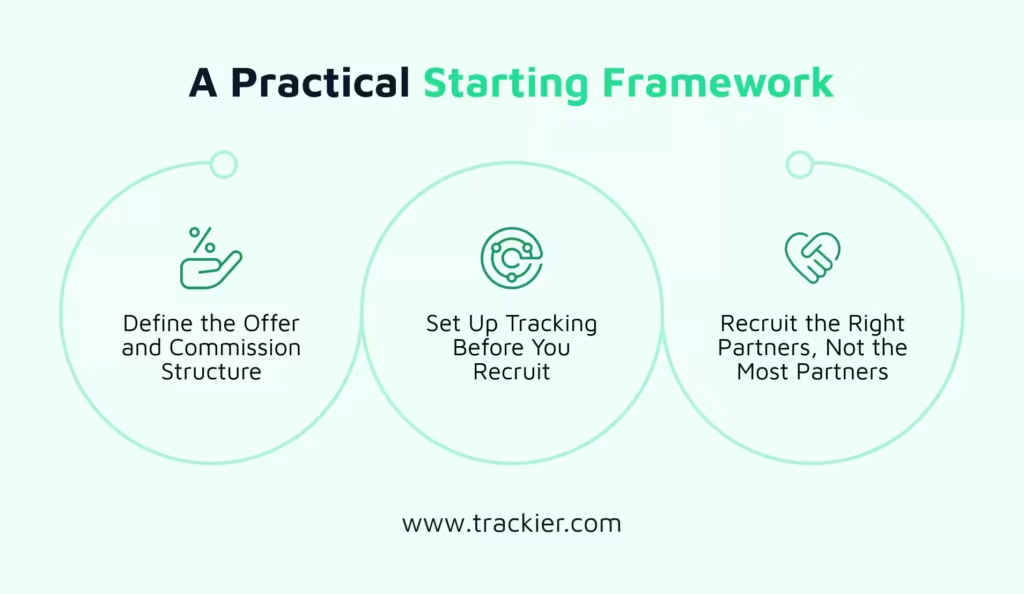
Define the Offer and Commission Structure
The commission rate needs to work financially for your business while being attractive enough to motivate partners. For physical products, 5 to 15% is a common range. For digital products and SaaS, rates can go significantly higher because the margin allows it.
Beyond the percentage, think about what you’re asking affiliates to promote. A well-converting landing page, a strong product with genuine reviews, and a clear value proposition make an affiliate’s job easier and increase the likelihood they’ll actively promote you.
Cookie duration is another detail worth considering carefully. A 30-day attribution window is standard, but extending to 60 or 90 days can be a meaningful incentive for affiliates promoting considered purchases where the sales cycle is longer.
Set Up Tracking Before You Recruit
This is where many small businesses get the sequence wrong. They recruit affiliates first and think about tracking later. The result is attribution gaps, disputed commissions, and broken trust with partners.
Reliable affiliate tracking needs to be in place before the first partner goes live. At minimum, you need unique tracking links per affiliate, conversion tracking that fires on the actual outcome you’re paying for (not just a page visit), and a reporting view that both you and your affiliates can trust.
Server-to-server tracking, also known as postback tracking, is increasingly important here. Browser-based pixel tracking is vulnerable to ad blockers, cookie restrictions, and iOS privacy updates. S2S tracking bypasses the browser entirely, recording conversions directly between servers. For a small business investing in affiliate marketing, this isn’t a technical nice-to-have. It’s the difference between accurate data and flying blind.
Recruit the Right Partners, Not the Most Partners
Volume of affiliates is not the goal, especially early on. Five engaged partners who genuinely believe in your product will outperform fifty passive ones who signed up and never promoted anything.
Start with people who are already in your orbit, customers who love the product, industry bloggers you’ve engaged with, and complementary business owners whose audience overlaps with yours. These partnerships start with a base of trust and familiarity that makes activation far more likely.
As you grow, expand into niche content publishers, comparison sites, and micro-influencers in your specific category. Avoid the temptation to join large generic affiliate networks immediately. The traffic quality from broad networks is often low, and the competition for commissions with established brands is harder to win.
How Performance Marketing Levels the Playing Field on Paid Channels
Affiliate marketing is a longer-term play. Performance marketing on paid channels can start delivering results much faster, but only when the measurement infrastructure is correct.
The biggest mistake small businesses make with Google Ads and Meta Ads is optimizing for the wrong metric. Clicks are not conversions. Impressions are not revenue. Yet many small business campaigns are structured around traffic objectives with no clear line to business outcomes.
A performance marketing approach to paid media looks different. Every campaign has a defined conversion event tied to business value, whether that’s a purchase, a form submission, a phone call, or a trial sign-up. Budgets are allocated based on cost per acquisition targets, not reach targets. Creative is tested systematically, and underperforming ads are cut without sentiment.
This discipline is actually easier to maintain on smaller budgets than on larger ones. A large brand managing $500,000 in monthly ad spend has organizational inertia, brand guidelines, agency relationships, and approval chains that slow down the kind of rapid iteration that performance marketing requires. A small business can test a new ad creative today, review the data tomorrow, and make a call by the end of the week.
Smart Bidding and Conversion Signals
Both Google and Meta have invested heavily in machine learning-based bidding strategies that optimize toward conversion goals rather than click volume. Target CPA and Target ROAS bidding on Google, and Advantage + campaigns on Meta, are designed to find users most likely to convert at your target economics.
These tools work best when fed clean, complete conversion data. The more conversion signals you send back to the platform, the better the algorithm learns who to target and when. This is another reason why robust tracking matters far beyond just internal reporting. It directly affects how efficiently the ad platform allocates your budget.
Content Marketing as a Performance Channel
Most small businesses treat content as a brand awareness exercise disconnected from direct revenue. A performance lens on content changes everything.
Content that ranks for transactional search terms, comparison queries, and “best X for Y” searches drives highly qualified traffic with commercial intent. A blog post titled “Best project management tools for freelancers under $50 a month” is not just informational. It’s a conversion asset that generates warm leads every day without ongoing ad spend.
For small businesses, the opportunity lies in specificity. Large brands often can’t produce content that speaks to niche audiences with the depth and authenticity that a smaller, more focused operator can. A boutique fitness brand can write about training protocols for people over 50 with far more credibility than a major sporting goods retailer. That specificity earns trust and converts at higher rates.
Performance marketing-oriented content also integrates naturally with affiliate marketing. Comparison posts, review articles, and “how to choose” guides are among the highest-converting affiliate content formats. If you’re building an affiliate program, creating content templates or guides for your affiliates is one of the highest-leverage things you can do to improve their output.
Tracking, Attribution, and the Data Layer
A small business that runs affiliate programs, paid media, and content simultaneously will quickly find that the hardest question to answer isn’t “are we getting conversions?” It’s “where are those conversions actually coming from?”
This is the attribution problem, and it affects every digital marketer regardless of company size. But for small businesses with limited budgets, misattribution is more costly. Money allocated to a channel that appears to be performing, but is actually just getting credit for conversions driven elsewhere, is money that could be working harder.
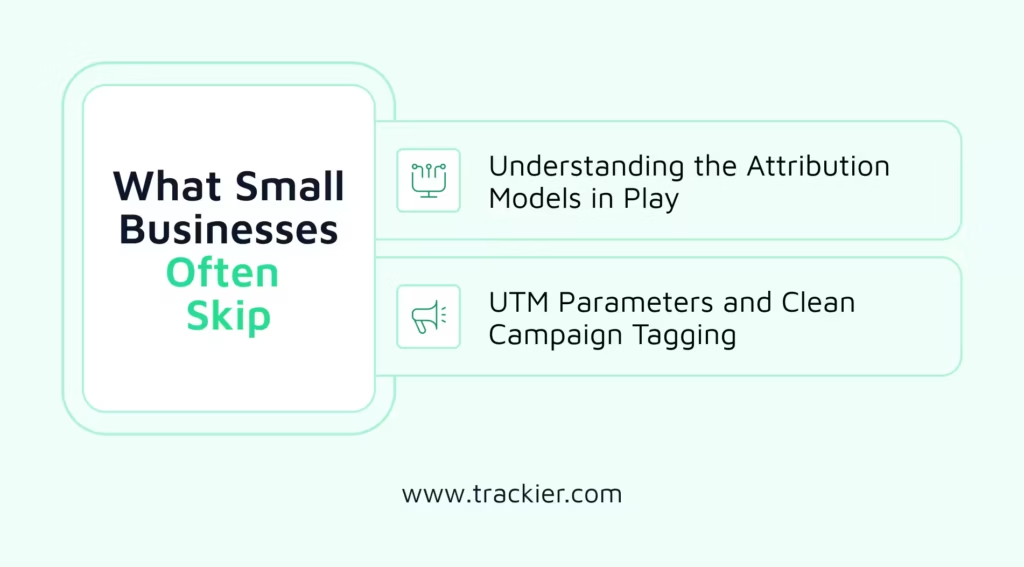
Understanding the Attribution Models in Play
Last-click attribution, the default in most platforms, gives 100% of the credit for a conversion to the last touchpoint before the purchase. It’s simple, but it systematically undervalues early-funnel touchpoints like content, social discovery, and affiliate partners who introduced the customer to the brand.
First-click attribution has the opposite bias. It credits the initial discovery touchpoint and ignores everything that happened after.
Data-driven attribution and time-decay models distribute credit across the customer journey in ways that more accurately reflect real influence. For businesses serious about optimizing their mix, moving beyond last-click is essential.
The practical implication for small businesses: if you’re running both paid ads and an affiliate program, make sure your tracking setup can tell you when a customer touches both before converting, and how you want to allocate commission and ad credit in that scenario. Setting this policy upfront avoids disputes with partners and prevents double-counting in your reporting.
UTM Parameters and Clean Campaign Tagging
UTM parameters are free, simple, and massively underused by small businesses. Adding UTM tags to every link, whether in an affiliate tracking URL, an email, a social post, or a paid ad, gives your analytics platform a complete picture of traffic sources.
Without consistent UTM tagging, Google Analytics and similar tools struggle to accurately categorize traffic, and you end up with bloated “direct” traffic numbers that make channel analysis unreliable.
Set a tagging convention, document it, enforce it for all affiliates, and review it monthly. This is one of those foundational habits that costs nothing and pays compounding dividends over time.
A Topic Small Businesses Can’t Afford to Ignore
Affiliate fraud is real, and it’s not just a problem for large networks running thousands of partners. Small businesses are arguably more vulnerable because a fraudulent affiliate can represent a disproportionate share of program activity before the pattern becomes obvious.
Common forms of affiliate fraud include cookie stuffing, affiliates inserting tracking cookies without a genuine referral, click injection on mobile, fake lead submissions, and coupon abuse, where affiliates claim commission on purchases driven by discount codes that were publicly available.
The consequences go beyond wasted commission spend. Fraudulent conversions skew your performance data, leading to poor optimization decisions. If you’re running a program based on cost-per-lead, a fraudulent lead influx can make a poor-quality channel look highly profitable.
Basic fraud prevention measures include monitoring for anomalous conversion rates, reviewing IP concentrations in affiliate traffic, using click caps per affiliate, and auditing order data against affiliate-driven conversions periodically. More advanced setups use dedicated fraud detection tools that analyze behavioral signals in real time.
For small businesses, the most practical first step is awareness. Knowing what patterns to look for and having the tracking granularity to spot them is the starting point.
Email Marketing and Affiliate Programs
Email marketing remains one of the highest-ROI channels in digital marketing, with an average return of $36 to $40 for every $1 spent, according to multiple performance marketing industry studies. For small businesses already building an email list, integrating affiliate partnerships into the email channel can amplify both.
The integration works in two directions. The first is using email as an affiliate channel. Niche newsletter publishers are increasingly valuable affiliate partners because they have highly engaged, self-selected audiences and deliver content in a high-attention context. Partnering with a newsletter in your category gives you access to that audience for a commission-only cost with no upfront placement fees in many cases.
The second is using your own email list to support affiliate-like partnerships. Cross-promotion deals, where two complementary businesses promote each other to their respective lists in exchange for revenue share on resulting conversions, are a structured and scalable version of word-of-mouth that small businesses can execute without a formal affiliate program in place.
How to Know If Your Performance Program Is Working
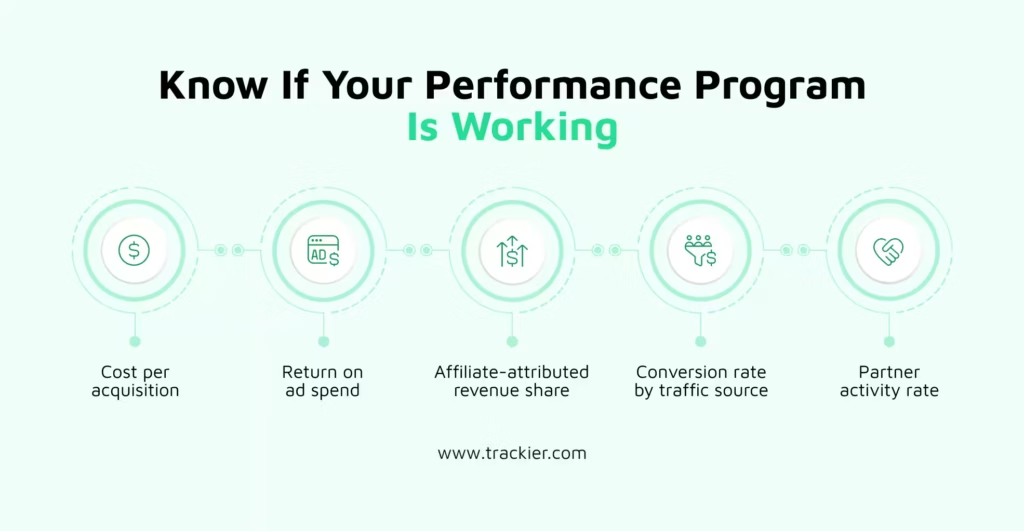
One of the benefits of performance marketing is that success is measurable. But having access to data and knowing which numbers actually matter are different things.
For small businesses running affiliate and performance marketing programs, the key metrics to track consistently are:
Cost per acquisition: The total cost to acquire one customer across a specific channel or campaign. This is the north star metric for any performance program. If your blended CPA is below your customer lifetime value, the program is working. If it’s above, something needs to change.
Return on ad spend: For paid media specifically, ROAS tells you how much revenue is generated per dollar of ad spend. A ROAS of 3x means $3 returned for every $1 spent. Target ROAS varies significantly by margin structure, so benchmarking against your own gross margin rather than the performance marketing industry averages is more meaningful.
Affiliate-attributed revenue share: What percentage of total revenue is coming through affiliate partners? This number reveals both program health and channel dependency. A program where 80% of affiliate revenue comes from one partner carries concentration risk that should be addressed by diversifying the partner base.
Conversion rate by traffic source: Not all traffic converts equally. Knowing the conversion rate for affiliate traffic versus paid versus organic search tells you where your landing experience and offer resonate most and where there’s room to improve.
Partner activity rate: In any affiliate program, a significant portion of registered affiliates will be inactive. Tracking the ratio of active to total affiliates, and working to improve it through better onboarding, better creative assets, and regular communication, is one of the fastest ways to grow program revenue without recruiting a single new partner.
Practical Channels Small Businesses Often Overlook
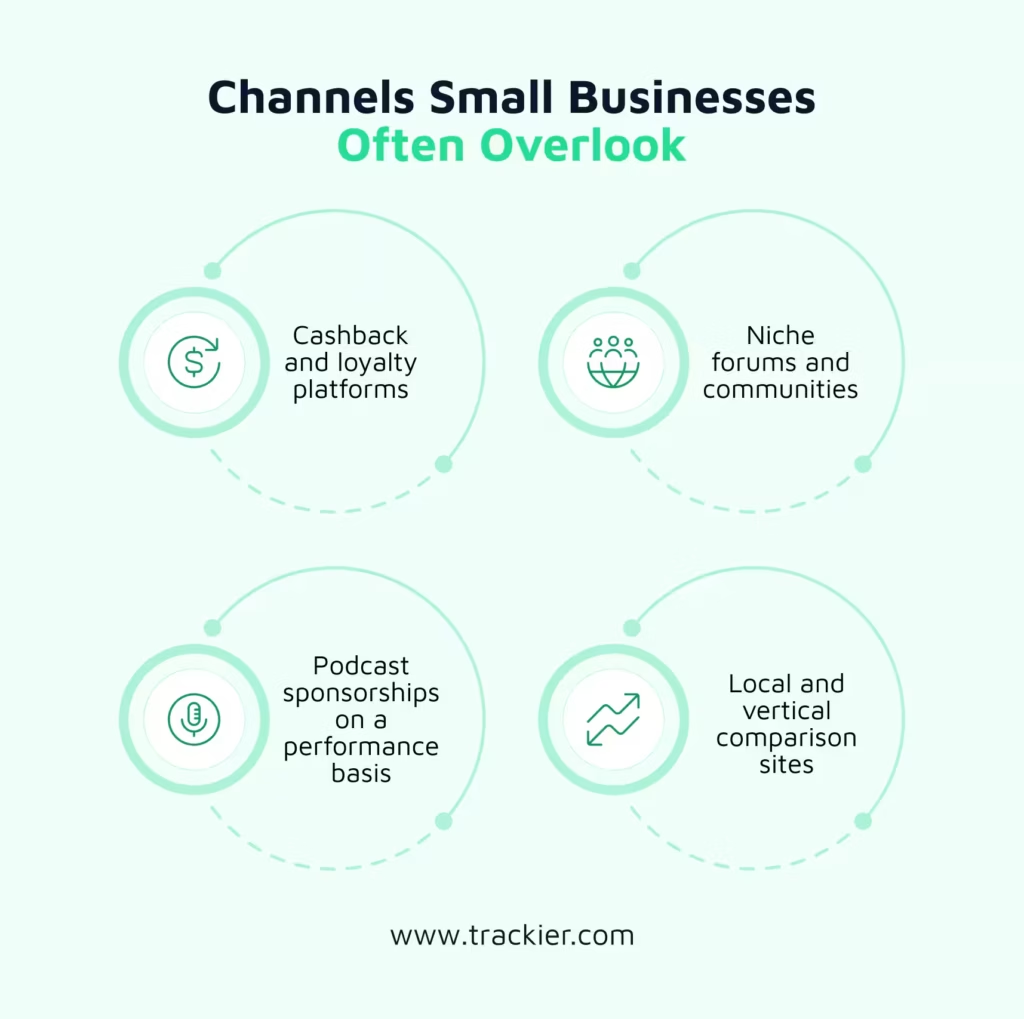
Beyond the core channels already discussed, several underused strategies are particularly well-suited to small business constraints.
Cashback and loyalty platforms: These affiliate partners have built-in audiences of deal-motivated shoppers. For businesses with enough margin, cashback programs can drive meaningful incremental volume, particularly for repeat purchases.
Niche forums and communities: Reddit communities, Discord servers, and performance marketing industry-specific forums host highly concentrated audiences with genuine purchase intent. Engaging authentically in these spaces and offering affiliate opportunities to active community members can generate high-quality traffic that broader channels miss entirely.
Podcast sponsorships on a performance basis: Many independent podcast hosts will consider host-read sponsorships with promo codes and revenue share rather than flat fees, particularly at the micro and mid-tier level. Podcast audiences tend to be loyal and high-intent, and the trust a host has built with their listeners extends to the products they recommend.
Local and vertical comparison sites: For businesses with a local or category-specific focus, partnering with comparison directories and local listing sites that offer affiliate or referral models can generate consistent, relevant traffic from users actively in a purchase decision.
Lessons from Small Businesses That Got It Right
The businesses that build durable affiliate and performance marketing programs share a few common traits that are worth internalizing.
They start simple and add complexity only when the data demands it. A program with three high-quality affiliate partners and clean tracking will outperform a complex multi-tier structure with twenty partners and unreliable attribution every time.
They invest in partner relationships before they invest in partner volume. Affiliate partners who feel supported, who receive timely payments, good creative assets, and responsive communication, perform better and stay longer. Attrition in a small affiliate program is expensive. Retention is cheap.
They treat their tracking infrastructure as a business asset, not an IT expense. Every marketing decision they make downstream depends on the quality of the data coming upstream. Poor tracking doesn’t just mean missing some conversions. It means every optimization decision is built on a flawed foundation.
And they resist the temptation to measure themselves against what large brands are doing. The metrics that matter for a business spending $3,000 a month on performance marketing are not the same as those that matter for a brand spending $3 million. The benchmark is your own economics: your margin, your LTV, your CPA target. Everything else is noise.
Conclusion
Digital marketing for small businesses has never been more accessible, and performance marketing is the reason why. Affiliate programs, cost-per-action paid media, and data-driven content strategies don’t require enterprise budgets. They require discipline, the right tools, and a clear understanding of what you’re measuring and why.
Bigger brands have more resources, but they also have more organizational complexity, more inertia, and less ability to move quickly when the data changes. A small business that operates with precision, tracks every outcome, and builds genuine partner relationships can compete in almost any digital category. The advantage isn’t outspending the competition. It’s out-optimizing them.
FAQs
What is performance marketing, and why does it matter for small businesses?
Performance marketing is a model where you pay only for defined outcomes like clicks, sign-ups, or sales. For small businesses, it means every rupee or dollar spent is tied to a real result, no wasted budget on impressions that don’t convert.
How is performance marketing different from traditional digital advertising?
Traditional advertising charges upfront for visibility regardless of results. Performance marketing flips that, you define the outcome first and pay only when it happens, making it a far lower-risk model for businesses with limited budgets.
Can small businesses run performance marketing programs without a big team?
Yes. Starting with a few high-quality affiliate partners, clean tracking links, and a simple commission structure is enough. You don’t need a complex tech stack or an in-house agency to get started.
What budget do I need to start with performance marketing?
There’s no fixed minimum. Affiliate-based performance marketing can start at near-zero fixed cost since you only pay commissions on actual conversions. Even paid media campaigns can be effective at modest budgets when conversion tracking is set up correctly.
How do I measure if my performance marketing program is actually working?
Track cost per acquisition against your customer lifetime value. If CPA stays below LTV, the program is profitable. Secondary metrics like ROAS, affiliate-attributed revenue, and conversion rate by traffic source round out the picture.