Affiliate marketing strategies are the best ways to increase revenue and build authority, which matters more for new brands. In fact, affiliate marketing generates an average return of $12–$15 for every $1 spent, which makes it one of the best marketing strategies to leverage.
Other than numbers, consumer behavior has changed from what it was earlier. They buy products from those they trust, like creators, publishers, and communities. They do not prefer to buy from ads, and this behavior pushes brands to make stronger partnerships.
But here is the main challenge: most affiliate marketing programs can not scale because of inefficient tracking, weaker partner alignment, and do not have the insights for optimizing campaigns.
Trackier, an affiliate tracking software, helps brands to grow their programs, increase revenue and attribution, and optimize their partner programs.
What is an affiliate marketing strategies?
An affiliate marketing strategy is to build, manage, and optimize partnerships for measurable business outcomes. Just creating an affiliate program is not enough; this is why it focuses on making a scalable system with the right partners, incentives, and, most importantly, insights; these work together to scale revenue.
Many new-age brands make the same mistake, which is onboarding some publishers and offering them the standard market-rate commissions (which obviously they do not want, and you will be the same as other brands).
But an effective strategy should be focused on building a customer acquisition funnel, focusing on revenue growth, and profitability (the most important number).
Why is affiliate marketing critical in 2026?
As we talked about above, affiliate marketing is not just another channel; it is one of the most important strategies. But what makes it the most effective? The answer lies in how it operates.
It is a performance-based strategy, where you only have to pay for actual results, which directly reduces your customer acquisition costs (as it is one of the most challenging things).
There are other reasons which makes it an effective marketing strategy, as today’s buyer journey is no longer linear. Before purchasing anything (online or offline), customers interact with multiple touchpoints, and that is why understanding their journey is more crucial.
If we talk about industries that should use affiliate marketing, it would be e-commerce, fintech, and SaaS, as they offer a unique model, which is pay for performance, that significantly reduces upfront costs.
How to build an effective affiliate marketing strategies?
Creating an effective affiliate marketing strategies is not about launching it; the thing that matters most is building a system that can continue to scale.
In 2026, brands that are winning are not those that have thousands of affiliates, but the ones that have a limited number but are focused on their goal and strategy.
1. Focus on business outcomes
Before recruiting affiliates, you should know what your goal is. Ask yourself:
- Are you optimizing for revenue?
- Focusing on new users?
- Increasing profitability?
As we already know, affiliate marketing would work best when you know the outcomes (it also should be measurable), and it could be reducing customer acquisition cost, or return on ad spend, or increasing customer lifetime value.
2. Onboard the right partners
Not all affiliates are equal (different niche, audience, country, etc.) To grow your affiliate marketing program, you need to focus on relevance rather than volume (100 relevant affiliates are better than 1000 irrelevant ones).
Although you can have a mix of them, it could be:
- Content creators (to build trust and increase reach)
- Coupon platforms (it should be only for conversions)
- Media buyers (only for scale)
- Niche communities (this is where the high-intent audience will be engaging)
3. Create a commission model
Payout matters most in affiliate marketing. Your payout structure decides which affiliates will join you. There are some of the most famous payout structures that you can implement:
- Cost per sale – you only pay affiliates when there is a sale, which is most common in e-commerce.
- Revenue share – best for high-revenue-generating affiliates; they earn a percentage of the ongoing revenue generated from their referred users.
- Hybrid model – It is less popular but more relevant for super affiliates, and this one is based on a mix of two models, like cost per sale with revenue share.
4. Build a tracking and attribution Foundation
If you can’t measure it, you can’t scale it. Modern affiliate strategies rely on:
- Multi-touch attribution (not just last-click)
- Cross-channel tracking
- Real-time performance visibility
With affiliate ROI often outperforming traditional channels (up to 12:1 ROAS in some cases), accurate tracking becomes your biggest competitive advantage.
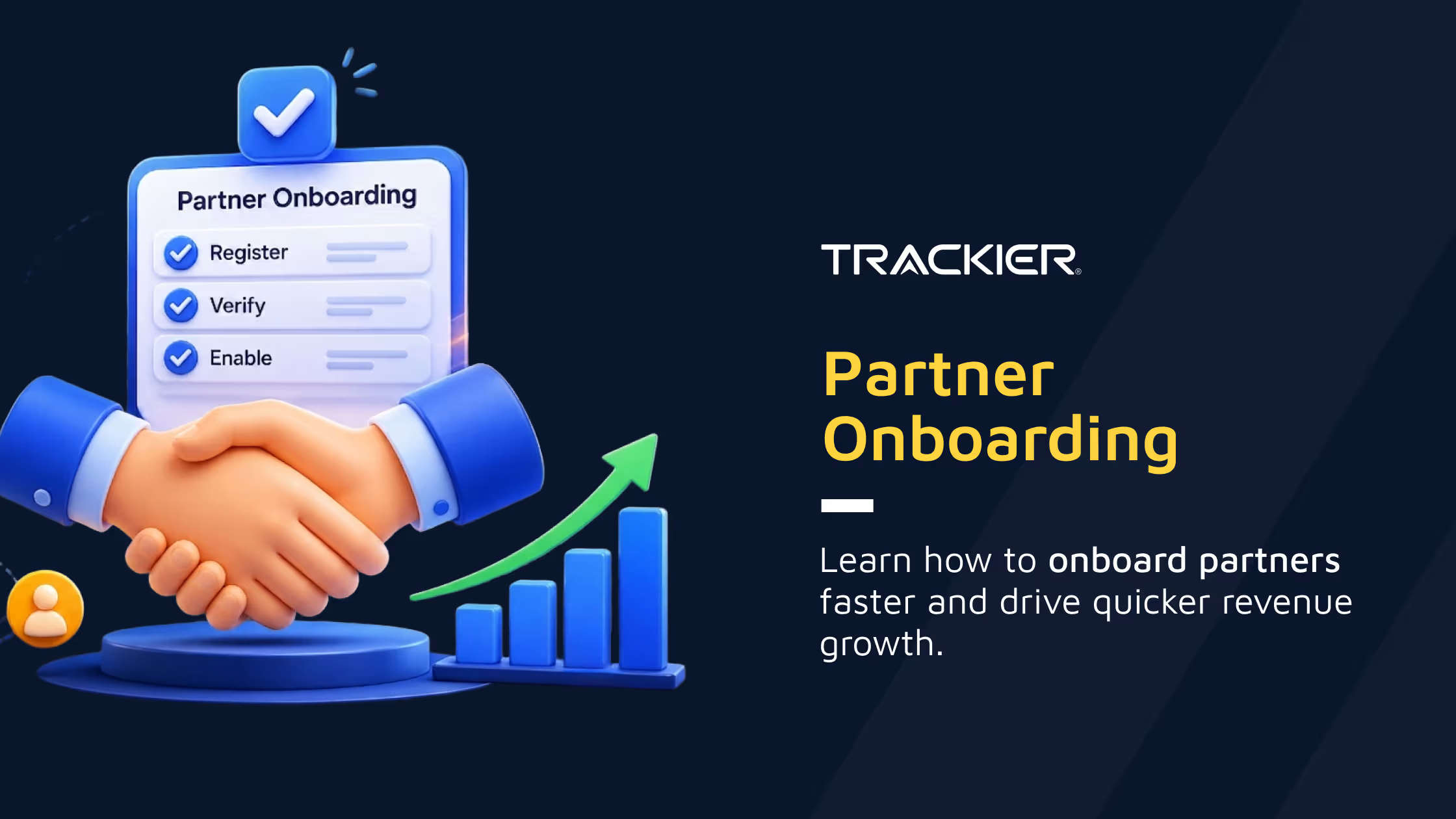
5. Create the best partner onboarding experience
The faster a partner starts earning, the faster your program scales. Top programs:
- Provide ready-to-use creatives and links
- Offer clear campaign guidelines
- Automate onboarding workflows
6. Continuously optimize and scale what works
Affiliate marketing is not “set and forget.” The most successful brands:
- Double down on top-performing partners
- Eliminate low-quality traffic
- Test landing pages, offers, and creatives
How to scale your affiliate program?
Scaling an affiliate program isn’t about adding more partners; it’s about building a system that can grow without breaking. Many brands hit a plateau because they focus on volume instead of structure.
The real shift in scaling comes from moving from manual growth to system-driven growth. Here’s how to do it effectively:
1. Expand your partner acquisition strategically
Growth starts with a consistent pipeline of high-quality affiliates. But scaling is not about onboarding everyone; it’s about onboarding the right mix.
- Diversify partner types (content, creators, media buyers, deal sites)
- Use multiple channels: outreach, referrals, communities
- Focus on partners with buying intent audiences, not just traffic
A broader partner ecosystem helps you reach users across the full funnel, not just at conversion.
2. Focus on partner enablement, not just recruitment
Most programs grow initially through recruitment, but scale through enablement.
- Help affiliates understand what works
- Share best-performing creatives and campaigns
- Provide clear performance insights
3. Segment and prioritize high-performing partners
As your program grows, not all affiliates should be managed equally.
- Top performers → dedicated support and higher incentives
- Mid-tier → optimization and testing
- Low-tier → automated workflows
4. Use data to drive smarter decisions
Scaling without data leads to wasted spend.
- Identify top-performing traffic sources
- Shift budgets toward high-ROI partners
- Continuously test landing pages and offers
5. Automate operations to remove challenges
Manual processes kill scalability. Automate your:
- Partner onboarding
- Commission calculations
- Payouts and approvals
- Fraud prevention
6. Build systems, not just campaigns
Sustainable scaling comes from repeatable systems:
- Standardized onboarding flows
- Defined communication cycles
- Clear attribution and payout rules
7. Continuously optimize and evolve
Even high-performing programs plateau if they don’t evolve.
- Refresh partner mix regularly
- Test new channels (like creators, video, communities)
- Update commission models based on performance
How to optimize for high ROI?
Driving affiliate revenue is one thing; making it profitable is where most programs struggle. High ROI doesn’t come from more traffic; it comes from better control, cleaner data, and smarter decisions. Here’s how top-performing programs optimize for maximum returns:
1. Focus on high-quality, intent-driven traffic
Not all traffic converts equally.
- Prioritize affiliates that bring high-intent users (not just clicks)
- Analyze conversion rates across partner segments
- Eliminate sources with high traffic but low revenue
2. Prevent affiliate fraud before it impacts ROI
Affiliate fraud is one of the biggest hidden profit killers. Some common types include:
- Click fraud (fake clicks via bots or scripts)
- Fake leads (auto-filled or stolen data)
- Cookie stuffing (claiming commissions without real referrals)
3. Improve attribution accuracy
Poor attribution leads to overpaying the wrong partners and under-rewarding the right ones.
- Move beyond last-click attribution
- Track cross-channel journeys
- Ensure visibility across the full funnel
4. Continuously test and optimize
High ROI comes from constant iteration, not static campaigns.
- Test different offers and commission models
- Optimize landing pages for better conversions
- Experiment with new partner types and channels
5. Use real-time data to make faster decisions
Delayed insights lead to wasted spend.
- Monitor performance in real time
- Quickly scale top-performing affiliates
- Pause underperforming campaigns instantly
6. Align incentives with business outcomes
Your payout model should reward what matters most.
- Pay for conversions, not just clicks
- Introduce tiered incentives for top performers
- Reward long-term value (LTV), not just acquisition
How does Trackier help you build and scale affiliate programs?
Building an affiliate marketing strategies is one thing; executing and scaling it efficiently is another. This is where a performance marketing software becomes critical. It is a comprehensive platform that connects partners, data, and decision-making into one unified system.
- Centralized partner management at scale – Managing multiple affiliates, campaigns, and geographies manually quickly becomes chaotic. Trackier allows you to manage all partners, campaigns, and performance data from a single dashboard, eliminating operational silos and improving control.
- Accurate tracking and attribution – Affiliate success depends on how well you measure it. Trackier provides click-level tracking across devices and channels, ensuring every conversion is accurately attributed. This eliminates guesswork and helps you identify which partners actually drive revenue.
- Flexible commission and payout automation – Manually calculating payouts can slow down growth and create errors. Trackier enables dynamic commission structures and automated payouts, allowing you to reward partners based on real performance, whether it’s CPA, revenue share, or custom rules.
- Real-time reporting for faster decisions – Scaling requires speed. With real-time dashboards and performance insights, you can instantly identify top-performing affiliates, campaigns, and traffic sources, and double down on what works.
- Built-in fraud prevention to protect ROI – Affiliate fraud can significantly impact performance; industry estimates suggest a large portion of ad spend is lost to invalid traffic. Trackier helps prevent this with real-time fraud detection, traffic validation, and automated rules, ensuring you only pay for genuine conversions.
- Automation that enables scalable growth – From onboarding partners to tracking performance and processing payouts, Trackier automates key workflows. This reduces manual effort, improves efficiency, and allows teams to scale affiliate programs without increasing operational complexity.
Conclusion
Affiliate marketing in 2026 is no longer about experimenting; it’s about building a predictable revenue stream. But results don’t come from simply launching a program.
They come from structured affiliate marketing strategies, accurate tracking, strong partner alignment, and continuous optimization. Without the right foundation, even high traffic won’t translate into revenue.
This is where most brands get stuck, and where the right platform changes everything. With Trackier, you can turn fragmented efforts into a scalable, data-driven growth system powered by real-time insights, automation, and precise attribution.
If you’re serious about driving high-ROI growth through partnerships, now is the time to act.
Don’t just run an affiliate program; build one that scales. Book a demo today.
FAQs
1. What are the advantages of an affiliate marketing strategy?
An affiliate marketing strategy offers performance-based growth, meaning you pay only for results. It lowers customer acquisition costs, expands reach through trusted partners, and drives scalable revenue. With proper tracking and optimization, it delivers high ROI while minimizing risk compared to traditional advertising channels.
2. What tools are needed to manage an affiliate program?
You need a platform that offers tracking, attribution, reporting, and automation. Tools like Trackier help manage partners, track performance in real time, automate payouts, and prevent fraud, making it easier to scale affiliate programs efficiently.
3. How can I scale my affiliate marketing program successfully?
Scaling requires more than adding affiliates. Focus on high-performing partners, optimize campaigns using data, and automate operations. Successful programs continuously test, refine, and expand partner types to build a predictable and scalable revenue engine.
4. What KPIs should I track in an affiliate program?
Key metrics include conversion rate, CAC, ROAS, and revenue per partner. Advanced programs also track LTV and attribution accuracy. Monitoring these KPIs helps identify high-performing affiliates and optimize campaigns for better ROI and long-term scalability.
5. How can I prevent affiliate fraud?
To prevent fraud, use tracking tools that detect suspicious activity like click spam, fake leads, and cookie stuffing. Set validation rules, monitor traffic quality, and analyze conversion patterns. A strong fraud prevention system ensures you only pay for genuine performance and protects your ROI.