Within video-based advertising, pre-roll ads secure one of the highest-reach and highest view completion when compared with all ad types. Users encounter them on streaming platforms, CTV, various websites and across social media. In this article, we’ll be covering their types, use cases and how to implement them correctly as part of the broader marketing strategy.
What are Pre-roll Ads?
When you view a video on Youtube, or begin an episode of a series on PrimeVideo, you may be shown an advertisement, even before the opening credits roll. In simple terms, this type of advertisement, which is presented before the main track ‘rolls’, is known as a pre-roll ad.
However, this type of ad is not just presented in video format. Instead, a pre-roll ad may be a video, a banner, an overlay on the screen or any other format which is presented right at the very beginning of the viewing experience.
Information is more easily digested when it is viewed versus when it is read. The Hubspot State of Marketing Report for 2026 identified short-form video as the format which delivered the highest ROI.
Around 2018-19, it was estimated that the average person consumed 84 minutes of video content in a day. More recent estimates suggest this number has risen, from anywhere between 100 minutes of video content per day to 17 hours per week.
You may stop and question at this point: are pre-roll ads only limited to videos? Not anymore. While previously, the video format on sites like Youtube and Vimeo made advertising easy to integrate, streaming platforms for audio and video are also preferred for placement. Users can experience a pre-roll ad before a podcast, audiobook stream or even a Spotify playlist.
A pre-roll ad usually presents itself at a specific time. The initial 15-20 seconds serve as the ideal moment for this promotional drop. Based on the platform they’re served, they can go on as long as 60 seconds too.
Are Pre-roll Ads Skippable?
Depending on the type of ad being implemented (say, banner vs video), the mandatory watch period may vary. Sometimes, ads can directly be skipped as soon as they appear. At other times, they may be skipped after a set duration, such as 5 or 10 seconds.
When you think of various static and dynamic placements of advertisements during live events, such as sports streams, the ads may be completely unskippable. Such pre-roll ads are served in the outer edges of the screen, ensuring the real action is still visible clearly.
A pre-roll ad can be skipped without interaction, depending on where a viewer is seeing the ad.
Therefore, advertisers must ensure the quality of content and the engagement value (in terms of the hook) is high enough to ensure viewers watch the complete advertisement.
Who Should Use Pre-roll Ads?
Pre-roll ads are most effective for businesses that need to capture attention early in the customer journey. Because these ads appear before a viewer’s chosen content, they offer high visibility and can influence awareness, consideration and purchase intent — particularly when the message is delivered within the first few seconds.
1. Brands Looking to Increase Awareness
For businesses entering a new market, launching a product or expanding into new audiences, pre-roll ads provide immediate visibility. YouTube reports that billions of hours of content are watched daily, making it one of the largest platforms for reaching consumers at scale.
2. Companies Launching New Products or Services
Product launches benefit from the combination of sight, sound and motion. A short 15-30 second pre-roll video can demonstrate a product’s value faster than static display or text ads, helping viewers understand the offering before they decide whether to learn more.
3. E-commerce Brands
Retailers can use pre-roll ads to showcase products, seasonal offers, or limited-time promotions. Video demonstrations often reduce uncertainty by showing products in use, making them particularly effective for consumer goods, electronics, beauty and home products.
4. Businesses with Visually Engaging Products
Industries such as travel, hospitality, food, automotive, fitness and fashion benefit from video-first storytelling. Demonstrations, before-and-after comparisons and immersive visuals communicate value more effectively than static creative.
5. Local Businesses
Pre-roll campaigns can be geo-targeted to reach audiences within specific cities or neighbourhoods, making them useful for restaurants, healthcare providers, educational institutions, gyms, real estate agencies and retail stores looking to increase local awareness.
6. B2B Companies
Pre-roll ads are not limited to consumer brands. Software providers, consulting firms and professional services companies can use them to promote webinars, product demos, case studies or downloadable resources to highly targeted professional audiences.
Differences Between Pre-roll, Mid-roll and Post-roll Ads
Having understood what pre-roll ads are, it is crucial to know how they are different from mid-roll and post-roll ads for the purpose of proper implementation and utilization.
Mid-roll Ads
When advertisements are shown at natural break points within the content, they are known as mid-roll ads. There is no fixed timeline for when they will show up, since their placement usually depends on the length of the content. Consider the intermission period during a movie screening.
A mid-roll works best when the primary content is long, ensuring the interruption doesn’t completely take away from the viewing experience. They are ideal for content formats like episodes within series, full-length movies, game streams, speeches and debates.
Post-roll Ads
An ad which appears right after the main content or video a user is watching comes to an end is known as a post-roll advertisement. In essence, it appears after the primary engagement period has ended, which means only those who stick around till the very end — such as for a post-credit scene — are likely to witness this ad.
Usually the format of post-roll ads is video-based, and is served only to those viewers who have a successful view completion when it comes to the content they clicked on. Therefore, unlike pre-roll and mid-roll ads, the number of people who will end up watching this ad type is few and far in between.
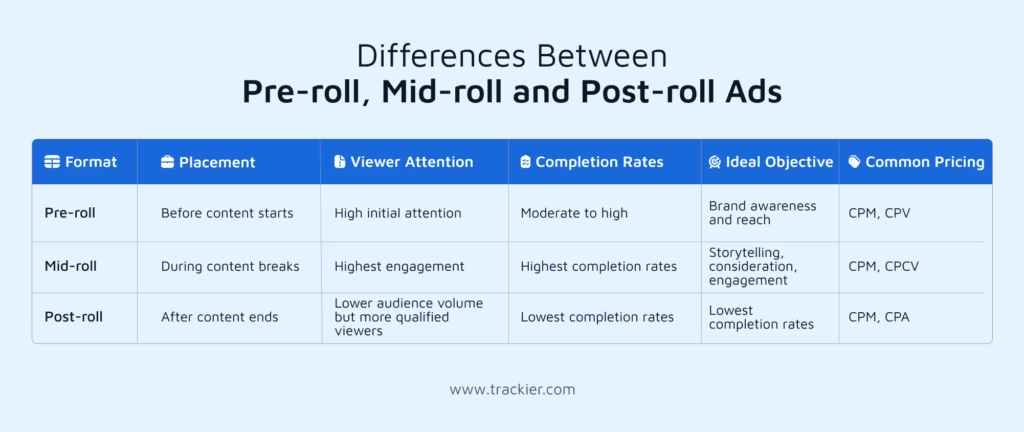
Refer to this table to understand how all the three ad types compare with each other.
Preferred for Advertisers: Pre-roll, Mid-roll or Post-roll Ads?
Due to their very nature, the highest reach is possible only through pre-roll ads. Anyone who quits watching or listening to the main content at some point will eventually miss the mid-roll and post-roll ads.
However, when it comes to long-format content (think: 1 hour or even longer), mid-roll ads work best. You can keep displaying the same ad after certain fixed durations to reinforce a brand message. Or, you could also display a series of ads, each of which serve to shape the viewer’s perception to ultimately produce a desired action (as is the end result of direct response advertising.
Not all ads are meant for awareness or action. Sometimes, brands can simply use the ad to produce recall in a highly engaged audience — which is a crucial part of building a brand. That’s something post-roll ads are perfect for.
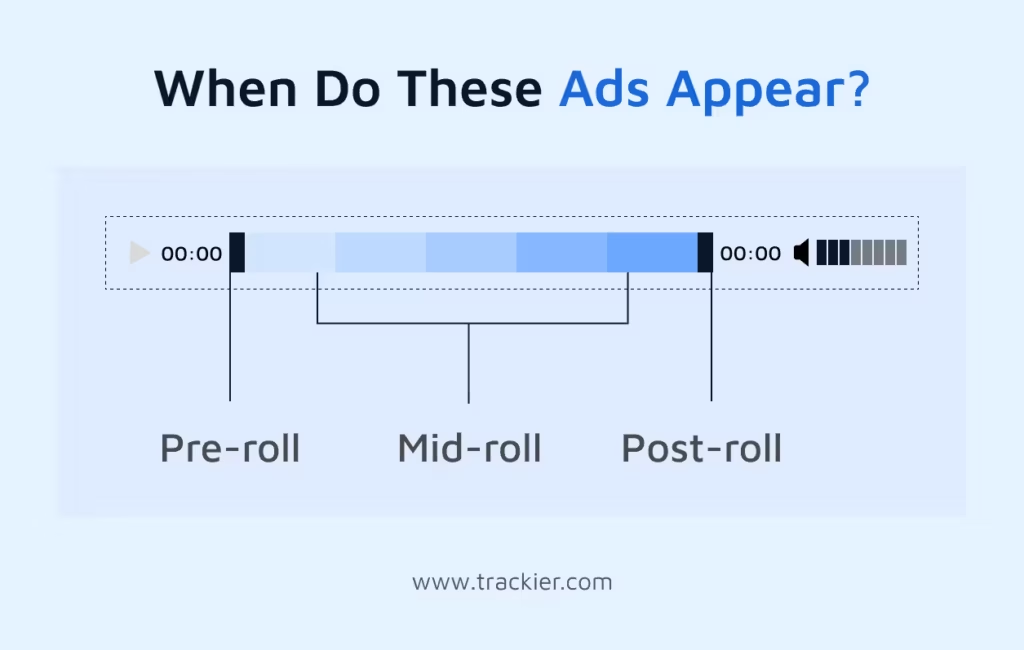
When we consider advertisers, based on their use case, any of the given types of ads can be ideal.
The most broad use-case, for the widest set of advertisers, is offered by pre-roll ads. They provide the largest impression share, since viewers may watch the complete ad to get to their content. However, this can produce a side effect, if the ads are too long or not engaging enough: viewers may simply choose to not watch their chosen content piece after all.
These ads matter because research from ‘Think with Google’ shows that video ad placement contributed towards the buyer journey of several users across journey stages.
- 50% were made aware of brands or products offered by them.
- 34% stated they were encouraged to buy a specific product or service post viewing such ads.
- Often, attention and trust were platform-reliant. Youtube scores well on both fronts — respondents shared they were 1.5x more likely to pay attention to content on YT, and treat said content as 2x more trustworthy than the stuff they watch on social media.
Types of Pre-roll Ads
Based on campaign goal, platform selected and audience type being targeted, there are a variety of pre-roll ad types which can be selected for use. Let’s understand what each of them is, and how they work.
Skippable Pre-roll Ads
When pre-roll ads are skippable, they usually play before the main content but allow viewers to skip the rest of the ad after watching the first 5 or 10 seconds. Advertisers usually run them on a cost per view (CPV) basis, where they pay for each viewer who continues watching beyond the ‘skip’ button’s appearance.
Google’s analysis of thousands of YouTube campaigns found that creative decisions made in the first five seconds have a significant impact on whether viewers continue watching and how well they remember the brand.
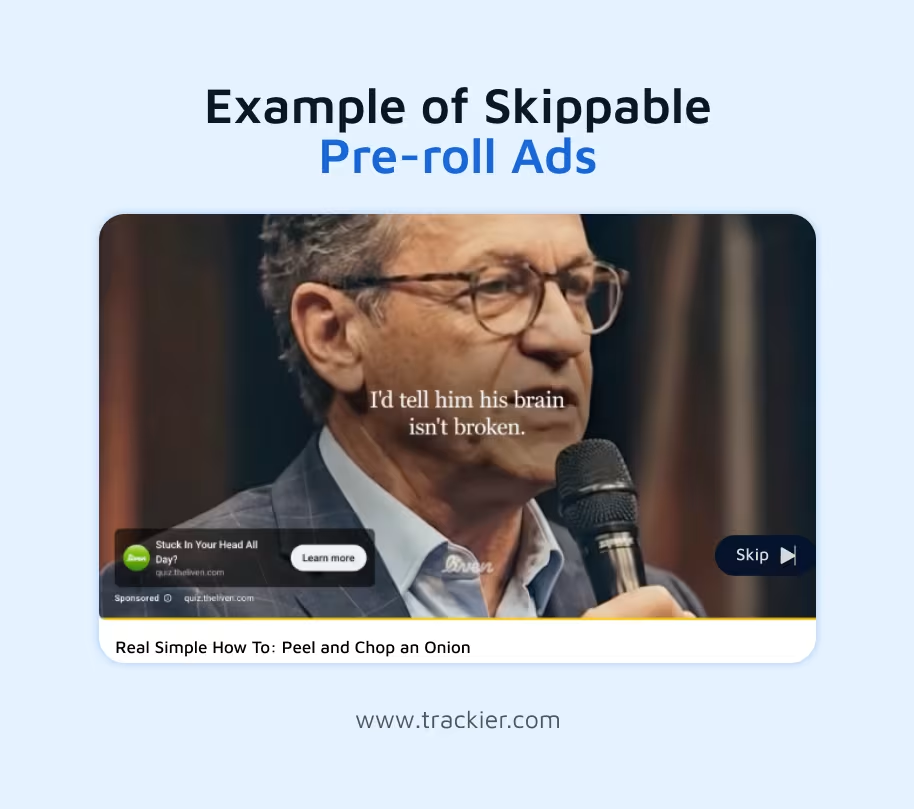
How can skippable pre-roll ads be used most effectively? Well, brands can use them for storytelling purposes (which keeps viewers engaged beyond the ‘skip’), app install campaigns or ecommerce marketing.
Research from Google shows that early brand introduction and strong calls to action improve conversion rates with video ads. To get the most out of the ad placement, advertisers should focus on using captivating hooks, with immediate brand introduction and align a clear call-to-action.
Non-skippable Pre-roll Ads
Accessing the video content in the case of non-skippable pre-roll ads is only possible once the ad is viewed in its entirety. Usually, based on ad inventory and platform, such ads lie between 6 and 15 seconds in duration. However, longer ad spots are also possible to place.
When should advertisers rely on unskippable pre-roll ads? When they’re working on new product launches, season campaigns, brand announcements or mass awareness campaigns, delivering a message in its complete form is extremely important. Consider the instance of smoking-related awareness campaigns or the polio awareness campaigns run by the Indian government, which are part of the movie viewing experience.
These campaigns have a clear benefit: view completion rates and subsequent brand awareness both remain high. But this will not always be the case.
If the ad is too pushy, or misses in its tonality, there is a chance that viewers will get frustrated and avoid the video content altogether. In fact, over multiple views, this could also sully existing brand repute, and lead to a poor perception among the target audience.
Bumper Ads
The 6-second non-skippable video-based ads which play before the main presentation are known as bumper ads. Their short duration makes their creation a challenge. Yet, when they’re made keeping the audience, message and platform in mind, they can deliver great impact.
Got a time sensitive campaign you want to push or a larger message which needs reinforcement through repetition? Bumper ads are perfect in such situations.
The key to creating winning bumper ads is simplicity. A direct message, shared simply with no frills. A clear, actionable message and call-to-action. Jumping directly into the heart of the message without much dilly-dallying.
Interactive Pre-roll Ads
The video or static advertisements, which contain a button on screen or other interactive elements which the audience can work with while watching the ad come under the categorization of interactive pre-roll ads.
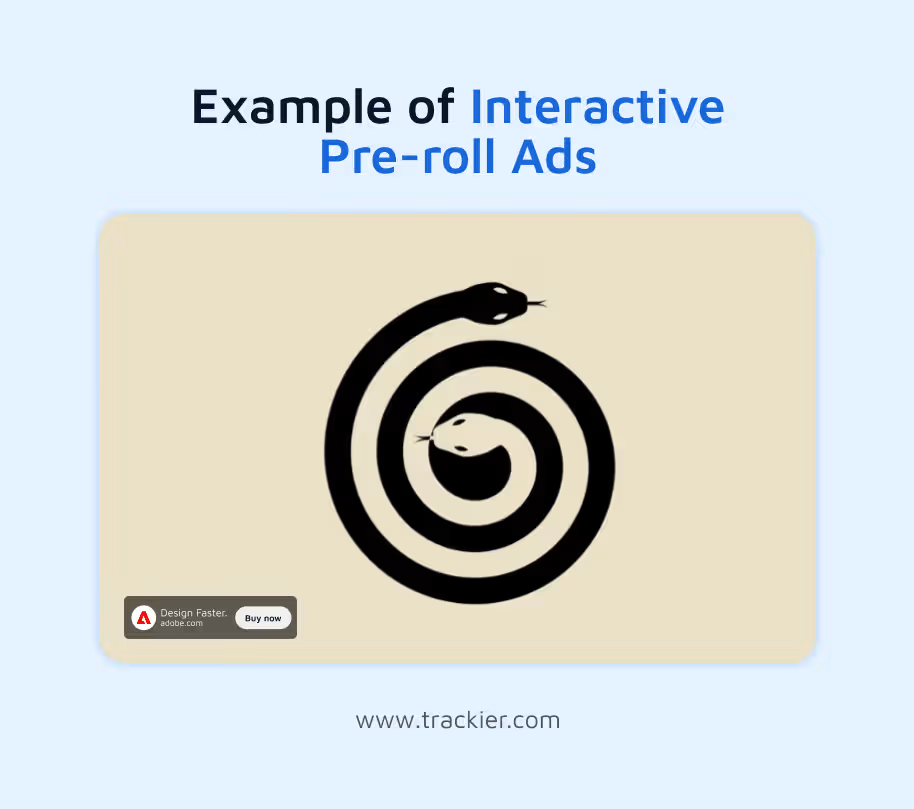
Unlike traditional video ads where passive viewing is required to absorb the message being shared, this ad enables direct action and participation, at the display site.
The interactive features, here, can be varied and include:
- calls to action (CTAs),
- product cards,
- polls,
- companion banners, and,
- shoppable video elements.
Interactions during display also enable for better measurement. You know viewers are engaged, or are actively viewing the advertisement, based on the immediate response rate. Brands can drive website visits, product discovery, lead generation and even sales from interactive ads.
The primary benefits of interactive pre-roll advertising include higher engagement rates, measurable user interactions and increased conversion opportunities.
Connected TV Pre-roll Ads
When pre-roll ads are delivered through the means of internet-connected television devices, including smart televisions, streaming devices or OTT advertising, they’re said to be CTV pre-roll ads.
Linear broadcasting limits the serving of ads to hyper-targeted audiences at very specific times. CTV ads help override these limitations, giving brands the opportunity to combine a premium television viewing experience with measurement and targeting that are normally found only through digital advertising.
Ad units within the CTV pre-roll framework need to be well-produced and high-quality since they appear on large flat-screens with high resolution. Advertisers can also leverage household-level targeting to reach audiences based on demographics, interests, viewing behavior and other relevant attributes, improving campaign efficiency and relevance.
It is expected that CTV advertising will exceed 40% when it comes to total ad spend by 2030, as spends on linear broadcast advertising continue to drop progressively year-on-year. This is significant since CTV as a format already commands about 50% of global viewtime across age groups.
As a format, CTV pre-roll ads are best suited to complement integrated, multi-channel brand campaigns for awareness building.
How do Pre-roll Ads Work?
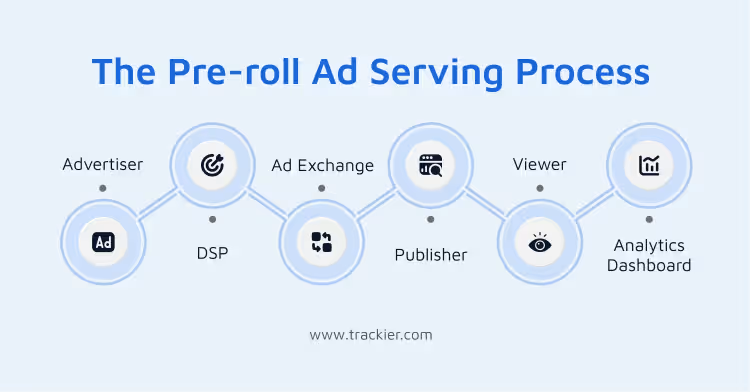
There are steps to how the entire pre-roll ad serving process works. A determination is made on which content will appear to a given viewer before a certain type of content piece. This takes roughly a fraction of a second.
Let’s understand the ad delivery process.
- User starts a video
A viewer decides on the content they want to consume on a given platform.
- Ad request is generated
Before the content is run, the player gets in touch with an ad server or a demand side platform to identify an available advertising opportunity.
- Real-time bidding or direct serving selects an advertisement
There are two ways in which the ad which will be displayed is selected.
- Programmatic bidding, where advertisers compete for the impression in real time.
- Direct-sold campaigns, where inventory has been reserved in advance by a specific advertiser.
- Pre-roll plays
The video content of the ad is retrieved, and depending on the campaign setting this ad may be skippable or non-skippable.
- User watches or skips
The user may watch the ad completely, or skip when the button appears. Additionally, if there are interactive elements, there may be interactions which get recorded while the ad is displayed.
- Performance data is recorded
The engagement and delivery data on the user’s end gets collected to evaluate campaign performance, and enable better ad serving and future campaign optimization.
Best Practices for Advertisers When Using Pre-roll Ads
Effective pre-roll advertising requires a combination of strategic targeting, strong creative execution and ongoing optimization. Using these best practices can improve ROI across all video-based campaigns.
- Match Format to Objective
- Use skippable ads for awareness, consideration and performance campaigns.
- Leverage non-skippable formats when complete message delivery is essential.
- Use bumper ads to reinforce broader brand campaigns and increase recall.
- Segment Audiences Well
Build clear target audience groups based on factors such as demographics, intent signals and interests. Create individual campaigns that target each of these audiences in a unique manner.
- Manage Frequency
Avoid excessive ad serving to ensure ad fatigue can be avoided.
- Measure Beyond the CTR
- Monitor completion rates, viewability, brand lift, engagement and view-through conversions.
- Check the performance of campaigns against set goals for what was due to be achieved.
Best Practices for Creating Pre-roll Ads
Capture Attention Immediately
Start with a compelling visual, question, statistic or value proposition.
Show Branding Within 1st 5 Seconds
Introduce your brand early to maximize recall, even if viewers skip the ad.
Design for Mobile Viewing
Use clear visuals, readable text and concise messaging optimized for smaller screens.
Leverage Social Proof
Include testimonials, ratings, reviews, or customer success stories to build credibility.
A/B Test Continuously
Test variations of creatives, calls-to-action, branding, hooks and audience segments to understand what works and what doesn’t.
Best Practices for Running Pre-roll Ads
Select the Right Bidding Model
Before making a given campaign live, check if the bidding model matches the expectations set around what the ad campaign will achieve. View-only ads can be set around impressions, where a CPM (cost per mille) model is effective. A model which pays out for an action (cost per click) can be aligned when interactive pre-roll ads are being used.
Build Sequential Campaigns
Don’t just pile on your message in a single long unskippable ad. Deliver a series of ads that progressively educate and nurture audiences through the funnel.
Refresh Creatives Regularly
Update visuals and messaging periodically to maintain effectiveness and prevent audience fatigue. If you’re running on niche platforms, it is possible the same people will be watching the ads on repeat.
Use Advanced Attribution Models
Measure the contribution of pre-roll ads across multiple touchpoints to gain a more accurate view of campaign performance.
FAQs
What are pre-roll ads?
Pre-roll ads are short video advertisements that play before a selected video begins on platforms like YouTube, OTT apps or websites. They are widely used to build awareness, drive engagement and deliver targeted brand messages.
Are pre-roll ads skippable?
Some pre-roll ads are skippable while others are not. Skippable ads usually allow viewers to skip after five seconds. Non-skippable formats must be watched fully before the main video starts depending on platform rules.
What is a good video completion rate for pre-roll ads?
A good pre-roll completion rate typically ranges from 70 percent to 90 percent depending on targeting, creative quality and ad length. Shorter formats and strong hooks generally improve completion rates significantly.
Where can businesses run pre-roll ads?
Businesses can run pre-roll ads on platforms like YouTube, OTT streaming services, social video platforms and publisher websites.
How long should a pre-roll ad be?
Pre-roll ads usually perform best between 6 and 30 seconds. Short formats work well for awareness while longer ads are better for storytelling or detailed messaging depending on campaign goals and audience attention span.