Partnership outreach is the process of identifying, qualifying, and contacting businesses or individuals that can help achieve a shared commercial goal. An effective outreach strategy typically has five steps: define the partnership objective, identify ideal partners, find the right decision-makers, build a mutual-value proposition, and use personalised outreach with structured follow-ups.
The goal is not to contact as many companies as possible. It is to identify partners with strong audience, commercial, or product alignment and give them a specific reason to start a conversation.
Partnership outreach can support affiliate programs, referral partnerships, co-marketing campaigns, technology integrations, reseller relationships, creator partnerships, and strategic alliances.
In this guide, we explain how to build that process from prospecting through activation, including outreach email examples, qualification criteria, follow-up tactics, and metrics for measuring success.
What is Partnership Outreach?
Partnership outreach is the process of finding, assessing, and approaching businesses or individuals that could support a shared commercial goal. It may lead to an affiliate programme, a referral agreement, a joint campaign, a technology integration, a reseller relationship, or a wider strategic partnership.
Sending the first message is only one part of the work. Businesses also need to decide which partners fit the programme, find the person responsible for partnerships, understand the company’s current priorities, and shape an idea that benefits both sides.
The approach will change based on the partner. A creator may care about audience relevance, content freedom, and payment terms. An agency will usually consider client value and delivery capacity. A technology partner may need proof of customer demand, product compatibility, and clear ownership before moving ahead.
Building a balanced mix of marketing partners also prevents outreach from becoming too dependent on one partner type or acquisition channel.
How is Partnership Outreach Different From Sales Outreach?
| Partnership outreach | Sales outreach | |
| Primary goal | Build a mutually beneficial relationship | Convert a prospect into a customer |
| Value exchange | Both organizations contribute value | Seller provides product or service. The buyer pays |
| Common outcomes | Affiliates, referrals, integrations, co-marketing, resellers | Demo, opportunity, purchase |
| Stakeholders | Partnerships, marketing, product, channel, legal, finance | Sales, procurement, buying committee |
| Success metric | Activated partners, partner pipeline, referrals or revenue | Pipeline, conversion, revenue |
Why is Partnership Outreach Important?
Partnership outreach gives businesses a practical way to expand their reach, connect with new audiences, and create growth opportunities through strategic relationships (also known as partner marketing).
Instead of building every sales, marketing or distribution channel internally, companies can work with complementary businesses, affiliates, distributors, creators and other partners that already have relevant audiences or expertise.
A well-planned outreach strategy can support customer acquisition, market expansion, referrals and distribution while also helping businesses strengthen their capabilities. For example, a company entering a new market may work with a local partner that understands its customers and established distribution networks. Similarly, referral and affiliate relationships can introduce products to audiences that may be difficult to reach through traditional advertising alone.
Partnership outreach is also valuable for B2B growth because businesses can combine complementary resources, expertise, technology, and customer relationships. Trackier’s guide to B2B partnerships explores how these relationships can support customer acquisition, market entry, and revenue growth.
How Do You Build a Successful Partnership Outreach Strategy?
A partnership outreach strategy gives each conversation a purpose before contact begins. It defines the type of partner required, the outcome the business wants to create, and the value it can offer in return.
Without that direction, prospecting becomes broad, and messages become difficult to personalise. A clear plan narrows the search and helps every proposal connect with a business goal.
Partnership Outreach in 5 Steps
| Step | What to do |
| 1. Define the goal | Decide whether you need affiliates, referrals, integrations, resellers, co-marketing partners, or another model. |
| 2. Build an ideal partner profile | Identify the audience, market, capabilities, reputation, and commercial fit required. |
| 3. Find the decision-maker | Match the partnership type to the relevant alliances, marketing, growth, product, or channel owner. |
| 4. Build the mutual-value proposition | Explain specifically what each company contributes and what measurable result the partnership could create. |
| 5. Outreach and follow up | Use a concise personalised email, one clear CTA, and useful follow-ups across relevant channels. |
Let’s understand in detail what each of these steps involves and functionally looks like.
1. What Outcome Should the Partnership Create?
Start by deciding what the partnership should achieve. The answer will shape who you approach, how you frame the proposal, and how success is measured later.
One company might want qualified referrals. Another could be looking for regional distribution, a product integration, co-branded content, or access to a new customer group. Each goal calls for a different partner profile and a different outreach message.
Before building the prospect list, write down five points.
- Define the partnership model. Decide whether the opportunity involves affiliates, referrals, co-marketing, technology, resellers, agencies, or another partner type.
- Set the business outcome. Connect the programme with revenue, customer acquisition, market entry, product adoption, or another result the company already tracks.
- Clarify each side’s contribution. One partner could provide distribution while the other contributes content, technology, data, customer support, or campaign funding.
- Check internal capacity. Outreach creates expectations. Confirm who will manage onboarding, communication, approvals, reporting, and partner support after an agreement.
- Choose the success measure. Set a clear metric such as activated partners, qualified referrals, integration adoption, partner-sourced pipeline, or revenue.
A written partnership marketing strategy keeps outreach connected to those goals and gives future partners a clearer proposal to assess.
2. How Should You Identify and Qualify Potential Partners?
Once the goal is clear, turn it into an ideal partner profile. This describes the type of business most likely to perform well in the programme. It keeps prospecting focused and gives every company the same basic test before outreach begins.
Ideal Partner Profile Checklist
Score potential partners on:
- Audience overlap
- Geographic reach
- Industry relevance
- Product or service complementarity
- Existing customer relationships
- Brand reputation
- Traffic or distribution capability
- Technical or operational capacity
- Commercial alignment
- Activation potential
Weight the criteria according to the partnership model. For example, customer overlap and technical compatibility matter more for an integration partner, while audience quality, reach and conversion potential matter more for an affiliate or publisher.
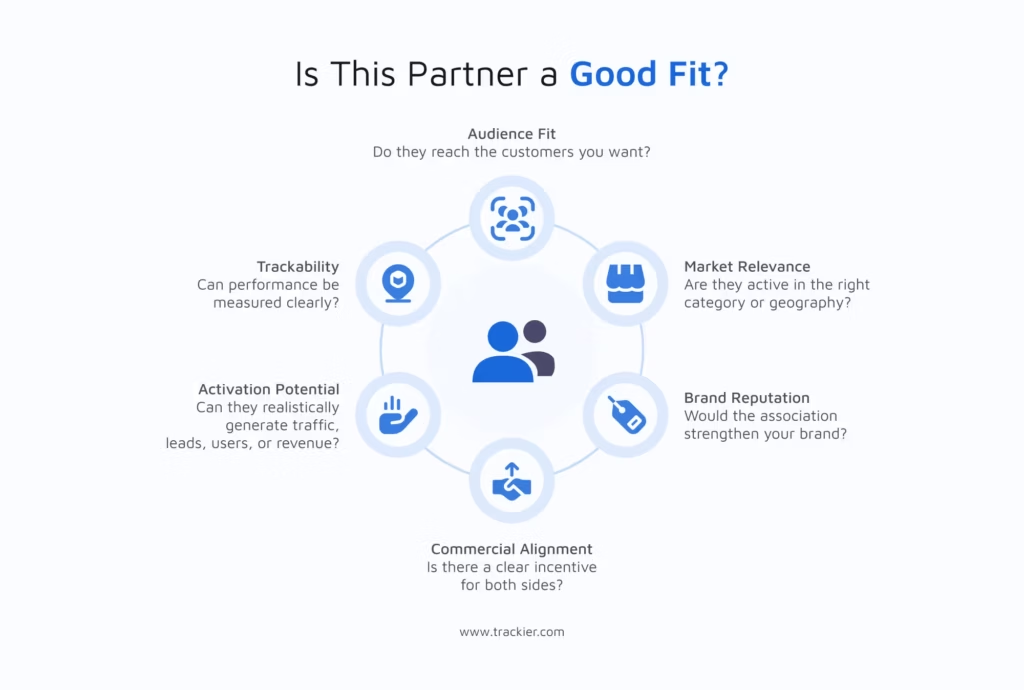
Then review the points that affect the partnership in practice.
The profile should also change by partner type. Agencies, creators, publishers, resellers, and technology providers bring different strengths, costs, and working styles. Using one qualification checklist for every category can remove promising partners for the wrong reasons.
A structured partner recruitment process helps move suitable businesses from research into outreach without filling the pipeline with names that have little chance of becoming active partners.
3. How Do You Find and Research the Right Decision-Maker?
Partnership roles are rarely consistent across companies. One business has a dedicated alliances function. Another gives the same work to business development, growth, marketing, product, or regional sales.
So, begin with the proposal rather than a job title.
A co-marketing idea will often sit with marketing or growth. Affiliate recruitment usually goes to affiliate or partner marketing. Product integrations tend to involve products, alliances, or business development. Reseller discussions are more likely to include channel sales and regional leaders.
The first person you find might still be the wrong person. Look at what they actually manage, the partnerships they discuss publicly, and the projects they have worked on. Their title offers a clue. Their work tells you far more.
Company research needs the same level of care. Review recent launches, new markets, existing integrations, partner announcements, customer groups, and public business priorities. This gives you enough context to judge whether the proposal fits before you start personalising the message.
Suppose a SaaS company has recently entered the US market. A proposal built around regional distribution or agency referrals has a clear connection with that move. A generic request to “explore synergies” does not.
Keep the research useful. A reference to someone’s latest LinkedIn post can show that you did your homework, but it will not rescue a weak proposal. Personalisation works when it connects your idea with a business priority, customer need, or current project.
There can also be more than one decision-maker. Marketing could support the idea, product could review feasibility, finance could examine the commercial model, and legal could review the agreement. Identifying these roles early helps the conversation move without repeatedly starting from zero.
Record the contact, research notes, previous messages, and likely stakeholders in one place. A clear partner relationship management process becomes useful once several conversations begin moving at different speeds.
4. How Do You Create a Mutual-Value Proposition?
Many outreach messages spend too much time introducing the sender. By the end, the recipient understands the company, but still has to work out why the proposed partnership deserves attention.
A stronger message makes the business case clear from their side as well.
Take an agency partnership. Saying, “We want access to your clients,” offers little reason to continue the conversation. A better proposal explains how the agency could add a missing service for its clients, improve campaign results, or create a new revenue stream without building the capability internally.
The same idea changes across partner types. A technology company will look for product compatibility and customer demand. A publisher will care about audience relevance and earning potential. A co-marketing partner will want a useful topic, a credible audience, and a fair split of the work.
Before writing the message, answer a few practical questions. Why does this company fit the opportunity? What can each side contribute? Which customer or business need does the partnership address? What result could both sides track? How much work would be required to test the idea?
This research needs to appear in the proposal, not as a forced compliment. Recent B2B research found that 85% of decision-makers associated a strong understanding of their company’s challenges and needs with high-quality business thinking. The research focused on vendor evaluation, but the lesson carries into partnership outreach. Relevance builds credibility before a formal discussion begins.
Keep the first proposal narrow enough to assess. A short pilot campaign, a referral test, a joint webinar, or an initial integration discussion gives both companies something concrete to review. Broad promises about “working together” leave the next step unclear.
A good value proposition does not claim that both sides will gain. It explains how. That clarity also helps the relationship develop into a more structured B2B partner marketing programme once the first opportunity is validated.
5. How Should You Combine Outreach Channels and Follow-Ups?
Email often carries the main proposal, but it does not need to carry the whole conversation.
A potential partner could notice your company through a shared contact, an industry event, a useful report, or a thoughtful LinkedIn interaction before opening the email. Each touchpoint adds context. Used with care, they make the outreach feel familiar without making it intrusive.
A follow-up study recorded its highest reply rate of 11.87% when email was paired with light LinkedIn activity.
The activity included profile views, follows, and relevant engagement rather than repeated direct messages. The figures come from sales outreach, so they should be treated as a useful signal rather than a fixed partnership benchmark.
Choose channels based on the person and the opportunity. A senior alliances leader could respond well to a warm introduction. An affiliate manager could be easier to reach through email or an industry community. Events work well when the proposed relationship needs a longer discussion before either side can assess it.
Follow-ups should add something to the conversation. The first can restate the idea in fewer words. The second can share a relevant example, campaign concept, customer request, or outline of how the partnership could work. A final message can close the conversation politely and leave space to reconnect later.
There is no useful universal sequence for every partner. A high-value technology integration deserves more research and wider stakeholder involvement than a simple content exchange. Timing also changes when the recipient has already shown interest or asked for material.
Keep each contact and response connected to the wider partner lifecycle. Once interest turns into a serious discussion, the next steps should move towards validation, agreement, onboarding, and activation rather than another round of outreach.
What Should a Partnership Outreach Email Include?
A partnership email should make three points clear within the first few lines. Why you chose the company, what you are proposing, and why the idea deserves a response.
Long introductions slow the message down. The recipient does not need your company history before they understand the opportunity.
How Should You Structure a Partnership Outreach Email?
Use a subject line that gives the reader some context. “Partnership opportunity” says very little. “Referral partnership for US SaaS clients” gives the recipient a reason to open the message.
The opening should connect with something relevant to the business. A recent launch, new market, customer group, integration, or partner programme can provide a natural starting point. Skip compliments that have no connection with the proposal.
Move into the idea quickly. Explain what the partnership could involve, what your business would contribute, and how the other company could benefit. Keep the first proposal focused enough for someone to assess without arranging a meeting to understand it.
A short proof point can help when it supports the idea. This could include customer demand, audience reach, regional experience, campaign results, or an existing use case. Avoid dropping several company figures into the email simply because they sound impressive.
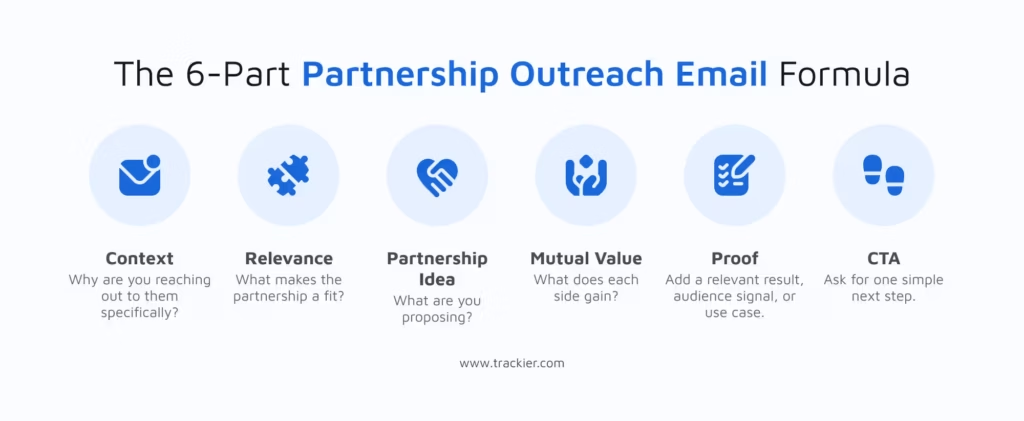
Close with one simple next step. Recent B2B prospecting guidance also recommends keeping outreach relevant and easy to act on.
A first message could read like this.
Hi [Name],
I noticed that [Company] is expanding its work with [relevant market or customer group]. We work with a similar audience and see a possible opportunity around [clear partnership idea].
We could contribute [your contribution] while helping both businesses [shared commercial outcome].
Would you be open to a short conversation to see whether the idea fits your current plans?
However, do not apply the same template to all situations. Ensure you map the specific partner requirement and list as per need, and implement accordingly. Here are some templates which can help you along.
General Partnership Outreach
Subject: Partnership idea for [Company]
Hi [Name],
I noticed [Company] is [specific relevant initiative]. We work with [audience/customer segment] and see a strong overlap around [specific opportunity].
One idea is to [specific partnership concept]. We could contribute [your contribution], while helping [Company] [specific benefit].
Would you be open to a short conversation to see whether it fits your current priorities?
Affiliate Partnership
Subject: Affiliate partnership with [Company]
Hi [Name],
We noticed your audience regularly engages with [relevant topic/product category]. We run a partner program for [product/category] and believe there may be a strong fit with your audience.
Partners receive [relevant benefit/commission/support], along with tracking and performance visibility.
Would it be useful if I sent over the program details?
Co-Marketing Partnership
Subject: Co-marketing idea: [Company] × [Your Company]
Hi [Name],
Our audiences overlap around [topic/customer problem], and I think there is an opportunity to create something useful together.
One idea is a [webinar/report/guide/event] on [specific topic]. We could handle [your contribution], while both teams distribute it to their respective audiences.
Interested in exploring it?
Technology or Integration Partnership
Subject: Integration opportunity for [shared customer group]
Hi [Name],
We work with [customer segment], and we have seen demand around connecting [your capability] with [their capability].
I think an integration could help shared customers [specific outcome].
If this aligns with your roadmap, would you be open to an initial product/partnership discussion?
The wording will change across integrations, co-marketing, referrals, and affiliate recruitment. The basic standard stays the same. Give the recipient enough context to understand the opportunity without making them search for the point.
What Subject Lines Create Most Impact in Partnership Outreach?
While no specific copy can lead to a landslide effect on your effort, there are a few subject lines which can give you an idea of what may strike a chord with potential recipients. Here are some of them:
- Partnership idea for [Company]
- [Your Company] × [Company]: quick idea
- Referral partnership for [customer segment]
- Co-marketing idea for [audience]
- Integration opportunity for [use case]
- Affiliate partnership with [Brand]
- Joint campaign idea for [market]
- Partnership around [specific business objective]
How Should You Follow Up on Partnership Outreach?
Silence does not always mean rejection. Partnership proposals often sit behind launches, client work, budget reviews, and internal approvals. A thoughtful follow-up brings the idea back into view without adding pressure.
Avoid sending the original message again with a different opening line. Each follow-up should move the conversation forward.
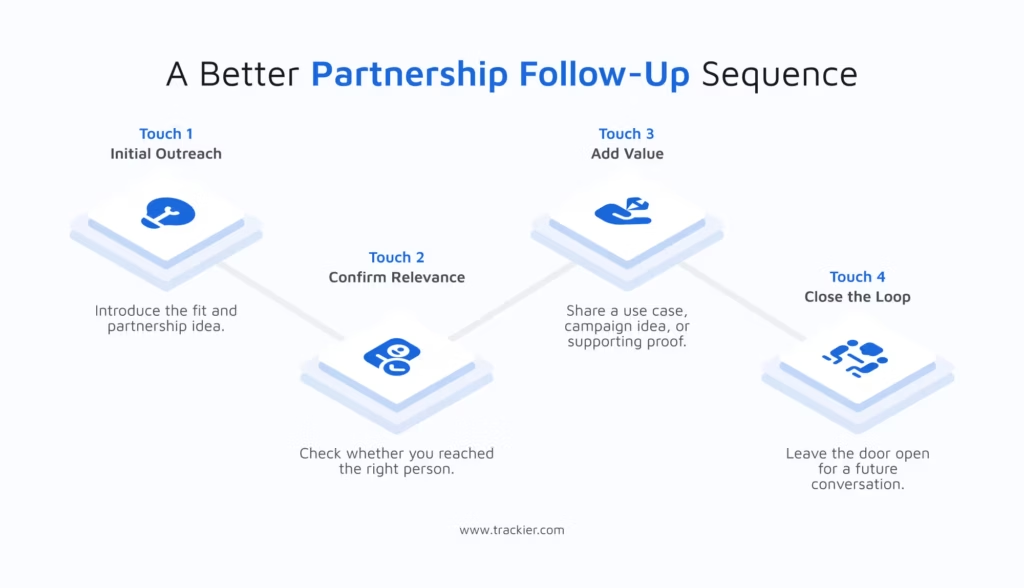
| Outreach Attempt | Purpose |
| Initial outreach | Present the fit, mutual value and one next step. |
| Follow-up 1 | Restate the proposal briefly and confirm you reached the right person. |
| Follow-up 2 | Add value: a customer example, campaign concept, use case or evidence of demand. |
| Final follow-up | Close the loop and leave an easy route to reconnect later. |
The first message can restate the proposal in fewer words and ask whether it falls within the recipient’s role. If there is no response, the next one should add something useful. Share a short campaign idea, evidence of customer demand, a relevant use case, or a clearer view of how both businesses could contribute.
A final note can close the loop politely. It gives the recipient an easy way to decline, redirect you to a colleague, or revisit the idea at a better time.
No fixed schedule suits every partnership. A simple co-marketing proposal can move faster than a product integration that needs input from product, legal, finance, and commercial leaders. Space messages far enough apart to respect the recipient’s workload, then adjust the sequence when they show interest.
The spacing between these messages should reflect the size and complexity of the opportunity. A simple affiliate or co-marketing proposal can move faster than an integration requiring product, legal and commercial approval.
When Should You Stop Following Up?
Stop when the recipient declines, asks not to receive further messages, or confirms that the proposal has no current fit. Continued silence after a short, well-spaced sequence is also a good reason to pause.
Outreach must follow the rules of the market where the recipient is based. In the US, the FTC’s CAN-SPAM guidance requires accurate sender details, honest subject lines, a valid postal address, and a clear way to opt out of commercial email.
Email practices also affect delivery. Google’s current email sender guidelines require authentication for messages sent to Gmail accounts. Senders handling more than 5,000 messages a day face added requirements for one-click unsubscribe and spam control.
A smaller, relevant outreach list is easier to manage and safer for sender reputation than repeated contact with businesses that have shown no interest.
Where Do You Find Potential Partners?
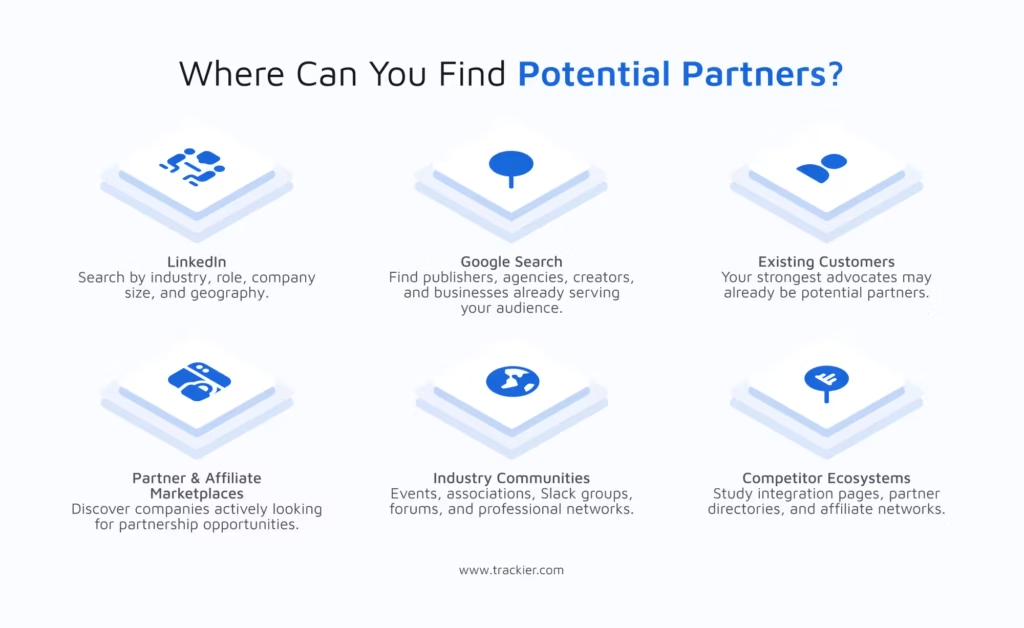
Potential partners can come from several sources:
- Google searches for companies, publishers, agencies, creators, and comparison sites serving your target market.
- LinkedIn searches using industry, location, role, company size, and partnership-related job titles.
- Existing customers who already understand and recommend your product.
- Current partners who can introduce other businesses in their network.
- Affiliate, creator, technology, and partner marketplaces.
- Industry conferences, communities, associations, and online groups.
- Competitor ecosystems and integration directories.
- Search results for commercial keywords related to your product, which can reveal publishers and content partners already reaching your intended customers.
The source matters less than fit. Every prospect should still pass the same ideal-partner criteria before outreach begins.
How Do You Measure Partnership Outreach Success?
Replies and meetings show that the outreach has created interest. They do not show whether the prospect was suitable, signed an agreement, became active, or produced business value.
Measurement should follow the full path from first contact to partner contribution.
Which Partnership Outreach Metrics Should You Track?
Start with the quality of the outreach pipeline.
| Metric | What it tells you |
| Qualified prospects identified | Whether prospecting is producing relevant candidates |
| Outreach response rate | Whether targeting and messaging are generating conversations |
| Positive response rate | How many replies show genuine interest |
| Meetings or qualified conversations | Whether outreach is creating viable opportunities |
| Partner acceptance rate | How many qualified conversations become partners |
| Activation rate | How many recruited partners take the first meaningful action |
| Time to activation | How efficiently partners move from agreement to activity |
| Partner-sourced conversions or revenue | Whether recruited partners ultimately create commercial value |
These figures expose different problems. A low reply rate can point to weak targeting or messaging. Plenty of replies with few qualified conversations suggests that the prospect list is too broad. Strong meeting numbers with few agreements can signal unclear terms, poor fit, or a proposal that asks for too much.
What Should You Measure After a Partner Agrees?
Signed agreements can create an inflated view of programme growth. Some partners never complete onboarding. Others launch one campaign and then become inactive.
Track whether the relationship progresses.
Partner activation rate measures the share of signed partners that complete the first agreed activity, such as launching a campaign, submitting a referral, publishing content, or completing an integration.
Partner activation rate = Activated partners ÷ Signed partners × 100
From there, review partner-sourced leads, conversion quality, revenue, retention, time to first result, commission costs, and return on programme spend. The final set of metrics should reflect the partnership model. Referral partners, affiliates, agencies, and technology partners create value in different ways.
Partner programmes are also moving towards outcome-based measurement. Google Cloud’s 2025 Partner Network update shifted its programme away from tracking administrative activity and towards verified partner contributions across the customer lifecycle, including pre-sales influence, service delivery, and post-sales support.
A clear marketing analytics setup connects partner activity with conversions, revenue, customer quality, and long-term performance. Without that view, outreach reporting ends at the point where the commercial relationship has barely started.
What Happens After a Potential Partner Says Yes?
A positive reply opens the discussion. It does not confirm that both businesses are ready to work together.
The next conversation should test the proposal in practical terms. Discuss the audience or customer opportunity, the contribution expected from each side, the commercial model, the people involved, and the resources needed to launch. Questions raised at this stage are easier to solve than problems discovered halfway through a campaign.
Keep the first plan focused. A referral test, a joint webinar, a pilot campaign, or an integration review gives both businesses a clear starting point. Large, open-ended proposals often move slowly because nobody knows which decision comes first.
Once the idea is agreed upon, document the working arrangement. Set out ownership, timelines, approval steps, tracking requirements, payment terms, data access, compliance responsibilities, and the result that both sides will review. Legal agreements should reflect the partnership type and the markets involved.
Onboarding should then prepare the partner for the first useful action. Give them access to the relevant platform, product information, campaign terms, brand material, tracking links, technical documents, and support contacts. Avoid sending a large resource folder without explaining what to use first.
Different partners need different routes. An affiliate needs campaign access, tracking details, creative assets, and payout terms. A reseller needs product training, pricing guidance, and sales material. A technology partner needs documentation, testing access, named technical contacts, and an agreed launch process.
Set the first activation milestone during onboarding. It could be the first referral, published campaign, registered deal, completed training module, or successful integration test. A structured partner onboarding process helps move the relationship from agreement to activity without losing momentum between the two stages.
How Can You Manage Partner Performance After Outreach?
Once a partner begins promoting, referring, selling, or integrating, the conversation moves into daily programme management.
Each partner needs a clear campaign setup, agreed conversion rules, access to performance data, and a reliable payment process. Without a shared view of results, questions around attribution, lead quality, commissions, and campaign ownership can slow the relationship down.
A partner and affiliate marketing platform brings these activities into one system. Businesses can record clicks and conversions, compare partner performance, apply commission rules, create reports, and review suspicious traffic before payouts are approved.
Access also needs some structure. Partners should be able to view the campaigns, links, creatives, earnings, and reports relevant to their work without seeing information meant for other partners.
Performance reviews can then focus on useful questions. Which partners are bringing qualified customers? Which campaigns need a different payout model? Where are conversions dropping? Which relationships deserve more support or budget?
Outreach creates the opportunity. Clear tracking and partner operations give the relationship enough structure to grow.
What Partnership Outreach Mistakes Should You Avoid?
Most outreach problems come from decisions made before or after the email, rather than the wording inside it.
- Using one proposal for every partner type. A referral partner, agency, creator, reseller, and technology provider will judge the opportunity differently. The message, commercial model, support plan, and proof should reflect the role being discussed.
- Hiding the work involved. A proposal can sound attractive until the recipient learns that it requires technical setup, frequent approvals, content production, or dedicated sales support. Share the expected contribution early enough for both businesses to judge whether the plan is realistic.
- Leaving internal ownership unclear. Interest can fade while several departments decide who should manage the relationship. Assign responsibility for commercial discussions, legal review, onboarding, reporting, and ongoing communication before outreach gains momentum.
- Counting agreements instead of active partners. Signed partners can make a programme appear larger without increasing referrals, conversions, or revenue. More than 60% of partnership functions are now measured against pipeline performance, according to the 2026 Guide to Partner Management and Enablement. Recruitment goals should therefore sit beside activation and commercial targets.
- Ignoring the reasons behind rejection. A declined proposal can reveal poor timing, weak fit, unclear value, or an issue with the commercial model. Record those reasons. Patterns across several conversations can improve partner criteria and future messaging.
Strong outreach filters out weak fits early and gives suitable partners a clear route towards the first shared result.
Frequently Asked Questions
1. What is partnership outreach?
Partnership outreach is the process of finding, assessing, and contacting businesses that could support a shared commercial goal. The relationship could involve referrals, affiliates, integrations, co-marketing, distribution, reselling, or another agreed model.
2. How do you approach a company for a partnership?
Begin with a clear reason for choosing the company. Find the person responsible for the relevant partnership type, study current business priorities, and present one focused idea. Explain the contribution from each side and suggest a simple next step.
3. How do you write a partnership outreach email?
Keep the message brief and specific. Open with a relevant business context, explain the partnership idea, state the shared benefit, add one useful proof point, and close with a clear question. Avoid long company introductions and vague requests to discuss possible collaboration.
4. How many follow-ups should you send after a partnership email?
Send a short, well-spaced sequence rather than repeated reminders. Use each message to add context, answer a likely concern, or share a useful example. Pause after continued silence, and stop immediately when the recipient declines or asks to receive no further contact.
5. How do you know whether a potential partner is a good fit?
Check audience overlap, business goals, market reach, reputation, delivery capacity, and the resources required from both sides. A suitable partner should bring a clear benefit to the proposed relationship and have enough interest and capacity to take the first agreed action.
6. What should you say when asking for a partnership?
Explain why you selected that company, describe one specific partnership idea, show the benefit for both sides, and ask for a simple next step. Avoid vague requests to “explore synergies” without explaining what the collaboration would involve.
7. Where can you find potential partners?
Potential partners can be found through LinkedIn, Google, customer networks, existing partners, industry communities, marketplaces, conferences, integration ecosystems, publishers, creators, and companies already serving your target audience.
8. What is the difference between partner recruitment and partnership outreach?
Partner recruitment covers the wider process of attracting, qualifying, onboarding, and activating partners. Partnership outreach is the proactive part of that process in which a company identifies suitable prospects and contacts them directly.