If you have actively run a performance marketing program in the last two years, you might be able to relate to the following –
- Campaigns that used to convert predictably are now becoming harder to read
- Attribution numbers don’t quite add up across the platforms
- Spending increases every quarter, but the results remain the same
One might start thinking of it as bad luck, but if we consider it more rationally, then it is the result of the direct data system that performance marketers have been relying on for a long time.
Third party cookies are not as relevant anymore as they were before, and privacy regulations are tightening. Customers do not hesitate before clicking on the “reject all cookies” button. Gone are the days when ad platforms used to do the heavy lifting of targeting and attribution. This is because they work with less information than ever.
User data collection is still necessary for a business to function properly. Salesforce State of Commerce report suggests that 92% of companies are using customer data to understand their behaviour.
To grow efficiently in this scenario, having a big budget is not enough. Quality of data is important here, especially first party data. This data is the information brands collect directly from their own customers, on their own properties, with consent.
This article aims to break down what first party data actually is, why it’s become the backbone of modern performance marketing, and how brands can put it to work.
What is First Party Data?
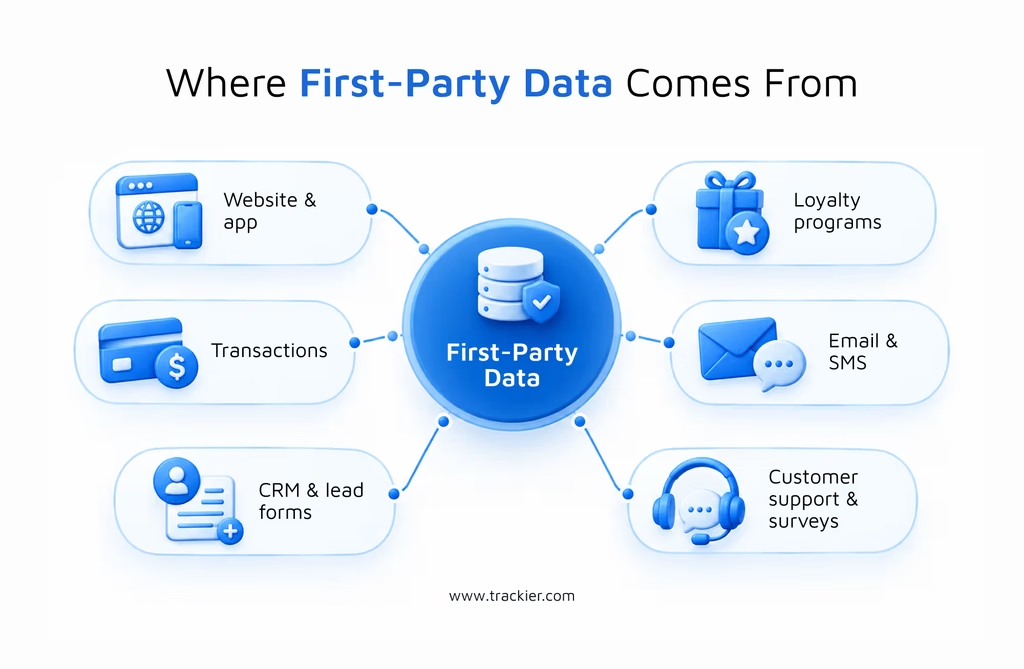
This data includes any information a brand collects directly from its own audience, through its own channels like website, app, CRM, point of sale, or customer support. This process must be consensual.
The concept can be understood better when compared to the other types of data marketers have historically relied on –
- First party data – Collected directly by the brand from its own customers and users (purchase history, app activity, email engagement, on-site behavior).
- Second party data – Another company’s first-party data, shared through a partnership (for example, a retailer sharing customer insights with a brand it co-markets with).
- Third party data – Aggregated from many unrelated sources by data brokers and sold to advertisers, often without a direct relationship to the end user.
The reason first-party data is having a moment is that the alternatives (second- and especially third-party data) are becoming less reliable, less available, and in many cases, legally riskier to use.
Common examples of this type of proprietary data that performance marketers can actually put to work include –
- Purchase and transaction history
- On-site and in-app behavior (pages viewed, features used, cart abandonment)
- CRM records and lifecycle stage
- Loyalty program activity
- Email and SMS engagement
- Customer support interactions and survey responses
- Conversion events passed back from tracking platforms (clicks, installs, sign-ups, sales)
Conversion data must especially be taken into account. In affiliate and performance marketing, the conversion data that flows through the tracking platform is the first party data. This data is the richest, action-ready dataset that a performance team could have.
First Party Data vs Third Party Data
The two types of data are mostly talked about alongside, or against each other. Before understanding how brands use either, it is important to know what makes them part ways.
It is established that first hand data is directly collected by the brand with customers’ knowledge. It is accurate and safer.
But, because third party data is aggregated by brokers and sources that have no direct relations with the users, it is less trusted. It is often modelled or implied rather than being observed, and the consent behind it is almost obscure. This is why its usefulness is shrinking as browsers block the cookies it depends on, and privacy laws tighten around it.
Performance marketers can understand this difference better because they can practically see the numbers. First party data gives attribution and audiences that can actually be relied on. Third party data, on the other hand, gives guesswork that the brands eventually have to pay for
Why Has First Party Data Become Important for Performance Marketing?
The End of Third Party Cookies
The role of third-party cookies lets advertisers track users across websites, build lookalike audiences, and retarget shoppers who abandoned a cart. Browsers, however, are closing that door now. Safari and Firefox blocked third party cookies by default a long time back. Chrome, which commands the largest browser market share, has been rolling out its own privacy-first changes.
Even where cookies technically still work, ad blockers, in-app browsers, and privacy-focused users mean fewer of them fire reliably.
This has literal consequences for performance and affiliate marketers –
- Attribution window gets shrunk
- Retargeting pools get shrunk
- The “spray and optimize” approach that once worked when tracking was cheap is not relevant anymore
Privacy Regulations are Rewriting the Rules
All the prominent acts like GDPR, CCPA, and India’s DPDP Act and some other growing regional privacy laws have clarified that data collection without explicit permission is a legal liability for businesses.
First party data sets aside the risk that third party data tends to bring to the table. When a customer gives their email to sign up for the loyalty program or agrees to app tracking, the business must have a clear, documented basis for using that data. This is something third-party data providers often can’t offer.
Rising Acquisition Costs are Forcing Efficiency
With third party tracking, targeting was also getting less precise. As a result, cost per acquisition tends to go up. Performance marketers had to ultimately pay for a broader audience, which makes the whole process lack precision.
Brands with strong first-party data, on the other hand, don’t face this issue. They can instead build audiences and lookalikes from actual customers and not modelled guesses or even data purchases. This process, hence, keeps the customer acquisition cost in check.
Attribution is Getting Harder Without Clear Data
The success of multi-touch attribution depends on whether it is able to connect a click to a conversion, and that too across devices, sessions, and channels. When cookies drop off, or tracking gets blocked, that chain breaks. This causes brands to lose visibility of which platforms, channels, or campaigns actually drove the sale.
This is exactly where a strong first-party data foundation, paired with affiliate tracking software built for a post-cookie world, keeps performance marketing measurable.
How is First Party Data Collected?
Now that we have established that first-hand data collection is the best mode of consumer data collection. It is important to understand how this data is collected.
Key Collection Methods
- Website and app tracking – Implementing tracking pixels, tags, and analytics tools on the digital properties records user behavior, page views, time on site, and navigation patterns.
- Transactional systems – E-commerce checkouts and order platforms automatically capture purchase history, average order value, cart abandonment, and product preferences.
- CRM and lead forms – Contact forms, newsletter sign-ups, gated content downloads, and account registrations gather direct user identifiers like names, emails, and phone numbers.
- Direct feedback and engagement – Customer surveys, polls, quizzes, support chat logs, and email engagement metrics (opens and clicks) log explicit preferences and sentiments.
How Brands Can Start Using First Party Data
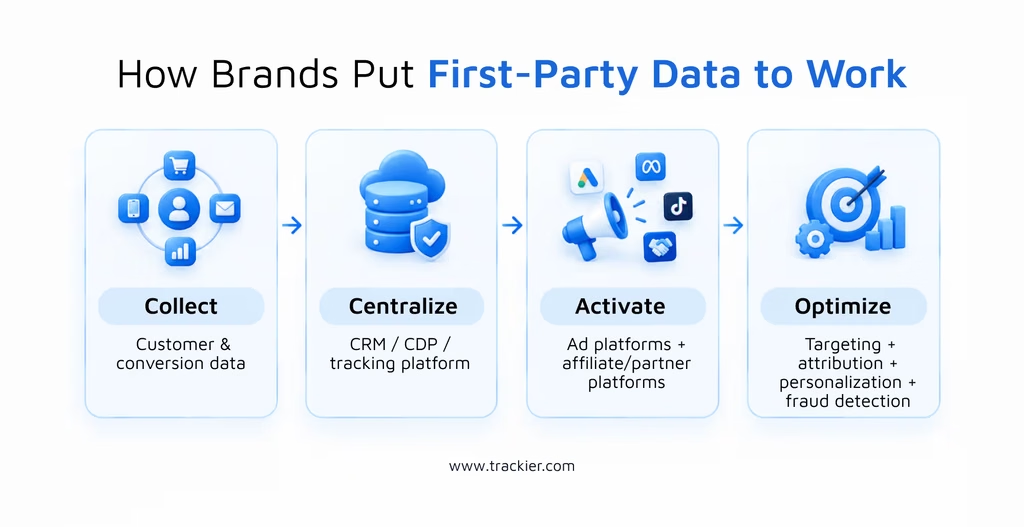
Collecting data is one thing, and operationalizing that data is another. The latter is the more complex and crucial part. Here is the practical path to this –
Build the Right Data Infrastructure
Before making use of the data, make sure that it is living in one space and is not scattered across five different tools. To bring this into action, the brand would require –
- A customer data platform or a well-structured CRM as the central hub.
- Consistent tracking across the web and app.
- A performance marketing or affiliate tracking platform that can capture and pass conversion data reliably
Without this, the data might remain in silos. Collected, but not actually usable.
Connect the First Party Data to Attribution or Marketing
This is where performance marketing teams see the most immediate payoff. When a tracking platform can capture real conversion events directly from their systems, attribution becomes dramatically more reliable.
This is the core of how Trackier approaches tracking. Instead of leaning on cookie-based methods that are often blocked or unreliable, Trackier supports server-to-server (S2S) postback tracking, which passes conversion data directly from your backend to the platform.
This is, functionally, first-party data doing the heavy lifting for attribution. For brands running affiliate and partner programs, this means –
- Conversions get attributed to the right partner even when browser-based tracking fails
- Multi-touch attribution models can work off real brand-owned event data
- Reporting stays consistent even as privacy restrictions are tightened
Feed First Party Signals into Ad Platforms
Meta, Google, and TikTok — all have built conversion APIs specifically so that advertisers can send first-party conversion data to the server side. Brands that connect their first-party conversion data to these APIs typically see better-optimized campaigns, because the ad platform’s algorithm is learning from real outcomes instead of degraded signals.
This logic is also applied in the affiliate and partnership system. The more data a tracking platform can capture and share with the ad and partner tools, the smarter the downstream optimization gets.
Segment and Personalize Based on Real Behaviour
Once the data is centralized, it can be used beyond one-size-fits-all campaigns. How?
- Segment customers by purchase frequency, recency, and value
- Trigger different offers for new users versus lapsed customers
- Route high-intent segments to the best-performing partners or affiliates
- Suppress audiences who’ve already converted to avoid wasting spend
The Value it Brings to Performance Campaigns
It’s easy to treat “collect first-party data” as a checkbox. The real value only shows up when that data is actually put to use. Let us look at this impact –
- More accurate attribution – A verifiable link between a partner’s traffic and a real outcome, instead of relying on third-party signals that may be incomplete or delayed.
- Sharper audience targeting – A customer list built from real purchasers or high-value users makes far better source audiences for lookalike targeting.
- Personalization that actually converts – Knowing what a customer already bought, browsed, or engaged with makes it easier to deliver tailored offers and creative instead of showing generic ads to everyone.
- LTV-based bidding and budget allocation – Instead of optimizing purely for cost-per-click or cost-per-install, first-party purchase and retention data helps with optimization for potentially valuable customers.
- Stronger fraud detection – Precise and real-time conversion and engagement data makes it easier to spot patterns that might not look like genuine human behaviour. This becomes a crucial layer of protection in affiliate and partner channels where there is a constant risk of fraud.
- Consistency across channels – When first party data feeds data in every channel from the same source, then paid, affiliate, and lifecycle marketing teams stop working off conflicting numbers that could be misleading

Common Mistakes Brands Make With First Party Data
Stumbling with execution is normal, even for the brands that are experienced with first party data collection. Which is why it is important to watch out for certain mistakes that can unintentionally be committed.
- Gathering emails or behaviour data “just in case” without any follow-up plan to activate is a waste of opportunity and time. It also adds unnecessary and avoidable fraud risk.
- If there is data, it should not remain siloed. Data that does not interact with ad platforms or the tracking tool does not serve any meaningful purpose.
- Consent should not be treated as a formality. If the customer is not able to trust the consent flow, their trust will erode off of the brand when it is the very relationship first-party data depends on.
- Duplicate records, outdated contact information, and inconsistent event naming subtly subvert every campaign built on top of them.
- If the affiliates and partners can’t see accurate, first-party-informed performance data, they can’t optimize their own traffic to send better leads.
A Practical Checklist for Performance Marketers
Add these questions to your strategy checklist before running the next campaign and that would be the roadmap for the quarter –
- Do we have a single source of truth for customer and conversion data?
- Is our tracking platform capturing conversions via server-side or postback methods, not just cookies?
- Are we passing first-party conversion events back to ad platforms through their conversion APIs?
- Can we segment customers by real behavior, not just demographic guesses?
- Are our affiliates and partners seeing accurate, timely performance data?
- Do we have fraud detection in place that relies on real conversion patterns, not just click counts?
- Is our consent and data collection process actually transparent to customers?
To Wrap It Up
The shift to first party data is a shift to a more durable foundation for performance marketing altogether. The data that a brand owns, when collected with consent, is tied to real customer behaviour. It will always outperform borrowed or purchased signals in the long run, irrespective of what happens next with browser policy or regulation.
For brands running affiliate, partner, or app growth programs, the path forward is straightforward even if the execution takes work.
- Centralize the data
- Connect it to a platform that is built for a cookie-light world
- Use it to sharpen attribution, targeting, and fraud detection at every step
Trackier is built so that gaps like these are closed. It does so by giving performance marketers accurate, privacy-friendly tracking and real-time reporting rooted in first-party conversion data. This way, growth does not come at the cost of precision.
FAQ
What is first-party conversion data and why is it valuable?
First-party conversion data is information about completed actions that a business receives directly from its own systems, such as a CRM, ecommerce platform, app, or backend. Some examples of this include qualified leads, purchases, subscriptions, deposits, and revenue events. Its value comes from being tied to actual business outcomes rather than relying only on clicks, impressions, or platform-estimated conversions
What is the difference between first-party data and zero-party data?
First-party data is information a company collects directly from customer interactions, such as purchases, website activity, app usage, or email engagement. Zero-party data is information a customer intentionally and explicitly provides about themselves, such as preferences, interests, or purchase intentions through a survey or preference centre. Zero-party data is therefore a particularly explicit form of customer-provided information, while first-party data also includes observed behavioural and transactional signals.
What first-party data should performance marketers prioritize collecting?
The most useful data is usually data that can be connected to a meaningful business outcome. Depending on the business, this can include qualified leads, purchases, subscription events, customer value, repeat purchases, product usage, cancellations, and partner-generated conversions. Prioritizing outcome-linked data is more useful than collecting large amounts of behavioural information that the marketing team has no clear plan to activate.
How does first-party data support value-based bidding?
First-party customer and conversion data can provide advertising platforms with information about which conversions are more valuable to the business. For example, instead of treating every lead as equal, a company can distinguish between leads that become customers and those that do not. Where the relevant platform supports it, these outcome signals can then be used to optimize campaigns toward higher-value conversions rather than simply maximizing conversion volume.