CPC marketing is a performance-based model where you pay partners for every eligible click they send to your offer. In partner marketing, that gives you a predictable price for traffic and a clear record of who delivered it.
Sounds simple. Here’s the catch: clicks are cheap to buy and hard to judge. A partner can send you 50,000 clicks without a single customer among them, and you still owe the payout.
This guide covers how CPC works inside a partner program, what moves your cost per click, how to optimise campaigns, and which metrics tell you whether a partner deserves to stay.
What Is CPC Marketing in Partner Marketing?
CPC (Cost Per Click) means the advertiser pays a partner a fixed or negotiated amount for each eligible click their promotion generates. “Eligible” means the click passes your validity rules: right geography, no duplicates, no bot traffic, and within your caps.
The aim is relevant traffic at an acquisition cost you can measure and control.
Other performance models differ in what triggers the payment:
- CPC: you pay when someone clicks
- CPL: you pay when someone becomes a lead
- CPA or CPI: you pay when someone completes a defined action, like a purchase or an app install
- Revenue share: you pay a percentage of sales
CPC fits when you need volume early in the funnel: a product launch, a content-led campaign, a comparison site sending shoppers to your category page, or a brand testing a new audience before committing to conversion-based payouts.
It also carries the most quality risk. You’re paying before the user has done anything of value, so the partner’s incentive is clicks, not customers. That’s why tracking and validation matter more here than in almost any other model.
How Does CPC Partner Marketing Work?
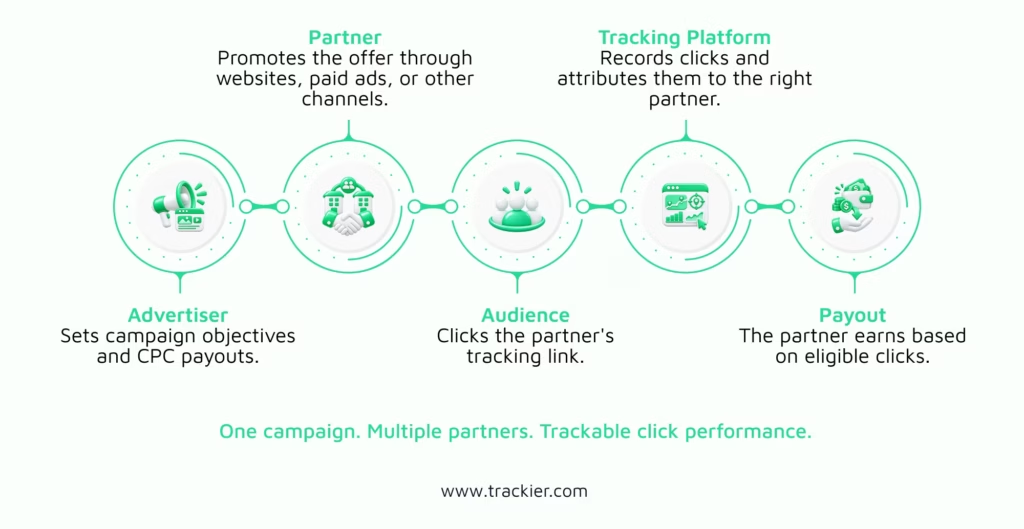
One campaign can run across dozens of partners, each sending traffic through its own tracked link. The flow has five parts:
- The advertiser sets objectives and payouts. You define the campaign goal, landing page, eligible geographies, and CPC rate. Rates can be the same for everyone or vary by partner, geo, or traffic type.
- The partner promotes the offer. Traffic comes from content sites, coupon pages, social, email, influencer posts, or paid ads. Each partner gets a unique tracking link.
- The audience clicks. The moment a user clicks, the click is stamped with a partner ID, a campaign ID, a timestamp, and a unique click ID.
- The tracking platform records and attributes the click. This is where validity gets checked. Is it a duplicate? Does it come from a flagged IP or a known bot range? Is it inside the campaign’s geo and cap limits? Valid clicks are attributed to the right partner. Invalid ones are filtered or held.
- The partner earns the payout. Payouts are calculated on eligible clicks, then approved and paid on the agreed cycle.
- The unique click ID is the detail that makes the rest work. The click ID travels with the user, so when a conversion happens later, you can tie it back to the exact click and partner. Without it, you can pay for clicks but never connect them to outcomes.
Top Five Factors that Influence Your CPC?
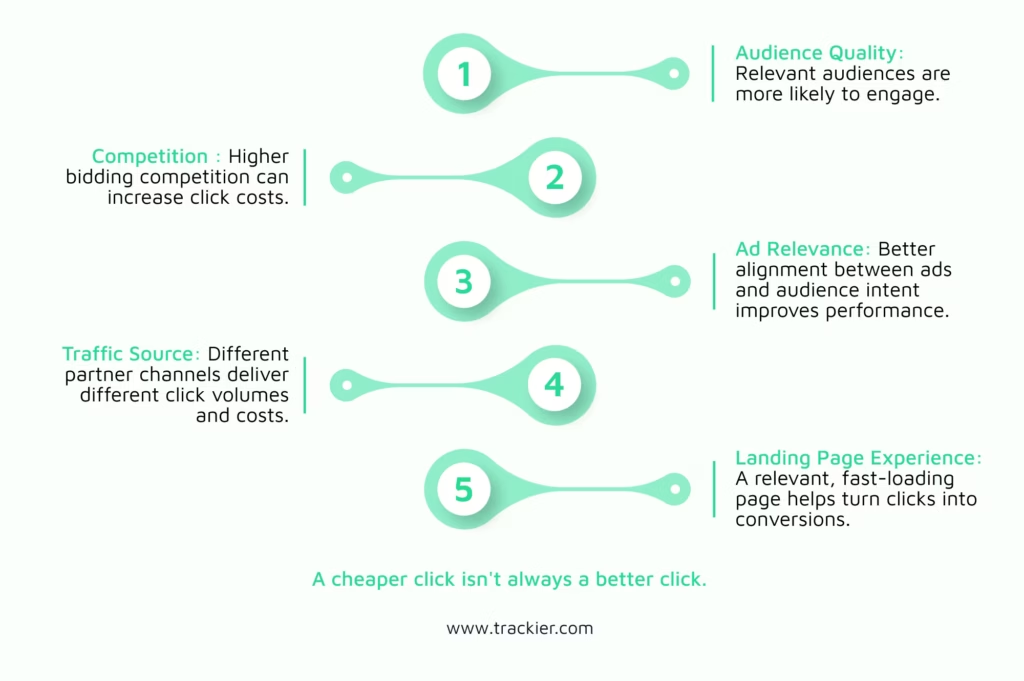
Your effective cost per click isn’t just the rate you set. Five factors shape it, and each one changes whether the click is worth paying for.
Audience quality. Relevant audiences engage more. A click from someone actively researching your category costs the same as one from someone who tapped by accident, but the two are worth very different amounts.
Competition. When partners buy traffic through paid channels, heavier bidding pushes up their own costs. They then ask you for higher payouts, or move their volume to advertisers who pay more. In crowded categories like fintech, travel and food delivery, that pressure never really lets up.
Ad relevance. The closer an ad matches audience intent, the better it performs. A partner whose creative matches your offer’s promise sends users who know what they’re clicking into.
Traffic source. A coupon site, a review blog, a social creator, and a push notification network all behave differently on click-through, intent, and conversion, and they deliver different volumes at different costs.
Landing page experience. A relevant, fast page turns clicks into conversions. If yours takes six seconds to load on a mid-range Android phone over 4G, you’ll lose a big share of Indian mobile traffic before it sees your offer. That cost lands on you, not the partner.
What ties all five together is that a cheaper click isn’t always a better one. A Rs 2 click that converts at 0.5% costs far more per customer than a Rs 4 click that converts at 2%. The metrics section puts real numbers on this.
Top Five Ways to Optimise CPC Marketing Campaigns?
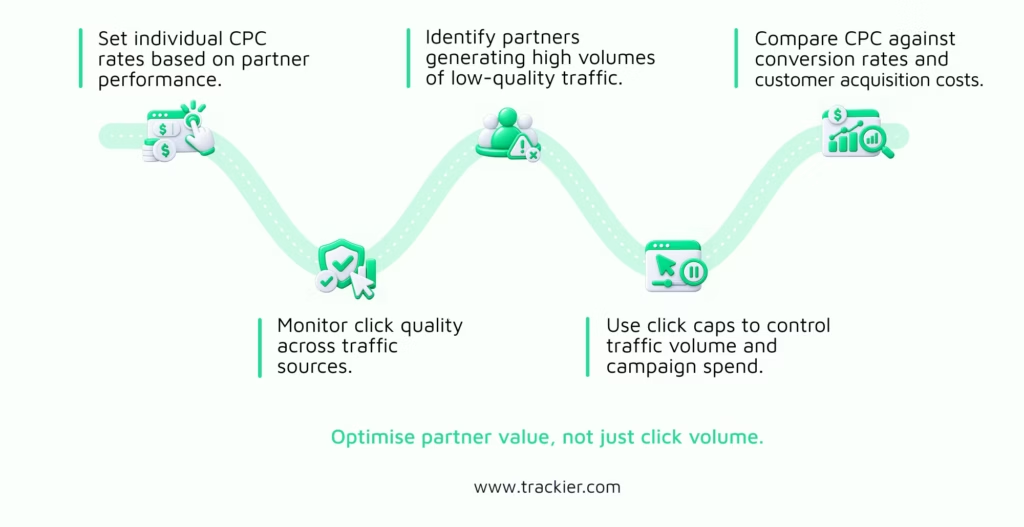
Optimising CPC marketing means moving spend toward partners who deliver value and away from those who only deliver volume. Five practices do most of the work.
Set individual CPC rates based on partner performance. A flat rate overpays your weakest partners and underpays your best. Start new partners at a test rate, raise it for those whose traffic converts, and lower it or pause for those whose traffic doesn’t.
Partners respond to this, and over time you end up with a stronger roster.
Monitor click quality across traffic sources. Don’t stop at the partner level. One partner may run five traffic sources, and a single one could be dragging the average down. Break reports down by source, sub-ID, geo, device, and placement.
Identify partners generating high volumes of low-quality traffic. The warning signs are fairly consistent:
- lots of clicks with near-zero conversions
- users leaving almost immediately after clicking
- clicks bunched up at odd hours
- repeated clicks from the same IP ranges
- sudden spikes with no change in promotional activity
Catch these early. If you wait for a monthly reconciliation, you’ve already paid for weeks of bad traffic.
Use click caps to control volume and spend. Daily, weekly, or total caps, set at partner or campaign level, stop a runaway partner from burning through your budget in a weekend. They also give you a safe way to test new partners: let them prove quality at limited volume before you open the taps.
Compare CPC against conversion rates and customer acquisition costs. CPC tells you what you paid, not what you got. Always read it next to click-to-conversion rate and CPA.
The principle under all five: optimise for partner value, not click volume.
Which CPC Metrics Should Partner Managers Monitor?
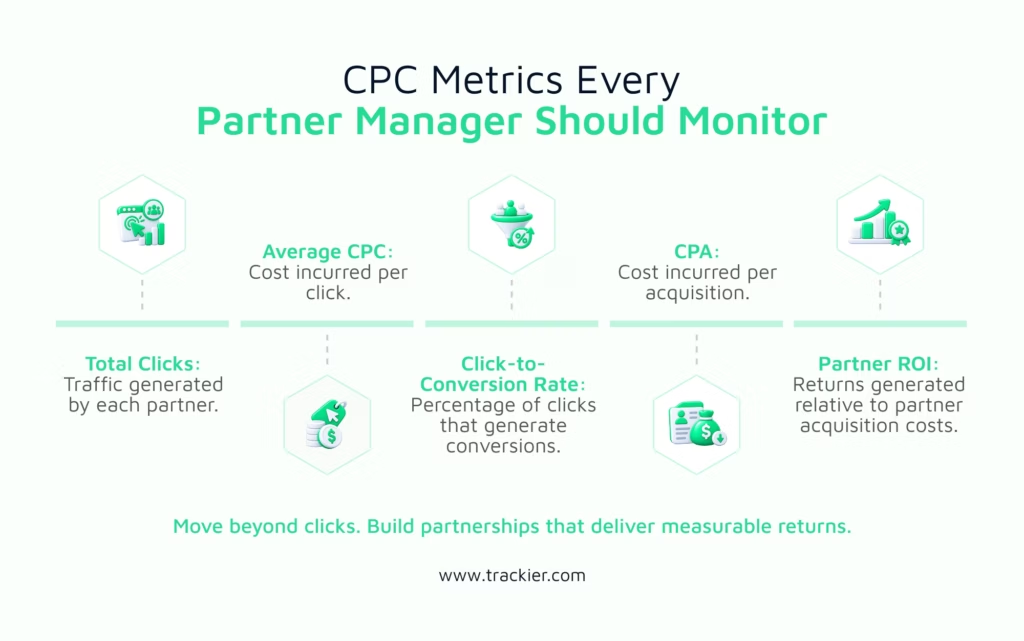
Five metrics give you the full picture, from traffic through to returns.
Total clicks: the traffic each partner generates. This is your volume baseline.
Average CPC: what you pay per click. Total click spend divided by total clicks.
Click-to-conversion rate: the percentage of clicks that become conversions. Conversions divided by clicks, multiplied by 100. This is your quality signal.
CPA: what you pay per acquisition. Total spend divided by conversions. It’s the number that connects clicks to customers.
Partner ROI: the return relative to what the partner costs. (Revenue minus partner cost) divided by partner cost, multiplied by 100.
Here’s how two partners compare on the same campaign, assuming each conversion is worth Rs 600 in revenue:
| Metric | Partner A | Partner B |
| Eligible clicks | 10,000 | 10,000 |
| Average CPC | Rs 4 | Rs 2 |
| Click spend | Rs 40,000 | Rs 20,000 |
| Conversions | 200 | 50 |
| Click-to-conversion rate | 2% | 0.5% |
| CPA | Rs 200 | Rs 400 |
| Attributed revenue | Rs 1,20,000 | Rs 30,000 |
| ROAS | 3.0x | 1.5x |
Partner B looks cheaper on CPC. Yet Partner A is twice as cost-efficient on CPA and returns four times the ROI. Optimise for the lowest click cost, and you’d have scaled the wrong partner.
Read these metrics together, never one at a time. Lots of clicks with a low conversion rate point to a traffic quality problem. A strong conversion rate with a high CPC might still be profitable, and might even justify a higher cap. A low CPA with low volume? That’s a partner worth scaling.
Clicks are only the start. The partnerships worth keeping are the ones that show measurable returns.
How Does Trackier Support CPC Marketing?
CPC campaigns only work when your tracking is reliable and your decisions are quick. Trackier gives partner teams the infrastructure for both:
- Unique click IDs and tracking links per partner, so every click and downstream conversion traces back to its source
- Partner-level payout rules, so you can set different CPC rates by partner, geo or campaign
- Caps and targeting rules to control volume and spend
- Fraud detection that flags and filters invalid or suspicious clicks before they reach payouts
- Real-time reporting that puts clicks, conversions, CPA and ROI side by side
The result is a program where you can see which partners are worth scaling and which need a conversation, without waiting for end-of-month spreadsheets.
FAQs About CPC Marketing
What does CPC mean in partner marketing?
CPC stands for Cost Per Click. The advertiser pays a partner a set amount for each eligible click sent to their offer through the partner’s tracking link. What counts as eligible depends on rules like geography, duplicate filtering and caps.
How is CPC different from CPA?
With CPC, you pay for the click. With CPA, you pay only when the user completes a defined action, like a purchase or sign-up. CPC leaves more of the quality risk with you as the advertiser. CPA shifts it to the partner.
When should a brand choose CPC over CPA?
Choose CPC when you need top-of-funnel traffic, you’re launching something new, you’re testing a new audience, or you’re working with content and comparison partners who influence the early stages of the journey. Brands with a strong landing page and good tracking get the most out of it.
How do you prevent click fraud in CPC campaigns?
Use unique click IDs, IP and device-level validation, duplicate click filtering, geo checks and click caps. Watch for click spikes, near-zero conversion rates and odd timing. A tracking platform with built-in fraud detection will catch most of this automatically.
What is a good CPC for partner campaigns?
There’s no universal number. It depends on your industry, your geography and what a customer is worth to you. The better question is whether your CPC, combined with your click-to-conversion rate, produces a CPA that’s profitable against customer lifetime value.
Which metrics matter most in CPC marketing?
Track total clicks, average CPC, click-to-conversion rate, CPA and partner ROI together. Clicks and CPC show cost and volume. Conversion rate, CPA and ROI show whether that spend is working.