Marketing Attribution rules are the instructions that decide which touchpoint will be given credit whenever a conversion happens. Say a customer clicks on an advertisement, reads an email, and then finally buys a product through an affiliate link. Here, the rule will make sure that the credit for that type of sale is given in the same way every time.
If the rules are not set or clear, then there is no confirmation about who will get the credit. Good attribution tracking records all clicks, views, and conversions, then applies your rules to the data and gives the credit.
These rules usually cover three things: how credit is shared across various touchpoints, how long it takes to give the credit for the conversion, and which channel wins when any other channel claims the same sale. This glossary explains all of this in simple terms.
What are Single-Touch Attribution Types?
Single-touch attribution works on the principle of giving 100% of the credit to a single touchpoint. They are
easy to set up and easy to report on, and they work best when the customer journey is very short.
For example, a customer’s journey begins when they open a promotional email about a new shoe launch (first interaction). A few days later, they see and click on a social media advertisement for the same shoes (second interaction). Finally, they watch an Instagram influencer’s review and click their affiliate link to complete the purchase (final interaction). Under single-touch attribution, 100% of the credit goes to just one of these touchpoints.
First-Touch Attribution
All of the credit goes to the very first interaction. It suits brands that focus on awareness, such as new D2C brands and influencers, to reach fresh audiences.
Here, 100% of the credit goes to the initial promotional email, completely ignoring the ad click and influencer link.
Last-Touch Attribution
All of the credit goes to the last interaction before the final conversion. It suits businesses that have a shorter sales cycle and just want to sell their items rapidly, like a flash sale where buyers decide quickly.
Here, 100% of the credit goes to the Instagram influencer’s affiliate link, since it was the final touchpoint right before the purchase.
Last Non-Direct Click
It totally ignores the direct website visits and assigns 100% of the credit to the last channel a customer clicked before converting. Instead of crediting direct traffic, the system looks back in the user’s history to find out the last touchpoint before directly coming to the website.
Here, if the customer later typed your website URL directly into their browser to buy the shoes, 100% of the credit would still go to the Instagram influencer’s link as the last non-direct interaction.
What are Multi-Touch Attribution Types?
Multi-touch attribution works on the principle of splitting the credit across various touchpoints. According to Mordor Intelligence, the multi-touch attribution market is valued at USD 2.76 billion in 2026 and is expected to reach USD 5.17 billion by 2031. It is most commonly used to measure long customer journeys.
For example, a customer first discovers a new shoe launch by opening a promotional email. A few days later, they engage again by clicking on a paid advertisement for those shoes. Finally, they decide to buy after clicking an affiliate link shared by an Instagram influencer. Instead of one channel taking all the credit, the conversion credit is shared across all three touchpoints along the journey.
Linear
It gives equal credit to every touchpoint. It fits businesses that have a very long customer journey, like online course platforms that use emails, webinars, and retargeting to make the user finally purchase the services.
Here, the conversion credit is split equally, 33.3% each across the promotional email, the paid advertisement click, and the Instagram influencer’s affiliate link.
Time Decay
Here, the touchpoints that are closer to the conversion point get more credit. It is best for businesses that want to sell their products rapidly, like end-of-season sales where the final push towards conversion matters the most.
Here, the Instagram influencer’s affiliate link gets the largest share of credit, followed by the paid ad click, while the initial promotional email gets the least since it happened furthest from the purchase.
Position-Based (U-Shaped)
The first and last touches get 40% each, and the middle touches share the other 20. This suits businesses where the first and last touchpoints matter the most, like lead generation.
Here, the initial promotional email and the final Instagram influencer link each get 40% of the credit, while the middle paid advertisement click gets the remaining 20%.
W-Shaped
The first touch, the lead creation, and the opportunity creation get 30% each, and the rest share 10%. It fits B2B SaaS companies with clear sales pipeline stages.
Here, if the customer also visited your website to sign up for a VIP waitlist between the ad click and the purchase, 30% credit would go to the initial email, the waitlist signup (lead creation), and the final influencer link, with 10% shared across any other clicks.

How Marketing Attribution Window Works?
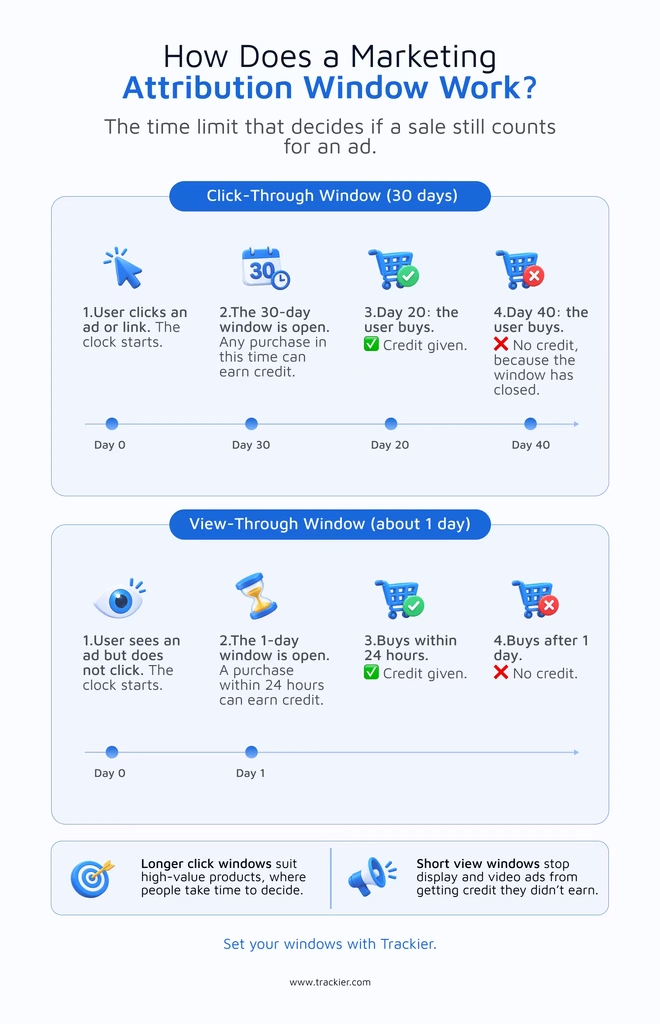
An attribution window sets the amount of time between the user interacting for the first time and finally purchasing the product. During this time period, the credit can be paid to the points of interaction.
Click-Through Window
This credits conversions after the user clicks on an advertisement or link. It is valid for up to 30 days, a purchase made anytime up to day 30 will be credited, but after that time period, nothing will be credited.
Longer windows are basically for high-value products which need time for the users to think and finally purchase them.
View-Through Window
This credits conversions after someone sees an ad but does not click. It is usually much shorter, often one day, because the link between a view and a sale is weaker. Keeping this conversion window short avoids over-crediting display and video ads.
Choosing the Right Attribution Rules for Your Growth
The attribution model determines who receives credit for a sale, therefore ensuring proper affiliate attribution across all partners and channels. One-tap models are simple to implement and appropriate for short journeys; multi-step models, on the other hand, present a more complete perspective of the user’s journey but are generally characterized by longer periods of time. The attribution window defines how long credit can be granted from the click/visit/lead. Begin with the simplest attribution model that suits your particular case and then customize as needed based on campaign maturity. Trackier helps with that, using the right attribution modeling, windows, attribution tracking, and proper reporting. With Trackier, affiliate attribution becomes simple.
1. What are marketing attribution rules?
Marketing Attribution rules allow you to assign conversion credit to touchpoints. They determine how credit is split between touchpoints, the time period in which the click/view will be attributed to a conversion, and which channel receives credit for multiple channels contributing to the same conversion.
2. What are the different types of Marketing attribution rules?
Single-touch attribution rules: First click, Last click, Last non-direct click. Multi-touch attribution rules: Linear, Time decay, position-based (U-shaped), and W-shaped. They differ in how credit is divided between touchpoints.
3. What is a marketing attribution model?
Marketing attribution models determine how credit for conversions/leads is allocated across touchpoints in the customer journey. This allows marketers to understand which channels, campaigns, or partners are driving conversions.
4. What is a marketing attribution window?
The conversion window allows you to allocate conversions to interactions within a certain period of time. If the window is set to 30 days, conversions made on day 20 will be attributed to the interaction; however, conversions made on day 40 will not be attributed.
5. What is the difference between single-touch and multi-touch attribution rules?
Single-touch attribution rules attribute 100% of the credit to one touchpoint. They are best suited to short journeys. Multi-touch attribution rules attribute credit to multiple touchpoints. They are best suited to long journeys with multiple interactions such as emails, ads, and social media.
