The transition to autonomous performance marketing is fundamentally driven by a new paradigm in artificial intelligence known as agentic AI. It represents a significant, epochal leap beyond the capabilities of traditional AI, machine learning models, and even basic generative AI. This is the moment AI stops being merely a passive tool for human marketers and becomes a proactive, goal-oriented collaborator, a self-directing digital worker dedicated to achieving defined business outcomes.
Where previous generations of marketing technology provided insights or handled simple, repetitive tasks based on rigid rules (e.g., “If condition X is met, execute action Y”), Agentic AI introduces true autonomy.
It can perceive a complex, real-time environment (like the performance of an affiliate network), reason strategically, dynamically break down a high-level objective (such as “Maximize Cost Per Acquisition (CPA) efficiency while scaling volume”) into executable steps, interact with external systems (like ad platforms or partner APIs), and critically, learn and adapt from the results of its own actions.
This transition shifts the dynamic from human-managed automation to AI-driven orchestration. The performance marketer’s role evolves from tactical execution, spending hours manually adjusting bids, reallocating budgets, and debugging campaigns, to becoming the strategic architect who sets the overall business strategy and the ethical guardrails.
The AI agent then assumes the role of the 24/7, hyper-efficient executor, capable of performing thousands of micro-optimizations simultaneously and navigating the complex, real-time chaos of the digital advertising landscape with a speed and precision that is humanly impossible. It is this capability for independent action and continuous, outcome-driven self-correction that establishes Agentic AI as the core engine powering the next era of performance growth.
The Era of Autonomous Performance Agent
The transition to Autonomous Performance Marketing is fundamentally powered by a shift in execution capabilities, moving far beyond simple rule-based automation. The AI agent, driven by Agentic AI principles, assumes the role of the 24/7, hyper-efficient executor, capable of performing thousands of micro-optimizations simultaneously and navigating the complex, real-time chaos of the digital advertising landscape with a speed and precision that is humanly impossible.
It is this capability for independent action and continuous, outcome-driven self-correction that establishes Agentic AI as the core engine powering the next era of performance growth. This new dynamic shifts the marketer’s focus from tactical execution to strategic architecture, allowing the agent to manage the complexity below.
The 24/7 Executor: Unlocking Real-Time, Micro-Optimization at Scale
The central, defining advantage of the autonomous performance agent is its capacity to operate at a scale and speed that defies human limitations. Unlike human teams restricted by working hours and the need for sleep, the AI agent is always on.
This 24/7 continuous optimization ensures that campaigns are perpetually fine-tuned, reacting instantly to shifts in global audience behavior, competitor activity, or unexpected market volatility, even during off-peak hours when human oversight is minimal or absent. Furthermore, the agent excels at parallel processing, meaning it can simultaneously handle complex, high-volume decisions.
In the same moment, the agent can be testing hundreds of creative headlines, adjusting CPA targets on a per-affiliate basis, reallocating budget across a dozen different channels, and dynamically re-routing traffic to the highest-converting landing pages. This capability for simultaneous, instant strategic adjustment is the definition of the promised hyper-efficiency, guaranteeing the maximum return on every advertising dollar in every second of operation.
The Closed-Loop System: Continuous Self-Correction via Real-Time KPIs
Agentic AI introduces true autonomy by executing a continuous, goal-oriented feedback loop that drives self-correction. The agent operates through an internal cycle: it perceives the real-time environment (affiliate performance, conversion rates, CPA data), reasons strategically based on the overarching objective (“CPA is rising on Source A while volume is stagnant”), takes immediate corrective action (“Reduce budget allocation to Source A by 10% and dynamically shift funds to high-performing Source B”), and then learns from the outcome of that action.
This crucial learning mechanism ensures the system is not static; it constantly improves its strategic models. This capability fundamentally shifts marketing from reactive (waiting for poor performance reports to adjust strategy) to predictive. By enabling the real-time anticipation of customer needs and market dynamics, the agent ensures brands can deliver the “hyper-personalized” experiences that feel human and drastically increase conversion efficiency.
The Data-Backed Justification: Benchmarks for Advanced Autonomy
The transition to an Agentic AI model is not merely a technological upgrade; it is a clear, data-backed revenue mandate. The quantifiable results from early adopters of advanced automation technologies provide the necessary justification for marketing leaders to invest in this shift. Companies leveraging AI-driven sales and marketing automation report productivity improvements of 15-20% and revenue increases of up to 26%.
These benchmarks clearly demonstrate that outsourcing tactical, high-frequency execution to autonomous agents yields dramatic performance improvements. This performance leap underscores that the adoption of Agentic AI is an essential requirement for maintaining competitive advantage, validating the decision to invest in platforms that facilitate this level of advanced, outcome-driven autonomy.
The Evolved Performance Marketer: Strategic Architect and AI Conductor
The rise of the autonomous performance agent does not eliminate the need for the human marketer; rather, it elevates their role, shifting the focus from tactical, low-value labor to strategic, high-value decision-making. The performance marketer evolves from a manual executor, spending hours adjusting bids, reallocating budgets, and debugging campaigns, into the Strategic Architect who designs the overall business strategy and the AI Conductor who sets the ethical and operational guardrails for the autonomous systems.
Elevating the Role: From Tactical Adjuster to Strategic Architect
With the Agentic AI handling the 24/7 hyper-execution, the human marketer is finally freed from the “complex, real-time chaos” of constant operational adjustments. This newfound freedom allows the professional to focus on tasks that truly require human creativity, foresight, and empathy. The marketer’s primary responsibility becomes defining the overarching strategy and setting the high-level objectives that the AI agents must pursue, such as “Maximize Cost Per Acquisition (CPA) efficiency while scaling volume by 40% in Q3.”
Their work shifts to exploring new market opportunities, developing innovative creative concepts, conducting high-level competitive analysis, and crafting the nuanced ‘brief’ that guides the AI’s autonomous actions. This transition transforms the role into one of pure strategy, leveraging the AI as a force multiplier for complex business goals.
Governance and Guardrails: Ensuring Ethical and Brand-Aligned Autonomy
Crucially, Agentic AI operates strictly within defined guardrails, and the establishment and maintenance of these boundaries becomes a core competency of the modern marketer. The AI agent, while goal-oriented, must adhere to brand safety guidelines, regulatory compliance (like data privacy laws), and strict financial limits (e.g., maximum acceptable CPA or budget ceilings).
The marketer acts as the governance layer, setting these ethical and financial boundaries, and continuously auditing the AI’s behavior to ensure its independent actions remain aligned with the brand’s long-term strategic vision. This new responsibility transforms the marketer into the ultimate ‘AI Conductor,’ directing the powerful orchestra of agents and ensuring their actions are always responsible and strategically sound. This ability to operate autonomously yet within strict, human-defined limits is the essence of effective autonomous marketing.
Key Advancements Brought by Agentic AI
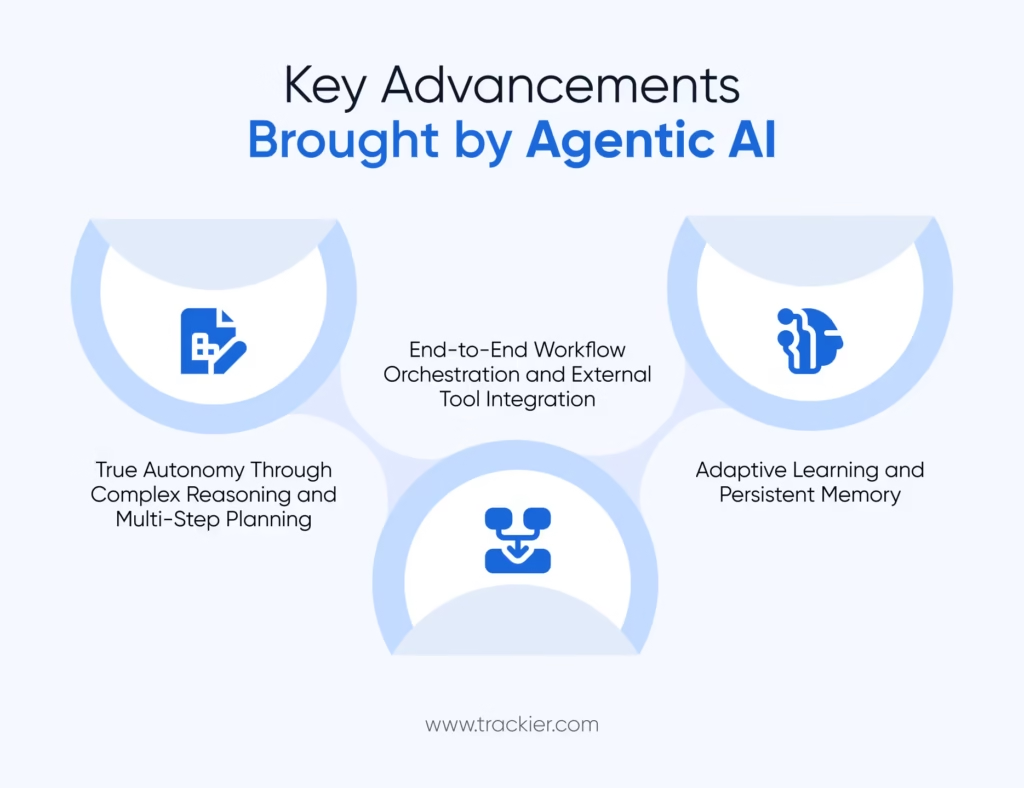
Agentic AI represents a fundamental functional break from its predecessors, moving the technology from a passive tool that assists marketers to an engine that acts autonomously. This epochal leap introduces critical new functionalities that completely reshape how performance marketing campaigns are conceived, executed, and continuously optimized. The advancements are centered on three core functional pillars: reasoning, execution, and memory.
True Autonomy Through Complex Reasoning and Multi-Step Planning
The most significant functional shift brought about by Agentic AI is the transition from following rigid, predefined rules to exhibiting true, goal-driven autonomy, supported by sophisticated reasoning. Traditional AI could only handle single, well-defined tasks (e.g., “if Conversion Rate drops below 1%, pause the campaign”). Agentic AI, by contrast, handles the complexity of real-world business objectives. It receives a high-level, abstract goal from the marketer, such as “Maximize Cost Per Acquisition (CPA) efficiency while scaling volume”, and autonomously breaks it down into a sequence of concrete, executable sub-tasks. This is known as Problem Decomposition.
The agent will internally generate a plan: “First, analyze the conversion funnel metrics. Second, identify the lowest-performing affiliate source. Third, test three new creative variants on the highest-performing channel. Fourth, reallocate 10% of the budget from the underperforming source to the top source.” This proactive initiative enables the agent to continuously monitor performance, identify opportunities or threats, evaluate multiple potential solutions, and execute the chosen plan across diverse systems without requiring human intervention at every decision point.
End-to-End Workflow Orchestration and External Tool Integration
A core functional advancement is the agent’s ability to act as the seamless connective tissue across the disparate marketing technologies that an enterprise relies on, enabling complex, end-to-end campaign orchestration.
Agents are specifically designed with Tool Use capabilities, meaning they can interact dynamically with external systems and APIs, such as ad platforms, CRM software, creative asset management platforms, and partner APIs, to carry out their multi-step plans in the real world. For example, an agent can detect a fraud anomaly within the tracking platform, access the ad network API to instantaneously block the corresponding fraudulent IP range, and then notify the internal communications tool with a full contextual summary of the action taken.
This functional depth ensures that the autonomous system is not siloed but acts as a complete Workflow Orchestrator, managing the full campaign lifecycle from data intake (perception) to real-world action (execution).
Adaptive Learning and Persistent Memory
Unlike stateless large language models (LLMs) or rigid machine learning models, Agentic AI systems are designed for continuous, outcome-driven refinement, possessing both short-term and long-term memory.
This Persistent Memory and Context allows agents to build complex, evolving customer and partner profiles and refine their strategic approach over time, ensuring that decisions made today are intelligently informed by the results, context, and learning accumulated over weeks or months.
Furthermore, they are equipped with Adaptive Learning Loops, utilizing techniques like reinforcement learning to continuously test, iterate, and refine their execution strategies. This functional capability means the agent automatically pushes the top-performing creative, bidding strategy, or traffic route to each prospect, ensuring optimization and refinement are continuous and automatic, drastically improving efficiency and eliminating the lag time inherent in periodic, manual human oversight. This sophisticated combination of memory, reasoning, and tool use unlocks a new level of scalable, real-time hyper-personalization.
Why Now and the Trajectory of Growth
The concept of intelligent agents has existed for decades, but the current surge in the adoption and market valuation of Agentic AI is an explosive phenomenon that is happening right now. This boom is not a temporary hype cycle; it is a rapid acceleration driven by foundational technological breakthroughs and undeniable economic pressure, positioning Agentic AI as a defining technology for the next decade.
The Confluence of Driving Forces: Why the Boom Is Happening Now
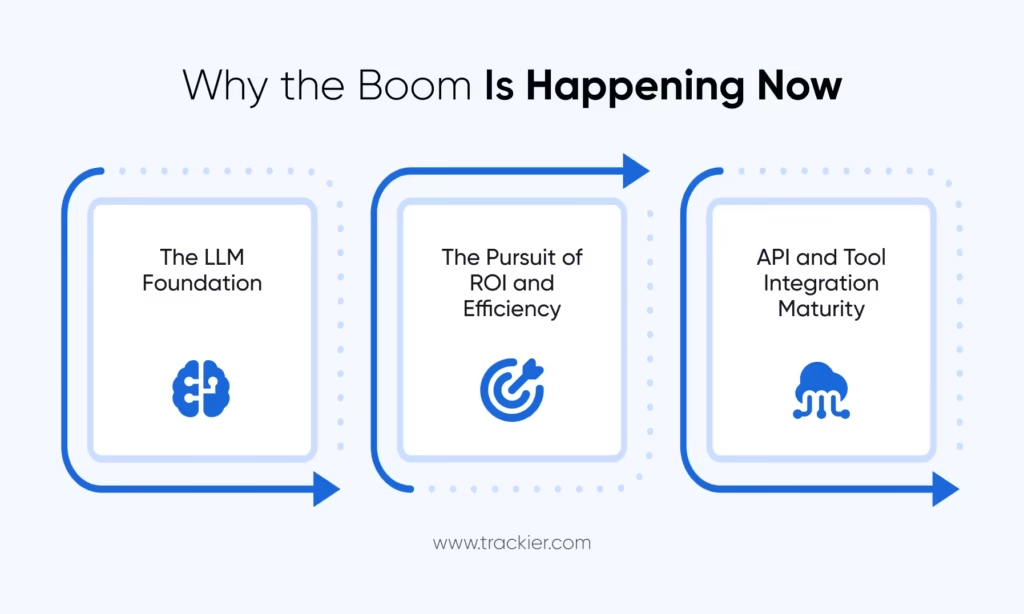
The current explosion in Agentic AI is the result of a powerful convergence of technological and market forces, which have only recently matured:
- The LLM Foundation: The fundamental breakthrough that enabled true autonomy is the dramatic advancement in Large Language Models (LLMs). Modern LLMs provide the agent with the necessary cognitive engine, the ability to perform complex reasoning, understand natural language goals, and generate human-like plans. This is the ‘brain’ that allows the agent to decompose high-level objectives into executable tasks, a capability that rule-based systems simply lacked.
- The Pursuit of ROI and Efficiency: Enterprises are under immense pressure to increase productivity and reduce operational costs. Agentic AI offers a direct pathway to solving this. By automating complex, multi-step workflows that were previously too ‘messy’ or variable for traditional Robotic Process Automation (RPA), agents deliver significant and measurable productivity gains (often cited as 15-20% or more) and substantial revenue increases (up to 26%).
- API and Tool Integration Maturity: The modern digital ecosystem, with its standardized, robust APIs, provides the perfect environment for agents to operate. Agents can now seamlessly integrate and communicate with all core enterprise systems, from CRMs and ERPs to ad platforms and tracking solutions, allowing them to act in the real world rather than merely providing text-based outputs.
The Trajectory of the Boom: Sustained, Exponential Growth
This boom is not expected to dissipate soon; instead, market projections suggest a sustained, exponential growth trajectory fueled by deepening enterprise adoption:
- Explosive Market Growth: The Agentic AI market is moving from a nascent phase into a rapid scale-up. Analysts project the global market, valued in the single-digit billions today, to reach figures well over $100 billion by the early 2030s, with a Compound Annual Growth Rate (CAGR) often exceeding 40%. This rate of growth signals sustained, aggressive investment.
- The Shift from Pilot to Production: While the initial phase involved experimentation, the current trend shows a decisive move toward scaled deployment. By 2026, Gartner estimates that over 80% of enterprises will have deployed generative or agentic AI-enabled applications, confirming that the technology is shifting from a conceptual experiment to a core operational component. Furthermore, some forecasts suggest that by 2027, AI agents will automate 15–50% of business processes.
- The Multi-Agent Future: The next evolution will see the proliferation of Multi-Agent Systems (MAS), where specialized AI agents cooperate, negotiate, and compete with one another to achieve a single, complex business goal. This layered intelligence will unlock even greater operational efficiency and complexity management, ensuring the boom continues as organizations move from single-task agents to collaborative, autonomous teams.
The boom in Agentic AI is thus not just a technological curiosity; it is a structural revolution in business execution, making the Autonomous Performance Agent an indispensable competitive asset for the foreseeable future.
The shift to the Agentic AI era is overwhelmingly advantageous for performance marketing, fundamentally transforming it from a discipline of manual optimization and tactical execution into a field of strategic oversight and hyper-efficient, autonomous growth.
Performance marketing, which is inherently measurable and outcome-focused (ROAS, CPA, CTR), is the perfect use case for Agentic AI because its success metrics are clear, allowing agents to optimize with precision.
The Advantage: Autonomous Efficiency and Scalability
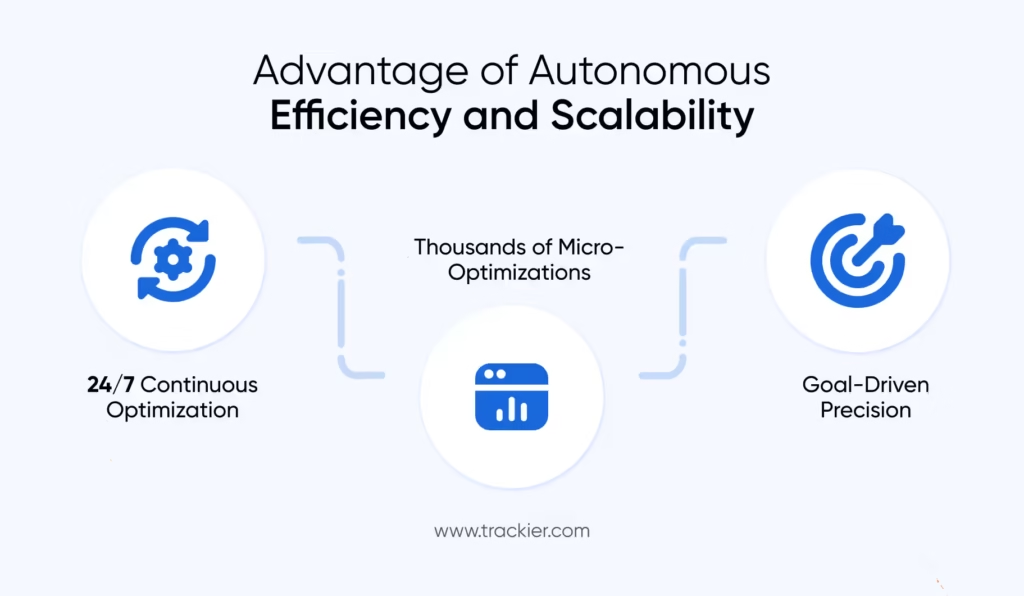
The core benefit is the ability to achieve hyper-efficiency and massive scalability that humans cannot match.
- 24/7 Continuous Optimization: Performance campaigns often run across global markets and time zones. The AI agent never sleeps, ensuring bids, budgets, and creative variations are adjusted instantly based on real-time data, maximizing performance gaps during off-peak hours that a human team would miss.
- Thousands of Micro-Optimizations: An AI agent can simultaneously manage and optimize complex multivariate tasks, adjusting bids on thousands of keywords, pausing underperforming ad sets, reallocating budget between channels, and initiating new creative tests, all within seconds. This leads to an unprecedented level of resource utilization, eliminating wasted spend in real-time.
- Goal-Driven Precision: The agent works backward from the performance goal. If the objective is to “Maximize CPA efficiency while scaling volume,” the agent isn’t just following rules; it’s reasoning, experimenting, and executing complex, multi-step plans to achieve that specific financial outcome with maximum precision.
Real-Time Personalization and Conversion Uplift
Agentic AI enables a level of real-time adaptation and personalization that directly boosts conversion rates and Return on Ad Spend (ROAS).
- Real-Time Journey Adaptation: The agent monitors customer behavior (e.g., browsing history, cart abandonment, content engagement) and adapts the ad creative, messaging, and channel in the moment. If a user interacts with a specific piece of content, the agent instantly triggers the next-best personalized ad and directs them to an optimized landing page.
- Elimination of Latency: In performance marketing, speed is critical. The agent eliminates the human latency between identifying a trend and acting on it. If an affiliate source suddenly spikes in conversions, the agent can reallocate budget and traffic instantly to capitalize on the opportunity before the trend plateaus.
- Automated A/B/n Testing: Agentic AI automatically runs complex multivariate tests on every element of a campaign (headline, image, button color, offer logic), instantly shifting traffic to the best performers. This ensures users consistently receive the most engaging and conversion-optimized experience.
Elevation of the Marketer’s Role
The performance marketer is no longer a tactical executor but a Strategic Architect, leading to higher-value work and greater career satisfaction.
- Focus on Strategy and Creativity: By automating the mundane, repetitive tasks (like bid management and reporting), the agent frees the human marketer to focus on high-leverage activities: defining the overarching business goals, developing breakthrough creative concepts, exploring new high-potential channels, and setting the ethical guardrails.
- Improved ROI and Productivity: Performance marketing teams that leverage advanced automation often report productivity improvements of 15-20% and significant revenue increases, providing a strong data-backed justification for the AI adoption.
- The Power of the Prompt: The marketer’s core skill shifts to writing better “briefs” or “prompts” for the AI agent, dictating what outcome is desired, not how to achieve it. This strategic input leverages the AI’s execution power to amplify human vision.
In the Agentic era, performance marketing moves beyond simply reporting on performance; it becomes a self-optimizing system that guarantees the highest possible performance within the human-defined strategic parameters.
Precursors to Advanced Autonomy
For users of the Trackier platform, the transition to Agentic AI is not a distant aspiration but the logical next step on an already established path.
Trackier’s current capabilities in automation and intelligent linking serve as the perfect precursors and foundational infrastructure for embracing advanced autonomous performance marketing. The platform is already structured to evolve the marketer into the “Strategic Architect” by handling complex, underlying execution.
Trackier’s Automation as the Foundation for Agentic Action
Trackier’s existing automation tools lay the essential groundwork for sophisticated autonomous agents. The rules, triggers, and logic already implemented by users are the deterministic building blocks upon which complex, goal-oriented agent logic can be constructed.
- “Easy Automation” as the Training Ground: Trackier’s “Easy Automation” features, which allow marketers to set up “If/Then” scenarios, teach marketers the principles of automated execution. These robust rules, such as automatically pausing underperforming affiliates or adjusting caps based on pre-set thresholds, are the functional equivalent of the agent’s first layer of decision-making. The transition involves shifting from rigid rules to adaptive, AI-driven reasoning.
- Data Accuracy as the Agent’s Perception: An agent’s effectiveness is entirely dependent on the quality and fidelity of the data it perceives. Trackier’s precision in tracking, attribution, and anti-fraud measures ensures the AI agent receives the cleanest, most reliable real-time signals, allowing it to make accurate strategic decisions and trust its own performance readings.
Smart Links: The Precursor to Agentic Traffic Orchestration
Trackier’s Smart Links are already a powerful, intelligent execution tool that foreshadows the complex traffic orchestration performed by an autonomous agent.
- Dynamic, Contextual Routing: Smart Links dynamically route traffic based on a defined set of parameters (geo, device, browser, etc.) to the optimal offer or landing page. This is essentially a proto-agent performing a specific execution task: finding the best path for a conversion.
- Seamless Transition: The shift here is minimal but profound. Instead of routing traffic based on pre-set human rules, the Agentic AI layer will override the Smart Links with real-time, outcome-driven decisions. The agent might dictate, for instance: “Route this segment of traffic to Offer B, not because of GEO, but because my predictive model shows a 20% higher conversion probability based on its real-time behavior and historical performance data.” The Smart Link becomes the AI’s reliable execution mechanism.
Customization: Empowering the Strategic Architect’s Unique Vision
The inherent flexibility and customization of the Trackier platform align perfectly with the evolving role of the Strategic Architect. The platform is not a rigid, one-size-fits-all system, which is crucial for maximizing agent performance.
- Defining Proprietary Goals: The unique needs of an enterprise, such as complex payout structures, niche compliance requirements, or custom KPI definitions, can be built into the platform. This means the Strategic Architect can define highly nuanced, proprietary goals that a generic, off-the-shelf AI model could never comprehend.
- Maximum Performance Within Guardrails: Trackier’s architecture allows for the precise definition of the financial and ethical guardrails required for Agentic AI. The platform is built to handle the complexity needed to ensure the autonomous agents are focused purely on the client’s unique path to growth while strictly adhering to all brand and regulatory constraints.
By viewing its current automation tools as a powerful stepping stone, Trackier frames itself as the indispensable platform that guides marketers toward the next era of advanced autonomy and unparalleled performance growth.
Building Agentic Intelligence Into Trackier: Our Multi-Year Platform Evolution
Trackier’s roadmap over the coming years is centered on a clear shift. Moving from a platform that reports on outcomes to one that actively shapes them. This evolution focuses on embedding agentic AI capabilities across the platform. These are intelligent systems that continuously observe performance, reason over complex data, and take or recommend actions with minimal manual input.
Rather than adding AI as a surface-level feature, Trackier is planning to introduce agents as foundational layers within the platform. These agents are designed to reduce operational complexity, protect profitability, and help teams scale performance marketing operations without proportionally scaling effort or headcount.
Agentic Analytics: Always-On Performance Intelligence
Trackier plans to introduce agentic analytics that replace periodic analysis with continuous intelligence. These agents will actively monitor campaigns, partners, and funnels to ensure that critical signals are never missed.
What these agents will do:
- Continuously track performance trends, deviations, and anomalies across dimensions
- Surface high-impact insights automatically instead of relying on manual dashboard reviews
- Recommend specific actions, such as optimization opportunities or corrective steps, based on live data patterns
Why it matters:
- Faster reaction time to performance shifts
- Earlier identification of revenue upside or downside
- More consistent decision-making across teams, even at scale
Advanced Fraud Detection: Proactive, Agent-Driven Protection
Fraud remains one of the largest hidden threats to performance marketing margins. Trackier is planning to evolve fraud detection from a reactive process into an agent-driven preventative system.
Planned agent capabilities include:
- Identifying abnormal CVR movements and conversion lag patterns in near real time
- Analyzing behavioral signals across traffic sources and partners
- Continuously learning from new fraud patterns to improve detection accuracy
Business impact:
- Proactive margin protection instead of post-loss recovery
- Reduced revenue leakage from invalid or low-quality traffic
- Increased confidence for enterprise clients operating at high volume
Predictive Risk and Revenue Agents: From Insight to Foresight
As client expectations mature, Trackier aims to move beyond descriptive and diagnostic analytics into predictive intelligence. Dedicated agents will focus on forecasting risk and revenue outcomes before they materialize.
These agents are expected to:
- Flag early indicators of payout stress and partner risk
- Predict revenue volatility across campaigns and verticals
- Assess fraud probability before performance degradation occurs
Value delivered:
- Better budget planning and partner selection
- More confident scaling decisions
- Clear differentiation through premium insight-led analytics offerings
Agentic AI Assistants: Scalable Support and Enablement
Support, onboarding, and enablement are critical but often resource-intensive areas of growth. Trackier plans to introduce agentic AI assistants that operate across both internal teams and client-facing workflows.
Key focus areas:
- Contextual in-app guidance based on user role, activity, and historical usage
- Faster resolution of common queries without manual intervention
- Continuous learning through feedback to improve accuracy and relevance over time
Expected outcomes:
- Reduced dependency on support and tech teams
- Faster time-to-value for new and expanding clients
- Stronger retention driven by a smoother customer experience
What This Evolution Means for Trackier and Its Customers
By systematically adding agentic capabilities, Trackier is positioning itself as a proactive intelligence layer for performance marketing rather than just a tracking or reporting system. These agents are designed to work quietly in the background, reducing friction, protecting margins, and accelerating decision-making.
For customers, this means fewer blind spots, faster action, and greater control at scale. For Trackier, it establishes a long-term platform narrative where AI is not an add-on but a core driver of growth, resilience, and differentiation.
The Point of No Return for Performance Marketing
Agentic AI marks a definitive turning point in the evolution of performance marketing. What began as reporting and rule-based automation is rapidly transforming into autonomous, outcome-driven execution at scale.
As markets grow more competitive, data becomes more complex, and margins more fragile, the ability to operate with speed, precision, and foresight will no longer be a differentiator. It will be a baseline requirement for sustainable growth.
This shift redefines how performance marketing operates at its core:
- From static reporting to continuous, self-optimizing execution
- From human-paced decision-making to real-time, system-led orchestration
- From reactive optimization to predictive and outcome-driven action
The transition to autonomous performance marketing is not about replacing human judgment, but about elevating it. In this new model, human expertise defines strategy, intent, and ethical boundaries, while agentic systems handle complexity, velocity, and continuous optimization at scale.
Together, they form a hybrid operating model that is:
- Faster in response to market changes
- Smarter in allocating spend and effort
- Structurally more resilient under scale and volatility
For Trackier and its customers, this moment represents both opportunity and responsibility. By building on strong foundations in automation, data integrity, and intelligent execution, Trackier is positioned to guide the market through this transition with clarity and control.
Its evolution toward agentic intelligence is not a sudden leap, but a deliberate progression toward a future where performance marketing is:
- Self-optimizing by design
- Margin-aware at every decision point
- Strategically aligned with business outcomes
As agentic systems mature, the winners will be those who adopt autonomy with intention, define guardrails early, and choose platforms capable of translating strategic ambition into continuous, measurable outcomes. Autonomous performance marketing is no longer a distant concept. It is the next operational standard.
Trackier’s direction ensures its clients are not merely adapting to this future but actively shaping it.