A partner program can help businesses reach new audiences, generate qualified leads, and create additional revenue streams without relying exclusively on direct sales and marketing.
However, its success depends on more than finding businesses willing to collaborate. Without clear objectives, the right partner model, sustainable incentives, and reliable performance tracking, even promising partnerships can struggle to deliver measurable results.
Launching a successful partner program requires a structured approach that aligns business goals with partner expectations. Businesses need to identify the right partners, establish mutually beneficial terms, provide the resources needed to drive results, and measure each partner’s contribution to growth.
They must also create processes for managing referrals, tracking conversions, handling commissions, and maintaining long-term engagement.
The approach will vary depending on the type of partnership. Referral partners may focus on introducing qualified prospects, affiliates may drive conversions through promotional campaigns, and resellers may manage customer relationships and sales. Each model requires different incentives, workflows, and performance metrics.
This guide outlines six steps to launching a successful partner program, from defining its objectives and recruiting suitable partners to establishing tracking systems, improving partner performance, and scaling what works.
It also covers practical considerations, common challenges, and key metrics to help businesses build a program that supports sustainable growth.
Step 1: Define Your Partner Program Strategy and Goals
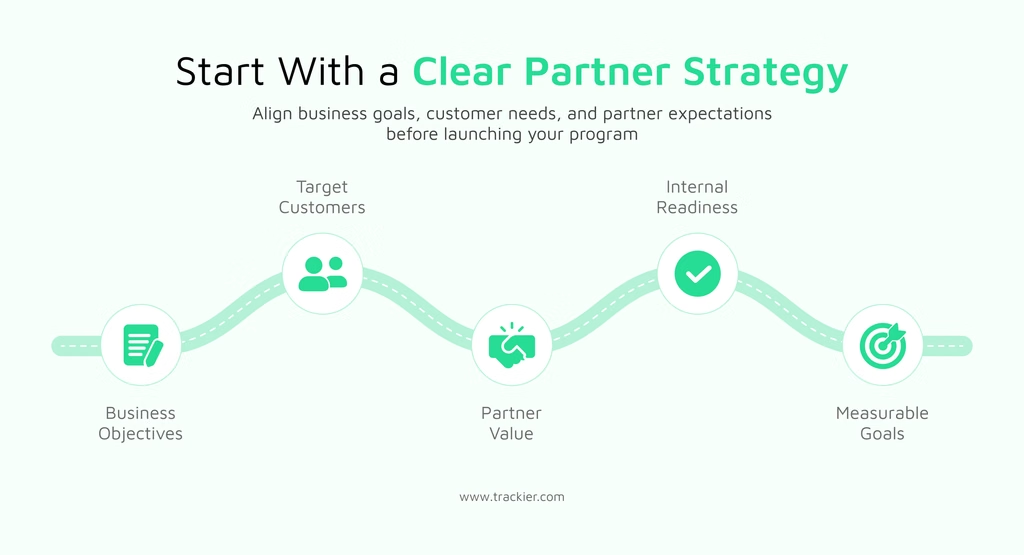
Before recruiting partners or deciding on commission structures, define what the partner program needs to achieve and how it will contribute to the business. A clear strategy helps ensure that the program attracts the right partners, allocates resources effectively, and delivers measurable business outcomes.
Without this foundation, businesses risk recruiting partners who do not align with their target audience, offering incentives that are difficult to sustain, or measuring success through activity rather than actual results. Start by answering four key questions:
- What does the business want to achieve?
- Which customers should the program reach?
- Why would partners want to participate?
- How will success be measured?
1.1 Identify the Business Objectives
The first step is to connect the partner program to specific business goals. Rather than launching a program simply to increase the number of partnerships, identify the business outcome those partnerships should support. Common objectives include:
- Generate qualified leads: Work with referral partners, consultants, or agencies that can introduce prospects who match the ideal customer profile.
- Increase customer acquisition: Use affiliate partners, publishers, or complementary businesses to reach potential customers through relevant channels.
- Expand into new markets: Collaborate with local resellers, distributors, or regional partners that understand a specific market’s customers and buying behavior.
- Improve customer retention: Partner with service providers or technology companies that can strengthen the customer experience and help customers get more value from the product.
- Expand product adoption: Build relationships with integration partners, implementation consultants, or agencies that can help customers adopt the solution.
- Increase revenue efficiently: Develop partner relationships that generate profitable opportunities without making customer acquisition costs unsustainable.
These objectives may overlap, but the program should have one primary goal and a small number of supporting objectives. This keeps recruitment, incentives, enablement, and reporting focused on the outcomes that matter most.
For example, a B2B SaaS company entering a new region might prioritize qualified pipeline generation through local agencies and resellers. A business with an established customer base might instead focus on referral partnerships that introduce prospects with similar needs.
The objective should also be specific enough to guide decisions. “Generate more leads” is too broad to serve as a useful target. “Generate 100 qualified partner-sourced leads over the next two quarters” provides a measurable starting point, provided the target is realistic for the business’s market, resources, and sales capacity.
1.2 Define Your Ideal Customer Profile (ICP)
Once the business objectives are clear, identify the customers the partner program should help reach. The ideal customer profile (ICP) describes the types of businesses or customers most likely to benefit from the product or service and become valuable, long-term customers.
Defining the ICP helps narrow down both partner recruitment and the opportunities partners should pursue. Without it, partners may focus on generating large volumes of leads that rarely convert or customers who are unlikely to stay.
To establish the ICP, consider the following factors:
- Industry and market: Which industries, business categories, or geographic markets have the strongest need for the product?
- Company size: Is the solution best suited to startups, small and medium-sized businesses, or enterprise organizations?
- Budget and purchasing capacity: Can the target customers afford the solution and justify its value?
- Pain points: What challenges are customers trying to solve, and how does the product address them?
- Buying behavior: Who makes purchasing decisions, what does the sales cycle look like, and which channels influence the decision?
- Retention potential: Which customer segments are most likely to continue using the product and generate long-term value?
1.3 Establish a Clear Value Proposition for Partners
A successful partner program must create value for both the business and its partners. While commissions and referral fees can attract interest, they are rarely the only factors that influence whether a partnership becomes productive.
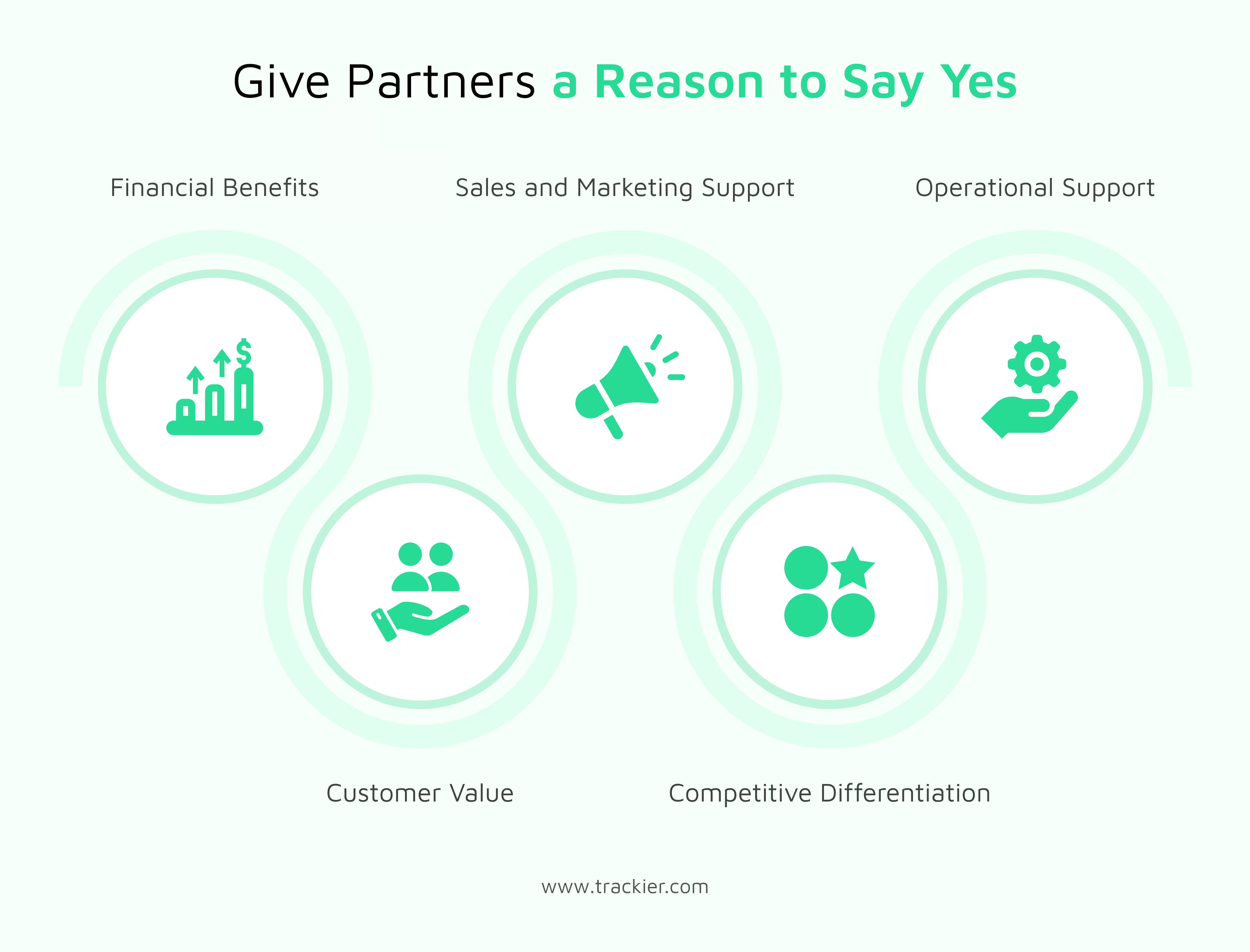
Partners need to understand why promoting, recommending, reselling, or integrating a product is worth their time and resources. A strong partner value proposition should explain:
- Financial benefits: How can partners earn revenue through commissions, referral fees, margins, or recurring payouts?
- Customer value: How does the product help partners solve their customers’ problems or complement their existing services?
- Sales and marketing support: What resources, training, co-marketing opportunities, and promotional materials will be available?
- Competitive differentiation: What makes the product worth recommending over alternative solutions?
- Operational support: How will the business help partners manage referrals, track performance, resolve issues, and receive payments?
The value proposition should reflect the needs of the partner type being recruited. An agency may value a solution that complements its existing services and creates opportunities for additional client revenue.
A technology partner may prioritize integration quality, product compatibility, and the ability to offer a more complete solution. An affiliate publisher may be more interested in conversion potential, commission terms, and the availability of reliable promotional assets.
The key is to make the mutual benefit explicit. The business should know what it expects from partners, while partners should understand what they receive in return and what support they can expect throughout the relationship.
1.4 Assess Internal Readiness Before Launch
Even a well-designed partner strategy can struggle if the business lacks the resources to support it.
Before launching an affiliate program, assess whether the teams, processes, and systems are ready to manage partner relationships consistently. Use the following checklist to identify potential gaps:
- Leadership alignment: Are the program’s objectives, budget, and expected outcomes approved by relevant stakeholders?
- Dedicated ownership: Is someone responsible for recruiting partners, managing relationships, and monitoring performance?
- Sales and marketing alignment: Do both teams understand how partner-generated leads will be handled, followed up on, and attributed?
- Customer support capacity: Can the business address partner and customer questions within a reasonable timeframe?
- Financial planning: Is there a budget for commissions, partner enablement, marketing activities, and program management?
- Tracking and reporting: Can the business record referrals, attribute conversions, calculate payouts, and evaluate partner contributions?
- Policies and agreements: Are partner eligibility requirements, payment terms, data-handling practices, and operating rules documented?
1.5 Set Measurable Goals and a Baseline
Finally, translate the strategy into measurable targets. These targets should reflect the program’s primary objective and provide a practical way to evaluate progress.
| Goal category | Example metrics |
| Recruitment | Qualified partners recruited, approved partners, activation rate |
| Pipeline generation | Partner-sourced leads, qualified opportunities, pipeline value |
| Revenue | Partner-sourced revenue, partner-influenced revenue, average deal value |
| Conversion | Lead-to-opportunity rate, opportunity-to-customer rate, conversion rate |
| Profitability | Customer acquisition cost, commission costs, partner program ROI |
| Retention | Customer retention, partner retention, repeat partner-generated revenue |
Step 2: Choose the Right Partner Model and Recruit Suitable Partners
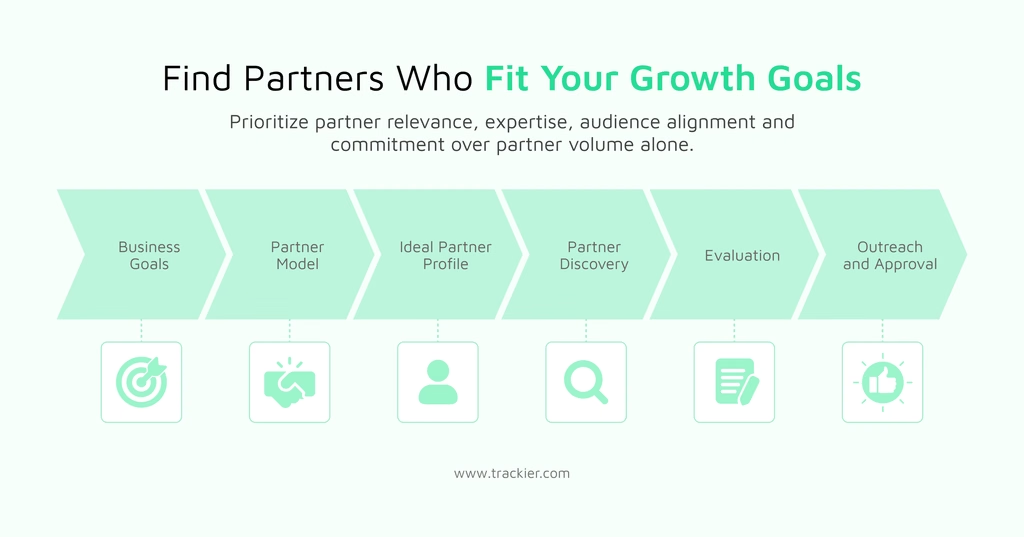
Once the program’s objectives and target customers are defined, the next step is to choose a partnership model and identify businesses or individuals capable of delivering results.
Different partner models serve different purposes. Some introduce potential customers, while others promote products, manage sales, provide implementation services, or connect complementary technologies. The right model helps establish clear expectations, determine incentives, and focus recruitment on relevant partners.
The goal is not to recruit as many partners as possible, but to build a network with the right audience, expertise, and motivation to contribute to business growth.
2.1 Understand the Different Types of Partner Programs
Partner programs can take several forms depending on how a business acquires customers, delivers value, and generates revenue.
- Affiliate partnerships: Affiliate partners promote products through websites, blogs, newsletters, social media, or other marketing channels. They typically earn commissions when tracked actions, such as sales or qualified leads, meet the program’s conditions. This model suits businesses looking to expand their reach through publishers, creators, and performance marketers.
- Referral partnerships: Referral partners introduce potential customers through existing professional relationships or customer networks. These may include consultants, satisfied customers, and complementary service providers. Referral programs work well when trust and personal recommendations influence purchasing decisions.
- Reseller and distributor partnerships: Resellers sell products to customers, while distributors may manage broader activities such as supplying resellers or supporting regional markets. These partnerships help businesses expand sales coverage and enter markets where local expertise or established commercial networks are important.
- Agency and service-provider partnerships: Agencies, consultants, and service providers recommend, implement, or manage solutions for their clients. This model is useful when customers need expert guidance to select, implement, or get value from a product.
- Technology and integration partnerships: Technology partners connect complementary products through integrations, APIs, or shared workflows. These relationships can improve customer experiences, simplify adoption, and create opportunities for joint marketing or sales.
- Strategic and co-selling partnerships: Strategic partners collaborate on broader objectives, such as joint go-to-market activities, bundled offerings, and shared customer relationships. Co-selling involves businesses working together on sales opportunities and generally requires clear responsibilities and ongoing coordination.
2.2 Match the Partner Model to Your Business Goals
Compare available models against the objectives established in Step 1. The best choice depends on what partners need to accomplish, the resources available, and the complexity of the sales process.
| Business objective | Potential partner model | Why it may fit |
| Generate qualified leads | Referral partners, consultants | Leverages trusted relationships |
| Increase online sales | Affiliate partners | Expands reach through performance-based promotion |
| Enter new geographic markets | Resellers, distributors, local agencies | Provides local expertise and market access |
| Improve product adoption | Service providers, implementation partners | Helps customers implement and use the solution |
| Expand product functionality | Technology and integration partners | Connects complementary products and workflows |
| Win complex deals | Strategic and co-selling partners | Combines expertise and customer access |
2.3 Define Your Ideal Partner Profile
An ideal partner profile (IPP) describes the characteristics of a partner most likely to contribute to the program’s success.
A partner’s audience size or popularity alone does not establish suitability. A smaller agency with strong relationships in the target market may generate more valuable opportunities than a large publisher with limited audience relevance.
Evaluate potential partners based on:
- Audience alignment: Do they serve the target industries, customer segments, or geographic markets?
- Relevant expertise: Do they understand the product category and customer challenges?
- Reach and influence: Can they access potential customers through established networks or channels?
- Engagement and trust: Do their customers or followers engage with their recommendations?
- Commercial fit: Is there a realistic opportunity for both parties to benefit?
- Operational capability: Can they manage referrals, promote the product, or support customers as required?
- Reputation and compliance: Do their practices align with the company’s standards?
- Commitment and capacity: Do they have the resources and interest to develop the partnership?
2.4 Find and Evaluate Potential Partners
With the ideal partner profile established, identify where suitable candidates operate and how to approach them.
- Explore existing networks: Current customers, consultants, industry contacts, and business relationships may know organizations serving the same audience without directly competing with the business.
- Research complementary businesses: Look for agencies, technology providers, and service companies whose offerings align with the product and address related customer needs.
- Use industry communities and events: Conferences, professional associations, webinars, and online communities can help identify partners with relevant expertise and established networks.
- Identify publishers and creators: For affiliate programs, assess websites, newsletters, creators, and comparison platforms covering the product category. Review audience relevance, engagement, and promotional practices rather than relying on traffic estimates alone.
- Evaluate inbound applications: Collect information about applicants’ audiences, business models, promotional channels, target markets, and experience to assess their suitability consistently.
2.5 Create a Partner Recruitment and Outreach Process
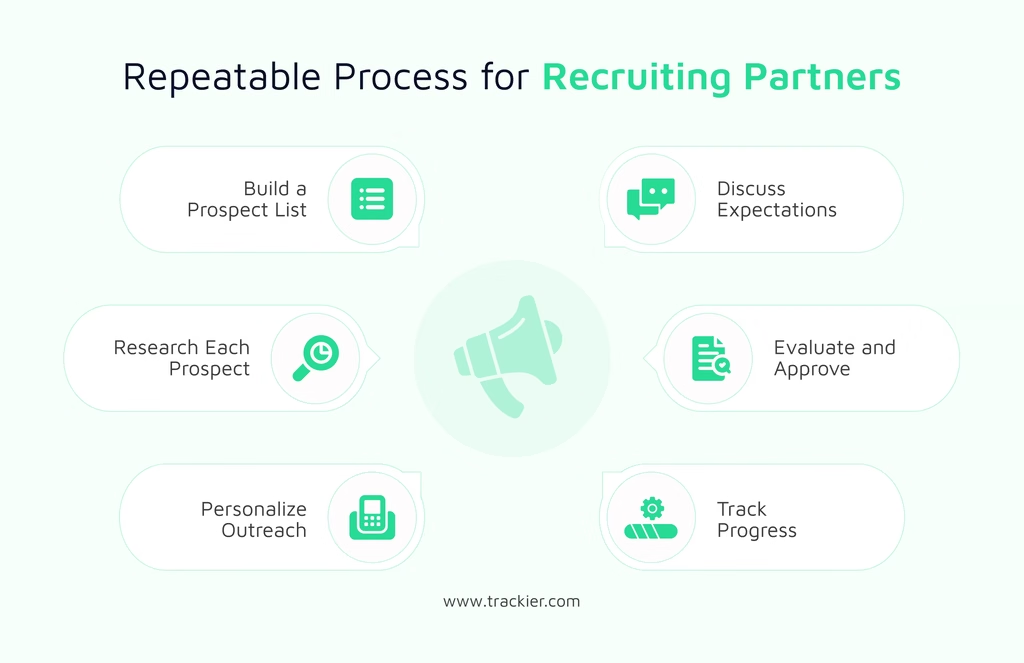
Partner recruitment should be a structured process rather than a one-time campaign.
- Build a prioritized prospect list. Group suitable candidates by partner type, market, audience, or strategic importance.
- Research each prospect. Understand whom they serve and how the product could complement their existing offering.
- Personalize the outreach. Explain why the partnership is relevant, how it could benefit both parties, and what collaboration might involve.
- Discuss expectations and terms. Clarify responsibilities, target audiences, available support, incentives, and performance expectations.
- Assess and approve candidates. Evaluate each prospect against established criteria and complete any required checks.
- Track recruitment progress. Monitor outreach, responses, discussions, approvals, and partner activation to identify bottlenecks.
Step 3: Design Partner Incentives, Commission Structures, and Program Rules
Once the right partner model and recruitment strategy are available, the next step is to determine how partners will be rewarded and what rules will govern the relationship. A well-designed commission structure motivates partners to generate valuable outcomes while ensuring the program remains financially sustainable for the business.
The challenge is to balance partner expectations with business economics. Commissions that are too low may discourage participation, while overly generous incentives can erode profit margins without guaranteeing better results. Similarly, unclear program rules can lead to disputes over attribution, payments, and partner responsibilities.
A strong structure combines appropriate incentives, transparent payment terms, and clearly documented rules that both parties understand before the partnership begins.
3.1 Choose the Right Partner Incentive Model
The right incentive model depends on the partner’s contribution, the business’s revenue model, and the outcome the program is designed to achieve.
A referral partner introducing a qualified prospect may require a different reward from an affiliate generating completed purchases or a reseller managing the entire sales process. Common incentive structures include:
- Revenue-based commissions: Partners earn a percentage of the revenue generated through their referrals or promotional activities. This model is common in affiliate programs and other performance-based partnerships. For example, a business might offer a 10% commission on eligible sales. If a partner generates $5,000 in qualifying revenue, the commission would be $500, assuming the full amount is commissionable and no adjustments apply.
- Fixed referral fees: Partners receive a predetermined payment for a qualifying referral, lead, or completed sale. For example, a company might pay $100 for every referred customer who meets its qualification criteria. Fixed fees make payout calculations straightforward and can work well when the business can estimate the value of each qualifying action. However, paying for leads rather than completed sales requires clear qualification standards to avoid rewarding low-quality submissions.
- Recurring commissions: Partners receive commissions for an agreed period or for as long as a referred customer remains eligible. This structure is particularly relevant to subscription-based businesses, where partners contribute to recurring customer acquisition. Recurring commissions can encourage partners to focus on customers who are more likely to remain active. The business must define the commission duration, treatment of cancellations, and eligibility of renewals or upgrades.
- Tiered incentives: Partners receive higher commission rates or additional rewards after reaching specific performance thresholds. For example, a program could increase commission rates when partners exceed a defined level of eligible monthly sales. Tiered incentives can encourage sustained performance, but thresholds should be realistic and based on business economics. Avoid rewarding volume alone if it could encourage poor-quality leads or unprofitable sales.
- Margin-based reseller discounts: Resellers purchase products at an agreed price and earn revenue from the difference between their purchase and resale prices. Depending on the agreement, they may also receive volume-based discounts or performance bonuses. This structure suits businesses where partners manage sales, customer relationships, or distribution. Pricing rules and responsibilities must be clear to protect margins and maintain consistency across sales channels.
- Non-monetary incentives: Not every partner is motivated exclusively by commissions. Co-marketing opportunities, product training, early access to features, sales enablement resources, certification, and access to dedicated support can also strengthen engagement. These benefits are especially useful when partners need to understand a product deeply or integrate it into their existing services. A business may combine multiple incentives, but each should have a clear purpose. For example, a referral program could offer a fixed fee for qualified opportunities and an additional reward when those opportunities become paying customers.
3.2 Calculate Commission Rates and Program Economics
Before finalizing commission rates, estimate how much the business can afford to pay for acquiring and supporting customers through the partner channel.
The calculation should account for more than the commission itself. Depending on the business model, relevant costs may include product delivery, payment processing, refunds, partner management, onboarding, promotional support, and customer service.
Consider a simplified example of a business selling a service for $1,000.
| Item | Amount |
| Revenue from a qualifying sale | $1,000 |
| Direct delivery costs | $300 |
| Partner commission at 10% of revenue | $100 |
| Remaining amount before other expenses | $600 |
3.3 Define Payment Terms and Commission Eligibility
Even an attractive commission rate can become a source of frustration if payment terms are unclear.
Document the conditions under which partners earn commissions, when payments are calculated, and how adjustments are handled. Key terms should include:
- Qualifying actions: Specify whether commissions are earned for submitted leads, sales, paid subscriptions, completed transactions, or another defined conversion event.
- Attribution rules: Explain how a referral is credited to a partner, including tracking windows, referral links, coupon codes, lead registration, and any applicable rules for overlapping referrals.
- Payment schedules: State how frequently commissions are calculated and paid, such as monthly or quarterly, and whether minimum payout thresholds apply.
- Refunds and cancellations: Define how refunds, chargebacks, cancelled subscriptions, or reversed transactions affect previously calculated commissions.
- Commission duration: For recurring or subscription-based commissions, specify how long payments continue and whether renewals, upgrades, or additional purchases qualify.
- Payment methods and documentation: Clarify available payment methods, invoicing requirements, tax documentation, and any applicable currency or transaction fees.
- Dispute resolution: Establish a process for partners to question missing conversions, incorrect calculations, or delayed payments, including how issues will be investigated.
3.4 Establish Clear Program Rules and Responsibilities
Program rules protect both the business and its partners by defining acceptable activities, responsibilities, and boundaries.
They should be specific enough to prevent misunderstandings without making participation unnecessarily complicated. Important areas to cover include:
- Promotional guidelines: Specify how partners can represent the product, use brand assets, create promotional content, and communicate product benefits. Partners should not make unsupported claims or misrepresent the business.
- Restricted marketing practices: Define whether activities such as paid search bidding on branded keywords, unsolicited bulk messaging, misleading advertisements, coupon misuse, or unauthorized incentive campaigns are prohibited or require prior approval.
- Lead and customer ownership: Clarify how partner-sourced leads are registered, how duplicate referrals are handled, and whether partners receive any defined period of protection for submitted opportunities.
- Confidentiality and data handling: Explain how customer information, business data, and confidential materials must be protected. Set requirements for consent, access, storage, and permitted use in line with applicable privacy laws.
- Performance expectations: Establish reasonable expectations for communication, reporting, promotional quality, and ongoing participation. Avoid imposing targets that do not reflect the partner model or the resources available.
- Termination and suspension: Explain the circumstances under which a partnership may be paused or terminated, including fraud, policy violations, inactivity, or material breaches of the agreement. Clarify how outstanding eligible commissions will be handled.
Step 4: Build the Operational Foundation and Set Up Tracking
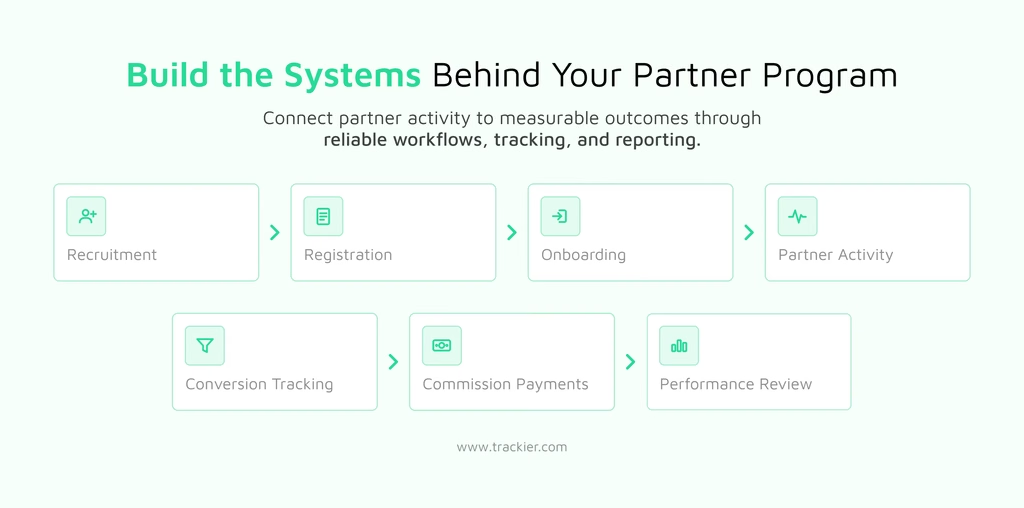
With the partner model, incentives, and program rules established, the next step is to build the systems and workflows needed to manage partnerships effectively. Without reliable operations, businesses may struggle to track referrals, attribute conversions, calculate commissions, and maintain consistent partner communication.
Manual spreadsheets may work for a small pilot, but they can introduce errors and delays as partner numbers and conversion volumes increase. A structured setup connects partner activities with business outcomes through clear workflows, reliable tracking, and consistent reporting.
4.1 Map the Partner Management Workflow
Document how the program will operate from recruitment to ongoing performance management. Each stage should have a clear owner and expected outcome.
A typical workflow includes:
- Recruitment and approval: Review applications and approve suitable partners.
- Agreement and registration: Record partner details and confirm program terms.
- Onboarding and enablement: Provide training, promotional resources, and tracking instructions.
- Partner activity: Enable partners to promote products, submit referrals, or support sales.
- Conversion tracking: Record eligible leads, sales, or subscriptions and associate them with the correct partner.
- Commission and payment: Validate conversions, calculate commissions, and process payouts.
- Performance review: Share results and identify improvement opportunities.
4.2 Choose the Right Partner Management Technology
The tools required depend on the program’s size, complexity, and reporting needs.
- Spreadsheets and shared documentation can help smaller programs track partner details and basic referral activity. However, manual data entry and commission calculations can become difficult to manage at scale.
- Customer relationship management (CRM) systems organize partner contacts, sales opportunities, and partner-sourced leads. They are particularly useful for referral, reseller, and co-selling programs.
- Partner relationship management (PRM) platforms support recruitment, onboarding, training, resource sharing, and performance reporting. Some also offer partner portals and deal registration.
- Affiliate tracking software focuses on referral links, clicks, conversions, attribution, and commissions. Depending on the platform, they may also provide partner dashboards and fraud detection.
4.3 Establish Reliable Partner Attribution and Conversion Tracking
Tracking connects partner activity to business outcomes and determines which partner receives credit for an eligible conversion.
Unreliable attribution can lead to incorrect reporting, commission disputes, and reduced partner trust. The tracking setup should reflect the partnership model.
- Referral links and unique identifiers: Assign unique links, codes, or IDs to associate activity with specific partners.
- Lead registration: Allow B2B partners to submit prospects through a form, CRM, or partner portal to establish referral ownership.
- Conversion events: Define qualifying actions, such as completed purchases, qualified leads, paid subscriptions, or approved sales opportunities.
- Attribution windows: Specify how long a referral can receive credit for a conversion.
- Duplicate referrals: Establish rules for handling customers referred by multiple partners or influenced by different channels.
- Offline conversions: Connect partner referrals to CRM records so businesses can track opportunities through to closed revenue.
4.4 Automate Commission Calculations and Payments
Commission administration requires accurate conversion data and consistent application of the terms established in Step 3.
Manual calculations become harder to maintain when rates vary by partner, campaign, or performance tier. Where practical, automate the process:
- Capture conversion data from the tracking system.
- Validate conversions against program requirements.
- Apply the relevant commission rate or incentive.
- Account for refunds, cancellations, or permitted adjustments.
- Generate commission statements for partners.
- Process approved payments according to the agreed schedule.
- Maintain records of calculations and completed payments.
4.5 Create a Centralized Reporting System
A centralized reporting system helps teams evaluate partner contributions without relying on disconnected spreadsheets or inconsistent definitions.
Depending on the program, reporting may combine data from tracking platforms, CRM systems, billing tools, and finance records. Monitor key metrics such as:
- Partner recruitment: Approved partners, active partners, and activation rates.
- Partner activity: Referrals, clicks, submitted leads, or registered opportunities.
- Conversions: Qualified leads, conversion rates, and sales progression.
- Revenue: Partner-sourced revenue, pipeline value, and average deal value.
- Program costs: Commissions, incentives, platform costs, and management expenses.
- Engagement: Training completion and participation in program activities.
4.6 Test the Entire System Before Launch
Before inviting partners to generate significant activity, test the complete workflow. Errors may emerge when tracking links, CRM records, conversion events, and commission calculations interact. Test the following:
- Partner registration and unique ID assignment.
- Referral and lead tracking.
- Conversion recording and attribution.
- Duplicate referrals and overlapping attribution.
- Commission calculations and incentive tiers.
- Refunds, cancellations, and adjustments.
- Reporting and commission statement accuracy.
- Payment approvals and notifications.
- User permissions and customer data access.
Step 5: Onboard, Enable, and Activate Your Partners
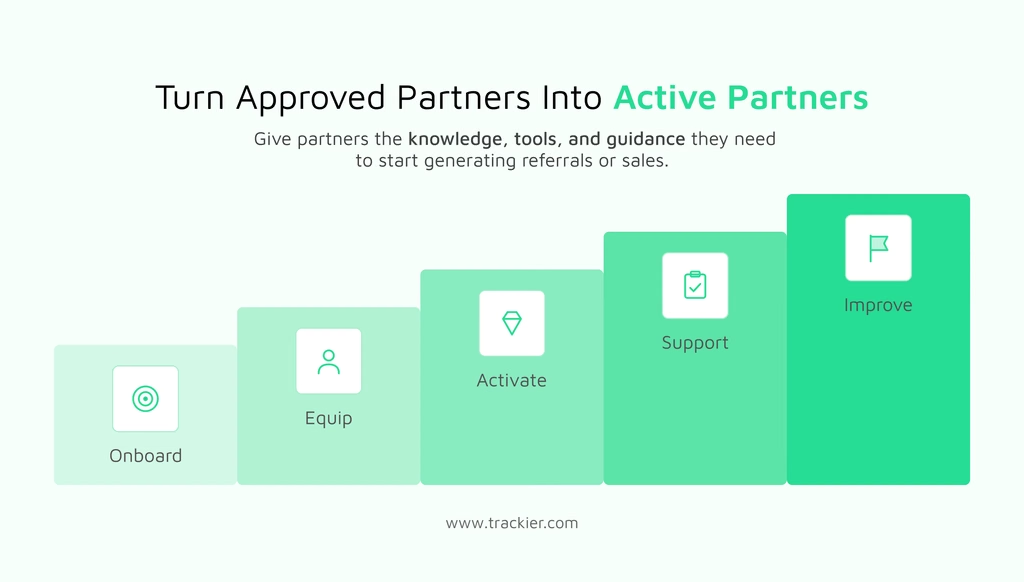
Recruiting suitable partners is only the beginning. To turn partnerships into measurable results, businesses must help partners understand the product, communicate its value, and start generating referrals or sales. A structured onboarding process reduces confusion, builds confidence, and helps partners become productive sooner.
5.1 Create a Structured Onboarding Process
Start by explaining the program’s objectives, partner responsibilities, commission structure, payment terms, and performance expectations. Walk partners through registration, tracking links, referral submission, and reporting tools so they understand how to participate and monitor their results.
Provide a clear point of contact for questions about product information, technical issues, or commission payments. A documented onboarding checklist ensures every partner receives consistent guidance.
5.2 Provide the Right Enablement Resources
Partners need practical resources to promote or recommend the product effectively. Depending on the partnership model, provide:
- Product information: Feature guides, product demonstrations, and key benefits.
- Marketing materials: Approved banners, email templates, landing pages, and social media assets.
- Sales resources: Pitch decks, case studies, pricing information, and objection-handling guides.
- Technical documentation: Integration guides, tracking instructions, and troubleshooting resources.
5.3 Help Partners Achieve Their First Outcome
Activation means moving beyond registration to meaningful activity, such as publishing a promotion, submitting a qualified referral, or registering a sales opportunity.
Set a clear first milestone for each partner and provide support where needed. For example, an affiliate might launch their first campaign, while a referral partner might identify and introduce a suitable prospect.
5.4 Maintain Engagement
Schedule regular check-ins, share performance feedback, and recognize valuable contributions. Use partner feedback to identify gaps in training, resources, or processes.
Step 6: Measure Performance, Optimize, and Scale Your Partner Program
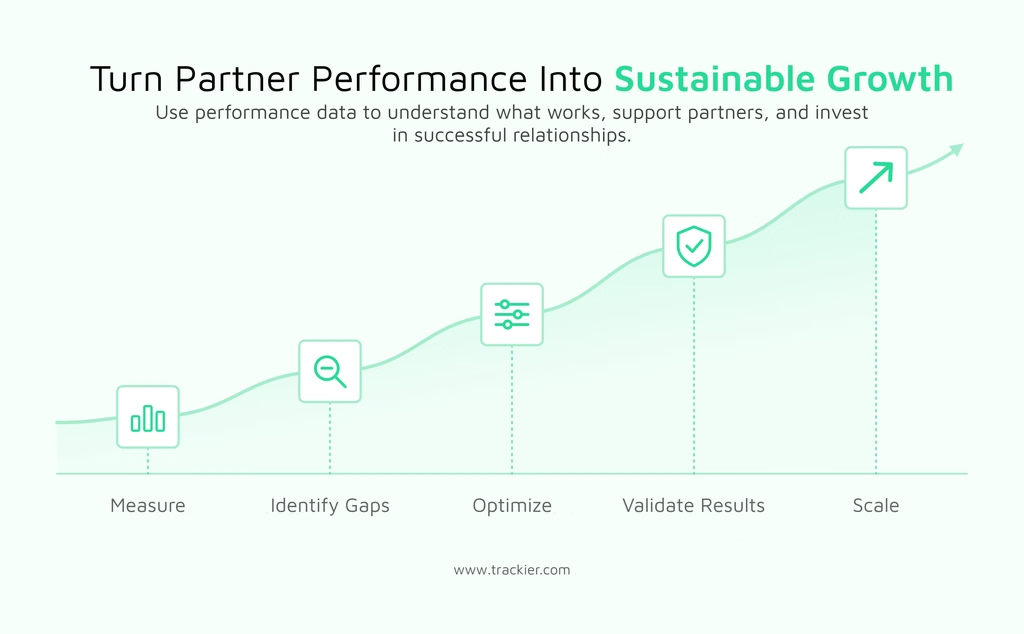
Launching a partner program is only the beginning. To achieve consistent results, businesses must monitor performance, identify improvement opportunities, and focus resources on partnerships that contribute to business goals.
Regular analysis helps determine what is working, where partners need support, and when the program is ready to scale. And this process is even simpler if you are leveraging performance marketing software.
6.1 Track the Right Performance Metrics
Choose KPIs based on your program objectives and partner model. Key metrics may include:
- Partner activation rate: Percentage of recruited partners who begin promoting or referring customers.
- Leads and conversions: Number of qualified leads, sales, or other target actions generated.
- Conversion rate: Percentage of referred prospects who complete the desired action.
- Revenue generated: Income attributed to partner activities.
- Partner acquisition cost: Cost of recruiting, onboarding, and supporting partners.
- Return on investment (ROI): Revenue or profit generated compared with program costs.
6.2 Identify Gaps and Optimize Performance
Use performance data to identify underperforming areas. Low activation may indicate unclear onboarding, while strong traffic but few conversions could point to landing-page, audience-fit, or messaging issues. Discuss results with partners and provide targeted support, updated resources, or improved incentives where necessary.
6.3 Scale What Works
Once the program shows consistent results, identify successful partner types, recruitment channels, and incentive structures. Recruit similar partners, strengthen high-performing relationships, and automate repetitive tasks as the program grows. Expand gradually, ensuring tracking, partner support, and payment processes can handle increased activity.
Partner Program Launch Checklist: From Planning to First Results
A structured launch checklist helps ensure that essential decisions, tools, and resources are in place before a partner program goes live. Use the following checklist to move from planning to activation and measure early progress.
- Phase 1: Planning and Strategy: Define the primary business objective and target audience. Identify the ideal partner profile and relevant partner models. Confirm internal resources, budget, and team responsibilities. Set measurable goals and key performance indicators (KPIs).
- Phase 2: Program Design: Finalize commission structures, incentives, and payment terms. Document partner eligibility criteria and program rules. Establish attribution, conversion, and commission policies. Prepare the partner agreement and compliance guidelines.
- Phase 3: Tools and Tracking: Select the required CRM, partner management, or tracking tools. Configure partner registration and approval workflows. Set up tracking links, conversion events, and reporting. Test attribution, commission calculations, and payment workflows.
- Phase 4: Recruitment and Onboarding: Identify and evaluate suitable prospective partners. Share program details and communicate expectations. Provide onboarding materials, product information, and promotional assets. Assign a point of contact and define the first activation milestone.
- Phase 5: Launch and Optimization: Confirm partners are ready to promote or refer customers. Monitor initial clicks, leads, conversions, and revenue. Collect partner feedback and resolve operational issues. Review results against launch goals and identify improvements. Expand recruitment and investment once the program demonstrates consistent performance.
Final tip: Treat the first 30–90 days as a learning period. Focus on partner activation, reliable tracking, and early conversion quality before expanding the program. The timeline will vary depending on the business model, sales cycle, and operational readiness.