Running an affiliate programme can be one of the easiest ways to grow revenue without taking on the full cost of traditional advertising.
But there is a less visible side to that growth: someone has to pay all those partners.
At the beginning, affiliate payouts rarely feel like a problem. You may have a few publishers, a manageable number of transactions, and a finance team that can handle payment approvals without much trouble.
Then the programme grows.
You have more publishers, more countries, more payout rules, more invoices, and more questions about payment status. Finance teams start working from spreadsheets. Affiliate managers spend time chasing missing information. Publishers want to know when they will be paid.
The problem isn’t usually calculating commissions. Affiliate tracking platforms can already handle conversion tracking and payout calculations. The harder part is taking those approved earnings and turning them into verified, approved, and completed payments without adding another layer of manual work.
That’s where affiliate payout automation comes in.
Why affiliate payouts become difficult as your programme grows
Affiliate payouts become difficult when the number of partners, transactions, and compliance requirements grows faster than the processes managing them.
A payout might look like one transaction from the outside, but there are usually several steps behind it:
- The conversion needs to be validated.
- The commission needs to be calculated.
- The payment period needs to be confirmed.
- Publisher information needs to be complete.
- KYC or other verification requirements may need to be satisfied.
- Internal approvals need to happen.
- Payment details need to be checked.
- The payment needs to be released and reconciled.
None of these steps is especially complicated on its own.
The friction appears when teams have to repeat them for dozens, hundreds or thousands of publishers.
A missing bank detail can hold up a payment. A mismatch in tax information can send a payout back for review. A delayed approval can push an entire payment cycle behind schedule.
That is when finance stops being a supporting function and starts becoming a bottleneck.
What goes wrong with manual affiliate payout workflows?
Manual payout workflows create problems because information has to move between multiple people and systems before money can actually be released.
A typical process can look like:
Track commissions → Export data → Verify payouts → Collect documents → Approve payments → Process payments → Reconcile
It works when the programme is small.
At scale, every handoff becomes another opportunity for a spreadsheet error, missing document, duplicate entry, or communication gap.
The affiliate manager ends up sitting in the middle, answering questions from both sides:
“Has my payout been approved?”
“Why hasn’t this publisher been paid?”
“Which partners are still waiting for verification?”
“Did finance process this month’s payments?”
That administrative work doesn’t generate affiliate revenue. It simply keeps the payment process moving.
Trackier’s current affiliate payments guidance similarly highlights the operational problems created by spreadsheets, multiple commission structures, payment deadlines, and global partners, and recommends connecting tracking with payment workflows rather than managing the processes separately.
What does affiliate payout automation actually do?
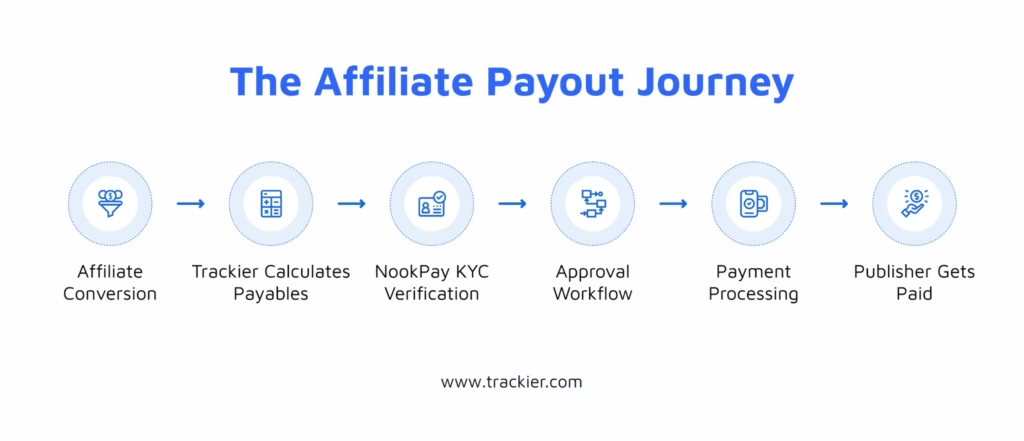
Affiliate payout automation connects the information needed to determine who should be paid with the workflow needed to verify, approve and process that payment.
Automation does not have to mean removing people from the process.
In fact, finance teams should still have control over exceptions, approvals, and higher-risk cases.
The goal is to remove repetitive work around those decisions.
A well-designed payout workflow should make four things clear:
- How much does the publisher need to be paid?
- Is the publisher ready to receive the payment?
- Has the payout been approved?
- Has the payment been successfully processed?
Once those answers live within a connected workflow, finance teams have fewer spreadsheets to maintain and fewer payment-status questions to answer.
NookPay describes its affiliate payment automation in a similar way, with automated payout workflows, validation, multiple payment methods, reconciliation, and compliance processes built around affiliate payments.
How the Trackier × NookPay workflow fits together
The Trackier × NookPay workflow connects affiliate performance and payable data with verification and payment operations.
Trackier handles the affiliate performance side of the workflow, including tracking activity and determining payable amounts.
NookPay provides the payment operations layer described in the integration workflow.
The process can be viewed simply as:
Trackier → Payment Data → NookPay → KYC → Approval → Payment
The important idea is not simply that two systems are connected. It is that the payment process has a defined sequence.
Trackier remains the source of affiliate performance and payable information, while the payment workflow handles the operational steps that happen after those amounts are ready.
That separation makes it easier for teams to understand where a payment currently sits and what needs to happen next.
Why KYC matters before an affiliate gets paid
KYC helps confirm that the person or business receiving an affiliate payment has been properly verified before money is released.
For a small programme, checking publisher information manually may seem manageable.
For a global programme, it becomes a completely different task.
Publisher records can contain:
- Legal names
- Addresses
- Tax information
- Bank details
- Business information
- Identity documents
Those details may also need to match across different records.
KYC is therefore more than a box-ticking exercise. It can help reduce payment errors, support compliance processes and make it harder for payments to go to the wrong recipient.
The exact KYC obligations vary by jurisdiction and payment arrangement. For example, US customer-due-diligence rules for covered financial institutions include requirements around identifying and verifying customers and, in relevant cases, beneficial owners.
For affiliate programmes, the practical lesson is straightforward: verification should happen before payment execution, not after a failed payment exposes a problem.
Choosing the right affiliate payout model
The best payout model depends on how much control your finance team wants to retain over payment execution.
Not every company has the same finance setup.
A fast-growing brand may want more operational support. A large enterprise may already have its own approval policies, accounting systems, and payment infrastructure.
The Trackier × NookPay workflow described in the supplied draft supports two approaches: the Custodian Model and the Self-Pay Model.
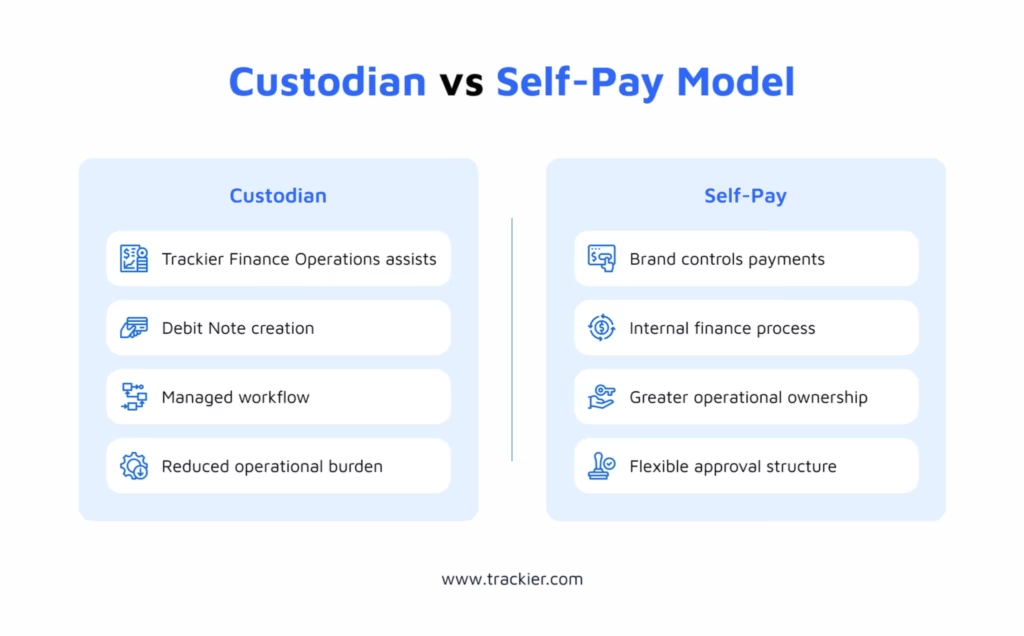
- Custodian Model: reduce the operational workload
The Custodian Model is designed for businesses that want greater operational support around affiliate payouts.
In this approach, Trackier’s Finance Operations team assists with the payment workflow.
The process includes creating a Debit Note for the selected payment period, followed by verification, approvals, and payment processing.
The workflow can be represented as:
Trackier Calculates Payouts → Debit Note → KYC Verification → Approval → Payment
Brands can select payment cycles based on their operating requirements, such as weekly, bi-weekly or monthly cycles, according to the supplied workflow.
This model can make sense when the finance team would rather avoid manually coordinating each step of the payout process.
- Self-Pay Model: keep payment execution in-house
The Self-Pay Model is designed for businesses that already have established finance and payment processes and want to keep control internally.
The workflow becomes:
Trackier Provides Payment Data → Brand Reviews Payables → Brand Processes Payment
Trackier continues to provide the affiliate and payout information, while the brand handles the actual payment process.
This can be a better fit for enterprises with existing approval workflows, internal finance controls or established payment infrastructure.
The advantage is flexibility: automation does not force a company to replace a finance process that already works.
Why flexible payout workflows matter
A payout system should adapt to how a business operates rather than forcing every business into the same payment process.
Consider two very different affiliate programmes.
A growing D2C brand may have a small finance team but hundreds of publishers. It may value operational support because every additional manual step takes time.
A multinational enterprise may already have finance teams in several regions, established approval controls and preferred payment providers. For that organisation, retaining control over payment execution may be more important.
Both businesses need accurate payout data.
They simply need different levels of operational involvement.
That’s why the ability to choose between managed and self-managed payment workflows matters more than having one rigid process.
Faster payouts are really about partner experience
Affiliate payouts are a partner experience issue as much as a finance issue.
Publishers care about their earnings, but they also care about predictability.
They want to know:
- What have I earned?
- Has my payout been approved?
- Do I still need to submit information?
- When will the payment be processed?
- Has the payment been completed?
When the answers are difficult to find, affiliate managers become the support desk for finance operations.
When the process is clear, the experience changes.
Publishers spend less time chasing payment updates. Finance teams spend less time answering repetitive questions. Affiliate managers get more time to recruit and develop partners.
That matters because affiliate relationships are built on trust. A programme can have excellent commission rates and strong conversion performance, but repeated payment problems can still damage those relationships.
International affiliate payouts add another layer of complexity
International affiliate programmes need to account for currency, payment methods, local requirements and cross-border payment friction in addition to commission calculations.
Cross-border payments continue to face challenges around cost, speed, transparency, interoperability and regulatory differences. The Bank for International Settlements noted in 2026 that these differences remain important barriers to efficient cross-border payments.
That is why global payout automation needs to do more than press a “Pay” button.
A robust workflow should help teams understand:
Who is being paid → How much → In which currency → Through which method → After which checks → With what payment status
Tax documentation can also become part of the process. For example, in the US, businesses paying qualifying independent contractors may have information-reporting obligations, including Form 1099-NEC, and may need the payee’s taxpayer identification information.
Requirements vary by country, so organisations running international affiliate programmes should get jurisdiction-specific tax and compliance advice rather than assuming one process applies everywhere.
What should businesses automate first?
Start by automating repetitive, rules-based steps before trying to automate every finance decision.
A practical starting point is:
- Commission data: move approved payout amounts directly from the tracking workflow.
- Publisher information: keep payment and verification details structured.
- Validation: flag missing or mismatched information before payment.
- Approvals: route payments to the right reviewers.
- Payment execution: use the appropriate payout method once requirements are met.
- Status tracking: give finance and publishers visibility into what happened.
- Reconciliation: keep payment records aligned with the underlying payout data.
This approach keeps humans involved where judgement matters and lets automation take care of repetitive administrative work.
That is also consistent with where affiliate platforms are heading. Trackier’s recent product updates have focused on reducing manual affiliate onboarding work, increasing API-driven control over payout logic, and improving operational efficiency.
The goal isn’t just to pay affiliates faster
The real goal of payout automation is to build a payment process that remains manageable as the affiliate programme grows.
A successful affiliate programme is not just about generating clicks, conversions, and revenue.
It also needs reliable operations behind those numbers.
As publisher counts increase, manual payout processes become harder to maintain. Verification requirements increase. Finance teams have more transactions to review. International payments introduce additional complexity. Publishers expect clearer communication.
A connected workflow helps bring those moving parts into one process.
For businesses using the Trackier × NookPay workflow described above, the choice between the Custodian Model and Self-Pay Model provides a way to align payout operations with the finance structure already in place.
And that is ultimately what good payout automation should do: make the growing programme easier to manage, without making the finance team work harder to support it.
1. What is affiliate payout automation?
Affiliate payout automation is the process of using software and connected workflows to calculate, verify, approve, and process affiliate commissions with less manual intervention.
Instead of moving payout data between spreadsheets, emails, and separate payment systems, businesses can connect affiliate tracking data with verification and payment workflows. This helps reduce repetitive finance work while keeping approval controls in place.
2. How does affiliate payout automation help finance teams?
Affiliate payout automation reduces repetitive administrative work by connecting payout calculations, verification, approvals and payment processing into a structured workflow.
Finance teams spend less time reconciling spreadsheets, chasing missing information, and answering payment-status questions. They can instead focus on exceptions, approvals, and financial controls.
3. Why is KYC important for affiliate payouts?
KYC helps businesses verify the identity and payment information of publishers before funds are released.
This can help reduce payment errors, support applicable compliance requirements, and ensure that payouts are directed to the intended recipient. KYC requirements can vary depending on the payment provider, jurisdiction, and business model.
4. What is the difference between the Custodian Model and Self-Pay Model?
The main difference is who manages the payment execution process.
With the Custodian Model, Trackier’s Finance Operations team assists with the payout workflow, including the Debit Note and subsequent payment steps. With the Self-Pay Model, the brand retains responsibility for reviewing and executing payments using its own finance processes.
5. Can affiliate payouts be automated for international publishers?
Yes, affiliate payout workflows can support international publishers, but the requirements depend on the countries, currencies, payment methods, and compliance obligations involved.
Global programmes may need to account for different payment methods, tax documentation, verification requirements, and cross-border payment considerations. Businesses should review the requirements for each market rather than assuming that one payout process will work everywhere.