Even though SaaS affiliate programs may deliver scalable income, affiliate marketing management is not just about tracking clicks and conversions.
It is expected that in 2026, 69% of leading B2B SaaS executives will plan to increase the amount they invest in partnerships; thus, proper affiliate management becomes more important than ever.
The management of affiliates in SaaS processes involves different steps, from tracking customers’ journeys to attribution and optimization of partners’ performance and profitability.
With Trackier, SaaS teams can bring tracking, attribution, fraud prevention, reporting, and partner performance management into one platform, helping turn affiliate activity into measurable, sustainable growth.
What is Affiliate Marketing Management for SaaS?
Affiliate marketing management for SaaS refers to the administration of the entire affiliate marketing program, which includes the recruiting and onboarding of affiliate partners as well as the tracking of clicks and revenue generated as a result of affiliates’ influence.
While a traditional ecommerce transaction results in a ‘one-time’ revenue, in SaaS, transactions can generate revenue through renewals, upgrades, and other subscription events, making monitoring and attribution ongoing.
An affiliate manager in SaaS oversees:
- Partner management: recruiting, onboarding, managing, and assessing affiliates
- Tracking: conversion of clicks to sign-ups, subscriptions, and revenue generation
- Attribution: deciding which affiliate deserves credit for the conversion based on a pre-defined attribution window
- Commission management: calculating commissions taking into consideration, for instance, renewals or refunds
- Performance optimization: assessing affiliates according to conversion quality, revenue, retention, and customer lifetime value rather than volume.
How Affiliate Tracking Works for SaaS
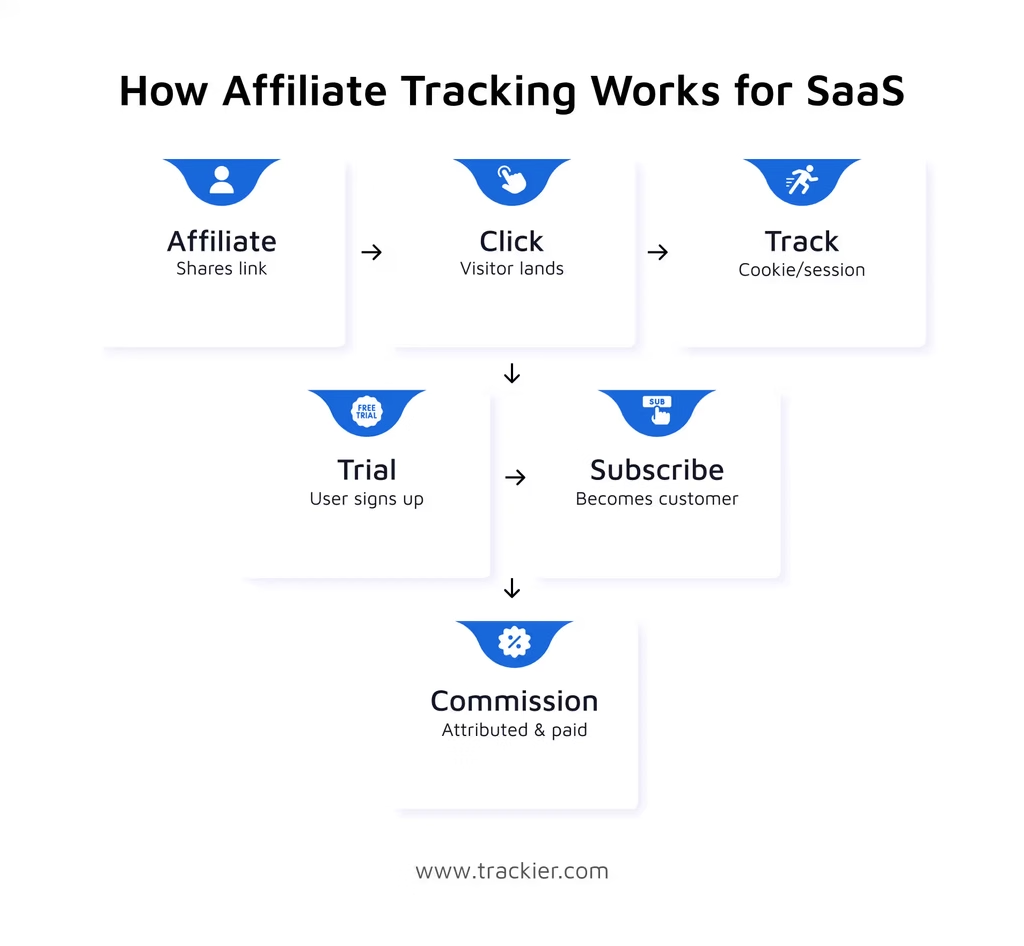
For SaaS companies, tracking of affiliate marketing activities should go way beyond clicks and conversions and be able to correlate affiliates’ actions with the full customer journey from the first referral through to registration, paid conversion, renewal, upgrade, return, and churn.
This allows the teams to identify those partners that bring revenue and long-term customer value rather than just traffic to the company. But the question is what should SaaS teams track? Proper tracking implies the following requirements:
- Affiliate ID – indicates which affiliate made a referral
- Click ID – links the click to any subsequent activities
- Campaign/source – identifies the referral source
- Signup or trial – records the very first conversion
- Paid conversion – determines when the user becomes a customer
- Revenue – associates the generated conversions with the subscription amounts
- Subscription events – tracks renewals, upgrades/downgrades, refunds, and cancellations.
The importance of tracking these events is that SaaS customers have the potential to generate income for months, if not years.
This implies that a partner possessing fewer conversions but enjoying a higher level of retention and lifetime value could be more advantageous than a high-volume affiliate.
Link Tracking in Comparison to Coupon Codes
Affiliate links are used to recognize partners, keep records of clicks, and process tracking information.
Using coupon-code tracking can lead to tracking conversions from media channels that may not use the tracked link, such as podcasts, YouTube, email newsletters, or social media.
First-Party Tracking and Server-To-Server Tracking
Tracking based on the browser can be affected by cookie limitations, ad blockers, privacy settings, etc.
Server-to-server tracking sends the conversion data directly from the advertiser’s server to the tracking platform connected by a unique transaction ID. Overall, this type of tracking is more reliable than browser-based tracking.
Attribution of Affiliates for SaaS: Idealizing the Right Partner
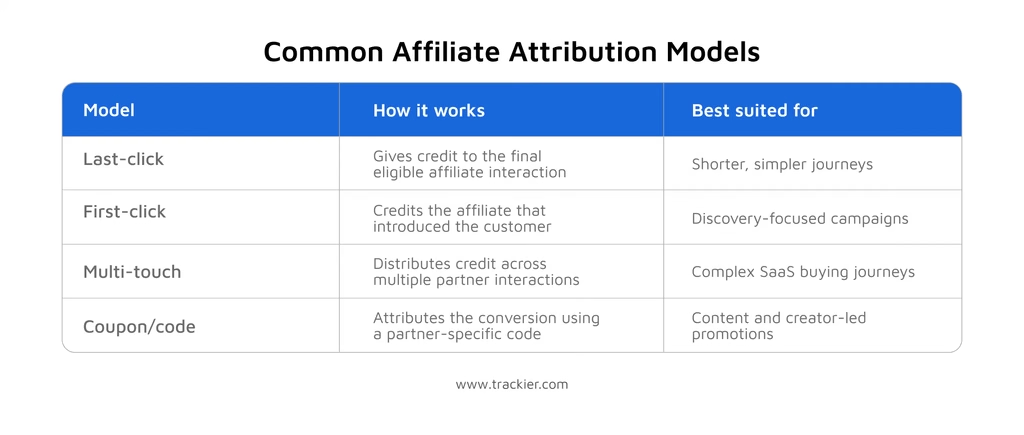
In the scenario of SaaS, people have a tendency to interact with many affiliate partners before they get converted into potential clients.
These individuals may discover the product via one affiliate, later return to another affiliate, and initiate the trial, hence becoming consumers of the product later.
Having said that, the attribution process becomes very important in the case of affiliate marketing management. Though the process of last-click attribution looks simple, it may give too much credit to the last partner while neglecting the influence of the affiliate that made discovery and consideration possible.
As per the recent study, 42% of B2B SaaS companies implement multi-touch attribution, while the ratios of first-click affiliate usage account for 31% and the implementations of last-click account for 19%.
Infographic
Establish a Clear Attribution Window
An attribution window specifies the duration of any interaction made by an affiliate and the possible event of conversion in question.
For instance, in the case of a 30-day window, the conversions made and validated during the span of 30 days after the affiliate interaction would be included in the process of attribution.
Based on the buying cycle you usually have, it is necessary to select the length of the attribution window and an appropriate time frame for your market.
For instance, a longer time spent on the process of making decisions generally leads to longer windows, while in cases of fast-moving SaaS products there might be a necessity to consider windows that are shorter in time.
Avoid Attribution Conflicts
It is necessary to determine the attribution rules and conflicts concerning multiple interactions, coupons on the same affiliate links, self-referrals, and cooperation with existing consumers in the framework of another marketing strategy.
It is necessary to receive clear commission attribution based on common and precise principles, avoiding the last considered interaction. Proper attribution guarantees protection of the commission budget as well as the acquisition of trust of partners in the SaaS industry.
10 Affiliate Marketing Metrics SaaS Teams Should Monitor
SaaS businesses should not only limit their analysis of affiliate performance to the number of clicks or conversions made. Even if the partner causes thousands of visits, they can still have customers who cancel after a short period of time, claim refunds, or generate a small amount of recurring revenue.
Thus, to have successful affiliate marketing management, one has to use the metrics that correlate affiliate actions with customer quality and the profitability from the customers.
For instance, a 2026 study of over 200 SaaS affiliate programs revealed that the best 10% of affiliates are responsible for 65-70% of overall affiliate revenue, which is the reason why SaaS teams should focus on clearly identifying and investing in the most effective affiliates instead of treating all affiliates equally.
1. Affiliate Clicks – This type of metric shows the number of affiliate clicks and allows you to see how much traffic one affiliate drives. This metric can help to identify active partners and also see sudden traffic fluctuations, but one cannot rely on a high number of clicks only.
2. Click-to-Signup Rate – This determines how well affiliate traffic converts into new signups or trial accounts. If the number is low, it may indicate that there is a problem with either the audience targeting or promotions conducted, as well as landing page performance.
3. Trial-to-Paid Conversion Rate – When it comes to SaaS, making a user sign up for a trial is just the first step. Monitor how many trials that originated from affiliates are transitioned into paid clients to establish the actual quality of the leads generated through partnerships.
4. Conversion Approval Rate – It is important to remember that not all conversions are eligible for commission accrual. Assess the percentage of the conversions that have passed through the validation process for duplicates, refunds, cancellations, fraud signals, and program rules.
5. Revenue per Affiliate – Determine how much revenue each active partner has generated. This is going to help differentiate between affiliates that require more support through marketing initiatives and offer commitments, or high tiers of commissions.
6. Revenue per Click – Indicates the amount of revenue made from affiliate traffic when compared to clicks. This basically allows for comparing partners even with varying audience sizes, as well as identifying affiliates bringing in a few clicks but high-value visitors.
7. Customer Lifetime Value – It is the long-term value of customers brought in through a certain affiliate. Even if a partner brings fewer conversions, the LTV they provide can be higher than the LTV from a high-conversion affiliate.
8. Churn and Refund Rate – Analyze whether customers who came from the affiliate have unsubscribed. High levels of churn and refunds can indicate bad traffic, aggressive marketing, and incentives provided at the moment of conversion.
9. Commission-to-Revenue Ratio – This allows you to analyze commissions received from affiliate customers compared to the revenue they bring in. This helps to understand whether the commission system you use is effective or if a particular partner is generating profits in terms of revenue received.
10. ROI from Affiliate Marketing – Lastly, one should assess the overall profitability of the program by comparing affiliate-generated revenue to various expenses, including commissions, recruitment, management, performance marketing software costs, etc.
How to Optimize Your Affiliates’ Performance
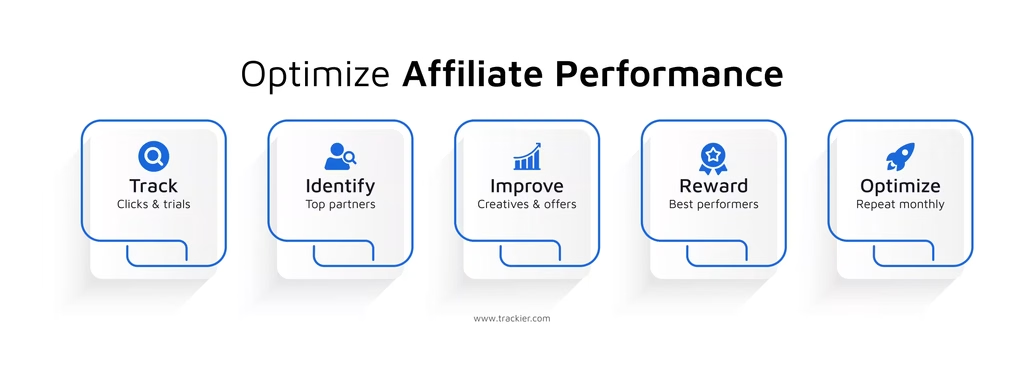
Tracking is merely the first step in the process of maximizing the effectiveness of affiliate marketing management.
This is because the actual benefits of affiliate marketing management result from analyzing performance data to improve partner effectiveness, customer recruitment, and profitability levels of the business.
When it comes to a SaaS brand, optimization should aim at focusing on earnings and customer value rather than just the volume of affiliates or conversions.
Categorize Affiliates Based on Their Performance
Classify affiliates according to how effective and productive they are in terms of generating revenue:
- High income with good customers: Provide higher commissions or special offers
- High volume of sessions and low conversion rate: Review whether this is the right audience and whether your marketing message and landing page are effective
- Low number of leads but high LTV: Keep working with these partners
- High number of conversions with high churn rate: Analyze the traffic quality and promotional efforts
Improve Your Commission Structure
Implement tiered commission rates, recurring payments, and bonuses for good performance.
According to a recent study, the average commission rate for SaaS affiliates has reached 20%, and 27% of campaigns use recurring commission payment methodology.
Enhance Underperforming Associates
Avoid discarding poorly-performing affiliates. Analysis must come first so that necessary decisions such as better-designed creatives, landing pages, messaging, and more effective campaign management can be made.
When the amount of traffic is considerable, yet its conversion is low, run tests on the funnel before changing commissions.
Focus on Customer Quality
Being the affiliate with the biggest amount of conversions does not mean being the one most valuable.
Evaluation needs to consider revenue, paid conversion rate, LTV, churn, refunds, and ROI to get the best partners to boost sustainable growth.
For the optimization to be effective, it has to be a constant process of working through the following cycle: Measure → Segment → Test → Improve → Reallocate
Affiliate Fraud and Attribution Vulnerabilities in SaaS
When it comes to SaaS firms, affiliate fraud is not just about bogus clicks and automated programs.
Fraudulent partners may engage in manipulating attribution, resulting in illegitimate conversions and obtaining credit for clients who were not their referrals, in addition to being responsible for clients who quit after a short while.
In SaaS businesses that disburse commissions over time, even minor attribution issues can be problematic. So, teams should track:
- Fake or robotic traffic: These bots generate clicks without bringing in clients
- Self-referrals: The affiliates will earn their commission from their own purchases or from current customers
- Cookie stuffing: Affiliate IDs are inserted without a valid referral
- Brand bidding: Affiliates will use paid search for restricted brand names
- Duplicate conversions: The same customer or transaction could be seen more than once
- Conversion manipulation: If a brand sees a sudden spike in conversion rates or unusual patterns in geography or device, then it may point to fraud
How to Create an Affiliate Management Workflow
An effective SaaS affiliate program requires more than a set of tracking software and a list of affiliates to work with.
It requires SaaS affiliate management software along with the management process that connects attribution, verification, performance measurement, optimization, and payouts.
According to a study done in 2026 on 31.4 million referrals across 3,425 subscription services, it is crucial to be aware of affiliate activation, concentration of income, changes in commission, and fraud examination.
Step 1: Keep Track of the Affiliates’ Activity – Collect information about affiliate IDs, clicks, campaigns, sign-ups, trials, conversions, revenues, and subscription actions. Tracking the conversions made by affiliates helps you determine the long-term efficiency of converted customers.
Step 2: Set Attribution Rules – Set the windows for attribution, rules for several affiliate actions, discounts, problems with duplicate referrals, and competition across channels. Clear rules minimize the possibilities of disputes and guarantee correct commission calculations.
Step 3: Validate Conversions – Before accepting all transactions that have been tracked, make sure there are no transactions that need to be flagged as fraudulent, refunded, cancelled, self-related, etc.
Step 4: Evaluate Partners’ Performance – Choose based on conversion ratios, the amount of revenue earned, LTV and churn, EPC, ROI, etc. Look not just at the number of good transactions but at successful partners.
Step 5: Optimize and Reallocate – Change commission types, creatives, landing pages, campaigns, and support based on performance data of the partner.
Step 6: Approve and Pay – After validation, finalize commissions and process payouts according to program terms. Keep clear records of approved, rejected, refunded, and adjusted commissions.
Step 7: Monitor Workflow Continuously – Think about affiliate management as a circular process: Track → Attribute → Validate → Analyze → Optimize → Pay → Monitor
Conclusion
Affiliate marketing management is not just about maximizing clicks and conversions in SaaS. It requires tracking, attribution, fraud prevention, and optimization to be able to find those partners who drive profitable lifetime customers.
Trackier offers centralized affiliate tracking and attribution, as well as fraud prevention and commission management for SaaS teams so they can make educated partner choices. To create a scalable and measurable affiliate marketing program, book a demo.
FAQs
How to manage affiliate marketing for a growing SaaS business?
To manage affiliate marketing effectively, create a structured process for recruiting and onboarding partners, providing promotional resources, communicating regularly, reviewing performance, managing commissions, and resolving partner issues. As the program grows, automate repetitive tasks and segment affiliates so managers can focus their time on high-value partnerships.
What should you look for in affiliate marketing management software?
When evaluating affiliate marketing management software, look for capabilities such as affiliate onboarding, campaign management, real-time tracking, commission management, automated payouts, reporting, fraud detection, integrations, and flexible attribution. For SaaS, the software should also support subscription events such as recurring payments, refunds, upgrades, and cancellations.
How does affiliate marketing program management help SaaS companies scale?
Affiliate marketing program management provides a repeatable system for managing partners as the program expands. It can centralize affiliate communication, campaign assets, commission rules, approvals, reporting, and partner performance. This reduces manual work while helping teams maintain consistent program policies across a growing affiliate network.
What is an affiliate marketing management platform?
An affiliate marketing management platform is software that centralizes the processes required to operate an affiliate program. Depending on the platform, this can include partner recruitment and onboarding, tracking, attribution, campaign management, commission calculation, reporting, fraud prevention, and payouts.
How can SaaS companies improve affiliate onboarding?
SaaS companies can improve affiliate onboarding by giving new partners clear commission terms, product positioning, tracking links, promotional assets, and campaign guidelines from the start. A structured onboarding process helps affiliates begin promoting faster and reduces confusion around program rules.