There is a fundamental limitation in traditional marketing attribution metrics. Most of them convey what happened after a marketing interaction, not necessarily what would have happened without it.
This is where marketing incrementality steps in.
A customer may click an affiliate link and purchase five minutes later. The affiliate attribution platform can accurately record clicks and conversions. However, the customer may already have decided to buy before clicking the link. In that case, the affiliate interaction is associated with the sale, but it may not have caused the sale.
In this guide, we will explore what incrementality means, how it differs from attribution, which metrics matter, and how to apply incrementality insights to affiliate and partner marketing.
What is Marketing Incrementality?
Marketing incrementality is the additional outcome caused by a marketing activity, measured against what would have happened without it. Rather than counting every conversion a channel touches, it isolates the slice of demand that a marketing channel actually created.
The easiest way to grasp this is through the idea of native demand. Some customers are going to buy regardless of what they see, click, or read. Maybe they’ve been eyeing the product for weeks. Maybe a friend recommended it. Whatever the reason, no amount of marketing was going to change their decision.
Incrementality is only interested in the portion of demand marketing genuinely shifts, not the portion that was already locked in.
In practical terms, marketing incrementality helps marketers answer questions attribution can’t:
- How many conversions did this campaign actually create, versus simply take credit for?
- Which partners generate genuinely new demand, and which ones are mostly capturing demand that already existed?
- Is a high ROAS translating into real incremental revenue, or is it inflated by conversions that would have happened anyway?
- If we increase spend on this channel, will it produce more sales, or are we already past the point of diminishing returns?
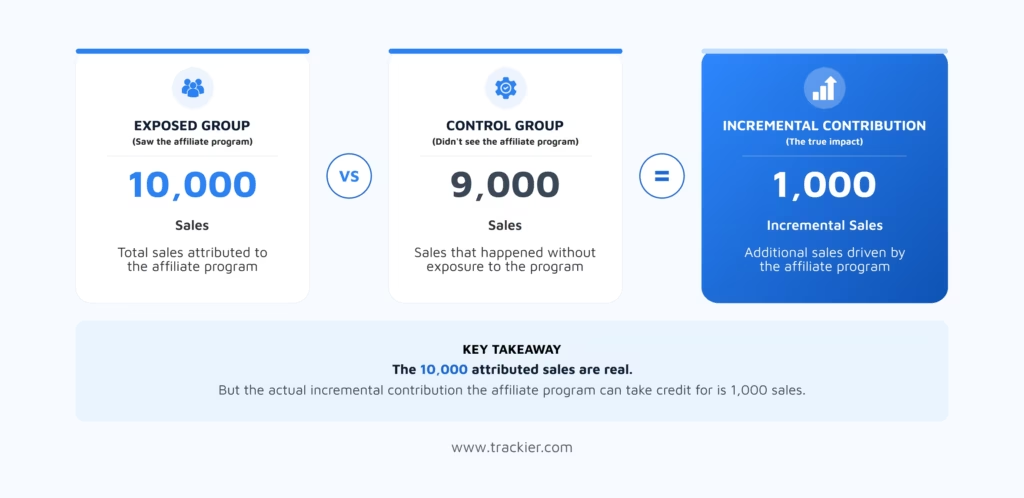
Example: A brand credits its affiliate program with 10,000 sales. An incrementality test comes back showing that customers exposed to the program generated 1,000 more sales than a comparable control group that wasn’t exposed. The 10,000 attributed sales are still real numbers. But the actual incremental contribution, the part the affiliate program can genuinely take credit for, is closer to 1,000.
What is the Difference Between Marketing Incrementality and Attribution
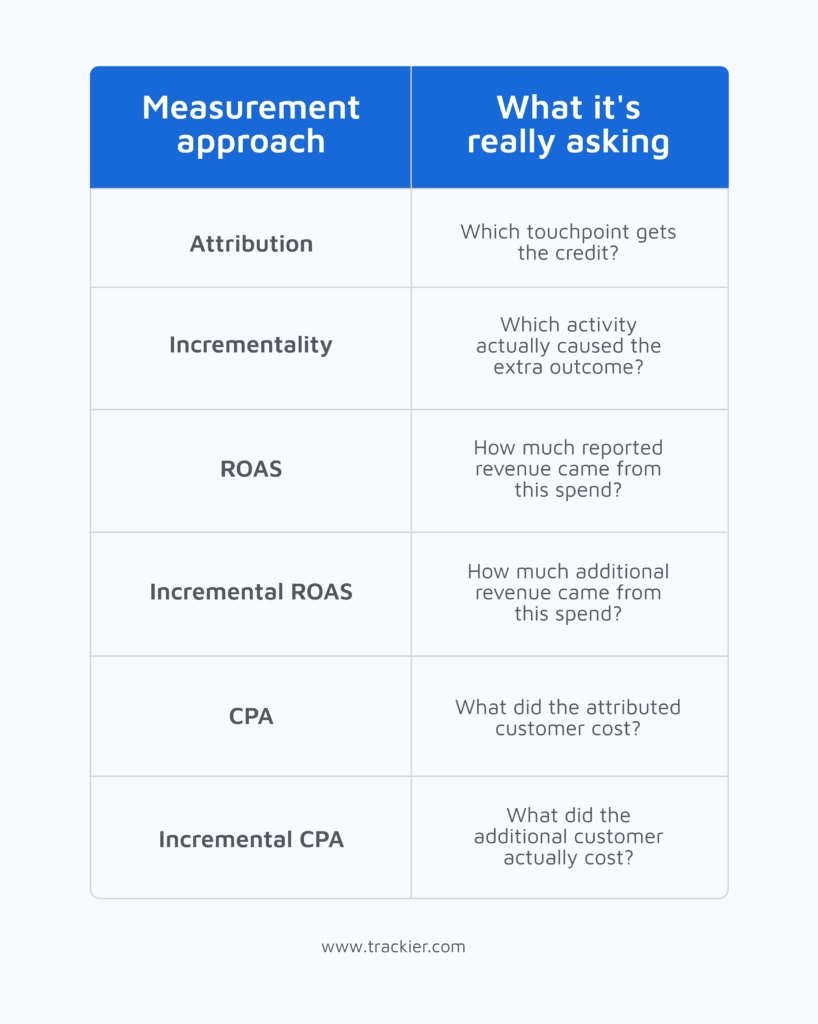
Attribution assigns credit. Marketing incrementality tests causality. That’s the whole distinction in one sentence, but it’s worth sitting with, because conflating the two is where a lot of marketing budgets go to die.
A last-touch attribution model hands a conversion to whichever affiliate happened to be the final tracked touchpoint. A multi-touch model spreads that credit across affiliates, paid search, email, and social. Neither model actually proves the marketing activity caused the purchase. They’re both just rules for dividing up credit after the fact.
Google draws this line explicitly in its Conversion Lift documentation: attributed conversions come from configured attribution rules and tracking, while incremental conversions come from comparing outcomes between treatment and control groups. One measures involvement. The other measures cause and effect.
Why Smart Marketers Combine Attribution and Incrementality
It’s tempting to treat marketing incrementality and attribution frameworks as competing for the “right” way to measure marketing. In practice, they work better as a pair.
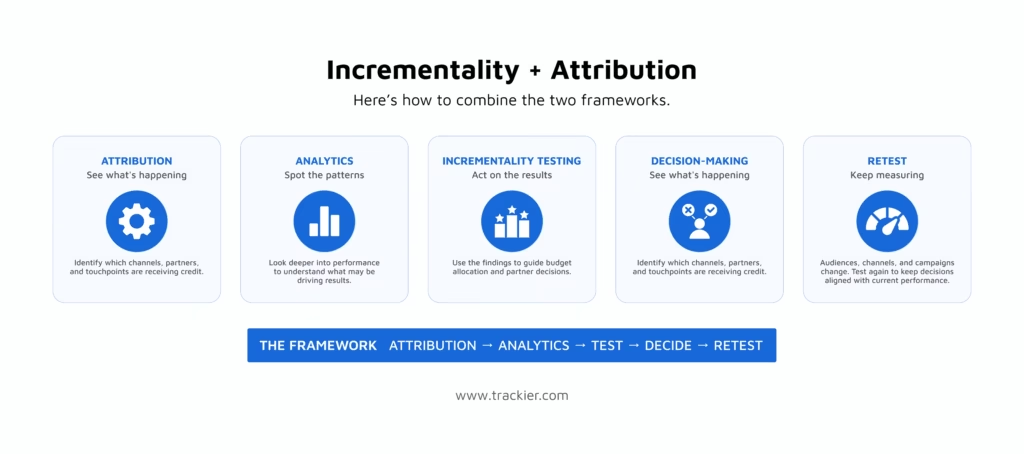
Attribution is genuinely useful for day-to-day operations: understanding customer journeys, tracking partner activity, and monitoring campaign performance in near real time. Incrementality adds the causal layer that either confirms or challenges what attribution seems to be telling you.
Example: A content partner shows $500,000 in attributed revenue. A follow-up incrementality test finds that customers exposed to that partner convert at meaningfully higher rates than a comparable unexposed group. Attribution told the team what happened. The test explains, at least partially, why it happened, and whether the partner deserves the credit attribution assigned to it.
Why Incrementality is Becoming the Norm Amongst Marketers
Modern marketing efforts have been split across more channels than ever. A single customer might discover a brand through organic search, a creator’s Instagram post, an affiliate blog, a retargeting ad, and a marketplace listing before they ever hit “buy.” As those touchpoints multiply and overlap, the same conversion often gets claimed by multiple reporting systems at once.
At the same time, marketing leaders are under real pressure to defend every dollar of spend, not just report on it. Incrementality answers that pressure directly by shifting the conversation from “who gets credit” to “what did we actually cause.”
Recent research backs up how much this matters in practice. A 2026 Nielsen analysis of Pinterest campaigns in the Canadian CPG sector found that 80% of campaigns produced statistically significant incremental sales, giving marketers a genuine benchmark for what “working” actually looks like when measured causally rather than just observed.
For performance teams, getting serious about incrementality opens up several practical wins: sharper budget allocation, clearer identification of which partners actually drive growth, less spend wasted on channels cannibalizing each other, more precise customer segmentation, better-designed commission structures, and earlier warning signs of diminishing returns.
How Incrementality Works in Affiliate and Partner Marketing
Affiliate and partner marketing is where marketing incrementality earns its keep, because partners influence customers at wildly different points in the buying journey.
For context, a content publisher might introduce someone to a brand for the very first time. An influencer might build consideration. A comparison site might help a shopper weigh their options. A coupon partner might tip the final decision. A cashback platform might just nudge someone to finish a purchase they’d already half-decided on.
Every one of these activities can generate an attributed conversion. Their actual incremental contribution, though, can look wildly different from one partner type to the next.
When evaluating a partner, it’s worth looking well past attributed conversions and into metrics like incremental conversion rate, incremental revenue, incremental new customers, incremental CPA, incremental ROAS, average order value, new-customer rate, repeat purchase rate, customer lifetime value, reactivation rate, and commission as a share of incremental revenue.
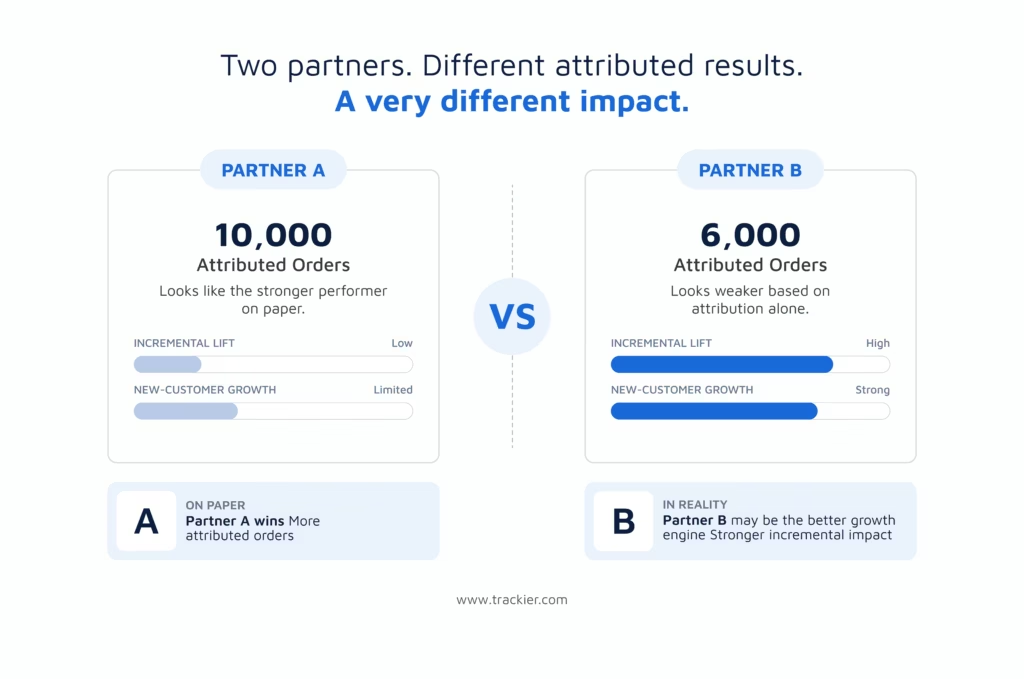
Example: Partner A generates 10,000 attributed orders, but testing shows limited incremental lift behind that number. Partner B generates only 6,000 attributed orders, yet produces significantly stronger incremental new-customer growth. On paper, Partner A looks like the stronger performer. Once incrementality enters the picture, Partner B might actually be the better growth engine.
How to Measure Marketing Incrementality
There’s no single marketing incrementality test that fits every campaign. The right approach depends on how much control a marketer has over who gets exposed to a given activity.
Before diving into the tests themselves, it helps to know what iROAS is and how it differs from ROAS:
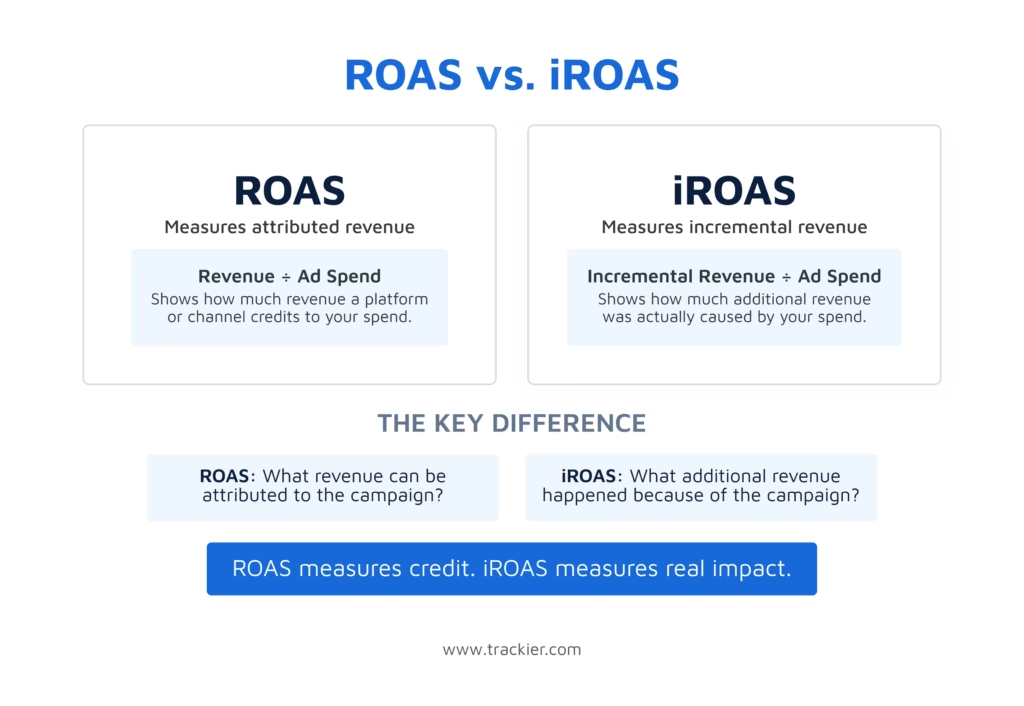
Unlike standard ROAS, which just divides revenue by spend, iROAS asks a sharper question: “How much of that revenue actually came from the money you spent?”
To get there, you take the conversion value from your treatment group (the audience exposed to the campaign) and subtract the conversion value from your control group (the audience that wasn’t).
What’s left is the revenue your spend can actually take credit for. Divide that figure by your ad spend, and you’ve got your iROAS, a number that reflects real, causal impact rather than everything a platform happens to attribute to a click.
The following are the three most popular tests that showcase an incremental lift in a marketing campaign:
Randomized Holdout Test
These tests split an eligible audience into a treatment group that receives the marketing activity and a control group that doesn’t. The gap between their outcomes is the estimate of incremental impact. Google’s Conversion Lift methodology runs on this same treatment-versus-control logic.
A solid holdout test defines its treatment and control audiences, the primary conversion being measured, secondary metrics, test duration, expected baseline rate, minimum detectable lift, and required sample size well before the test ever goes live.
Example: A brand randomly withholds an affiliate promotion from 10% of eligible users. If the exposed audience converts at 3.2% and the holdout converts at 2.8%, the estimated incremental lift is 0.4 percentage points.
Geographic Test
These tests use regions, cities, or states as the treatment and control groups instead of individual users. They’re especially useful when it’s difficult to control exposure at the individual level. Academic research has looked closely at how to estimate incremental ROAS from paired geo experiments, and it highlights how tricky the statistics get when you’re working with only a handful of geographic units.
Example: A retailer runs a new partner promotion in 10 cities while 10 comparable cities remain untreated. Sales in both groups are tracked during the same period and compared against historical performance.
Scale Test
These tests examine what happens as spend increases, and they’re particularly good at revealing diminishing returns. A channel might be genuinely incremental at its current budget and noticeably less efficient the moment more money gets thrown at it. The channel remains profitable in this simplified example, but each additional dollar is producing less incremental revenue.
Example: A team is spending $20K to generate $60K in incremental revenue (a 3.0x incremental ROAS). They increase spending to $60K, and incremental revenue only climbs to $105K (a 1.75x incremental ROAS). The channel is still profitable. It’s just producing less lift per additional dollar, and that’s exactly the kind of pattern a scale test is built to catch.
Considerations to Keep in Mind While Testing for Incrementality
A well-designed incrementality test can still lead you astray if a few practical realities get overlooked along the way. Before trusting any result enough to shift budget or partner strategy, it’s worth checking it against these three common failure points.
- Control group contamination
On many channels, users assigned to the control group can still get exposed to the marketing anyway, through organic search, another affiliate, social, email, or plain word of mouth. That leakage quietly undermines the whole comparison, so it’s worth mapping out where contamination is most likely before a test launches.
Example: A customer assigned to the control group may not receive a specific affiliate promotion but may still see the affiliate’s content through Google search. The customer is therefore not truly unexposed.
- Seasonality
Holidays, paydays, back-to-school periods, and competitor promotions all shift baseline demand on their own. Run a test during one of these windows without accounting for it, and normal seasonal movement can easily get mistaken for incremental lift.
Example: A campaign launched during a major holiday period may appear highly incremental simply because demand increased during the same period.
- Sample size
Small samples can produce results that look dramatic but aren’t reliable. Therefore, sample size math needs to happen before a test launches, not after, since that’s what separates a trustworthy result from a coin flip dressed up as data.
Example: A test group converting at 3% against a control at 2% looks like a striking 50% relative lift, but if that gap is only 10 extra conversions across 1,000 users per group, it’s just as likely to be noise as a real signal.
What Should Performance Marketers Remember About Incrementality?
Incrementality is ultimately about answering a simple but difficult question:
“What additional business value did marketing create that would not have existed without it?”
Attribution can tell you which partner, channel, advertisement, or touchpoint was associated with a conversion. Incrementality asks whether that activity changed the outcome. It is also important to note that incrementality testing only becomes valuable when the findings influence actual decisions.
A useful framework is:
High attributed performance + high incremental performance
→ Consider scaling.
High attributed performance + low incremental performance
→ Investigate cannibalization and customer intent.
Low attributed performance + high incremental performance
→ Investigate under-attribution and consider increasing investment.
Low attributed performance + low incremental performance
→ Reassess the channel or partner.
This framework prevents marketers from automatically scaling the channel with the largest attribution number.
Example: A content partner produces less attributed revenue than a coupon partner but significantly higher incremental new-customer revenue. The brand may decide to increase investment in content while reassessing the coupon partner’s role.
For performance marketers, the most useful approach is not to abandon attribution. It is to combine attribution, experimentation, and business metrics.
Keep these principles in mind:
- Attribution tells you where credit went.
- Marketing incrementality tells you what marketing caused.
- Incremental lift measures the difference between treatment and control.
- Incremental conversions estimate additional actions caused by marketing.
- Incremental revenue estimates additional business value.
- Incremental ROAS connects that value to marketing spend.
- Incremental CPA measures the cost of acquiring an additional customer.
- Customer-level analysis can reveal which audiences respond most strongly.
- Partner-level analysis can identify which affiliates create genuine incremental value.
- Repeated experiments can improve confidence in budget and optimization decisions.
The goal is not to find a single “best” channel based on an attribution dashboard. The goal is to understand which marketing investments create additional growth.
FAQs
How do you actually calculate marketing incrementality and incremental lift?
Incremental lift comes from a simple comparison: take the conversion rate of your exposed group, subtract the conversion rate of your control group, then divide that gap by the control group’s rate. Multiply by 100, and you’ve got your lift percentage. Incrementality itself is a slightly different number; it’s the share of your exposed group’s total conversions that the lift accounts for. For an affiliate program, this means tracking a partner’s exposed audience against a matched, unexposed audience over the same stretch of time and doing the math on the gap between them.
Why does my incremental ROAS come in so much lower than what my platform reports?
This trips up a lot of marketers the first time they run a test, but it’s not a sign something’s wrong. Platform-reported ROAS counts every conversion a channel touched, including people who were already going to buy. Incremental ROAS strips that out and only counts what the channel actually caused, so naturally it’s a smaller, more honest number. A partner or channel can look fantastic on a dashboard and still post a modest incremental ROAS once you control for native demand. That drop isn’t a failure of the test; it’s the whole reason to run one.
Is marketing incrementality testing sensible for small programs?
Smaller programs don’t have the conversion volume to hit statistical significance quickly with a classic user-level holdout, and running a test for months just to get a shaky answer isn’t worth anyone’s time. The more practical path for smaller or mid-sized programs is usually a geo test or a scale test; both need far fewer total conversions to produce a trustworthy read than splitting individual users into treatment and control. Worth noting too, the cost of running these tests has come down a lot industry-wide in the last year or so, which has opened the door for programs that couldn’t have justified it before.
Does incremental lift show up right away, or can it take a while to appear?
Depends heavily on the type of partner. A coupon or cashback partner tends to show lift almost immediately since they’re catching someone at the final decision point. A content partner or influencer, on the other hand, might be planting a seed that doesn’t convert for days or weeks. If your test’s read-out window is too short, you’ll miss that delayed effect entirely and end up undervaluing partners who work higher in the funnel. Building in extra time after the exposure period, before you close out the test, catches conversions that would otherwise get missed.
If I run a holdout test, aren’t I just losing sales from the group I’m holding out?
Yes, and it’s worth going into a test with eyes open about that. Deliberately keeping a slice of your audience from seeing a partner’s promotion means you’re likely forgoing some revenue from that group for the length of the test. It’s a short-term cost in exchange for a clearer, longer-term answer about whether that partner actually moves the needle. Framing this trade-off for stakeholders before the test starts, rather than after results come in, tends to save a lot of awkward conversations.