In 2026, marketing runs on data, but most teams still struggle to make that data usable. While 87% of marketers say data-driven decisions are critical, only about one-third actually trust the quality of their data, highlighting a major gap between ambition and execution.
This is where the modern marketing data stack becomes essential. It is no longer just a set of tools, but a connected architecture that unifies acquisition, tracking, attribution, and activation across every channel.
From fragmented dashboards to real-time decision systems, the stack defines how efficiently brands can turn signals into revenue.
Trackier offers unified tracking, attribution clarity, and partner performance visibility, helping marketers move from guesswork to precision. In an industry where every click matters, the right data foundation decides who scales.
What is a Modern Marketing Data Stack?
A modern marketing data stack is the connected system of tools, platforms, and infrastructure that collects, unifies, processes, and activates marketing data across every channel to enable accurate measurement and decision-making.
Unlike traditional “tool-based” martech setups where platforms work in isolation, a modern stack is built as an integrated data architecture. It brings all marketing signals: ads, website behavior, CRM activity, affiliate traffic, and product usage; into a centralized system, usually a cloud data warehouse, where the data is standardized and made usable for analytics and activation.
The stack solves a simple but critical problem: most marketing data is fragmented. Every platform tells a different version of the truth. A modern data stack fixes this by creating a single source of truth for performance, attribution, and customer journeys.
Typically, it includes four key layers:
- Data collection (tracking events from ads, apps, websites)
- Data storage (cloud warehouses)
- Data transformation (cleaning and modeling data for consistency)
- Data activation and analytics (dashboards, attribution, and campaign optimization)
Layers of a Modern Marketing Data Stack
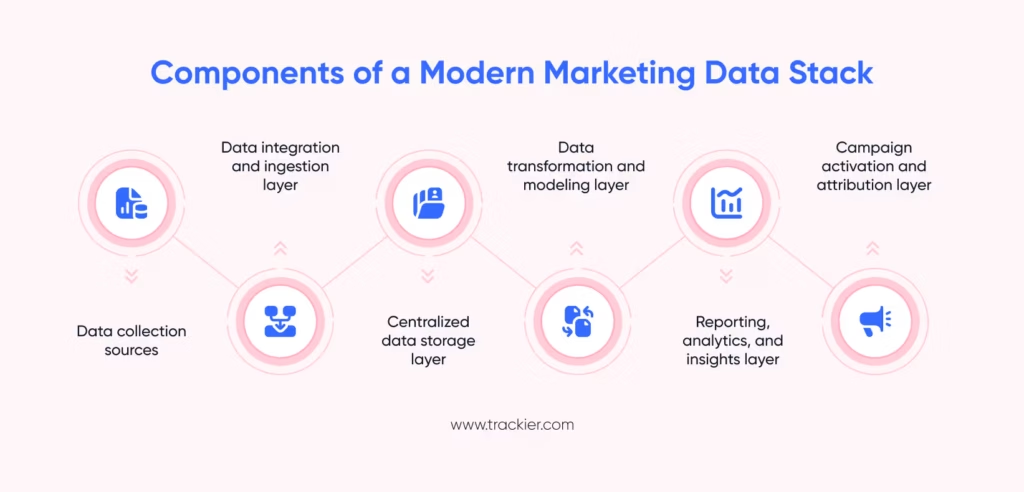
A modern marketing data stack is built as a multi-layered system, where each layer plays a specific role in converting fragmented marketing signals into reliable, revenue-grade insights.
In 2026, this architecture will have become essential because marketing teams now operate across 100+ tools on average, making unified data flow a necessity rather than an advantage.
The stack solves a simple problem: marketing data is scattered, inconsistent, and often not comparable across platforms. Without structure, attribution breaks, dashboards conflict, and decisions become guesswork.
1. Data sources layer
This is the foundation of the entire stack. It includes every system that generates marketing and customer signals:
- Paid media platforms (Google, Meta, LinkedIn, programmatic)
- CRM and sales systems
- Website and app analytics tools
- Affiliate, partner, and influencer networks
- Product usage and transaction databases
In 2026, this layer is expanding rapidly due to omnichannel journeys, where a single user may interact with 10–15 touchpoints before converting.
2. Data ingestion and collection layer
This layer ensures data is captured and transported reliably into a central system. Key components include:
- API-based integrations with ad platforms and CRMs
- Server-side tracking (reducing dependency on cookies)
- Event tracking via SDKs and tags
- Streaming pipelines for real-time click and conversion data
Modern stacks increasingly favor real-time ingestion because delayed reporting leads to delayed optimization, something marketers can no longer afford.
3. Data warehouse layer
This is the “brain” of the stack.
- Cloud warehouses
- Central storage for all structured marketing data
- Enables cross-channel analysis and identity stitching
In 2026, enterprises are increasingly adopting warehouse-first architectures, where every tool feeds into a central data layer instead of storing isolated datasets.
This shift is driven by the need for data gravity, keeping all critical data in one controlled environment.
4. Transformation and modeling layer
Raw data is rarely usable without processing. This layer ensures consistency and accuracy. It includes:
- Cleaning duplicate or broken records
- Standardizing metrics (CAC, ROAS, LTV definitions)
- Joining datasets across channels (ads + CRM + product data)
- Building analytical models for performance insights
In advanced stacks, this layer also includes causal modeling and machine learning-based transformations, improving how marketing impact is measured beyond simple correlation.
5. Analytics and insight layer
This is where data becomes visible and actionable.
- BI dashboards
- Channel performance reporting
- Funnel and cohort analysis
- Real-time performance monitoring
A key 2026 trend is the rise of self-serve analytics, where marketers don’t depend on data teams for every report, enabling faster optimization cycles.
6. Activation and attribution layer
This is where insights turn into action.
- Audience segmentation and targeting
- Reverse ETL into CRM and ad platforms
- Campaign optimization and personalization
- Multi-touch attribution and marketing mix modeling (MMM)
In 2026, attribution is no longer single-model. Most mature teams now run multi-touch attribution for tactical decisions with MMM for strategic budget allocation, often reconciled using AI systems.
Key Tools in a 2026 Marketing Stack
In 2026, the marketing technology ecosystem is best understood as a composable stack, where different tool categories handle specific parts of the data lifecycle instead of one platform doing everything.
Most modern organizations run dozens of tools across analytics, data, and activation layers, and larger enterprises often exceed 50–100 tools, making integration and governance more important than tool selection itself.
Instead of focusing on individual product names, the modern approach is to understand tool categories and their role in the data flow, from collection to activation to attribution.
1. Data ingestion and integration tools
This layer is responsible for capturing all marketing interactions and moving them into a centralized system. It typically includes tools and systems for:
- Event tracking (clicks, impressions, conversions)
- API-based data extraction from ad platforms and CRMs
- Server-side tracking for privacy-first measurement
- Real-time event streaming pipelines
In 2026, this layer has shifted heavily toward first-party and server-side tracking, as third-party cookies continue to decline and platforms prioritize privacy-safe data capture.
2. Customer data platform (CDP) layer
This layer unifies fragmented customer data into a single, usable profile. Core capabilities:
- Identity resolution across devices and channels
- Building unified customer profiles
- Real-time audience segmentation
- Syncing behavioral and transactional data
CDPs have become critical because modern customers interact across multiple touchpoints before conversion, and without identity stitching, attribution becomes unreliable.
3. Data warehouse/lakehouse layer
This is the central storage and computation layer of the entire stack. Key responsibilities:
- Storing structured and semi-structured marketing data
- Acting as a single source of truth for reporting
- Enabling cross-channel analysis (ads, CRM, product, affiliate data)
- Supporting scalable analytics workloads
In 2026, most mature stacks follow a warehouse-first architecture, where every tool feeds into a central data foundation instead of storing isolated data silos.
4. Data transformation and modeling layer
This layer ensures that raw data becomes business-ready. Functions include:
- Cleaning and deduplicating datasets
- Standardizing KPIs like CAC, ROAS, CTR, and LTV
- Joining data across platforms (ads, CRM, web, affiliate)
- Creating consistent business definitions
This layer is critical because without it, every dashboard tells a slightly different story, which directly breaks trust in marketing reporting.
5. Analytics and business intelligence layer
This is the layer where marketing teams consume insights. Capabilities:
- Dashboards for performance tracking
- Funnel, cohort, and retention analysis
- Self-serve reporting for non-technical teams
- Real-time performance monitoring
A major 2026 shift is toward AI-assisted analytics, where systems automatically surface insights like anomalies, drop-offs, and performance changes instead of requiring manual analysis.
6. Attribution and measurement layer
This layer connects marketing activity to revenue outcomes. Key capabilities:
- Multi-touch attribution across channels
- Marketing mix modeling (MMM) for budget allocation
- Incrementality testing and lift measurement
- Cross-device and cross-channel conversion mapping
Because user journeys are no longer linear, modern attribution increasingly uses hybrid models combining multiple methodologies instead of relying on a single “last-click” logic.
7. Activation and automation layer
This is where insights are turned into action. It enables:
- Audience activation across ad platforms
- Personalized campaign execution
- CRM workflows and lifecycle automation
- Real-time bidding and optimization signals
8. AI and decision intelligence layer (Emerging 2026 Standard)
AI is now embedded across every part of the stack. Use cases include:
- Predicting customer lifetime value and churn
- Automated anomaly detection in campaigns
- Budget allocation recommendations
- Content and creative optimization
- Real-time decision support
In 2026, the biggest shift is that stacks are moving from reporting systems to decision systems, where AI actively guides marketing actions instead of just analyzing them.
Attribution Frameworks in 2026
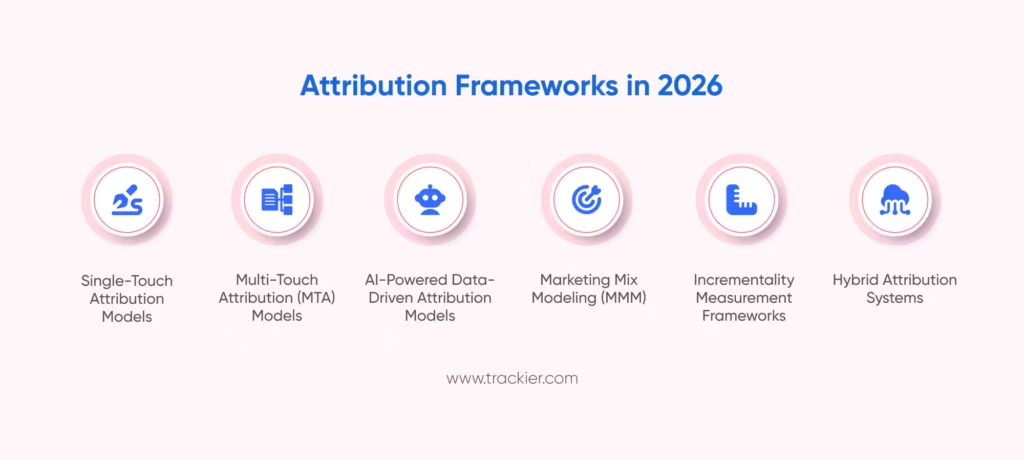
Attribution in 2026 is no longer about identifying a single “winning channel”; it is about understanding the full contribution of every touchpoint across a fragmented, multi-device customer journey.
With users interacting across 8–12+ touchpoints before conversion on average, single-click attribution models have become unreliable for real decision-making.
Modern attribution frameworks now combine statistical modeling, machine learning, and experimentation to build a more accurate picture of marketing impact.
1. Single-Touch Attribution
This is the simplest form of attribution, where one interaction gets all the credit.
- First-click attribution: credits the first touchpoint
- Last-click attribution: credits the final conversion touchpoint
While easy to implement, this model is increasingly outdated in 2026 because it ignores the full journey.
It often overvalues lower-funnel channels (like branded search or retargeting) while undervaluing awareness and consideration channels that actually create demand.
2. Multi-Touch Attribution (MTA)
Multi-touch attribution distributes credit across multiple interactions in the customer journey, providing a more realistic view of how conversions happen. Common approaches include:
- Linear models (equal weight across touchpoints)
- Time-decay models (more credit to recent interactions)
- Position-based models (first and last touch weighted higher)
- Algorithmic models using probabilistic or machine learning approaches
MTA is widely used for performance optimization and campaign-level decisions, as it provides granular, user-level insights into what drives conversions.
However, it still depends heavily on user-level tracking data, which is becoming harder due to privacy regulations and cookie restrictions.
3. Data-Driven Attribution (AI-Based Models)
In 2026, data-driven attribution is becoming the default advanced framework. Instead of fixed rules, it uses machine learning to:
- Analyze converting vs non-converting user paths
- Identify which touchpoints actually influence conversion probability
- Dynamically assign credit based on observed behavior patterns
These models continuously learn from large datasets and improve accuracy over time, making them significantly more reliable than rule-based MTA systems.
A common technique used here is Shapley value modeling, which evaluates the contribution of each touchpoint by simulating all possible journey combinations.
4. Marketing Mix Modeling (MMM)
MMM is a top-down statistical framework that measures the impact of marketing on business outcomes using aggregated data instead of user-level tracking. Key characteristics:
- Uses historical spend with revenue data
- Includes external factors like seasonality, pricing, and macro trends
- Works even in privacy-heavy environments without cookies
Unlike MTA, MMM focuses on long-term impact and budget allocation, making it ideal for strategic decisions like channel investment and annual planning.
5. Incrementality Testing Frameworks
Incrementality testing measures what would have happened without a specific marketing activity. Common methods include:
- Holdout experiments (control vs exposed groups)
- Geo-based testing
- Lift studies
This framework is critical in 2026 because it validates whether attributed conversions are truly caused by marketing or would have happened anyway.
6. Hybrid Attribution Models
The most advanced organizations no longer rely on a single model. Instead, they use hybrid frameworks combining:
- MTA for tactical optimization
- MMM for strategic planning
- Incrementality tests for validation
This triangulation approach reduces bias and improves confidence in decision-making, especially in environments with fragmented data and privacy constraints.
How to Build Your Marketing Data Stack?
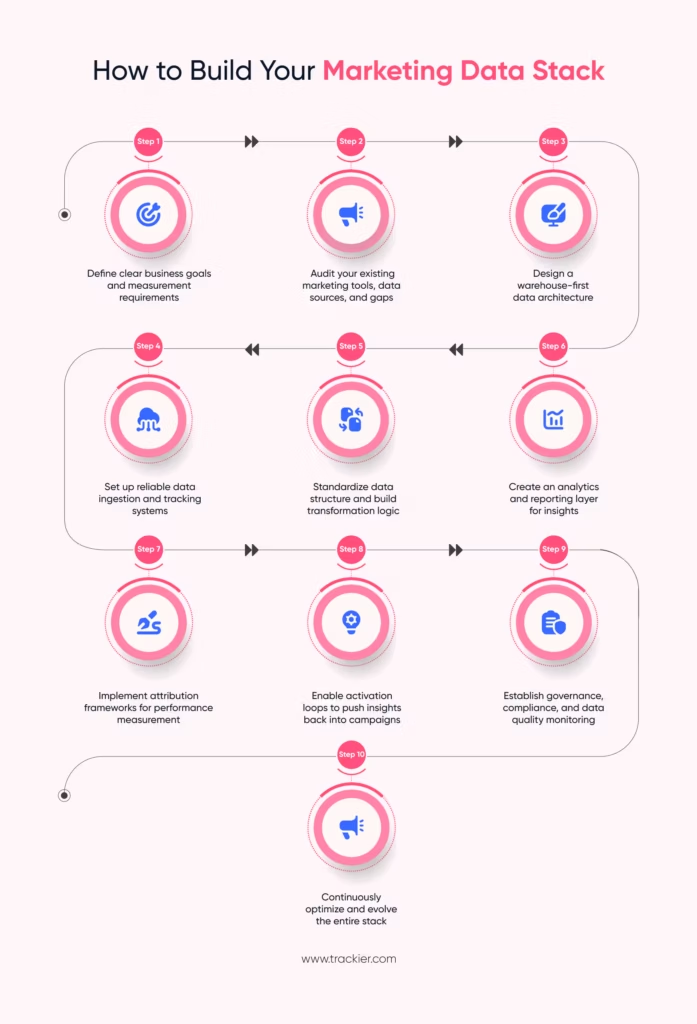
Building a modern marketing data stack in 2026 is not about buying tools; it is about designing a connected data system that turns fragmented marketing signals into usable, revenue-driven intelligence.
With marketing teams now managing 100+ tools on average and dealing with increasing data fragmentation, a structured build process is essential to avoid silos and attribution gaps.
Below is a practical, step-by-step approach to building a scalable and future-ready marketing data stack.
Step 1: Define Business Goals and Measurement Needs
Start by clearly identifying what the stack must solve.
- Do you need better attribution accuracy?
- Do you want unified reporting across channels?
- Are you trying to improve ROAS, CAC, or LTV visibility?
Without clear goals, stacks often become tool-heavy but insight-poor. In 2026, successful stacks are built from business outcomes backward, not tools forward.
Step 2: Audit Existing Marketing and Data Systems
Before building anything new, map your current ecosystem:
- All marketing channels (paid, organic, affiliate, CRM, product)
- Data flow between tools
- Reporting inconsistencies across platforms
- Gaps in attribution or tracking
Most organizations discover they already have overlapping tools but lack integration and data standardization.
Step 3: Design a Warehouse-First Architecture
Modern stacks are built around a central data foundation.
- Choose a central data warehouse as the “source of truth.”
- Ensure every tool feeds data into it
- Avoid isolated reporting systems
This approach eliminates data silos and ensures every team works on the same dataset, which is critical for accurate attribution and forecasting.
Step 4: Set Up Data Ingestion and Tracking Systems
This step ensures all marketing signals are captured correctly. Key requirements:
- Event tracking for clicks, conversions, and user actions
- API integrations with ad platforms and CRM systems
- Server-side tracking to reduce data loss
- Real-time data pipelines for faster reporting
In 2026, real-time ingestion is becoming the norm because delayed data leads to delayed optimization decisions.
Step 5: Standardize Data and Build Transformation Logic
Raw data is inconsistent across platforms, so it must be normalized. This includes:
- Cleaning duplicate or broken records
- Standardizing KPIs (ROAS, CAC, LTV, CTR)
- Aligning naming conventions across campaigns
- Joining data across multiple sources (ads + CRM + product + affiliate)
Step 6: Build Analytics and Reporting Layer
Once data is clean and centralized, it must be made usable.
- Create dashboards for performance tracking
- Set up funnel and cohort analysis
- Enable self-serve reporting for marketing teams
- Monitor real-time campaign performance
Step 7: Implement Attribution Frameworks
Attribution is where the stack turns into a decision strategy. You should implement:
- Multi-touch attribution for campaign optimization
- Marketing mix modeling for budget planning
- Incrementality testing for validation
- Hybrid models combining multiple approaches
This ensures you are not over-relying on a single model like last-click, which is no longer reliable in multi-channel journeys.
Step 8: Enable Activation and Feedback Loops
A modern stack is not complete unless insights are activated back into marketing systems.
- Push audience segments back into ad platforms
- Sync insights into CRM and automation tools
- Trigger campaign optimizations in real time
- Enable personalized targeting based on behavior
Step 9: Add Governance, Compliance, and Monitoring
As data scales, control becomes critical.
- Ensure GDPR, CCPA, and DPDP compliance
- Set role-based access controls
- Monitor data quality and tracking accuracy
- Maintain audit logs for changes
Step 10: Continuously Optimize the Stack
A marketing data stack is never “finished.”
- Replace underperforming tools
- Improve data accuracy and speed
- Add AI-driven automation layers
- Optimize attribution models based on new signals
Common Problems in Marketing Data Stacks
Despite rapid evolution in martech and analytics ecosystems, most marketing data stacks in 2026 still struggle with fragmentation, poor data quality, and broken attribution logic.
In fact, even as organizations invest heavily in tools, many still fail to connect data into a usable system that drives business decisions.
A key industry issue is that almost half of marketing leaders cite tool fragmentation and lack of integration as a major barrier to ROI clarity. Below are the most common challenges that limit stack performance.
1. Data Silos Across Tools
One of the biggest problems is that data remains trapped in disconnected systems.
- Ad platforms don’t talk to CRM systems
- Affiliate and partner data sit separately
- Product analytics lives in another environment
This creates multiple “versions of truth,” making it impossible to understand full customer journeys.
Many organizations still treat marketing data as a department-level problem instead of an enterprise-wide system issue, which worsens fragmentation.
2. Poor Data Quality and Inconsistent Metrics
Even when data is collected, it is often unreliable. Common issues include:
- Duplicate or missing events
- Inconsistent campaign naming conventions
- Misaligned KPIs across teams (ROAS, CAC, LTV defined differently)
- Broken tracking due to platform updates
In many cases, teams end up spending more time cleaning data than analyzing it, which slows decision-making and reduces trust in dashboards.
3. Broken or Incomplete Attribution
Attribution remains one of the most complex challenges in modern stacks.
- Cookie loss reduces tracking accuracy
- Cross-device journeys are hard to stitch together
- Last-click models overvalue lower-funnel channels
- Multi-touch models require clean identity resolution
4. Tool Overload Without Integration
Modern stacks often grow organically rather than strategically.
- Multiple overlapping tools for the same function
- No unified architecture or governance layer
- High cost with low interoperability
- Difficulty maintaining integrations as tools scale
Many organizations end up with a “stack of tools” instead of a connected data system, which creates operational inefficiency and slows down insights delivery.
5. Slow Time-to-Insight
Even when data is available, it is often not actionable in real time.
- Batch reporting delays decision-making
- Manual dashboard updates create lag
- Teams rely on outdated performance snapshots
- Optimization happens after campaigns have already ended
In fast-moving channels like paid media and affiliate marketing, delayed insights directly impact revenue efficiency.
6. Privacy and Signal Loss
Privacy regulations and platform changes have significantly reduced tracking visibility.
- Third-party cookies are becoming unreliable
- Consent requirements limit data collection
- Walled gardens restrict user-level tracking
- Server-side tracking is not always fully implemented
As a result, marketers often operate with partial visibility of the customer journey, making attribution and personalization less precise.
7. Lack of Governance and Ownership
Another major challenge is the absence of clear data ownership.
- No standardized data definitions across teams
- Unclear responsibility for data quality
- No centralized governance framework
- Inconsistent reporting logic across departments
Future of Marketing Data Stack
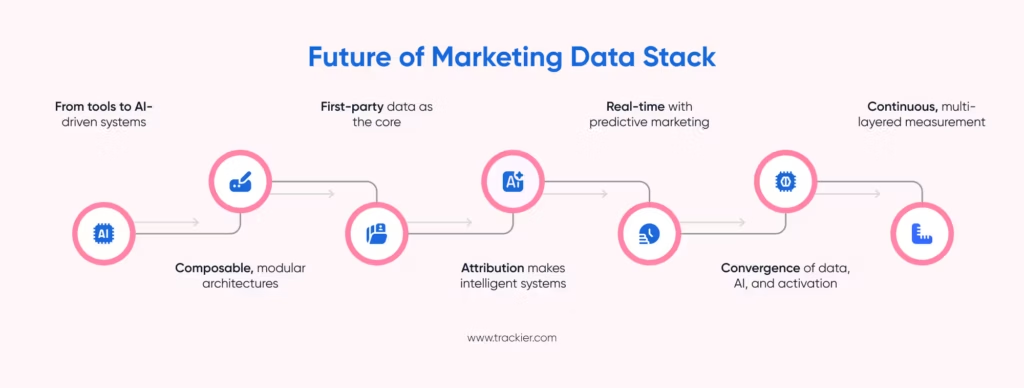
The future of the marketing data stack in 2026 and beyond is moving toward a fully intelligent, automated, and privacy-first ecosystem where tools no longer just store or report data; they actively decide, predict, and optimize outcomes.
The traditional idea of separate analytics, attribution, and activation tools is being replaced by unified, AI-driven systems that operate as a continuous decision strategy.
Industry trends already show that marketing is entering a phase where AI is embedded across the entire stack, from data collection to campaign execution, fundamentally reshaping how organizations operate.
1. From Tool-Based Stacks to AI-Driven Systems
The biggest shift is the move away from fragmented tools toward agentic, self-operating marketing systems. Instead of:
- Marketers manually analyze dashboards
- Switching between multiple tools
- Building static reports
Future stacks will:
- Automatically detect performance changes
- Recommend or execute optimizations
- Continuously learn from user behavior
AI agents will increasingly handle repetitive marketing tasks, shifting human roles toward strategy, governance, and creative direction.
2. Rise of Composable and Modular Architectures
The future stack will not be one fixed system; it will be composable, meaning brands can plug in or replace components without rebuilding everything.
Key trends:
- Modular data pipelines instead of monolithic platforms
- Flexible switching of analytics and activation tools
- Reduced dependency on single vendors
This approach gives marketers agility without losing data control, especially important in fast-changing AI and privacy environments.
3. First-Party Data Becomes the Core Foundation
With the decline of third-party cookies and tighter privacy regulations, the stack is becoming heavily dependent on first-party and consent-driven data systems. Future-ready stacks will:
- Prioritize user-consented data collection
- Build unified customer identities internally
- Reduce dependency on external tracking signals
- Focus on data governance and transparency
4. Attribution Moves from Models to Intelligence Systems
Attribution in the future will not rely on a single fixed model. Instead:
- Multiple models (MTA, MMM, incrementality) will run together
- AI will reconcile differences between models
- Real-time attribution adjustments will become standard
- Budget allocation will become partially automated
5. Real-Time and Predictive Marketing Systems
Future stacks will operate in real time, not in reporting cycles. Capabilities will include:
- Predicting conversions before they happen
- Detecting anomalies instantly across channels
- Adjusting campaigns automatically based on performance
- Forecasting LTV and churn dynamically
6. Convergence of Data, AI, and Execution Layers
One of the biggest structural changes is the collapse of boundaries between:
- Data storage
- Analytics
- Activation
Instead of moving data between systems, future stacks will:
- Keep data centralized
- Apply AI directly on top of it
- Execute campaigns from the same system
7. Measurement Becomes Multi-Layered and Continuous
Future attribution will not depend on one approach but on a combined measurement ecosystem:
- Behavioral tracking (user-level insights)
- Statistical modeling (MMM-level insights)
- Experimentation (incrementality testing)
- AI-based prediction models
Conclusion
The modern marketing data stack is not a one-time setup; it is a continuous system of planning, integration, optimization, and evolution. From data collection to attribution and activation, every layer works together to ensure that marketing decisions are not based on assumptions, but on reliable, connected, and real-time data.
If built correctly, a modern data stack becomes one of the most powerful growth engines for any business, helping teams reduce wasted spend, improve attribution accuracy, and unlock scalable, data-driven decision-making across channels.
Here’s how you can take action today:
- Audit your current data stack – Identify gaps in tracking, attribution, and integration across tools. Look for silos between ads, CRM, analytics, and partner data.
- Define your single source of truth – Ensure all marketing and revenue data flows into one centralized system instead of multiple disconnected dashboards.
- Strengthen your tracking and attribution layer – Fix broken or inconsistent conversion tracking and move toward more reliable, unified attribution models.
- Automate one critical workflow – Whether it’s reporting, data syncing, or campaign activation, remove one manual process that slows down decision-making.
- Measure one core metric consistently – Focus on a key KPI like ROAS, CAC, or LTV and track it across all channels using a unified definition.
- Upgrade your performance infrastructure if needed – If your current setup lacks real-time visibility or accurate partner tracking, consider platforms like Trackier to bring clarity to attribution, affiliate performance, and conversion tracking across channels.
The next stage of marketing maturity belongs to teams that treat data not as reporting, but as infrastructure. Every improvement you make to your stack compounds over time, turning fragmented marketing activity into a connected, predictable, and scalable growth system.
The cycle is simple: build, unify, measure, optimize, and repeat.