An effective, good quality affiliate software is akin to using a road roller to lay down a road, or a food processor to chop, shred or slice vegetables — it is required to get the job done most optimally.
Of course, an affiliate program can be built and run without an affiliate tracking software. But its presence certainly speeds things up, improves quality and hygiene and reduces time spent on manual, repetitive tasks across the marketing team.
If you’re an e-commerce brand, partner marketing agency, D2C product firm or a freelance performance marketer who has made the switch to using such a product, it might as well be the best affiliate software out there. But what’s the yardstick you should be using to make that judgement? That’s what we’re going to be discussing.
Truth be told, tracking tools for affiliate marketing are a dime a dozen. But no one can be reasonably expected to try one affiliate tracking platform after another to get to “the best one”.
Let’s understand which factors truly allow one affiliate marketing platform to be better than the next one — and why.
What to Know Before Buying Affiliate Software?
Affiliate software in itself is a very broad term. What a ‘software’ built to serve affiliate marketing needs can deliver can be quite dense, ranging from locating and onboarding partners in a given part of the world or globally, or managing partners effective through communication tools. Or, you could be use an ‘affiliate software’ to manage commission models and payout frequencies. Perhaps, you’re looking for a tool that can record affiliate activity and display reports of effectiveness.
See, the possibilities are endless, and that’s why knowing what you need before you go looking for it will save you both time, and needless demos.
Diagnose your partner program’s need and investigate what the range of applications should be because such platforms make a lot of actions happen — from tracking to fraud detection to link checking and even invoicing.
Before you go out seeking an affiliate software, with the clear intention of purchase, make sure you take note of the variations in offerings available in the marketing, and narrow down on your top picks accordingly.
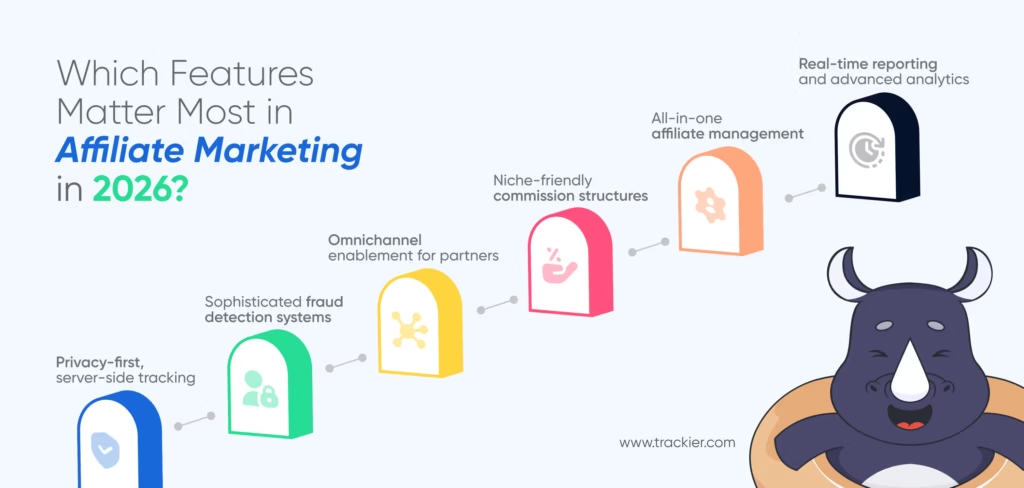
To make it easy for you to select the right option for your needs, here’s a list of most relevant features that a worthy affiliate software must possess to add value to any affiliate program in 2026. While the features available can be endless, these are the ones you simply should not do without.
The 6 Must-Have Features in an Affiliate Software
For any organization looking to use such a product, it is vital to ascertain if it performs at par with the expectations of key users of such a platform across the market. If you look at it in this manner, there are 6 key features which set an affiliate platform apart from others.
A Unified, Single Source of Truth
The entire process of performance marketing across SaaS organizations, fintech ecosystems, retail advertisers or e-commerce retailers takes an army of tools. There are multiple:
- Touchpoints,
- Partners,
- Actions,
- Parameters,
- Landing pages,
- Offer types, and so on to track.
Additionally, there is the responsibility of adding, managing and communicating with each affiliate to ensure long-term relationships can be maintained with reliable partner marketers. So, an affiliate software will be required to allow for:
- Smooth onboarding of individual and groups of affiliates,
- Management and sorting of partners into groups based on various factors,
- Communication regarding new campaigns with partners,
- Sharing of creatives, promotional guidelines and links or coupon codes with promoters, etc.
What’s more? This entire system should work in a real-time context. An affiliate manager should be able to do one or more of these tasks, while running multiple campaigns simultaneously and see data and reports refresh in real-time.
Trackier is a platform that fits the bill perfectly. It also acts as a singular, uniform source of information for key stakeholders using the account — from finance to marketing and operations — showing data that refreshes every second, continuously.
Complete Lifecycle Management for Affiliate Marketing
Like all forms of marketing, affiliate marketing is not a moment, but a cycle. There are starts and stops within the journey — all of which should be operable through a single affiliate software.
- Recruitment: First off, affiliates need to be recruited. A well-functioning affiliate program needs a regular inflow of new partners to ensure a good conversion rate, earnings per click rate and a method to compensate for those affiliates who may choose not to remain with the same organization.
- Onboarding: The affiliate needs to be onboarded, the contract needs to be signed and the basic guidelines of working with a brand or a business need to be established.
- Setup: As an advertiser, you may need to inform them about the type of attribution which applies to the various campaigns run, as well as aligning their payout model, payout disbursement timeline and setting up their payment methods.
- Tracking and Attribution: Once the campaigns partners work on go live, there needs to be a clear accounting of their performance based on the goal of the campaign — CPS, CPL, CPM or something else. Each affiliate’s performance must be visible in the form of reports which can be sorted, reviewed and validated.
- Commission Payout: An affiliate software must be able to automate the process of invoicing and payouts in 2026. Without this, each payout will need to be reconciled manually and then paid out one at a time by hand, which may not only take up manhours, but also lead to errors and dispute.
Affiliates, too, must be given this transparency: to review their performance in real-time and know which of their actions matter to the advertiser in financial terms.
On the Trackier performance marketing platform, you get all of this within a single, comprehensive analysis dashboard. Brands, marketing places and agencies can customize all areas of the journey, including:
- Creating custom registration forms
- Setting up personalized payout plans and payment cycles
- Which campaigns an affiliate or their group can take part in
- Which conversions count as valid and which are fraudulent, i.e. won’t result in payouts
- How much traffic publishers direct to which campaign, through smartlinks and so on.
Publishers are able to view their individual campaign performance as well as comparisons, on their dashboards. Therefore, there is no lengthy reconciliation process, and the final steps from invoicing to payment become a breeze.
API-first Infrastructure
MarTech is a larger collection of tools, within which affiliate software is just one. If these various disparate software like BI, CRM, email automation platforms, etc. are unable to sync, each function will be relegated to a silo.
Such a format is reflective of a lack of vision and leads to poor planning, execution and results. That’s why Trackier was built to be a central performance marketing platform in this jigsaw of platforms, through a two-way API integration capability.
Not only can data be pushed out of the platform to Salesforce, Mixpanel or Intercom, it can also be pulled in from Singular, Shopify or Amazon.
Balanced Fraud Detection Features
Some estimates suggest up to 40% of traffic in certain verticals can be fraudulent. With the prevalence of artificial intelligence (AI), many bad actors are increasingly able to take advantage of primitive fraud prevention tools.
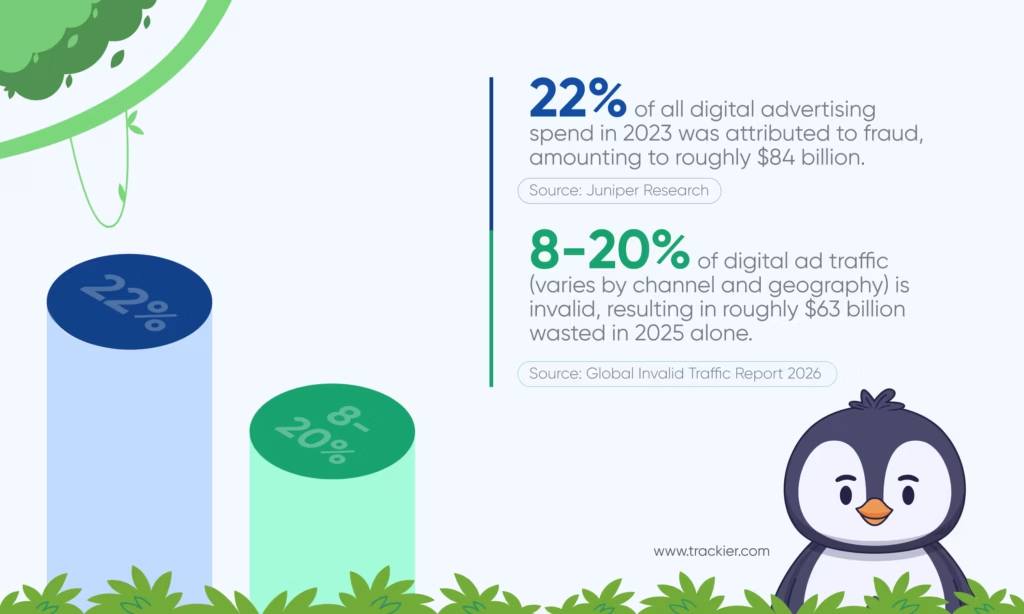
Ad fraud consists of 9-17% of the complete traffic brought in by affiliates. Click fraud seems to be even more common, with 14-22% of clicks captured in any campaign, based on industry and geography, tend to be fake.
But the loss isn’t only limited to the KPIs set on your affiliate software. Up to $172B is expected to be lost to ad fraud by 2028 globally.
To resolve this very real concern within the larger partner marketing ecosystem, it is vital that platforms and tools dealing in performance marketing come with features that limit the loss of advertisers on this front. With brands running limited-time, seasonal or sudden offers, this practice becomes harder to keep up with because the activity rate of such an advertiser occludes the wastage.
Luckily, that’s not something you have to worry about when you use Trackier. It comes with in-built click and conversion fraud prevention features that prevent advertisers from losing money to unworthy, false traffic.
Everything, from duplicate activity to proxy users, IP and device-based misdemeanors get detected and limited in real-time.
Compliant, Privacy-first Tracking
Did you know: up to 40-50% of traffic in many countries is cookie-blind in 2026? That’s the effect of new privacy regulations in mature markets like the US and EU, which has trickled down across the entire world.
The GDPR and CCPA, as well as other complimentary ad restrictions from DSPs and the Google Privacy Sandbox are making attribution break at various points.
In this scenario, having the capability to track events on a server-to-server basis is certainly a boon — one offered by Trackier. Through this type of tracking, postbacks trigger the recording of events in real-time on the affiliate software, leading to no discrepancy and clear, even reporting. Network issues, cookie expiration and so on do not affect it, making partner and influencer attribution seamless.
All the activities are mapped through click IDs, maintaining privacy as per data norms across countries.
Does it Come With Support?
You don’t want to be given an affiliate software and left on your own to figure out how to make it work. That’s where customer support comes in.
A meaningful onboarding sequence for a platform leads to a hand-off to a dedicated customer success manager who is responsible to ensure you get maximum benefit from using such a tool. Their core responsibilities should be aligned around ensuring:
- Anyone from your team can operate the platform and all its functionalities without hesitation,
- You’re able to get any challenges or queries about regular use cases and edge cases resolved on an immediate basis,
- Any new feature additions to your affiliate software dashboard are explained with real-life scenarios on implementation, and,
- Your campaign outcomes can be improved over time by effectively leveraging the complete product toolkit.
When you use Trackier, you’re provided with a dedicated CSM who is available 24/7 to assist anyone from your team in executing campaigns, troubleshooting and bettering results. Advertisers who have used the platform over a period of time often appreciate this aspect the most, beyond the features present on the affiliate software.
Additionally, such continued, consistent support cuts down the time-to-value significantly (with some teams taking off in 7 days or less), and improves adoption rates across affiliate marketing teams.
BONUS: What’s the Range of Use?
The bells and whistles may all match up. On a basic level, all affiliate tracking tools come with the same attachment. Perhaps, even these 6 pointers on how to suss out your winner are not enough (it’s okay, it can happen).
So what should an affiliate software possess to immediately become a winner?
It’s simple: the pricing plan. See, affiliate marketing or influencer marketing may be one of your many channels. Is it the main one? Is it one of four or five marketing mediums? Well, in that case, the budget you have to spend on just tracking attribution through this channel changes.
You don’t need a very pricey plan to measure results because a basic tool will probably also serve you right. Trackier allows you to check for this type of match by providing the first 10,000 conversions for free.
But maybe you don’t need a test period. Maybe you’re an affiliate network and you need heavy click counting along with the complete tracking package. Or impressions are high on your list of priorities, and the market is saturated with affiliate software that offers a fixed cap of impressions tracked on clicks tracked. Time to escape this dichotomy altogether.
When you decide to choose Trackier, based on your needs, you can find a whole range of customizations. See, we understand, apples and oranges aren’t the same — no two clients compare exactly.
In 2026, your range of use or terms and conditions placed within your affiliate marketing tracking tool subscription need not be a charter of limitations. Rather, you should be able to pick and choose as per your requirements to get the best outcomes for your business.
The Affiliate Software Buyers’ Checklist
The thing is, choosing an affiliate software isn’t just about which tool can track clicks and conversions. It comes down to a variety of factors, including supporting growth, protecting marketing budgets from wastage and limiting time spent on manual workflows to the greatest extent possible.
The tool should be an enabler of better outcomes for the business, no matter which industry it is in, or how big the program is. There should be a clear underlying value proposition that improves the capacity of the marketing functioning in meeting required business or revenue goals. Or, perhaps there is a cost saving inoperative. No matter what the underlying reason for selecting a software is, it’s essential to match it with what the performance marketing platform can actually do for you.
Consider the case of GrabOn, where multi-touch complex user journeys and data inconsistencies were affecting the outcome of their affiliate marketing efforts. That’s the primary reason behind their switch to Trackier. The result? Quarter-on-quarter growth stood at 738.26%.
Or, for that matter consider mCaffeine, a D2C brand which was faced with rising acquisition costs while revenue wasn’t scaling fast enough. They moved their affiliate operations to Trackier to improve on both fronts. The outcome was a nearly 20% drop in CPA with about 12% increase in profits.
As the buyer of an affiliate software, your buyer journey should begin with understanding exactly why a tool is needed, or why a new tool is needed, in the first place. All subsequent actions on making a purchase decision should rely on whether the selected affiliate software can actually fix the problem — with clear evidence presented within the demo call.
Make Sure You Compare Affiliate Software Against Each Other
When you’ve shortlisted the software that matches your needs, it is possible you’re looking at a list containing 2-3 options. How do you narrow it down? One way in which you can determine where one platform outshines another is through comparing them on the features that matter most to your use case.
Compare platforms across attribution capabilities, fraud prevention, reporting depth, integrations and scalability. You can check how one options stands against another, and try to determine which combination of feature capabilities would be best for your organisation.
This inspection is vital to save time and costly migration processes, and ensure time-to-value can be as good as possible.
Conclusion
At the core of a “good” affiliate platform in 2026 are four key areas of evaluation:
- accuracy
- scalability
- compliance
- fraud protection
Beyond these baseline features, advertisers across e-commerce, SaaS, fintech, D2C and more are looking for innovative, new features and persistent, personalized support that helps them excel and achieve their business goals.
Where you stand as a business also matters in picking a software. Here’s a table that distils this idea better.
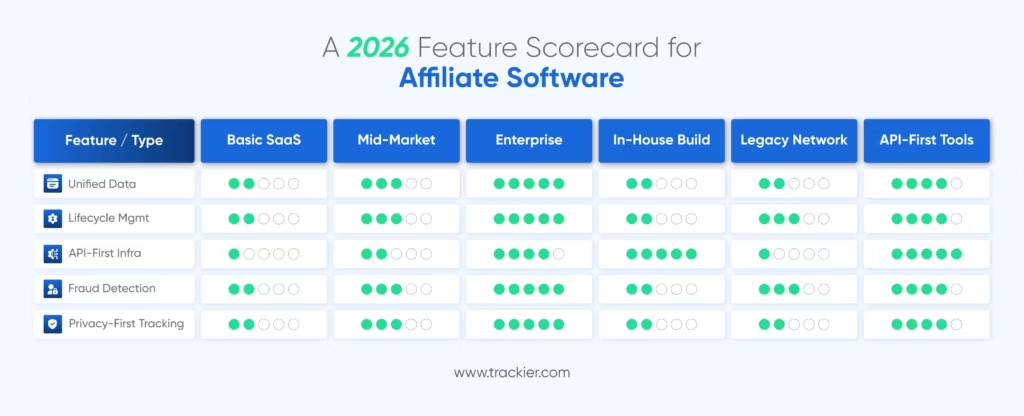
One affiliate software becomes better than the next when it is able to enable these aspects, and proactively build for the next, emerging challenge within performance marketing.
Trackier is a platform that covers all these areas and is able to customize its offerings for advertisers of all sizes, across various industries, as per their need. That’s one of the reasons why the Trackier affiliate platform stands out amongst others in 2026.
FAQs
What features should I prioritize when choosing affiliate software in 2026?
In 2026, prioritize features like accurate tracking, real-time reporting, fraud detection, API integrations and privacy compliance. Modern affiliate software should also offer lifecycle management and automation. These capabilities ensure scalability, reduce manual work and help maintain trust with affiliates through transparent and reliable performance tracking.
Why is API-first infrastructure important in affiliate marketing tools?
API-first infrastructure enables seamless integration with CRMs, analytics tools and ad platforms. It supports server-to-server tracking, improving data accuracy and reliability. This approach also allows businesses to build custom workflows, automate processes, and scale efficiently without depending on rigid, one-size-fits-all solutions.
How does privacy-first tracking impact affiliate marketing performance?
Privacy-first tracking ensures compliance with global regulations while maintaining data accuracy in a cookieless environment. By relying on first-party and server-side tracking methods, businesses can still capture reliable attribution data, reduce data loss and build user trust without compromising on performance insights.
Why is having a single source of truth critical in affiliate tracking?
A unified dashboard eliminates data discrepancies by consolidating clicks, conversions, and payouts in one place. This improves decision-making, reduces disputes with affiliates and enhances transparency. Without a single source of truth, businesses risk inaccurate attribution, inefficient reporting and lost revenue opportunities.
Which features are most sought-after in an affiliate software based on industry type?
The most important features vary by industry and their use-case. Ecommerce brands prioritize coupon tracking and influencer attribution, SaaS companies value recurring commission management and CRM integrations, while finance sectors focus on fraud prevention and compliance. However, broadly across all industries, some features are commonly valued: accurate tracking, precise measurement, automation and reliable payouts.
What’s the best affiliate tracking software for multi-channel campaigns?
Trackier is a clear winner if you’re looking for multi-channel tracking within your affiliate campaigns. With existing Facebook CAPI, Snapchat CAPI, TikTok CAPI, Shopify integration as well as 100+ flexible integrations, Trackier enables multi-platform, multi-geography and multi-brand campaigns across as many channels as you need with ease, flexibility and complete control.