People move across screens all day, and your campaigns feel the ripple effect even when you cannot see it.
A shopper might browse on a laptop at work, compare prices on mobile in the evening, and finish the purchase on an app later. If those steps stay disconnected, you end up with broken journeys and confused attribution. That is where cross device tracking steps in.
With US households now owning more than twenty connected devices, as reported in Deloitte’s Connected Consumer Survey, it is no surprise that marketers need a clearer map of these multi-screen journeys.
In this blog, we will break down what cross device tracking means, how it works, the methods behind it, and the real challenges teams face today.
If you want a unified view of your conversions across partners and channels, explore Trackier’s partner marketing platform for a deeper look at journey insights.
What is cross device tracking and why does it matter?
Cross device tracking helps you understand how one person moves across phones, laptops, tablets, smart TVs, and everything in between. It connects those scattered touchpoints and shows you that all of them came from the same user. When you look at a journey in one clean line it becomes much easier to understand what influenced the final conversion.
This matters because people rarely stay on one screen anymore. Statista’s data shows the global average is now 3.6 devices per person, while North America sits close to thirteen devices per person. That means every campaign you run has a real chance of spreading across several screens before a user takes action.
Marketers who do not track across devices end up with broken stories. You see clicks that look cold, traffic that looks random, and conversions that seem to come out of nowhere. Cross device tracking helps you fill those gaps so you can plan budgets, measure partners, and build journeys that actually reflect how people behave.
What cross-device tracking solutions should you consider?
When you decide to adopt cross device tracking, you typically pick among a few broad solution types depending on your stack, data privacy stance, and user base. Here’s what you’ll usually see, and what to check for:
Identity Resolution & Identity Graph Platforms
These are tools or platforms that take identifiers (when available), like logged-in user IDs, email hashes, or persistent cookies, and combine them with device or behavioral signals.
Such platforms help you unify a user’s web sessions, app usage, and other touchpoints under a single “identity.” This kind of cross device tracking solution works especially well when you have users who log in on multiple devices. It gives you clean, deterministic matches where accuracy matters.
Server-Side Tracking + Event Ingestion
As browser restrictions and privacy controls limit what client-side tracking can reliably capture, server-side tracking becomes more valuable.
With server-side tracking, your backend or server collects the event data (after consent), associates it with user identifiers or session IDs, and sends it to your analytics or identity platform. This reduces signal loss due to ad-blockers, cookie restrictions, or browser privacy updates.
Mobile SDK + MMP Integrations
For mobile-first products, apps or hybrid web/app flows, using a mobile SDK (via a Mobile Measurement Partner, MMP) helps capture installs, in-app conversions, and other events tied to device IDs.
When combined with resolution platforms, these SDKs help correlate app behaviour with web behaviour, enabling accurate cross-device conversion tracking even when a user shifts between app and browser.
Hybrid Stacks (Deterministic + Probabilistic Matching)
Often the smartest approach is not “only deterministic” or “only probabilistic.” Many modern stacks combine deterministic identifiers (for logged-in users) with probabilistic matching (for anonymous or pre-login users). This boosts coverage without sacrificing precision completely.
Identity-resolution providers often offer confidence scoring for each match. That lets you filter or treat high-confidence matches differently from lower-confidence ones.
What to Evaluate When You Choose a Solution
- Privacy Controls & Compliance: Make sure the platform supports consent management, hashed or tokenized identifiers, and aligns with data privacy regulations.
- Transparency & Match Confidence Reporting: Vendor should clearly document what signals they use, how identity graphs are built, and how confident each match is.
- Flexibility & Integration: Whether you have web, mobile, app, or partner-driven conversions, the solution must smoothly integrate with analytics, CRM, and partner postbacks.
- Scalability and Robustness: As the device-per-person average rises, you want a solution that can handle growing data volume and still produce clean cross-device linking.
How Can You Implement Cross Device Tracking in Your Stack?
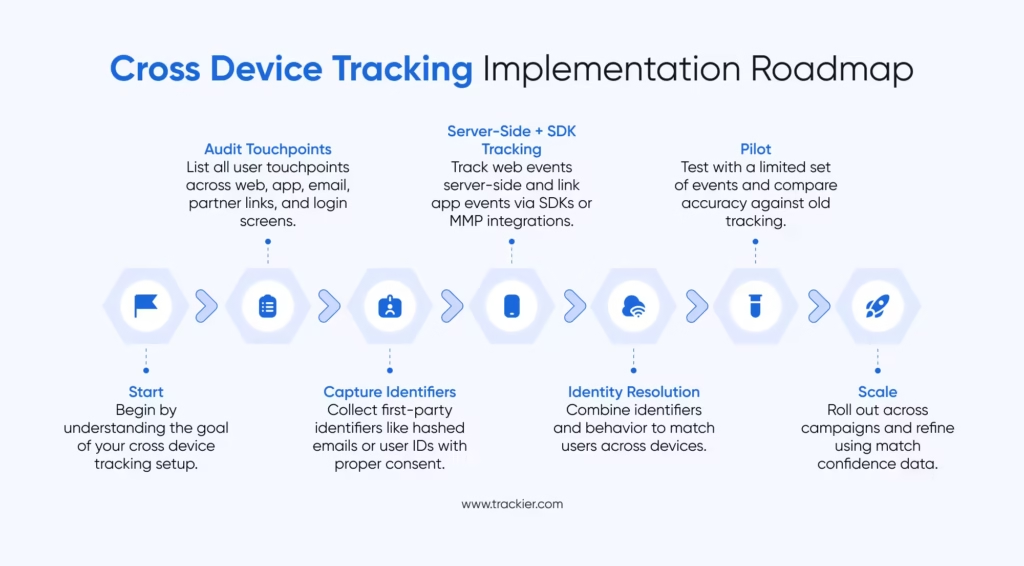
If you were to start today, here is a pragmatic implementation roadmap. You do not need to overhaul everything at once. Instead, take a phased, data-mindful approach.
Step 1: Audit all your touchpoints
List every place where users interact: website pages, landing pages, marketing landing paths, app screens, emails, partner referral links, partner postback endpoints. Also mark where users sign up, log in, or provide consent.
This audit gives a clear map of possible device transitions: e.g. web → mobile browser → app.
Step 2: Capture first-party data wherever possible
When users sign in or provide identifiable info, store a persistent identifier (like a hashed email or user ID) server-side. Make sure you collect consent before storing or hashing identifiers.
Use these identifiers when sending events to your identity or analytics platforms.
Step 3: Set up server-side event tracking + SDKs
For web events, move tracking from client-side to server-side wherever possible to reduce loss of signal due to ad-blockers or privacy restrictions.
For mobile or app paths, integrate a SDK from an MMP so you capture installs and in-app events. Feed both web and app events into the same identity resolution or analytics pipeline.
Step 4: Choose matching logic & combine methods smartly
Use deterministic matching for logged-in users. For anonymous or pre-login traffic, rely on probabilistic matching (device fingerprinting, behavior, IP, etc.).
Keep a “match confidence score”, that way you know which matches are reliable and which are fuzzy.
Step 5: Run small pilot and validate results
Rather than flipping on cross device tracking for all campaigns, start with a two-week pilot. Pick a set of conversions (say app installs + web purchases), match them across devices, and compare results with your older single-device attribution model. Check whether deduplication or re-attribution changes your ROAS or channel performance significantly.
Step 6: Review privacy and compliance before scale-up
Ensure you have documented consent flows, transparent user notices, and opt-out mechanisms. If you operate in privacy-sensitive regions (EU, US, India), verify your identity resolution stack aligns with compliance requirements.
Step 7: Roll out across campaigns and monitor continuously
Once pilot succeeds, expand across all marketing and partner channels. Monitor metrics like conversion deduplication rate, lift in matched journeys, changes in channel ROI, and drop-offs in attribution accuracy.
Use regular audits to ensure data hygiene and compliance.
What Are The Main Types of Cross Device Tracking?
We often hear terms like deterministic, probabilistic, or identity graphs and wonder how these pieces actually work together.
Cross device tracking depends on a few core methods, and each one plays a different role in connecting one user across all their devices.
Let’s take a look at a simple breakdown.
1. Deterministic tracking
This is the most accurate method.
It relies on strong identifiers that users willingly provide, such as:
- Login IDs
- Phone numbers
- Hashed emails
- In-app authentication events
When someone signs into your website using a laptop and then opens your app with the same account, the system can confirm with high confidence that the actions came from the same user.
Most enterprise and B2B SaaS platforms use deterministic tracking as their foundation because the match rate tends to be extremely reliable.
2. Probabilistic Tracking
This method uses softer but still meaningful signals to estimate whether two devices belong to the same user. These signals include:
- IP clusters
- Device models and OS versions
- Time and location patterns
- Shared browsing or session behaviour
Probabilistic tracking is helpful when users do not log in often or when consented identifiers are limited.
Probabilistic methods help fill “blind spots” in journeys when deterministic identifiers are missing.
3. Identity Graphs
Identity graphs connect all identifiers and behavioural patterns in one structured place.
They maintain links between:
- Login IDs
- Device IDs
- Behavioural signals
- Consent and privacy preferences
The IAB Tech Lab’s Identity Guidance (2024) notes that identity graphs now sit at the center of most modern cross device tracking solutions because they keep profiles updated and compliant across major regions.
4. Hybrid Cross Device Tracking
Most advanced stacks mix all three methods.
Here is what that usually looks like:
- Deterministic identifiers form the backbone
- Probabilistic models fill tracking gaps
- Identity graphs keep everything centralised and compliant
This blended approach gives marketers the most complete view of the user journey.
Why These Methods Matter
Customer journeys rarely stay in one place anymore.
McKinsey’s research shows that omnichannel customers now engage across three or more channels and often deliver 1.25 times higher lifetime value.
When journeys stretch across so many touchpoints, you need multiple tracking methods working together. Without them, your reports become fragmented and your attribution loses accuracy.
What Should Your Next Steps Be?
Cross device tracking gives you a clearer view of how people move through your funnels, but the real value comes from what you do after understanding the COMPLETE picture.
Now that you know how the process works, it helps to look at small, practical steps you can take to bring this into your own campaigns.
Here are a few simple next steps you can take right away:
- Audit your touchpoints so you know exactly where users interact with your brand.
- Capture consented identifiers such as hashed emails or login IDs wherever possible.
- Set up server side tracking for your website and clean event tracking for your app.
- Test a small journey first to measure accuracy before rolling out fully.
- Review your identity resolution layer and decide whether you need deterministic, probabilistic, or a mix of both.
As you follow these steps, you will start noticing smoother journeys and better-connected data.
This is also where a platform like Trackier fits naturally. Trackier helps you link clicks, impressions, installs, and conversions across devices in one place, so you don’t have to rely on fragmented reports.
Our attribution engine combines server side tracking, deep linking, and identity-based matching to help you understand the true path your users take. If you are running performance or partner campaigns, this becomes a practical way to connect the dots without extra technical overhead.
So once you have mapped your journeys and know what you want to measure, explore how Trackier’s platform can help you unify your cross device tracking setup. It gives you a single place to monitor performance, track conversions, and understand the impact of every device your users switch to along the way.
Hungry for more? Download our free case studies that cover real stories.
Or sign up for the Trackier’s newsletter to get weekly best practices on referral programs and partner marketing.
Frequently Asked Questions
1. How does cross device tracking improve attribution accuracy?
Cross device tracking improves attribution accuracy by linking all user interactions across phones, laptops, tablets, and other connected devices into one continuous path. When you can see the entire sequence, you no longer treat a mobile click and a desktop purchase as two unrelated events.
This reduces duplicate counting, fixes broken journeys, and helps teams understand which channels actually influenced the final conversion. The result is clearer reporting, cleaner data, and campaigns that you can optimise with confidence.
2. What identifiers are used for cross device tracking?
Most cross device tracking solutions depend on identifiers that help recognise the same user across different screens. These include login IDs, hashed emails, mobile advertising IDs, device fingerprints, and behaviour-based signals. When captured with proper consent, these identifiers allow identity platforms to match incoming events and build a unified profile.
Stronger identifiers support deterministic matching, while softer ones are used in probabilistic models. Both layers work together to complete cross device journeys that would otherwise stay disconnected.
3. Is cross device conversion tracking compliant with privacy laws?
Yes, cross device conversion tracking can be compliant as long as consent, transparency, and proper data governance are in place. Privacy standards like GDPR, CCPA, and regional data regulations allow cross-device measurement if the user has given clear permission for data use. Modern solutions use techniques like hashed identifiers, consent flags, data minimisation, and opt out controls.
Platforms also rely more on server side tracking, which provides better auditing and reduces reliance on third-party cookies. The goal is to maintain accurate journeys while respecting user choices.
4. What is the difference between deterministic and probabilistic tracking?
Deterministic tracking connects devices using strong, verified identifiers such as login data or hashed emails. Because the match is based on confirmed user information, accuracy stays very high. Probabilistic tracking, on the other hand, uses signals like IP clusters, device attributes, time patterns, and behavioural similarities. It creates likelihood scores rather than confirmed matches.
Most cross device tracking solutions combine both methods so marketers can capture full journeys even when users switch devices without logging in.
5. Why do marketers need cross device tracking solutions today?
Marketers need cross device tracking solutions because customer journeys rarely stay on one screen. Research shows that people switch between multiple devices before converting, often mixing mobile discovery with desktop research and app-based purchases. Without a unified view, attribution becomes scattered, and teams cannot see which channels truly drive conversions.
Cross device tracking helps solve this by linking all the touchpoints together so brands can understand behaviour, optimise spend, and measure performance more accurately across channels.
6. How does identity resolution support cross device tracking?
Identity resolution sits at the core of cross device tracking. It compares identifiers across incoming events and determines whether they belong to the same user. When done correctly, it builds a stable profile that updates every time the user interacts with your brand.
This allows systems to track behaviour across apps, browsers, and devices without losing continuity. Modern identity graphs also keep track of consent, data freshness, and match confidence, which helps maintain both accuracy and compliance.
7. Can cross device tracking help with app-to-web and web-to-app journeys?
Yes, cross device tracking is especially helpful for app-to-web and web-to-app journeys. Users often browse on mobile web before installing an app, or discover your product on a desktop before completing the final purchase in an app. Without proper tracking, these switches appear as separate journeys and break your attribution chain.
With a strong cross device setup, you can trace these transitions, understand which source drove the action, and measure conversion paths that move between web and app environments.