What is Cost Per Lead?
Cost Per Lead is a core digital marketing metrics, that calculates how much a brand spends to acquire one qualified lead. A lead is typically a user who has shown interest in your product or services, whether by filling out a form, signing up for a demo, downloading gated content, or subscribing to a newsletter.
CPL helps marketers understand the true cost of generating interest and serves as a foundation for performance measurement, funnel optimization and budget planning. It is one of the most widely used metrics in B2B and B2C marketing, affiliate marketing and lead generation campaigns.
Why is Cost Per Lead Important?
Understanding CPL empowers marketers to:
- Optimize marketing budget across channels
- Identify high-quality lead sources that convert better
- Reduce wasted ad spend by eliminating low performing campaigns
- Forecast future revenue based on lead volume and conversion rate
- Align sales and marketing teams, as CPL directly impacts CAC and pipeline health
- Measure the profitability of different partners, affiliates or ad networks
CPL is not just a cost metric, it is a strategic indicator of marketing efficiency.
How to Calculate Cost Per Lead?
The cost per lead formula is:
CPL = Total marketing spend/ Total leads generated
For example:
If the total spend given is 50,000 and leads generated is 400, CPL will be calculated as 50,000/400 = 125
This metrics becomes more actionable when segmented by channel, campaign, audience, or publisher.
How Does CPL Work in Performance Marketing?
In CPL campaigns, advertisers only pay when a qualified lead is generated. The qualifying criteria will include:
- Form submissions
- Demo requests
- Webinar signups
- App trial activations
- Newsletter opt-ins
- Downloading gated sources
Marketers define what counts as a lead, and affiliates, ad networks, or publishers drive the required action. This ensures low risk and high intent marketing.
Trackier’s platform enables brands to set custom event rules, validate leads, detect fraud, and track CPL in real time.
Functions of Cost Per Lead
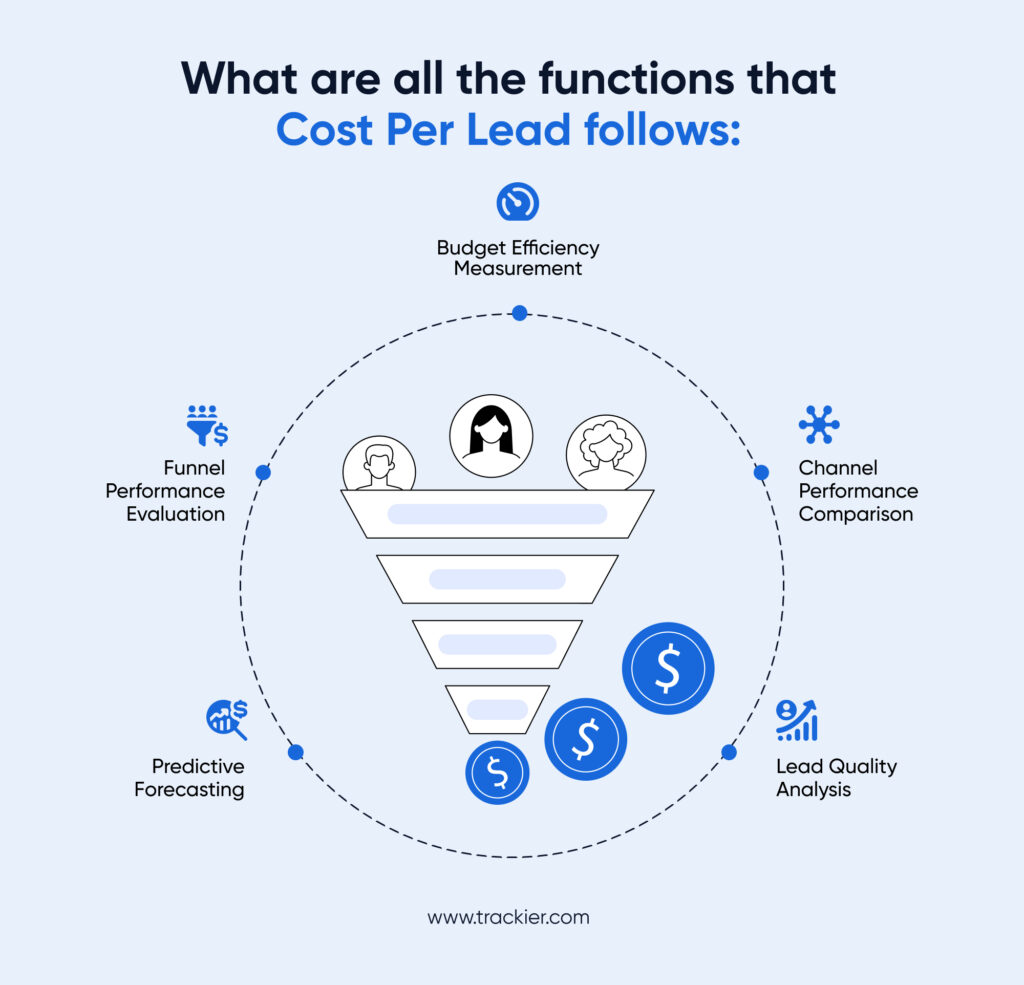
Budget Efficiency Measurement
- Shows how efficiently money is being spent on lead acquisition
Channel Performance Comparison
- Helps compare CPL across Google ads, Meta, affiliates, email marketing and more.
Lead Quality Analysis
- A decreasing CPL may not always be good, sometimes it signals low quality or unqualified leads, which Trackier helps identify.
Funnel Performance Evaluation
- CPL is the first step in determining CAC, ROAS, LTV, and funnel conversion.
Predictive Forecasting
- Knowing your CPL helps forecast future sales and scale campaigns with confidence.
Benefits of CPL Campaigns
- Low financial risks: pay only when you receive leads
- High scalability: ideal for publishers, affiliates, and programmatic lead generation
- Better control: easy to set caps, budgets and payout thresholds
- Clear ROI: direct linkage between spend and leads
- Better alignment: with sales because CPL influences funnel quality
- Flexible optimization: using automation, bidding strategies, and A/B testing
- Reduces dependency: on vanity metrics like clicks and impressions
What Is a Good Cost Per Lead?
A good CPL varies by:
- Industry
- Target Audience
- Product pricing
- Competition
- Lead qualification criteria
Cost Per Lead Calculator
A cost per lead calculator simplifies CPL computation by allowing users to enter:
- Total spend
- Leads generated
- Channel metrics
- Conversion percentages
These tools help marketers:
- Estimate campaign costs
- Forecast budgets
- Analyze breaks in lead flow
- Compare performance amongst platforms
Trackier provides real-time CPL insights across all campaigns and partners.
Factors That Influence CPL
Audience Targeting
- Highly refined targeting increases quality but may raise CPL. Audience targeting plays a major role in determining CPL. Highly specific or niche targeting often leads to better-quality, sales-ready leads, but it can also increase the cost due to smaller audience size and higher bidding competition.
Ways in which targeting affects CPL is as follows:
- Hyper-targeted audience often have higher CPL, but significantly higher conversion rates.
- Broad audience may reduce the CPL but attract low intent or irrelevant audience
- Retargeting audiences usually deliver the lowest CPL because users are already familiar with your brand.
- Lookalike audiences strike a balance between reach and relevance, keeping CPL stable.
Effective segmentation ensures you are paying for a qualified intent, not just volume.
Ad creatives and Messaging
- Stronger creatives reduce CPL by attracting high-intent users. Your ads specifically shapes user perceptions and significantly impacts how much you pay per lead.
How creatives influence CPL:
- Strong, clear messaging directly improves ad engagement and reduces CPL.
- Emotion driven visuals catch attention quickly, and can lower cost per click indirectly lowering CPL.
- Mismatch between ads and landing pages leads to drop-offs and increased CPL.
- Benefit focused headlines increase click-through rate and decrease the cost required to attract a qualified lead.
High-performing campaigns help maintain a good CPL by ensuring your spend focuses on high-intent users.
Landing page performance
- Slow or unclear landing pages increase drop-off and inflate CPL. Even with strong targeting and great ads, a poorly optimized landing page will drive your CPL higher.
Key factors affecting CPL:
- Slow load time increases bounce rates and reduces conversions.
- Unclear structure or messaging causes users to drop before filling forms.
- Too many distractions weaken the funnel.
- Weak or confusing CTAs decrease lead submissions.
- Poor mobile optimization drastically inflates CPL, as a significant percentage of users browse on mobile devices.
A clean, fast and conversion-focused landing page is essential to keeping CPL under control.
Lead qualification criteria
- More fields = higher CPL but better lead quality. The complexity of your lead form or qualification requirements directly impacts both volume and CPL.
How qualification affects CPL:
- Users generally drop off when forms feel lengthy.
- Stricter qualification filters low-quality leads but raises CPL.
- High-friction forms discourage users, inflating CPL.
- Low-friction forms reduce CPL but may lead less qualified users.
- Progressive profiling helps maintain low CPL while collecting details across multiple touchpoints.
The ideal balance depends upon whether you prioritize quality or quantity.
Competition & Seasonality
- CPL spikes during high-demand seasons like sales or holidays. Market dynamics directly influence advertising costs and in turn your CPL.
Competition’s impact on CPL:
- When competitors target the same audience, ad costs rise due to bidding wars.
- Industries like finance, real-estate, and SaaS see high competition, and therefore higher CPL.
- Seasonality-festive sales, year-end budgets, holiday shopping seasons, pushes CPM and CPC upwards, indirectly raising CPL.
- During quieter months, CPL usually drops due to lower bidding demand.
Industry type
- Niche industries often have higher CPL due to smaller audiences. CPL varies widely across industries because every sector has different lead values, audience sizes, and sales cycles.
Industry differences affecting CPL:
- B2B industries like SaaS, insurance and enterprise solutions typically have higher CPL due to long sales cycles and niche targeting.
- B2C industries like e-commerce, apparel and consumer apps have lower CPL but rely on high volume.
- Real estate, finance and healthcare often have high CPL, because leads require more trust-building and compliance screenings.
- Education, hospitality, and lifestyle sectors typically have affordable CPL due to broader audience bases.
Understanding your industry benchmarks helps set realistic CPL expectations and optimization goals.
When Should You Use CPL Campaigns?
Use the CPL campaigns when you aim to:
- Built a pipeline for sales team
- Collect high-quality leads
- Promote webinars, events or demos
- Grow email subscribers
- Run affiliate lead-gen campaigns
- Boost trial signups or gated content downloads
CPL is ideal for both scaling and optimizing top and middle funnel campaigns.
Ultimately, Cost Per Lead gives marketers the clarity they need to grow with confidence. When measured and optimized properly, CPL becomes more than just a metric, it turns into a reliable indicator of campaign health, audience intent and long term profitability. Whether you are scaling lead-generation efforts, refining performance strategies, or improving funnel quality, a strong handle on CPL ensures that every marketing dollar works smarter for you.
With the right tools, insights, and optimization strategies brands can consistently attract high-intent leads while maintaining a healthy, sustainable cost per lead.
FAQs
What does CPL mean in marketing?
It reflects how much a brand spends to generate one qualified lead. This could be through signups, form fills, demo requests, or downloads. It helps measure how efficiently campaigns attract potential customers.
Is a lower CPL always better?
Not necessarily, because low costs can sometimes indicate low-quality or unqualified leads. It’s important to balance cost with lead intent. Quality should matter more than just volume.
How is it different from CPA?
CPA measures the cost of a final action like a purchase, while this metric captures interest at an earlier stage. Both serve different purposes within the funnel. Together, they give a complete performance picture.
Can CPL vary across channels?
Absolutely, because cost per lead differs based on user intent across channels. Paid ads often cost more, while email or affiliates may deliver cheaper leads. Evaluating each source individually provides better clarity.
What campaigns work best for the CPL model?
Webinars, product demos, trials, and gated content typically deliver strong cost per lead efficiency. These formats attract users who show real interest. They help build a meaningful pipeline with lower risk.
How often should CPL be monitored?
Tracking cost per lead regularly helps maintain stable performance. Weekly or daily monitoring can catch issues early. This consistency ensures continuous optimisation and budget control.
