The situations where one organization conducts business with another is known as B2B or business-to-business dealings.
However, if the said business transactions occur within online goods and services, this type of business dealing falls under the broad categorization of B2B ecommerce.
You may wonder, how often such business is conducted in the first place. According to Mordor Intelligence, the B2B ecommerce market size in terms of value was $36.86 trillion in 2026, with an expected CAGR of 10.84%.
While the largest market for type of commerce is Asia, the fastest one in terms of growth was North America.
While the scope and scale is worth noting, it is vital to examine exactly what qualifies as B2B ecommerce, how ecommerce is marketed and on what basis it occurs as a standalone category — separate from ecommerce, B2C business, etc.
What is B2B eCommerce?
The business-to-business transactions occurring between two organizations or ventures, such as:
- manufacturers selling to distributors,
- distributors supplying retailers, or,
- software providers offering subscription-based services to enterprises,
All fall under the common umbrella of B2B ecommerce.
This is a type of commercial activity that involves:
- Two or more organizations in a single business dealing,
- High-volume transactions or exchanges of goods and services,
- Multi-stakeholder discussions for the conduction of business activities,
- Relationship-driven decision making,
- Long decision cycles, and,
- Diverse target audiences who can be appealed to for the initiation of such business.
As far as the scope of such marketplaces is concerned, there is a lot of diversity. B2B ecommerce often includes:
- SaaS product subscriptions
- Industrial equipment
- Raw materials of various types
- Office supplies, and,
- Other types of bulk procurement items.
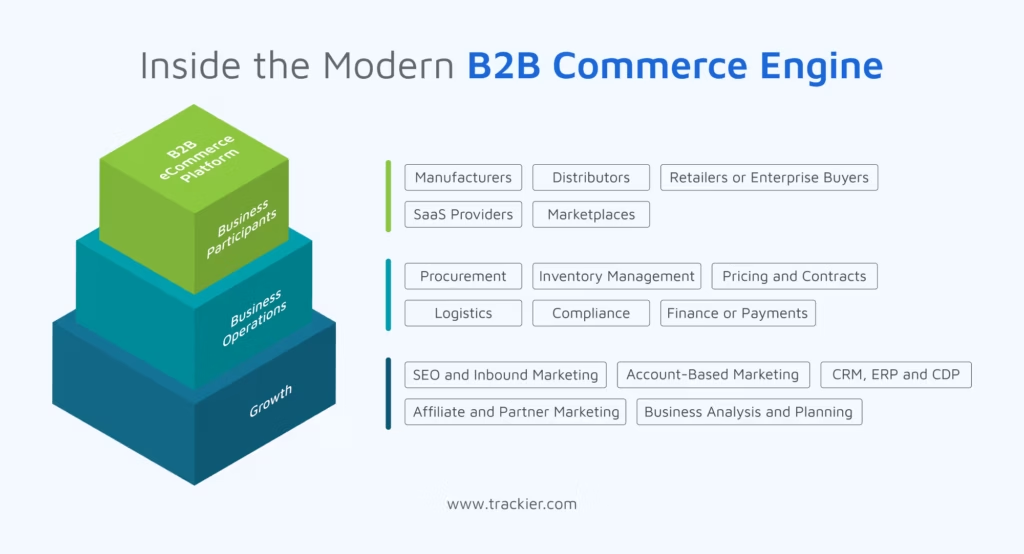
Modern B2B platforms for conducting ecommerce usually reduce time taken to initiate by enabling businesses to:
- Manage their own catalogues
- Negotiate per lead pricing
- Automate any order or re-order placement
- Track inventory availability and management in real-time
Key Features of B2B eCommerce
There are clear distinctions between B2B ecommerce and other types of business dealings, which are evident from the understanding of what exactly this sphere of business stands for. However, there are changes of overlap for obvious reasons — commerce of any kind at the end of the day tends to fall back into familiar patterns.
To clearly distinguish this vertical from other types of financial dealings, here are the unique features that serve to qualify a business operation as B2B ecommerce:
- Bulk Pricing Structures
Since the business hinges on orders being large in volume, the pricing is often tiered or multi-layered to accommodate modalities of this nature. Quantities determine pricing, with no flat structure in place.
Additionally, discounts may be applied at will, depending on the quantities of goods and services being offered. Such practices encourage relationship building and trust, which may further lead to repeated business.
Overall, such a pricing model allows suppliers to increase sales volumes, while allowing buyers to reduce procurement costs.
- Account-based Pricing and Contracts
Instead of setting pricing to be directly linked to the product, pricing is usually determined by account. Specific customers can negotiate a custom pricing on various factors, such as long-term relationships or purchase histories.
This means, depending on who the customer is, all B2B marketing aspects, from the catalogue and discounts to add-on items visibility, may vary dramatically.
- Industry-specific Product Requirements
B2B ecommerce is a type of business dealing, which encompasses a variety of businesses. Everything from SaaS to pharmaceuticals, manufacturing to construction and heavy machinery to paper clips can run in a business-to-business setup. Here, buyers specifically require to have their technical specifications, documentation regarding customizations, certifications and licenses in place while conducting business affairs.
- Custom Payment Terms
When we consider the fact that a business is doing business with another, alignment on payment terms is also different for each client. In one instance, the B2B ecommerce transaction may be conducted for purchase of raw materials such as bamboo or cement, while for another, it may be an in-office business expense, such as binders or monogrammed cups.
That’s why flexibility in payment terms becomes essential. In the case of raw materials, production depends on procurement and therefore, payment may be scheduled even 2 months after delivery of the goods. In the second case, payment may be expected even before the items are dispatched.
eCommerce platforms that service B2B organizations usually support invoicing, net payment terms (such as Net 30 or Net 60), purchase orders, partial payments and credit-based transactions to accommodate corporate-style requirements (as listed in the second example).
- Longer Sales Cycles
B2B purchases usually involve research, negotiations, budget approvals and multiple stakeholders before a transaction is completed. Unlike B2C buying decisions, which are often quick and emotion-driven, B2B transactions are more strategic and can take weeks or months to finalize.
- Relationship-Driven Sales Cycles
Trust and long term partnerships are the key to conducting B2B business. Priority is assigned to reliability to service, consistent product quality, timely logistical support, post-delivery service and personal touch without reminders.
As a result, securing a long-term and healthy business deal is more important than making a single sale.
- Complex Decision-making
Since the conduct of business occurs between organizations, and not individuals, there is no single decision maker. Rather, the process of procurement is executed at multiple levels between departments like procurement, finance, operations and management. This ensures the purchase process is structured and aligned with standard business practices of the given organization, with approvals, compliance checks, and internal evaluations before purchases are confirmed.
- Wider Business Operations
Running a B2B business is more than just making a sale. There are areas of expertise such as inventory management, supply chain operations, accounting and more required for efficient operations. There are various tools required by a B2B organization to keep participating in ecommerce properly, such as a CRM, an ERP, a CDP and so on.
Is there any difference between B2C and B2B eCommerce?
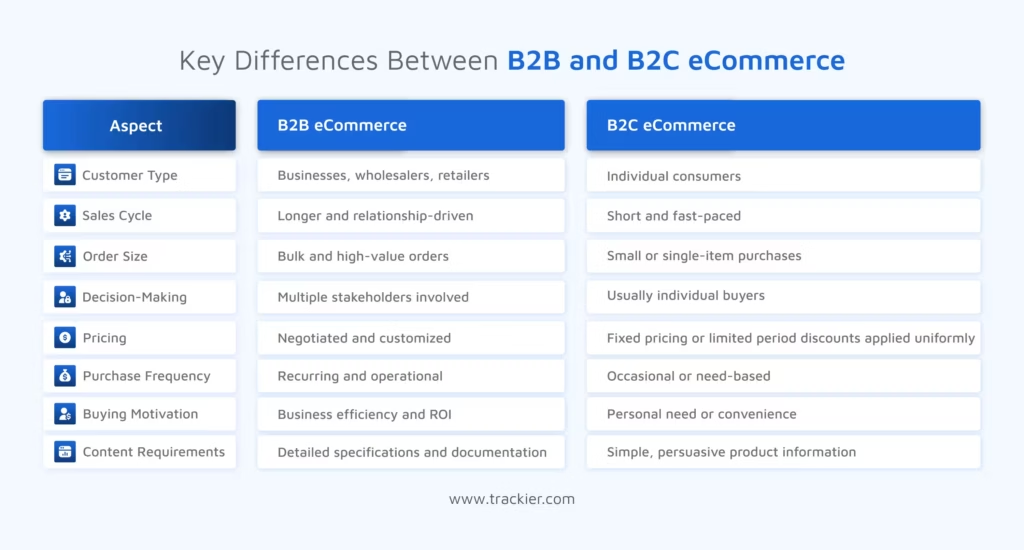
In the broadest sense, both B2B and B2C ecommerce are aligned on the fact that they involve the sale of goods and services over the internet. However, that’s where the similarities end. They differ quite a bit in areas such as:
- Customer behavior
- Purchasing processes
- Sales and marketing strategies
- Brand visibility mediums and efforts
B2C is purely a retail-style activity, where the purchase is made by individuals for individual use and consumption. There is usually a single decision maker, sometimes driving the decision purely through impulse.
Where B2B commerce is driven through prolonged discussions and lengthy sales cycles, a B2C commercial exchange can be done in the matter of even seconds. The customer adds to their cart and checks out — all in a few taps on their screen.
The size of the orders in terms of revenue also differ extensively. This is not to say that B2C orders cannot be large in size. It simply means that in terms of average order size, B2B far exceeds B2C activity.
In fact, before placing an order, Forrester reports that 73% of businesses undertake extensive online research. This same process may be completely missing from the buyer journey when you consider B2C ecommerce.
Here’s a look at the most striking differences between B2C and B2B ecommerce.
Types of B2B eCommerce
B2B organizations include various types of ecommerce models, based on how companies buy or sell products and services within the supply chain. Each typology serves a different purpose in commercial terms, and has its own unique operational structure.
Manufacturer to Distributor
In this model, manufacturers sell products in bulk to distributors who then manage regional supply and logistics. For example, an automobile parts manufacturer supplying products to authorized distributors is a common B2B transaction model.
Distributor to Retailer
Here distributors act as middlemen between manufacturers and retailers, who finally end up selling the product or service to the individual customer. The products here range from FMCG to fashion and pharmaceutical. Consider a beverage manufacturer, moving their product from the factory ahead for distribution.
Wholesale eCommerce
In this type of B2B ecommerce, a business will purchase the goods of another business in bulk for the conduction of their own business. Think of retail outlets or multi-brand department stores, for instance. By purchasing in large quantities, they end up getting better deals on the product price.
B2B Marketplaces
There are online marketplaces for businesses where they can seek out other businesses for commerce. These online spaces act as enablers for sales, purchase, negotiations, prospecting and more without having to individually dig out businesses that serve the purpose.
SaaS Platforms
SaaS-based B2B businesses provide software solutions through subscription models. Examples include CRM, accounting software, inventory management and marketing automation tools used by enterprises.
For B2B marketplaces, performance tracking becomes essential when it comes to partner-driven sales. In this instance, platforms like Trackier support affiliate campaign running, accurate attribution, identification of sources of good traffic, conversion tracking and other requirements within performance marketing.
Marketing Strategies for B2B eCommerce
Since B2B purchase decisions are often complex and research-driven, businesses need targeted strategies to attract and convert high-value clients.
Content Marketing and Thought Leadership
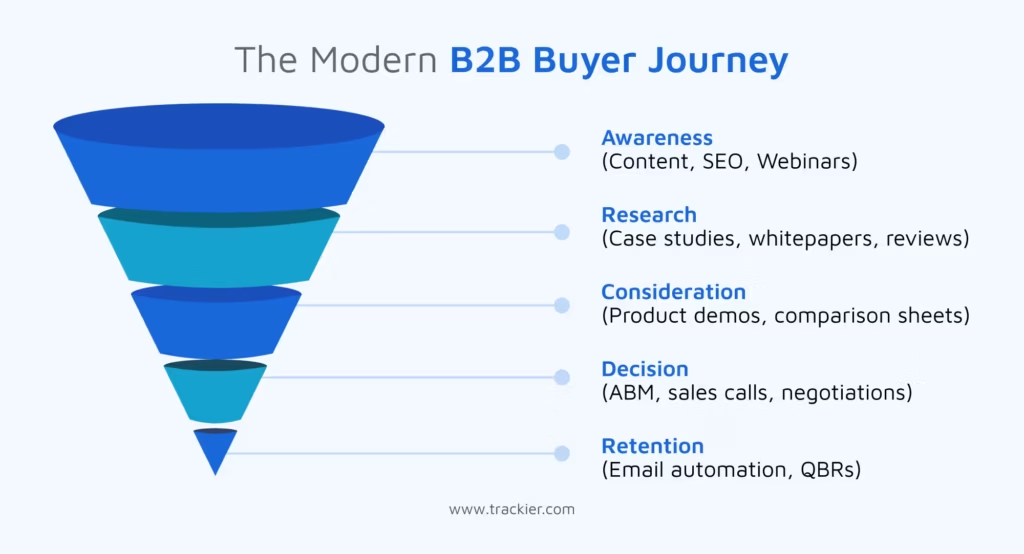
According to 6sense’s B2B buyer experience report, 69% of the purchase process has already occurred before buyers engage with sellers in the first place.
That’s why curating informative content, with technical depth is important — so that buyers add your B2B enterprise to the comparison list before making their purchase decisions. Therefore, strategic content needs to be aligned to take users from prospects to decision-making, such as:
- Whitepapers,
- Industry reports,
- Case studies,
- Blogs,
- Webinars, and,
- Product guides.
By educating customers and projecting yourself as an authoritative voice within the industry with the help of high-quality content leads to qualified lead generation and organic brand visibility.
Account-based Marketing (ABM)
Certain high-value accounts are directly targeted through marketing in a personalized manner, and therefore, this type of marketing exists separately from other various ecommerce marketing strategies. Here’s how it works:
- Businesses create customized messages, targeted ads and attempt personalized outreach to key stakeholders and decision makers in the target organizations.
- Based on this personal relationship-building and 1-1 connect, business is conducted in a B2B ecommerce setup.
Email Marketing and Automation
Email remains one of the most effective B2B marketing channels. Businesses use automated email workflows to nurture leads, onboard customers, promote product updates and trigger upsell or cross-sell opportunities based on buyer behavior and engagement.
SEO and Paid Advertising
By optimizing their websites for hyper-focused, industry-specific audiences with the help of high-intent, high-volume keywords, B2B marketers attract prospects who may be looking for the solution they are offering. In addition to this, paid marketing through search engine-based ads and other PPC marketing on social platforms, businesses can further expect the generation of MQLs and SQLs.
Affiliate and Performance Marketing
Performance marketing helps B2B brands scale customer acquisition through affiliates, partners, publishers and referral networks. Here platforms like Trackier add value by enabling a variety of marketing analytics, conversion monitoring, invoicing automation, partner onboarding and so on. It also captures all the relevant marketing key performance indicators (KPIs) which a B2B ecommerce operation may need to log.
How to Measure Promotions in B2B eCommerce?
Measuring the performance of marketing campaigns in B2B ecommerce is just as essential as it is for any type of commercial activity. All of this information enables organizations to tailor better experiences for users, including lead generation, conversions, users’ funnel stage-wise journeys, high-potential clients and more.
Since B2B sales cycles are longer and involve multiple touchpoints, businesses need data-driven tracking to evaluate campaign effectiveness accurately. The key metrics that simply cannot be missed are:
- ROI Per Campaign: This metric measures the revenue generated compared to the amount spent on a specific campaign, giving businesses the opportunity to identify the most profitable marketing channels.
- Lead Conversion Rates: Tracks how many prospects successfully convert into paying customers, providing insights into campaign quality, high-intent traffic sources and overall sales effectiveness.
- Customer Lifetime Value (CLV): Evaluates the long-term revenue a customer generates throughout the business relationship, enabling their identification so that marketers focus on high-value acquisition strategies.
- Performance Marketing Metrics: Includes clicks, conversions, revenue generated and partner contribution to assess the effectiveness of affiliate and referral campaigns.
By monitoring multi-channel attribution and cross-device flow of users, B2B businesses can better account for revenue-driving mediums, sources and channels, and direct more resources towards the most ROI-linked areas.
Examples of B2B Businesses
Exness
A global fintech and trading platform that provides access to forex, commodities, cryptocurrencies and other financial instruments for traders and institutional clients around the world. The company operates across multiple international markets and focuses heavily on digital customer acquisition and partner-led growth.
JioCoupons
The business connects other businesses with the customers through the enablement of coupon marketing. The platform supports affiliate eCommerce businesses with real-time insights, attribution tracking and campaign analytics to improve marketing efficiency.
Torazzo
This global affiliate network connects advertisers (or its B2B clients) with publishers or affiliates through the means of performance marketing campaigns. Torazzo focuses on affiliate growth, fair commission structures, campaign transparency and scalable publisher partnerships across multiple digital verticals.
Conclusion
B2B companies are increasingly adopting the online medium to sell and buy goods and services. From manufacturers and wholesalers to SaaS providers and online marketplaces, companies are adopting digital commerce models to streamline operations, improve procurement efficiency and keep even revenue growth.
As businesses scale, it becomes equally important to use effective marketing strategies to stand out in a crowded marketplace. In the digital era of B2B commerce, it has become increasingly vital for businesses to measure campaign performance, optimize B2B partner marketing efforts, and improve ROI through accurate attribution and real-time analytics (made possible through platforms like Trackier).
FAQs
What is the difference between B2B and B2C ecommerce?
The simplest, main difference between B2B and B2C ecommerce businesses is the end customer. While in the former it is another business, enterprise or client, in the case of the former it tends to be a single individual who is also most likely to be the end user of the product. This implies, in B2B ecommerce, the product may change state beyond every single business transaction, while in B2C, the state remains the same. B2B involves slow sales cycles and lengthy decision making processes. Both are quick and short for B2C ecommerce.
What are the main types of B2B ecommerce operations?
The most common B2B ecommerce models include:
– Manufacturer to Distributor
– Distributor to Retailer
– Wholesale eCommerce
– B2B Marketplaces
– SaaS-based B2B Platforms
Each model plays its own unique role in the industry where it exists, and is critical in ensuring order, structure and clear outcomes within the broader marketplace.
What marketing strategies work best for B2B ecommerce players?
Some of the most effective B2B ecommerce marketing strategies include:
– Content marketing and thought leadership
– Search engine optimization (SEO)
– Account-based marketing (ABM)
– Email marketing automation
– Paid advertising
– Affiliate and performance marketing
They help businesses dealing with other businesses achieve brand visibility, continuous discoverability and effective retention rates.
What challenges do B2B ecommerce businesses face?
Like all other kinds of business operations, B2B ecommerce players have to deal with their own set of obstacles. Some of them can be:
– Having long sales cycles, which makes deals harder to crack.
– Maintaining technical inventory checks to deliver consistent quality across regions and time.
– Tracking B2B customer journeys across multiple touchpoints and mediums.
– Retaining enterprise clients through continuous revisits or reviews to ensure alignment.