
Affiliate marketing cost is one of the most common questions marketers ask.
With customer acquisition costs rising and consumers paying less attention to traditional ads, more brands are moving toward performance-based channels.
Affiliate commissions are generally connected to approved sales, leads, installs, or other agreed actions. However, running an affiliate programme can also involve fixed costs for tracking technology, programme management, affiliate recruitment, creative production, compliance, and payment operations.
However, building an affiliate program involves more than just setting a commission rate. There are technology fees, management costs, and payout structures that vary across industries. If you are planning to launch or scale a program this year, you need clarity on what to budget for and what kind of returns you can expect.
With tools like Trackier’s automated invoicing, you can further simplify and automate your affiliate payouts.
This blog will help you map income against expenses and make informed decisions for growth.
How much does affiliate marketing cost?
Let’s peel back the layers of affiliate marketing cost. There are three primary drivers: commission payouts, platform or network fees, and program management. Each one requires careful planning to avoid surprises and control your affiliate marketing cost properly.
Commission Payouts
Affiliate commissions may be calculated as a percentage of an approved sale, a fixed amount for a qualified action, or a recurring share of subscription revenue.
There is no universal affiliate commission rate. The appropriate payout depends on gross margin, average order value, customer lifetime value, refund rate, sales cycle, programme competition, geography, and the amount of work required from the affiliate. In practice, many businesses refer to this payout as their affiliate marketing percentage, which is the percentage of revenue shared with affiliates for approved conversions.
According to Shopify’s 2026 affiliate commission guide, commonly reported reference ranges include 5%–15% for physical goods, 20%–50% for digital products and online courses, 15%–30% recurring commission for subscription services, 10%–30% of the first contract value for B2B software and services, and 3%–8% for high-ticket physical products.
These figures should be treated as starting references rather than guaranteed industry standards. Businesses should calculate the maximum sustainable payout from their own margins and verify what comparable programmes currently offer.
Platform or Tracking Tool Costs
Affiliate tracking software may charge a fixed subscription, a usage-based fee, a percentage of tracked revenue, or a customised enterprise price.
Costs can vary according to:
- Monthly clicks and conversions
- Number of affiliates, advertisers, or users
- Attribution and reporting requirements
- Fraud-detection capabilities
- API and integration requirements
- Custom domains and white labelling
- Technical support and onboarding
- Automated invoicing and payout features
- International payment, tax, and currency-conversion services
Many enterprise platforms use custom pricing, so businesses should request a complete quotation rather than relying on a generic monthly benchmark. Confirm whether implementation, data overages, premium support, payment processing, and additional modules are included in the quoted price.
Programme Management
Programme-management costs depend on whether the work is handled by an existing marketing employee, a dedicated affiliate manager, an agency, or an outsourced programme manager.
The required scope may include:
- Affiliate recruitment and vetting
- Contract and programme-term management
- Affiliate onboarding
- Campaign and offer setup
- Creative and content support
- Partner communication
- Commission approval and reconciliation
- Compliance monitoring
- Fraud prevention
- Performance reporting and optimisation
Compare the full annual cost of internal staffing with the complete agency or outsourced-management fee. Include benefits, recruitment, software, creative support, and the time required from finance, legal, analytics, and technical teams.
Putting it all together
A more accurate affiliate-marketing budget should separate fixed costs from costs that change with performance.
Monthly affiliate programme cost = approved commissions + platform or network costs + programme management + affiliate recruitment and enablement + creative production + payment and currency costs + compliance and fraud-control costs
Use approved commissions rather than recorded conversions because cancelled, refunded, duplicated, fraudulent, or otherwise invalid actions may not qualify for payment.
The final budget should be based on the programme’s expected conversion volume and unit economics rather than the company’s size alone.
How Much Does It Cost to Start Affiliate Marketing?
This question can refer to two different activities: becoming an affiliate who promotes other companies or creating an affiliate program for a business.
Cost to Start as an Affiliate
Joining an affiliate programme does not necessarily require an application fee. However, free programme participation does not mean that building an affiliate business has no cost. Expenses depend on the promotional channel and may include:
| Expense | Is It Always Required? |
|---|---|
| Affiliate programme application | Often free, but approval may be required |
| Website, domain, and hosting | Optional when using an existing social, video, podcast, or email audience |
| Content production | Depends on the required writing, design, audio, or video quality |
| Product access or samples | Depends on whether first-hand testing is required |
| SEO, analytics, email, and design tools | Optional, but may support content production and measurement |
| Freelance or production support | Optional |
| Paid traffic | Optional and sometimes restricted by programme terms |
| Legal, disclosure, accounting, and tax support | Depends on the affiliate’s location and business structure |
An affiliate using an existing audience and free content tools may have little or no direct programme cost. A website-led, video-led, or paid-acquisition strategy may require a larger investment. There is therefore no reliable universal minimum budget for starting affiliate marketing.
Free programmes may still impose eligibility requirements. Shopify, for example, states that applicants should have an active website, an established audience, original content, and relevant commerce experience.
Cost to Start an Affiliate Programme as a Business
A business launching its own programme should budget for:
- Tracking and attribution technology
- Affiliate commissions
- Programme management
- Affiliate recruitment
- Creative assets and product samples
- Network or marketplace access, where applicable
- Contract and compliance work
- Fraud detection
- Payment processing and reconciliation
- Returns, cancellations, and commission reversals
The commission pool is variable, but technology, management, and implementation costs may begin before the first approved conversion.
Affiliate Marketing Commission Rates by Industry
Affiliate commission rates vary by product economics and programme terms. The following ranges are useful reference points from Shopify’s May 2026 affiliate commission guide, but they should not be treated as fixed market rules.
| Product or Industry Type | Commonly Reported Commission Structure |
|---|---|
| Physical goods, including fashion, home, and beauty | 5%–15% of an approved sale |
| Digital products and online courses | 20%–50% of an approved sale |
| Subscription services | 15%–30% recurring commission |
| B2B software and services | 10%–30% of the first contract value |
| High-ticket physical products | 3%–8% of an approved sale |
What Affiliate Marketing Cost Should Businesses Plan For?
Businesses should calculate their affiliate budget from customer economics rather than applying a generic percentage of the total marketing budget.
Start by identifying the maximum amount the business can spend to acquire an approved customer while maintaining its required contribution margin.
A simplified calculation is:
Maximum affiliate acquisition cost = gross profit per conversion − non-affiliate variable costs − required contribution margin
Non-affiliate variable costs may include payment processing, fulfilment, customer support, returns, discounts, taxes absorbed by the business, and expected fraud or cancellation losses.
For example, consider an order with:
- $100 in revenue
- $60 in gross profit before affiliate costs
- $20 in fulfilment, payment, discount, and return-related costs
- A required contribution margin of $25
The maximum sustainable affiliate acquisition cost would be $15. If the commission is calculated on the $100 order value, the corresponding maximum commission rate would be 15%. This calculation helps businesses determine the right affiliate marketing percentage instead of copying competitor commission rates that may not fit their margins.
This is an illustrative calculation, not a universal benchmark. Each business should use its own margins, approval rates, repeat-purchase value, and finance requirements.
After calculating the maximum variable payout, add fixed and operational expenses such as platform fees, programme management, creative production, affiliate recruitment, legal review, fraud controls, and payment operations.
How to approach your affiliate budget strategically
Assigning a number is just the first step; how you track and allocate it makes all the difference.
Start with a percentage
Link your affiliate marketing cost to business goals.
Set an initial payout ceiling using the maximum sustainable acquisition cost calculated from your margins. Review the ceiling after the programme produces sufficient data on approved conversions, customer value, cancellations, and total operating cost.
Use a tiered rollout
Begin with a trial period using a small group of affiliates and moderate commission. As conversions and ROI improve, layer in bonuses or jump to higher tiers. That keeps your affiliate marketing cost aligned with performance.
Monitor and adjust regularly
Check affiliate marketing income vs expenses on a month-by-month basis. If effective cost per acquisition is lower than paid media, reinvest in that channel. If not, hold or reduce spend.
Factor in production costs
Affiliate marketing costs often miss design or copy expenses.
Include the cost of banners, landing pages, product samples, promotional codes, videos, email copy, affiliate toolkits, and content review. Record these expenses against the programme rather than treating them as general marketing costs.
Plan for seasonal changes
Sales and holidays bump up affiliate activity. Set aside extra budget in Q4 or around key launches.
Increase the budget around relevant launches or seasonal periods only when historical conversion, margin, inventory, and partner-performance data justify the additional spend.
Why budget clarity matters
When you treat affiliate marketing as a channel that can scale predictably, it changes how finance and leadership view it.
Instead of wondering about how much it costs, you present a model:
- Fixed costs: platform, tools, content
- Variable costs: affiliate payouts, bonuses, seasonal spikes
- ROI data: cost per acquisition, return on affiliate spend
This separation helps finance and marketing teams understand which costs are fixed, which are performance-linked, and how changes in commission or conversion volume affect programme profitability.
Affiliate types and cost implications
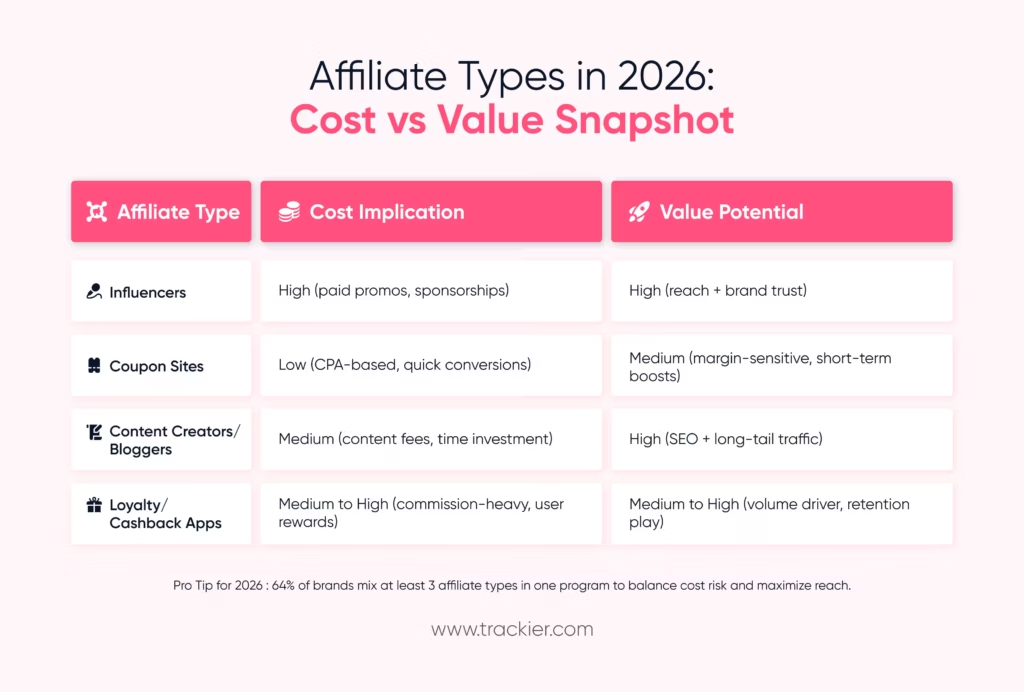
Not all affiliates cost the same, or deliver the same value. Your affiliate marketing cost and strategy should account for the differences.
Here’s how various affiliate types typically compare in cost and performance in 2026:
Influencer Affiliates
Influencer partnerships may combine a fixed content-production fee, gifted products, performance commission, or a hybrid of these arrangements. Cost depends on audience relevance, required deliverables, content-usage rights, exclusivity, platform, geography, and the creator’s previous performance.
Separate the content fee from the performance commission so the business can distinguish media or production costs from approved acquisition costs.
Coupon and Deal Sites
Coupon and deal partners commonly work on performance commissions, but the commercial terms vary by retailer, category, placement, and promotional period.
Evaluate whether the partner is introducing new customers, assisting an existing customer journey, or appearing only at the final stage of checkout. Consider new-customer rules, minimum order values, code exclusivity, margin, and incrementality before increasing the commission.
Content Creators and Niche Publishers
Content publishers may work on commission alone or request an additional fee for content production, placement, testing, or access to their audience.
Assess the complete arrangement using content quality, ranking potential, audience relevance, approved revenue, conversion rate, assisted contribution, and the expected useful life of the content. Do not assume that every article or review will continue producing conversions with minimal maintenance.
Loyalty and Cashback Platforms
Loyalty and cashback partners return part of their commission to the customer, so they may request different commercial terms from standard content affiliates.
Review margin, customer type, order value, incrementality, repeat purchases, attribution position, and the value returned to the customer. Use tiered or campaign-specific rates only when the resulting economics remain sustainable.
Affiliate Marketing Cost: Income vs Expenses
Every affiliate program needs to answer a fundamental question: Does the income justify the expenses? While affiliate marketing is often praised for its cost-effectiveness, the reality is much more nuanced.
Expenses are no longer limited to just payouts, and income depends heavily on program maturity, industry, and the ability to manage partner relationships effectively.
1. Breaking Down Affiliate Marketing Income
Affiliate program income and value can be measured in several ways:
- Direct Revenue: Revenue attributed to approved affiliate conversions.
- Incremental Revenue: Revenue that is reasonably determined to have occurred because of the affiliate contribution rather than an existing customer journey.
- New-Customer Revenue: Revenue from customers who meet the programme’s new-customer definition.
- Customer Lifetime Value: The value generated after the initial affiliate-attributed conversion.
- Assisted Value: The affiliate’s documented contribution when another channel receives the final attribution credit.
Directly attributed revenue is not automatically incremental. Businesses may need customer-status rules, attribution analysis, controlled testing, or other incrementality methods to determine whether an affiliate introduced additional demand.
2. Mapping the expenses side
Expenses in affiliate marketing programs fall under three categories:
- Fixed costs: Tools, software subscriptions, tracking platforms, compliance audits, and management salaries.
- Variable costs: Commissions, bonuses, and performance incentives which scale with sales volume.
- Hidden costs: Fraudulent clicks, partner churn, and opportunity costs when creative assets or landing pages underperform.
Hidden costs can include invalid traffic, self-referrals, duplicated leads, attribution errors, unauthorised coupon use, reversed orders, delayed creative production, and inactive affiliates. Measure these costs using the programme’s own validated data rather than applying a generic fraud percentage.
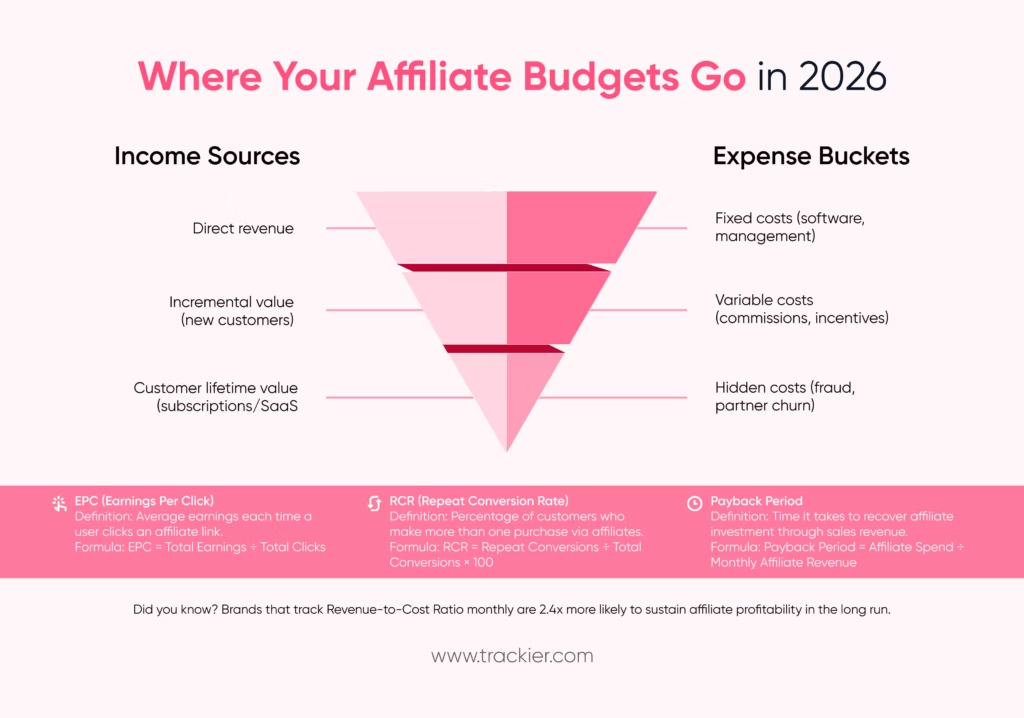
3. Income vs expense ratios to track
To evaluate success, companies should track these ratios:
- Earnings per click (EPC): Shows income earned relative to clicks generated by affiliates.
- Revenue-to-cost ratio: Compares affiliate-attributed revenue with total programme cost. The acceptable ratio depends on gross margin, repeat-purchase value, required contribution margin, and the company’s finance targets.
- Payback period: Especially for SaaS or subscriptions, how long it takes for affiliate-acquired customers to cover acquisition costs.
For instance, a SaaS company might invest $100 in affiliate commissions for one new customer, but if that customer stays for 18 months paying $40 per month, the LTV of $720 far outweighs the upfront expense.
4. The profitability trend
Unlike paid ads where costs rise with competition, affiliate marketing offers more stable cost scaling. The reason is simple: commissions are tied to actual results. This makes income-vs-expense dynamics more predictable compared to channels like search or display.
However, program complexity in 2026, like multi-touch attribution, influencer commissions, and tiered partner payouts, means businesses need more refined expense tracking to avoid overspending in the name of growth.
How do affiliate marketing payouts work?
Affiliate marketing payouts are one of the biggest factors influencing profitability for both businesses and marketers. Understanding how affiliate marketing payouts work in 2026 helps brands set clear expectations and gives affiliates insight into how much they can realistically earn.
The common payout models
Most affiliate programs use one (or a mix) of the following models:
- Cost Per Sale (CPS): Affiliates earn a percentage commission for every sale made through their referral link. This is the most common payout model in industries like e-commerce and SaaS. Commissions usually range between 5%–30%, though some programs (like digital products) can go as high as 50%.
- Cost Per Action (CPA): Affiliates earn when users complete a predefined action such as signing up for a trial, downloading an app, or filling out a form. This model is popular in finance, education, and subscription-based niches.
- Cost Per Click (CPC): Less common today, affiliates earn based on the number of valid clicks driven to the advertiser’s site.
- Recurring Commissions: Especially common in SaaS and subscription businesses, affiliates continue earning as long as the customer stays subscribed. For example, platforms like ClickFunnels offer 40% recurring commissions for affiliates.
How payouts are structured
- Flat Rate vs. Percentage-Based: Some businesses prefer a flat payout per lead or sale (e.g., $50 per sign-up), while others provide a revenue-share model (e.g., 20% of every sale).
- Payment Thresholds: Affiliates usually must meet a minimum payout threshold before receiving commissions. For example, Amazon Associates sets a minimum of $10 for payouts.
- Frequency of Payment: Standard payment cycles include monthly, bi-weekly, or net-30 (payment after 30 days). High-performing affiliates may negotiate faster payouts.
Affiliate network influence
When affiliates use networks like CJ Affiliate or ShareASale, payouts are often standardized and backed by platform policies. Direct brand-to-affiliate partnerships, however, sometimes allow more flexible or customized payout structures.
The rise of hybrid payout models
In 2026, hybrid models are gaining traction; brands combine CPS + CPA to reward both immediate conversions and micro-actions. For instance, an affiliate might earn $10 for a sign-up plus 15% commission on the first purchase. This balance encourages affiliates to focus on both lead quality and sales.
Why payout transparency matters
Clear payout policies not only attract high-quality affiliates but also prevent churn. Affiliates want to know exactly how they’ll be compensated and how tracking ensures their work is properly credited. A transparent payout system builds trust and strengthens long-term partnerships.
How can businesses manage affiliate marketing costs more efficiently?
One of the biggest challenges for businesses running affiliate programs in 2026 is not just setting the right budget, but tracking how that money is being spent and ensuring payouts align with actual performance. Many brands still struggle with attribution issues, fraud detection, and inefficient partner management, all of which inflate costs.
This is where affiliate marketing platforms come in. Instead of manually juggling spreadsheets or relying on inconsistent data, businesses can use tools that provide:
- Real-time performance tracking so every click, lead, and sale is visible.
- Automated payout management that reduces the risk of overpaying or missing affiliate commissions.
- Fraud prevention systems to catch suspicious clicks or fake leads before they drain the budget.
- Cross-channel attribution that shows whether a conversion came from an affiliate, influencer, or paid ad.
Platforms like Trackier are designed specifically for this kind of optimization. For example, a brand can use Trackier’s partner marketing platform to identify which affiliates consistently drive high-value customers versus those with high churn.
That allows marketing teams to reallocate budgets to the right partners, keeping overall costs predictable while boosting ROI.
Businesses comparing affiliate software should also evaluate Trackier pricing based on click volume, conversion volume, integrations, fraud-prevention features, payout automation, and reporting requirements rather than looking only at the monthly subscription fee.
What is the best strategy to balance affiliate marketing cost and ROI in 2026?
By now it’s clear that affiliate marketing in 2026 is no longer about “how little can I spend” but rather “how smartly can I invest.” The businesses seeing the best results are the ones that view affiliate programs as profit centers instead of cost centers.
A winning strategy often includes:
- Clear budget allocations: separating fixed costs (like tech platforms) from variable payouts tied directly to performance.
- Data-led partner management: focusing spend on affiliates who bring loyal, repeat customers rather than one-time signups.
- Regular cost audits: checking for hidden inefficiencies like delayed payouts, fraudulent activity, or underperforming affiliates.
- Technology adoption: using affiliate management platforms to streamline payouts, attribution, and fraud detection.
The smarter way to think about affiliate marketing cost
Affiliate marketing is one of the most budget-flexible channels in digital marketing, but flexibility without planning can quickly turn into overspending. In 2026, the brands winning at affiliate marketing are those who track income vs expenses in real time, budget for growth rather than just survival, and use technology to keep their programs efficient.
Whether you’re a startup with a small affiliate budget or an enterprise running hundreds of partnerships, the key is to treat costs as investments in performance. Done right, every dollar spent on affiliates can return multiples in revenue, brand awareness, and long-term customer value.
If you’re mapping out your next steps, ask yourself:
- Do I know exactly where my affiliate budget is going?
- Am I rewarding the right affiliates for sustainable growth?
- Is my program scalable without my costs spiraling out of control?
If the answer isn’t a confident yes, it might be time to review your affiliate budget strategy and invest in tools that give you transparency and control.
Affiliate marketing will always carry costs, but in 2026, the businesses that manage those costs with clarity, data, and the right tech will be the ones seeing the highest ROI.
Hungry For More?
Sign up for our weekly newsletter to get tips like these delivered straight to your feed.
FAQs
1. How much does affiliate marketing cost?
Affiliate marketing costs vary depending on commission models, partner types, and technology stack. In 2026, most brands allocate 10–30% of their digital marketing budget to affiliate programs.
Costs include:
– Affiliate commissions (typically 5–30% of each sale, depending on industry and partner type).
– Platform fees for tracking and automation software.
– Network fees if using an affiliate network (often 20–30% override on publisher payouts).
– Operational overhead like creative production and fraud prevention.
Unlike paid ads where you spend upfront, affiliate marketing is performance-based; you pay only when results come in. This makes it easier to scale while keeping acquisition costs predictable.
2. What is the 80/20 rule in affiliate marketing?
The 80/20 rule, or Pareto principle, means that 80% of affiliate revenue usually comes from 20% of affiliates.
– These top partners (like established content publishers or loyalty apps) are often the primary revenue drivers.
– The other 80% of affiliates still matter, but they typically generate smaller contributions or act as brand amplifiers.
For program managers, this rule is a reminder to:
– Nurture high-performing affiliates with better incentives and exclusive campaigns.
– Diversify the base so dependence on a handful of affiliates doesn’t create risk.
3. Is affiliate marketing cost-effective?
Affiliate marketing is not “cheap” in the sense of low-quality or low-effort, but it is cost-efficient compared to traditional channels.
– Since payments are tied to performance, the risk of wasted spend is lower.
– However, costs can add up when working with premium affiliates like influencers or cashback apps, where commission rates and bonuses are higher.
– The “hidden cost” is management effort, recruiting, vetting, and nurturing affiliates to keep the program profitable.
So while it’s not free or effortless, affiliate marketing remains one of the most budget-flexible and ROI-friendly strategies available in 2026.
4. What is a good affiliate marketing percentage for a new business?
A good affiliate marketing percentage depends on your margins and customer lifetime value. Many physical-product brands start between 5% and 15%, while SaaS and digital products may offer 20% to 40% or recurring commissions. The goal is to choose a percentage that remains profitable after fulfilment, support, refunds, and advertising costs.
5. How do I calculate affiliate marketing percentage?
To calculate affiliate marketing percentage, divide the commission paid by the total approved sale value and multiply by 100. If you pay ₹500 on a ₹5,000 approved order, the affiliate marketing percentage is 10%. Always calculate it on approved conversions, not on cancelled, refunded, or fraudulent transactions.
6. What should I consider before choosing affiliate software?
Before choosing affiliate software, evaluate attribution accuracy, fraud prevention, payout automation, reporting depth, API access, integrations, scalability, and support quality. Pricing should be assessed against the revenue and operational efficiency the platform can generate, not just the lowest monthly fee. A cheaper tool may become expensive if tracking is inaccurate.