Invalid traffic includes clicks, impressions, or site visits that don’t come from a genuine user with intent to engage with the ad. This includes automated bots, web crawlers, accidental clicks by real people, fake interactions designed to inflate ad spending, and many more.
Let’s look at a simple example for more clarity. A brand runs a pay-per-lead performance marketing campaign, and a partner reports 1,000 leads. An audit later reveals that 400 of those leads are fake or invalid. If the brand fails to identify these invalid leads, then it would end up paying for 400 leads that carry no business value.
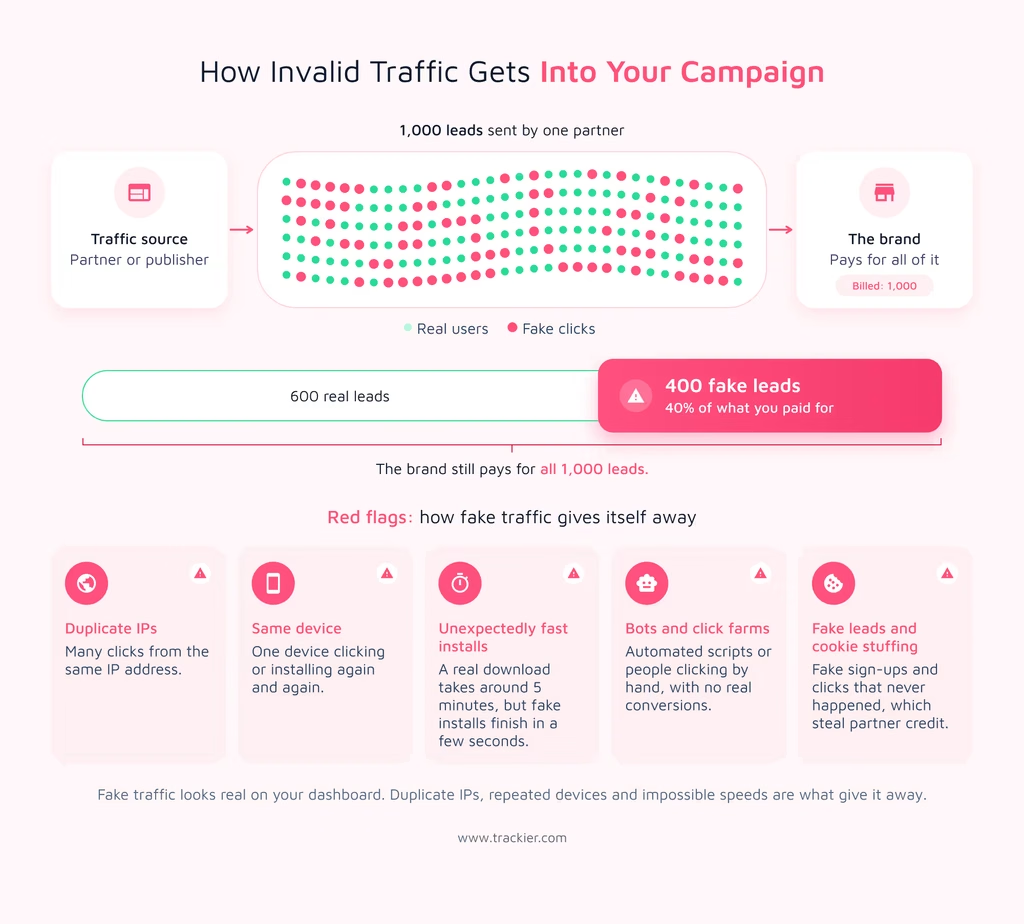
Types Of Invalid Traffic
Fake traffic can be done by mistake or by intention. Let’s take a look at various types of traffic so that you can differentiate among them.
General IVT (GIVT)
General IVT is typically caused by search crawlers, web spiders, routine site-monitoring tools, or simple accidental clicks by real users. So it basically includes all those factors that are not intended to do any fraud intentionally. Because GIVT follows predictable patterns, most ad platforms can detect and filter it out before it impacts your budget.
Sophisticated IVT (SIVT)
Sophisticated IVT is more complex because it intentionally mimics real human activity to perform fraud. Identifying SIVT requires advanced analytics, machine learning, and multi-point behavioural tracking. Various fraud tactics operate across these classifications; especially SIVT includes:
- Bot traffic & click Farms:
Automated scripts or fake networks designed to mimic human browsing behaviour, generating high volumes of non-converting clicks and impressions that silently drain your advertising budgets.
- Affiliate Fraud:
It includes the manipulation of clicks, leads, conversions, or attribution data to improperly claim referral commissions. The common tactics are cookie stuffing, fabricated leads, automated clicks, and many more.
How Does Invalid Traffic Affect Publishers and Advertisers?
According to Lunio’s global IVT report, about $63 billion of ad spend is wasted every year on bots and ad fraud. Let’s see how it affects publishers and advertisers.
Wasted Ad Spend
When campaigns get inauthentic traffic, budget is allocated to non-human or illegitimate activity rather than reaching real potential customers. Over time, these fake traffic generators drain all your marketing budget without reaching many more real customers.
Lower ROI
When affiliate fraud happens. Advertisers pay for traffic that never happened in real life, so a large amount of budget gets wasted without any return. A campaign can look like it has a lot of clicks and impressions, but at the same time it doesn’t have many conversions.
Damaged Partner Relationships
Advertisers lose faith in publishers due to the fake traffic they send; it affects even those publishers who didn’t do anything wrong. Once this trust between advertiser and publisher breaks, it takes a lot of time to recover and rebuild the same relationship as before.
Unreliable Reporting
Fake visits inflate traffic and click numbers, lower conversion rates, and distort attribution, which leads teams to optimise towards the wrong channels and audiences. Wrong and unreliable data also makes budget planning just a guessing game.
How to Stop The Leak: Detect, Block and Save Budget With Trackier
The solution to this leakage starts with complete visibility. Marketers should actively monitor metrics like click-to-conversion timing, device details, and geographic patterns across all traffic sources. However, indicators such as a shared IP address or identical device parameters are not immediate proof of fraud. For instance, dozens of real people connected through a public wifi will naturally share the exact IP address. So these indicators should be treated as signals only.
Next, identify suspicious activities and block those partners who are continuously sending fake traffic in your affiliate program so that there is no further budget loss.
If you want to do this whole process of detecting fake traffic, blocking it, and saving budget from getting wasted, then you can go for a good performance marketing platform like Trackier, which records all the traffic in real time so that nothing gets missed and flags suspicious activity before it’s too late to take action, and also gives you the option to set fraud rules for your campaigns.
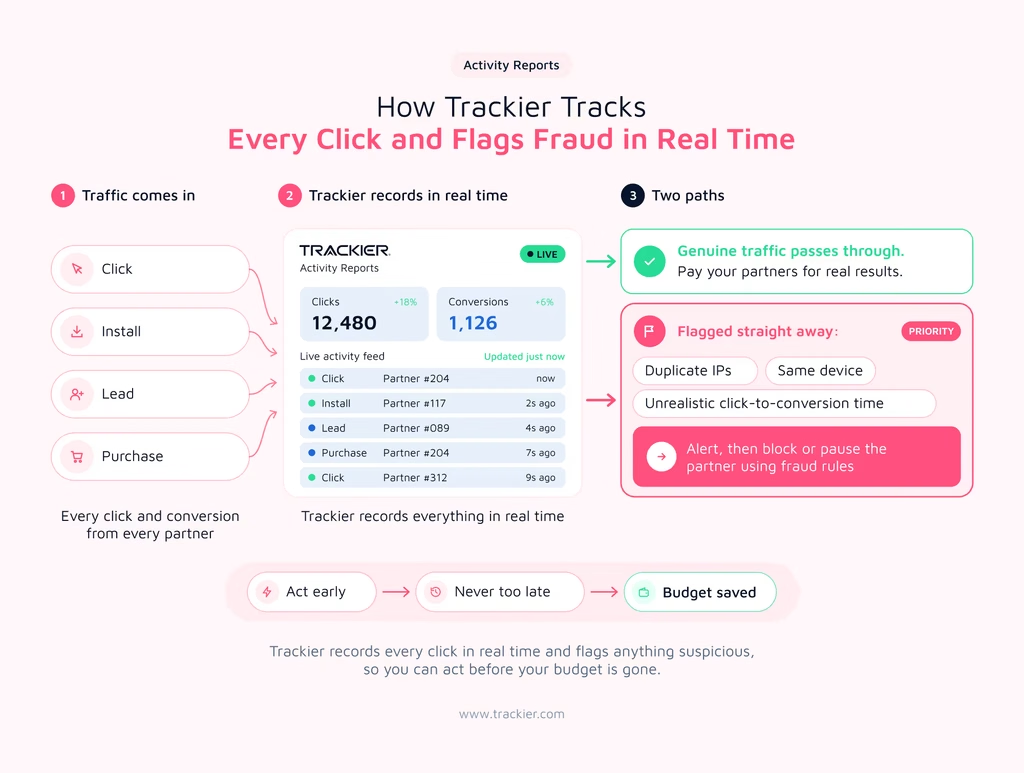
For ex: Imagine a campaign suddenly gets 500 app installs from a single source in just a few minutes – all coming from identical device models with almost zero time between the click and the download. Instead of immediately writing every install off as fake, a team should check downstream details like post-install engagement and actual user retention to help confirm whether it is a real issue or not.
Conclusion
If you want to protect your campaign, then start by detecting the problem. Fake visits are no longer a small issue; they can silently drain all of your budget without giving any return.
The key is to consistently monitor traffic quality, investigate unusual patterns, and apply appropriate fraud controls. The good news is that unauthentic traffic can be managed by using a good performance marketing platform like Trackier, which keeps monitoring the clicks and conversions in real time and also notifies you if anything suspicious is detected.
1. What is invalid traffic?
IVT includes any clicks, impressions, or conversions that do not have genuine advertising engagement. This ranges from automated activity like bots and web crawlers to accidental clicks by real users, or deliberate fake interactions designed to artificially inflate ad spending.
2. What is the difference between GIVT and SIVT?
GIVT comes from simple, non-human sources like search engine crawlers, web spiders, site-monitoring tools, or accidental clicks. Most ad platforms filter it out before billing you. SIVT is deliberate and copies real human behaviour using hijacked devices or spoofed domains, so it needs advanced analytics to catch.
3. How does unauthentic traffic affect advertisers and publishers?
Unauthentic traffic affects both sides in distinct ways:
For Advertisers: It drains ad budgets on fake engagements, distorts performance analytics, and lowers overall return on ad spend (ROAS).
For Publishers: It damages reputation and trust with advertisers, leading to lost revenue and potential clawbacks, even when the fraud is unintentional.
4. How can you detect invalid traffic?
Track clicks, installs, and conversions by source, comparing metrics like conversion rates, device details, geography, and completion time. Suspicious patterns – such as duplicate IPs, repeated devices, or near-instant downloads – should be viewed as investigative signals rather than absolute proof of fraud, triggering a deeper look into traffic quality and user engagement.
5. How can you stop invalid traffic and save your budget?
Set rules to block suspicious activity, such as duplicate IPs, the same device, or an unrealistic click-to-conversion time, and pause partners who keep sending bad traffic. A performance marketing platform like Trackier tracks traffic in real time, flags suspicious activity, and lets you set fraud rules for each campaign, so your budget stays protected.
