Imagine how it would feel to spend a fortune on affiliate marketers, influencer marketers, referral programs, and joint ventures, and then realize that you have no idea how to measure the sales generated through each partner.
This scenario is not uncommon among marketers today.
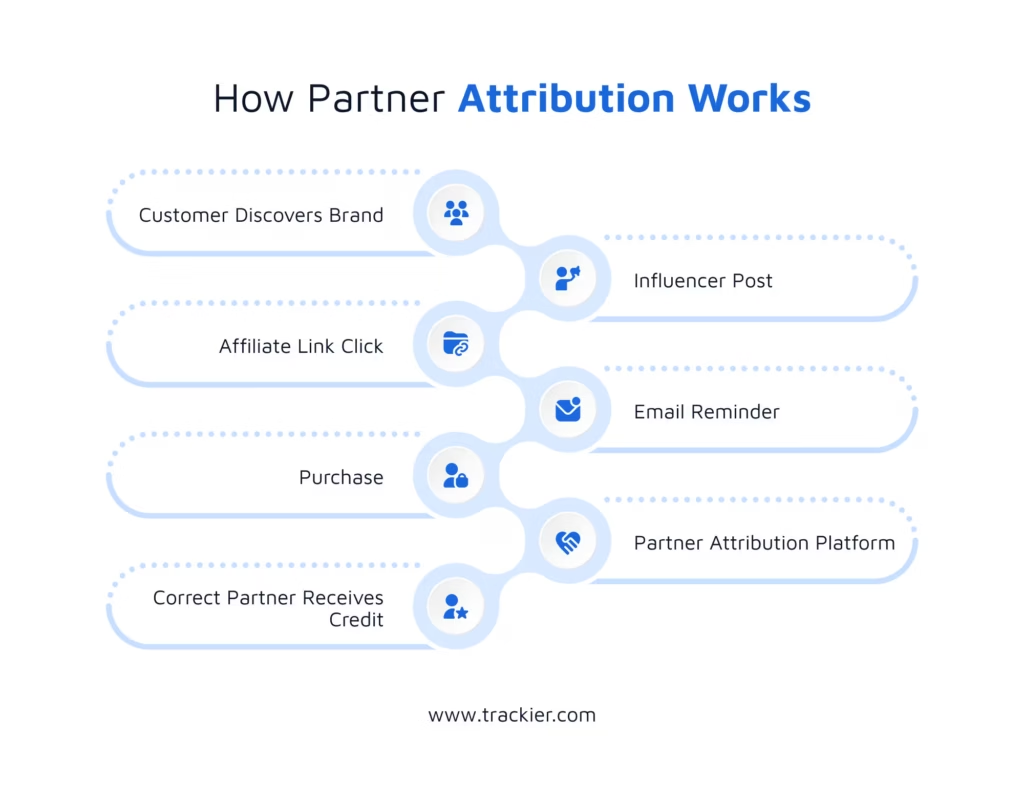
Today, consumer behavior is not linear in nature. A consumer is likely to get awareness of your brand through an influencer, click an affiliate link days later, view a retargeting ad, and finally be converted through an email. Partner attribution is the only thing that can tell us which partner should take credit for the conversion. What does this lead to? Loss of marketing dollars, inability to reward real partners effectively.
Essentially, the purpose of partner attribution is to enable marketers to understand where conversions are coming from and consequently understand which partners are impacting their bottom line.
In this article, you will learn more about the meaning of partner attribution, why it is important, and what are the common attribution model that drives smarter business growth.
What is Partner Attribution?
Partner attribution is a method of checking and giving credit to the partner in affiliate marketing, which drives desired actions like carrying out the desired purchase, installation of applications, subscription, or obtaining a lead.
There are different kinds of partners that can be involved in this process:
- Affiliate marketers
- Influencers
- Media buyers
- Referral partners
- Strategic partners
- Coupon and cashback websites
- Content publishers
The purpose of partner attribution is to identify the one who has influenced the customer.
Why Partner Attribution Matters in Affiliate Marketing?
Partner attribution goes beyond just assigning commissions and allows marketers to understand how much a partner has contributed to a customer’s journey. This helps marketers better optimize their campaigns and create more fruitful partnerships.
1. Make Better Budget Decisions
In affiliate marketing, not every partner generates the same value. Attribution helps to identify the partners who are driving high-quality traffic, conversions, and revenue, allowing you to invest more in what works and reduce spending on underperforming channels.
2. Reward Partners Fairly
Proper attribution guarantees that partners are rewarded according to the actual contribution they made to a conversion. By establishing a transparent and fair commission model, trust will increase, and partner satisfaction will be secured, resulting in long-lasting relationships among partners.
3. Optimize Campaign Performance
By using attribution analytics, you can understand how different partners in your network are generating success. It answers important questions such as:
- Which affiliates are responsible for bringing in the best customers?
- Which influencers are responsible for driving the most profitable users?
- Which channels perform best in terms of conversion?
With this information, it becomes simpler to optimize your campaigns, as well as strategize for more effective campaigns and better ROI.
4. Build Stronger Partner Relationships
Behind the successful partnerships, transparency plays a very important role. When partners have a clear view of attribution and performance data, it reduces the chance of disputes and increases confidence, which leads to long-lasting relationships.
What are the Different Types of Partner Attribution Models?
One thing is clear: Partner attribution is not that simple. The right attribution model depends on your goals and the role each partner plays in the customer journey.
In some businesses, attribution is done on the basis of who brought the customer to your brand, but in others, the emphasis might be on the last touch before the purchase. If your customers deal with multiple partners before making a purchase, you might want to consider a multi-attribution model.
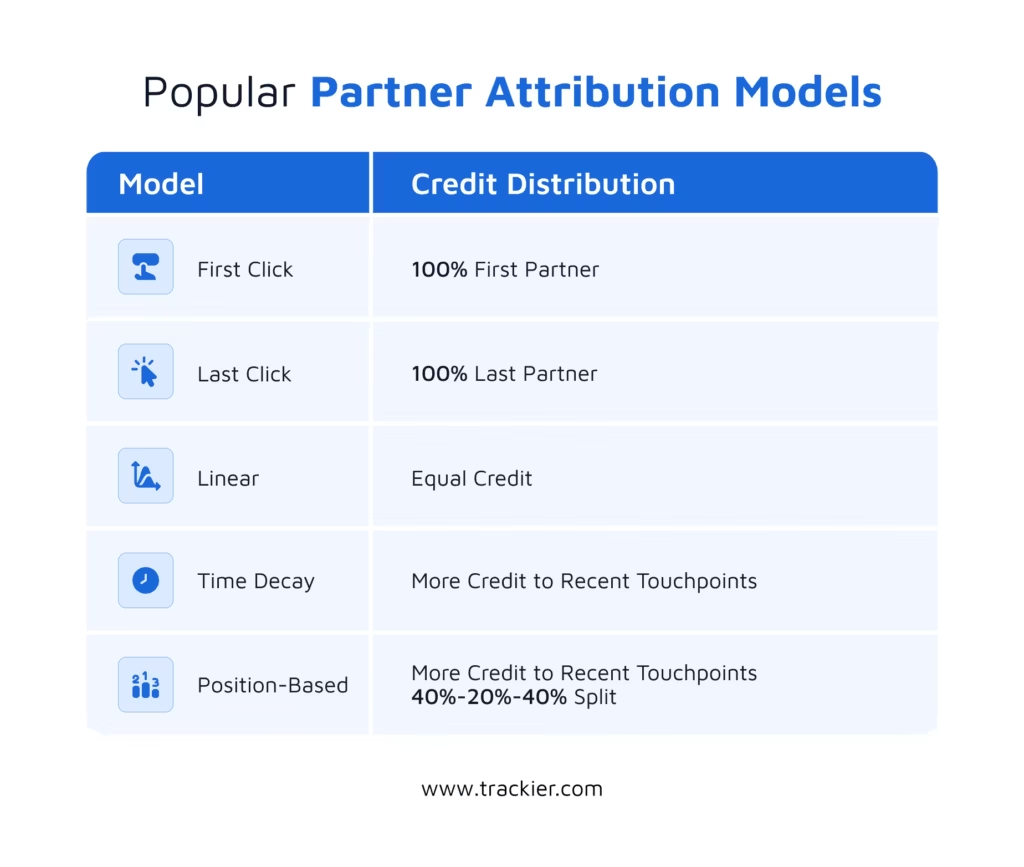
Here are the most commonly used partner attribution models.
1. First-Click Attribution Model
In the first-click attribution model, the first marketing partner who introduces a customer to your brand receives 100% of the conversion credit, regardless of how many interactions occur afterward.
Best for:
- Brand awareness campaigns
- Customer acquisition initiatives
- Businesses focused on expanding their reach
Advantages:
- Rewards partners who generate initial interest.
- Highlights channels that bring new users into the funnel.
Limitation:
- Ignore the contribution of partners who nurture and convert the customer later in the journey.
2. Last-Click Attribution Model
With last-click attribution, the final partner a customer interacts with before completing the desired action receives all the conversion credit.
Because of its simplicity, this remains one of the most widely used attribution models in affiliate and performance marketing.
Best for:
- Short buying cycles
- Direct-response campaigns
- Businesses focused on immediate conversions
Advantages:
- Easy to understand and implement.
- Clearly identifies the final touchpoint that led to conversion.
Limitation:
- Overlooks earlier interactions that may have influenced the customer’s decision.
3. Linear Attribution Model
Linear attribution distributes conversion credit equally across every partner involved in the customer journey.
For example, if a customer interacts with four partners before making a purchase, each partner receives 25% of the credit.
This model recognizes that every touchpoint contributes to moving the customer closer to conversion.
Best for:
- Multi-channel marketing campaigns
- Long customer journeys
- Businesses with multiple partner touchpoints
Advantages:
- Provides balanced recognition for every contributing partner.
- Encourages collaboration across partner channels.
4. Time- Based Attribution Model
Time decay attribution gives progressively more credit to partners who interact with the customer closer to the conversion event.
The assumption is that recent touchpoints often have a stronger influence on the customer’s final decision while still acknowledging earlier interactions.
Best for:
- Longer sales cycles
- B2B partnerships
- High-value purchases involving multiple interactions
Advantages:
- Recognizes the entire customer journey while emphasizing the most influential recent touchpoints.
- Provides a more balanced view than last-click attribution.
Limitation:
- Early-stage partners may receive less credit, even if they played a crucial role in generating initial interest.
5. Position-Based Attribution (U-Shaped Attribution)
Position-based attribution, also known as the U-shaped model, assigns greater importance to the first and last interactions while sharing the remaining credit among the middle touchpoints.
A common distribution is:
- 40% credit to the first interaction
- 40% credit to the final interaction
- 20% shared across the remaining touchpoints
This model acknowledges both the partner who introduced the customer and the partner who ultimately drove the conversion.
Best for:
- Affiliate and partner programs
- Businesses with longer buying journeys
- Campaigns involving multiple partner interactions
Advantages:
- Balances customer acquisition and conversion efforts.
- Rewards both discovery and closing partners.
How Trackier Simplifies Partner Attribution
Managing partner attribution manually becomes more challenging as marketing programs grow.
A dedicated partner marketing platform like Trackier helps businesses to automate attribution, reduce tracking errors, and gain complete visibility into partner performance.
With Trackier, businesses can:
- Track conversions across multiple partner channels
- Support various attribution models based on business needs
- Monitor campaigns through real-time reporting dashboards
- Detect fraudulent activities with built-in fraud prevention tools
- Measure partner performance using actionable analytics
- Automate commission tracking and partner payouts
- Integrate with marketing tools for a unified tracking experience
Whether you’re managing affiliate programs, influencer campaigns, referral partnerships, or media buying channels, Trackier helps ensure every conversion is attributed accurately.
Conclusion
Customer journeys have become more complex, requiring more advanced tracking methods. Partner attribution gives you the visibility you need to see which partners are actually contributing to your success. This way, marketers can make sure they are giving credit to the right partners and reducing wasteful ad spending.
The point is not to collect as much data as possible but rather to obtain relevant and useful data. By implementing the appropriate attribution model and tracking all important touchpoints along the way, companies are able to develop successful partnerships.
The era of competition in which companies work has changed not only their relationship but a reporting system.
