Brand vs performance marketing comes down to objective, time horizon, and measurement. Performance marketing drives measurable actions such as leads, sales, or sign-ups and is optimized using CPA, CAC, conversion rate, and ROAS. Brand marketing builds awareness, memory, preference, and trust over a longer period, and is tracked through brand awareness, consideration, branded search, share of voice, and brand lift.
The key difference is therefore not simply the channel being used, but the objective, time horizon and measurement approach.
Where do they fit in for the industries they serve? Well, most businesses need both: brand marketing helps create future demand, while performance marketing helps capture and convert existing demand. The right balance depends on the brand’s maturity, category, growth goals, buying cycle, and economics.
Binet and Field’s widely cited research identified approximately 60:40 as an average starting point in favor of brand building, although later work stresses that the appropriate mix varies by category, business maturity, price, objectives, and market conditions.
What is Performance Marketing?
Performance marketing is a results-oriented approach in which campaigns are planned, measured, and optimized around predefined business outcomes such as clicks, leads, app installs, purchases, or revenue.
The associated affiliate marketing payment models can include CPC, CPL, CPA, CPM, or revenue-sharing arrangements. What truly defines performance marketing (and separates it from brand marketing) is its emphasis on measurable outcomes and continuous optimization.
PPC (pay-per-click) is a common performance marketing channel because advertisers can connect keyword or audience intent with measurable outcomes such as clicks, leads, and purchases. Some of the ways in which it manifests are:
- Paid social feed ads
- Sponsored content
- Video ads
- Lead-generation ads
- Retargeting campaigns
- Creator partnership ads
However, performance marketing is in no way limited to PPC-style marketing. Affiliate marketing, influencer marketing, and various other channels or formats can be leveraged to achieve performance-driven outcomes.
Strengths and Limitations of Performance Marketing
Strengths:
- Clear accountability: spend connects to leads, sales, or revenue.
- Fast feedback, so campaigns can be tested and adjusted quickly.
- Easy to start small and scale what works.
Limitations:
- It mostly captures demand that already exists rather than creating new demand.
- Costs can climb as more advertisers compete for the same high-intent audiences.
- Attribution has blind spots, so short-term numbers can understate or overstate what is really working.
- A focus on short-term metrics can leave little room for brand building.
What is Brand Marketing?
Brand marketing, also called brand advertising, is the process of building a recognisable and trusted brand over time rather than focusing only on immediate conversions. The goal is to increase familiarity and strengthen factors such as:
- brand awareness,
- recall,
- consideration, and
- preference.
Instead of asking someone to buy immediately, brand marketing can create familiarity and positive associations that influence future purchase decisions.
Common brand marketing activities include advertising campaigns, video content, sponsorships, public relations, social media storytelling, and other initiatives designed to build a lasting connection with an audience. Success can be assessed through measures such as aided and unaided awareness, brand recall, consideration, share of voice, branded search activity and brand lift.
This does not mean brand marketing cannot contribute to revenue. Stronger brand awareness can influence how customers discover, evaluate and choose a business, while sustained brand investment can support demand beyond the period of an individual campaign.
For this reason, brand marketing vs performance marketing is not necessarily an either-or decision. Brand marketing tends to focus on creating and strengthening future demand, while performance marketing is generally designed to capture measurable actions and outcomes. Businesses can use both approaches to address different stages of the customer journey.
Strengths and Limitations of Brand Marketing
Strengths
- Builds recognition, trust, and preference that can support future demand.
- Can strengthen differentiation and pricing power over time.
- Effects can compound beyond the life of a single campaign.
Limitations
- Results take longer to appear and are harder to attribute to a single activity.
- Requires patience and sustained investment.
- It can be difficult to know which creative, channel, or message did the heavy lifting.
Branding vs Brand Marketing: What’s the Difference?
Branding is the identity itself: the name, logo, visual style, tone of voice, positioning, and promise. Brand marketing is the activity that puts that identity in front of people and builds familiarity with it, through advertising, content, sponsorships, PR, and partnerships.
In the branding vs performance marketing debate, branding is the foundation. Performance marketing then works best when the audience already recognises and trusts what it is being asked to click or buy.
Brand advertising is the paid part of brand marketing: video, social, display, audio, out-of-home, and sponsorships designed to build awareness and preference rather than drive an immediate transaction. It is usually judged on reach, recall, and brand lift, not last-click conversions.
Performance Marketing vs Brand Marketing: The Key Differences
The difference between brand and performance marketing is what each is trying to achieve and how success is measured. Performance marketing aims for measurable actions and is judged on conversions, cost, and revenue.
Brand marketing aims to build awareness, memory, and preference and is judged on awareness, consideration, branded search, and brand lift. The table below compares them across twelve factors.
| Factor | Performance marketing | Brand marketing |
| Primary objective | Generate measurable actions and revenue outcomes | Build awareness, memory, preference, and brand equity |
| Demand role | Primarily captures and converts existing demand | Primarily creates and strengthens future demand |
| Typical time horizon | Shorter feedback and optimization cycles | Longer-term effects that compound over time |
| Primary KPIs | CPA, CAC, conversion rate, revenue, ROAS, ROI | Awareness, consideration, recall, branded search, share of voice, brand lift |
| Measurement | Attribution, conversion tracking, experiments, incrementality | Brand tracking, surveys, search trends, MMM, incrementality |
| Optimization | Frequent campaign-level optimization | Longer measurement windows and strategic optimization |
| Audience | Often weighted toward higher-intent audiences | Often broader category or future buyers |
| Creative role | Encourage a specific measurable action | Build distinctive memory structures and associations |
| Channels | Search, paid social, affiliates, creators, display, email, and others | Video, social, creators, content, sponsorships, OOH and others |
| Biggest strength | Accountability and rapid feedback | Sustained demand, differentiation and future preference |
| Main limitation | Can overvalue short-term attributable demand | Impact is harder to attribute directly in short windows |
| Best approach | Use alongside brand building | Use alongside performance activation |
PR vs Performance Marketing
PR vs performance marketing comes down to how attention is earned and how it is measured. PR earns credibility through press coverage, mentions, and third-party validation. It is judged on reach, sentiment, share of voice, and the branded search it generates. Performance marketing pays for, or partners on, specific actions and is judged on leads, conversions, CPA, and ROAS.
The two support each other. PR builds the trust that can make performance campaigns convert better, and performance data shows which messages and audiences are worth amplifying through PR. PR belongs on the brand marketing side of the table, but it is rarely measured with last-click attribution.
Brand Marketing vs Performance Marketing Examples
These examples are illustrative. They show how the same business can use each approach for a different goal.
Brand marketing examples
- Sponsorship: A sportswear brand sponsors a city marathon and publishes runner stories around it. Success is measured by awareness, branded search, and share of voice, not same-week sales.
- Educational content: A fintech app publishes explainers and founder-led thought leadership so that it is the name people recall when they enter the category.
- Video: A consumer brand runs a reach-focused video campaign and measures recall and brand lift in a survey.
Performance marketing examples
- Paid search: An online retailer bids on high-intent product keywords and tracks conversion rate, CPA, and ROAS.
- Affiliate and partner programs: A fintech or e-commerce brand pays partners per verified sign-up or sale (CPA or revenue share) and tracks every conversion back to the partner.
- Retargeting: A SaaS company retargets pricing-page visitors with a demo offer and measures cost per lead.
Trackier example: GrabOn
GrabOn, an Indian platform for verified discounts, shows why attribution matters when both approaches are in play. Its customers touched several channels before converting, which made it hard to credit the right activity.
After moving to Trackier, GrabOn reported 738.26% growth in conversions between Q1 and Q2 and a 70% increase in revenue, with multi-touch attribution improving credit allocation.
When several touchpoints contribute to a sale, last-click reporting can under-credit the upper-funnel and brand activity that started the journey. Read the GrabOn case study.
When Should You Prioritize Performance Marketing vs Brand Marketing?
| Business Situation | Increase Brand Emphasis | Increase Performance Emphasis |
| Low awareness in category | ✓ | |
| Launching into a new category | ✓ | |
| Long sales cycle | ✓ | |
| Need future demand | ✓ | |
| Strong awareness but weak conversion | ✓ | |
| Proven offer ready to scale | ✓ | |
| Short-term revenue target | ✓ | |
| High-intent demand already exists | ✓ | |
| CAC rising despite campaign optimization | ✓ | ✓ |
| Mature business seeking sustainable growth | ✓ | ✓ |
In practice, the allocation should change over time based on market maturity, audience awareness, available demand, margins, growth targets, and measured incremental returns.
How to Measure Performance Marketing vs Brand Marketing?
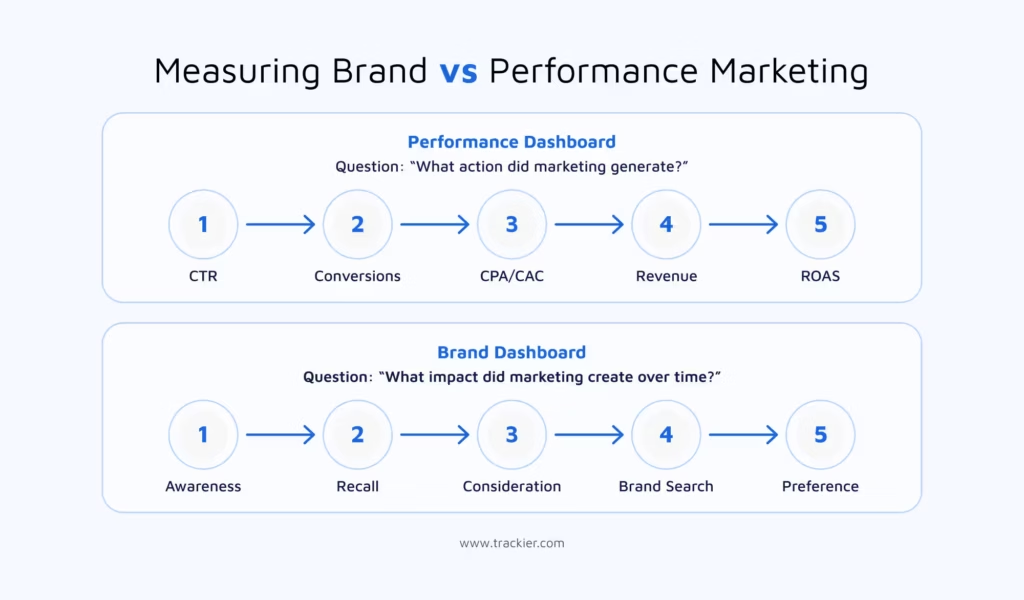
One of the biggest gaps in performance marketing vs brand marketing is measurement. Brand metrics such as recall, customer sentiment, market reach, and share can be useful, but on their own they are too broad to show how marketing contributes to business growth. A stronger framework measures both brand and performance outcomes and connects them.
Performance Marketing Metrics
Performance marketing can be measured through metrics that directly reflect efficiency, acquisition and revenue, including:
- Conversion rate
- Cost per acquisition (CPA)
- Cost per lead (CPL)
- Customer acquisition cost (CAC)
- Revenue
- Return on ad spend (ROAS)
- ROI
- LTV:CAC
- Incremental conversions
Brand Marketing Metrics
Brand marketing needs a broader set of indicators that capture changes in how customers perceive and interact with a brand over time:
- Aided and unaided awareness
- Brand recall
- Consideration
- Brand preference
- Share of voice
- Share of search
- Branded search volume
- Direct traffic
- Brand lift
- Pricing power
- Incremental sales over longer periods
Brand Performance Marketing (Performance Branding)
Brand performance marketing, also called performance branding and sometimes “brandformance”, applies measurement discipline to brand-building activity, and brand thinking to performance activity. It does not remove the distinction between the two. It connects them through shared commercial goals and shared metrics.
That means:
- Consistent creative: performance ads carry the same voice, visuals, and promise as brand campaigns.
- Dual KPIs: report brand metrics (awareness, branded search) alongside performance metrics (CPA, ROAS) for the same period.
- Lift testing: run brand lift or conversion lift tests on channels that are usually judged only on clicks.
- Shared planning: brand and performance teams review the same dashboard and agree on one growth target.
How Do Brand and Performance Marketing Work Together?
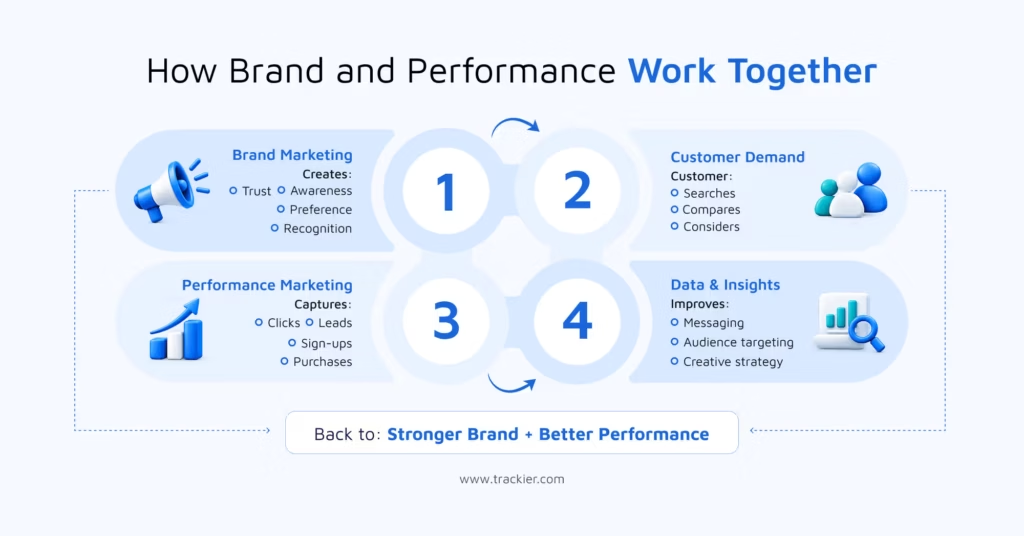
Brand marketing and performance marketing influence different stages of the same growth system. Brand activity increases awareness, familiarity and consideration among current and future buyers.
When those buyers eventually enter the market, performance campaigns can capture that demand through search, social advertising, affiliates, retargeting or other measurable channels.
Performance data then feeds back into brand strategy by showing which audiences, messages and offers produce meaningful actions. The result is a cycle rather than a funnel split:
- brand creates and strengthens demand,
- performance captures and converts it, and,
- measurement improves both.
How Much Budget Should Go to Performance Marketing vs Brand Marketing?
There is no fixed percentage that every business should allocate to performance marketing vs brand marketing. The right balance depends on factors such as business stage, category, existing brand awareness, sales cycle and growth objectives.
A practical way to approach the split is:
- Prioritise brand investment: when the business needs to build awareness, reach new audiences or create future demand.
- Adjust for your situation: A newer business with limited awareness may need a different balance from an established brand with strong existing demand.
- Increase performance investment: when there is established demand and the priority is generating measurable leads, sales or revenue.
- Measure both time horizons: Evaluate performance campaigns through metrics such as CPA, conversions and revenue while tracking brand investment through awareness, consideration, recall and brand lift. This helps prevent short-term performance from dominating the entire budget decision.
- Use both when possible: Brand activity can create demand while performance campaigns help capture it.
The IPA’s effectiveness research has found that a roughly 60:40 balance between brand building and activation can be effective across its dataset (as discussed in the opening section of this article). However, this should be treated as a benchmark rather than a universal formula.
Conclusion
Performance marketing and brand marketing solve different growth problems. Performance activity makes demand measurable and actionable through metrics such as conversions, CAC and ROAS, while brand marketing builds the awareness, memory and preference that influence future demand.
The strongest marketing strategies connect the two rather than optimize them separately. Marketers must think beyond performance marketing vs brand marketing in 2027. Measure immediate outcomes without allowing short-term attribution to become the only definition of marketing effectiveness, and evaluate brand investment over an appropriate time horizon. The right allocation should change as the business, market and customer journey change.
FAQs
What is the difference between PR and performance marketing?
PR earns attention and credibility through coverage and third-party mentions, and is judged on reach, sentiment and share of voice. Performance marketing pays for or partners on specific actions and is judged on conversions, CPA and ROAS. PR supports brand building, while performance marketing drives measurable results.
Can the same marketing channel be used for brand and performance?
Yes. Channels such as social media, search, video, and display advertising can support both objectives. The difference lies in campaign strategy, creative, targeting, calls to action, and measurement. One channel can therefore contribute to both brand building and conversions.
Is branding the same as brand marketing?
No. Branding is the identity: name, visual style, tone, and positioning. Brand marketing is the activity that promotes that identity through advertising, content, sponsorships, and PR.
What is brand performance marketing?
Brand performance marketing, also called performance branding, combines brand-building and performance goals in one measured approach. It uses consistent brand creative in performance channels and tracks brand metrics alongside CPA and ROAS.
What is brand advertising?
Brand advertising is the paid side of brand marketing, using video, social, display, audio, out-of-home, and sponsorships to build awareness and preference rather than drive immediate sales.