A B2B partnership is a commercial relationship between two businesses that work together toward shared goals such as acquiring customers, entering new markets, expanding distribution, increasing product value or generating revenue. Depending on the model, partners may refer leads, resell products, co-market, integrate technologies, distribute services or jointly sell to customers.
A well-crafted B2B partnership defines four things from the start:
- the shared objective,
- each partner’s role,
- the commercial model, and,
- how performance will be measured.
This guide explains the main B2B partnership models, how to choose partners, structure the relationship, activate the partnership, and measure whether it creates incremental value.
What is a B2B Partnership?
When two or more businesses come together in a quest to achieve a shared, common goal or vision that benefits one or both the parties, it is said to be a B2B partnership. To understand this better, you can breakdown the concept on the basis of the terms involved:
- B2B here implies that the joint venture exists between two business, as opposed to any other kind of entity.
- A ‘partnership’ by its very definition is a relationship which involves partnering. Such terminology indicates that there is a ‘partnering’ at play here — associating, affiliating, consorting, collaborating, cooperating, joining, uniting, getting together, combining, merging, working together, linking up or joining of forces.
As such, the term B2B partnership can be treated as an umbrella concept for the act of teaming up between two commercial entities for the purpose of gaining a common end through aligned means such as co-marketing, co-branding and other such options.
Is a B2B Partnership the Same as Partner Marketing?
When examining the clear differences between what a B2B partnership is vs partner marketing, think of the former as a broader concept.
A B2B partnership can be described as a structured relationship between businesses created to achieve a shared commercial or strategic objective. Partner marketing is one possible activity within that relationship, focused specifically on jointly reaching, influencing, or acquiring customers.
Affiliate programs, referrals and co-marketing are therefore forms of partner marketing, while reseller, distribution, integration and strategic-alliance relationships may involve marketing as only one part of the partnership.
How are Partnership Marketing, Referral Marketing, and Affiliate Marketing Different from Each Other?
While the terms may appear to overlap, and semantically align to a large extend, they are all separate ways of conducting marketing as a B2B business. They do have one commonality: these marketing tactics involve third-party promoters or entities, outside of the existing organization who are involved in driving clear outcomes in terms of both, business goals and marketing results.
Let’s understand what the purpose of each of these channels is, how it is carried out and what the payout framework looks like.
| Model | Primary purpose | Partner typically does | Compensation |
| Strategic B2B partnership | Achieve a shared long-term objective | Co-build, integrate, co-sell or enter markets together | Negotiated |
| Partner marketing | Jointly acquire or influence customers | Co-promotes to shared/complementary audiences | Shared cost, CPA or revenue share |
| Affiliate partnership | Generate measurable actions | Drives traffic, leads or sales | Commission per conversion |
| Referral partnership | Introduce qualified prospects | Makes introductions or recommendations | Fixed bounty or revenue share |
| Reseller or channel partnership | Expand sales/distribution | Sells the vendor’s product to its customers | Discount or reseller margin |
What are the Different Types of B2B Partnerships?
There are a variety of commercial relationships which a brand might seek out to achieve its specific goals. What’s more? The partnership style which would best suit one organization or goal may also vary by industry type and solution involved.
Let’s understand how each type of B2B partnership type can be represented for easy understanding.
| Recommended Partnership Type | What it Solves | Best Suited For |
| Referral partnerships | Qualified introductions | SaaS, services, B2B |
| Affiliate partnerships | Performance-based acquisition | SaaS, B2B ecommerce, fintech |
| Reseller / VAR partnerships | Extending sales capacity | SaaS, enterprise technology |
| Distribution partnerships | Geographic or category expansion | Products, platforms |
| Technology / integration partnerships | Creating combined customer value | SaaS, fintech, martech |
| Co-marketing partnerships | Shared audience acquisition | Complementary B2B brands |
| Agency / service partnerships | Extending implementation or expertise | SaaS and professional services |
| Strategic alliances | Long-term market or product objectives | Larger or ecosystem-led companies |
Does Every B2B Business Need a Partnership Marketing Strategy?
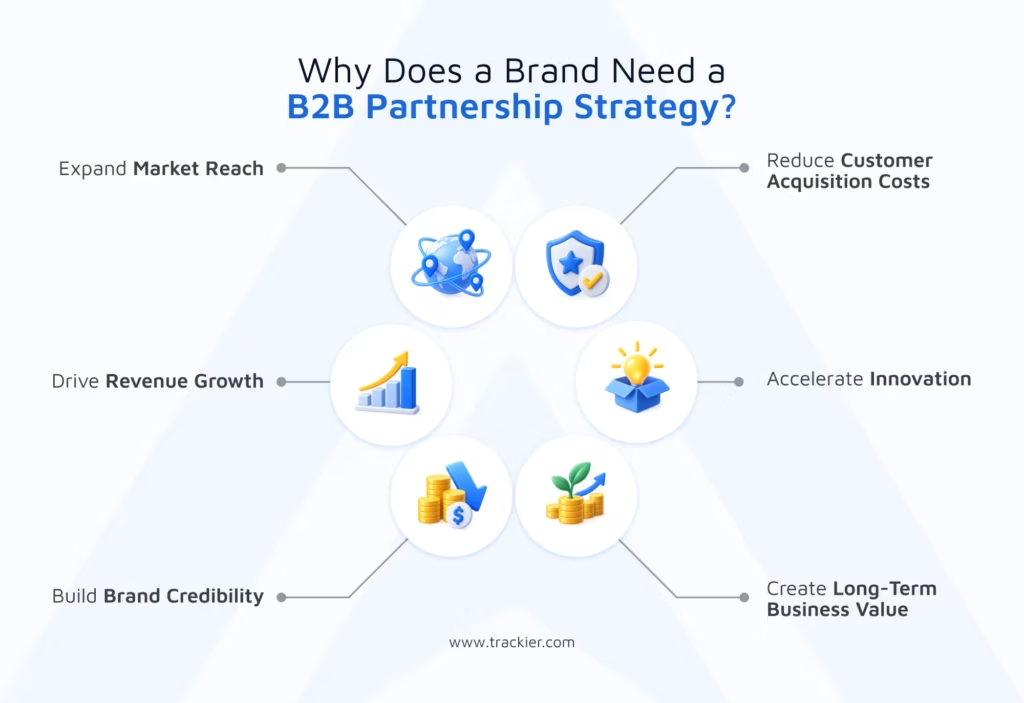
A partnership marketing strategy can be valuable for many B2B businesses, but it should support the company’s growth stage, audience and goals rather than be adopted simply because it is popular. However, it simply cannot be ignored that building partnerships does offer unique benefits at any given stage for a business.
Here’s how to know if setting up a B2B partnership is actually going to serve your interests, rather than acting as a checklist item for your marketing team.
- Partnerships work best when audiences overlap. If another business already reaches your ideal customers and offers a complementary solution, a partnership can help you access that audience more efficiently.
- Consider your growth goals. Partnerships can support lead generation, customer acquisition, market expansion, product adoption and brand credibility. If these are priorities, partner marketing may be worth exploring.
- The business model matters. SaaS companies, agencies, marketplaces, fintech platforms, and other ecosystem-driven businesses can often benefit significantly from referral, affiliate, integration or co-selling partnerships.
- Don’t build partnerships without a clear payoff. Managing partners requires resources, communication, incentives and measurement. If the expected customer or revenue impact is too low, those resources may be better invested elsewhere.
Further on, we explore 4 instances where a B2B partnership payed off for the brands who participated. Each instance perfectly demonstrates the need for creating such opportunities, as well as the underlying of basis of ensuring successful partner-led activities.
B2B Partnership Activation Tactics
A partnership can be built to execute a variety of activation formats across time, based on which identified goals each of the partners wishes to achieve through the joining of forces. The most popular ways in which such a strategy is executed are listed as follows.
1. Webinars
The sharing of information on a commonly valuable topic is one of the most effective ways to set up a B2B partnership. The stakes are low, and the avenues for dispensing values are endless. You don’t need to stick to 2 partners. Instead, you could have multiple partners getting involved to add even more value through the means of easy-to-take-back insights and information.
Within the partnership framework, two or more partners can come together and hold up a webinar either offline or digitally. They can not only market it together to their audiences and new target groups, but also participate in collective lead generation.
After the event closes, they can further harness the collaborative information to run advertisements and create more marketing collaterals, which further continue the same process and assist in achieving the laid down goals.
2. Sponsorships
Two or more partners can also come together under the umbrella of a sponsorship to leverage their B2B partnership. How does this work? A sports event or a game show or a conference can have multiple sponsors. In fact, an MMP and a desktop-based tracking solution like Trackier could come together and sponsor an affiliate marketing seminar.
The ways in which the joint finances could be used to fuel a creatively-led collaboration are truly endless.
3. Influencers
Got an e-book coming out, built on combined knowledge, shared across partners? Now you could use an influencer in the broader industry to let the audiences know about it.
Within B2B marketing, influencers carry a lot of value in terms of the potential revenue they can influence. In such a scenario, it becomes essential to leverage their audience to fulfil the revenue-aligned goals of the given B2B partnership.
Here, it is crucial to note that, the influencer should not be someone who matches the industry of one of the given partners. Instead, they should either be a neutral third-person, or someone who fits the description of the broader umbrella industry or area of expertise. This gives both the organizations enough advantage, and ensures the partnership or joint venture isn’t leaning towards one or the other.
4. Content Partnerships
Move aside BTL partnerships, there’s a more distribution-friendly format in town.
The simple philosophy behind building your B2B partnership on content is that it can be disseminated easily just about anywhere. You can send physical copies of your e-book or research report, or you could share digital versions. The same can be used for multi-channel campaigns including PR activations, and also play the role of lead-generation, gated material on the websites and social media of all the partners involved.
Having noted the various manners in which a partnership can be activated, let’s understand how to build such a joint venture together, from scratch.
How to Build a Value-creating B2B Partnership?
Partnerships can come together for a variety or reasons and to serve a changing set of end goals. But what’s the basis of actually coming up with a B2B partnership which can add value to your business (beyond the generation of vanity metrics and eyeballs).
Let’s understand what kind of discernment and process must be implemented to design and set up such effective collaborations in the business-to-business space.
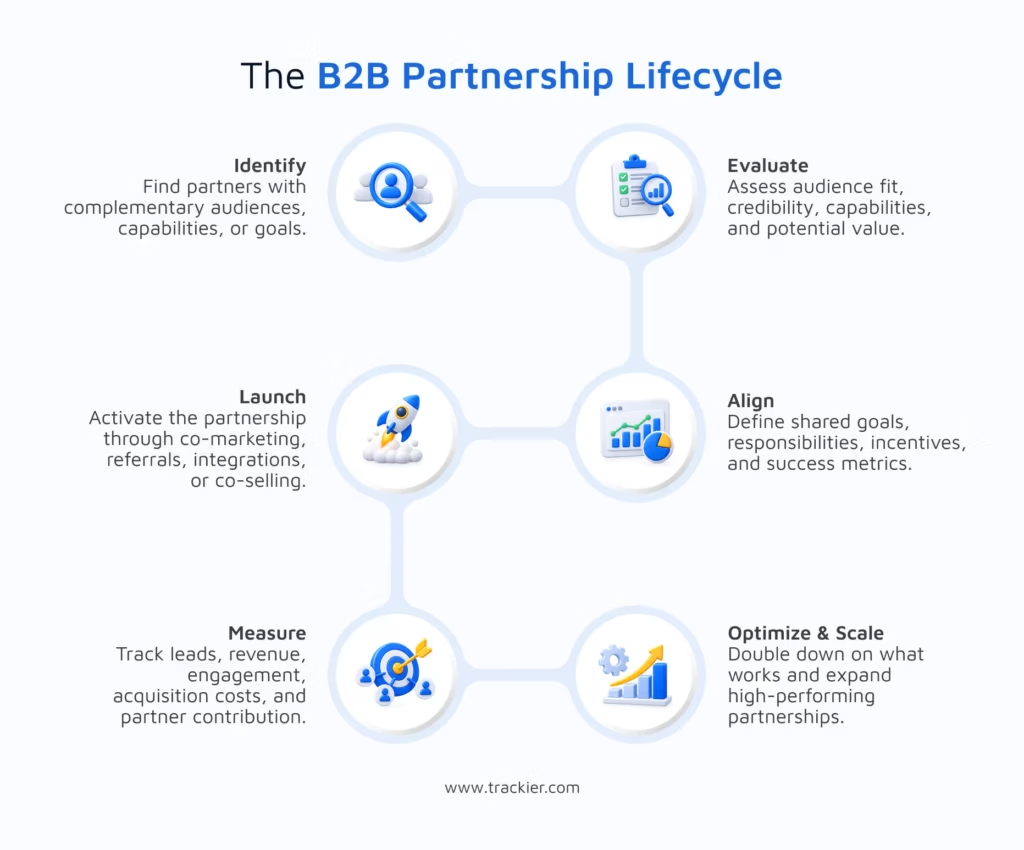
Define the objective
Decide whether the partnership exists to generate pipeline, expand distribution, enter a market, improve the product or increase retention.
Create an ideal partner profile
Define target audience overlap, complementary capabilities, geography, reputation, technical fit and commercial potential.
Evaluate mutual value
Document what each business receives and contributes. A partnership with one-sided economics rarely remains active.
Choose the commercial model
Decide between referral fees, CPA, revenue share, reseller margin, shared campaign costs or negotiated terms.
Agree on attribution
Define which events count, attribution windows, ownership rules, duplicates and how partner-sourced versus influenced revenue will be treated.
Formalize responsibilities
Establish owners, timelines, assets, data usage, SLAs, payment terms and exit conditions.
Launch and enable
Train partners, provide campaign assets and make tracking and reporting accessible.
Review performance
Measure revenue, activation, conversion, incrementality and partner engagement regularly.
How Do You Choose the Right B2B Partner?
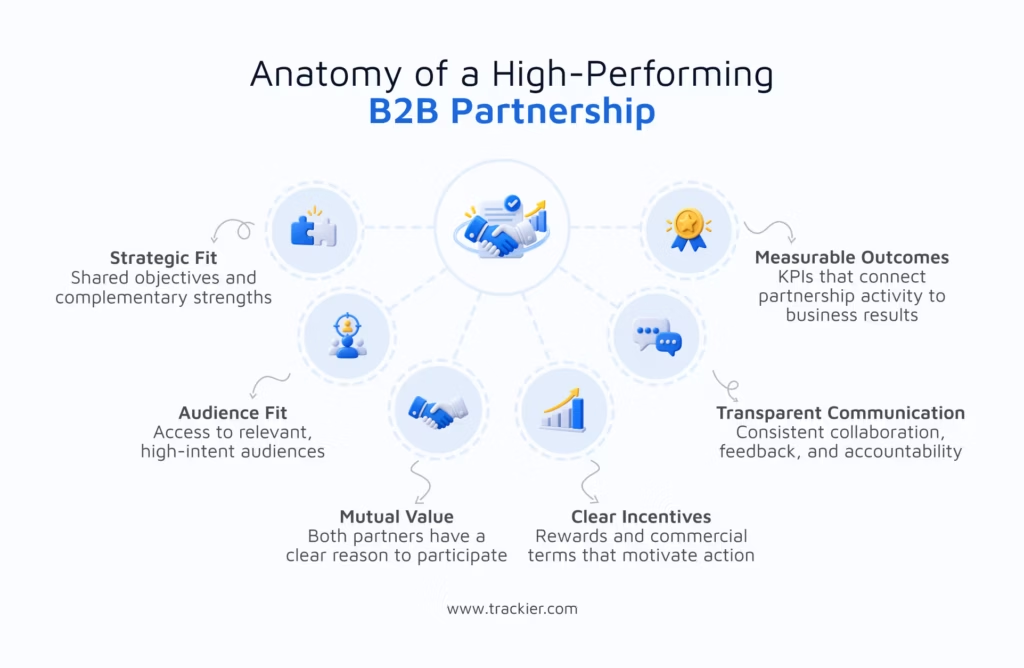
The best B2B partner usually serves a similar customer without directly competing with your core offer, has a credible reputation, brings a capability or audience you lack, and has a clear economic reason to invest in the partnership.
| B2B partnership evaluation factor | What question should you be asking? |
| Customer overlap | Do we serve relevant buying audiences? |
| Complementarity | Does the partner add something we do not? |
| Commercial potential | Is the opportunity large enough for both sides? |
| Reputation | Would association strengthen or weaken trust? |
| Operational readiness | Can both companies actually support the partnership? |
| Data and tracking compatibility | Can outcomes be measured reliably? |
| Strategic alignment | Do both businesses want the same outcome? |
How Do You Measure B2B Partnership Success?
Just running another type of campaign without typing down the results directly to the efforts involved is wastage. That’s why, there need to be clear measurement terms which are aligned at the initiation of any B2B partnership marketing situation.
What’s more? These cannot just be a singular decision. What needs to be measured after the partnership campaign needs to be aligned across all the partners, to ensure no matter who runs a given collateral, the outcomes being evaluated remain the same across the entire length and breadth of collaboration.
So, begin by asking what is the complete list of outcomes which can be measured within a B2B partnership.
- Partner-sourced revenue: Revenue originating directly from partner activity
- Partner-influenced revenue: Revenue where a partner materially participated but was not necessarily the original source
- Qualified partner-led pipeline: Value of partner-generated qualified opportunities
- Conversion rate: Quality of partner-generated traffic or leads
- CPA or CAC by partner: Tells you about cost efficiency
- Customer lifetime value: Displays the long-term quality of partner-acquired customers
- Incremental revenue: Revenue that would not otherwise have occurred
- Active partner rate: Percentage of recruited partners producing meaningful activity
- Time to first conversion: How quickly a new partner becomes productive
- Partner retention: Determines the sustainability of the B2B partnership ecosystem
Partner-sourced vs Partner-influenced Revenue: How Do They Differ?
When you consider partner-sourced revenue, the creation of opportunities happens through a partner. The impact is direct and you can clearly attribute “who” drove the revenue. For example, a reseller may identify a prospect, generate the lead, and help move it into the sales pipeline. The revenue can therefore be clearly attributed to that partner.
Partner-influenced revenue is broader. There is some vagueness when we map the entire attribution chain. Here, the company’s sales opportunity may originate through its own channels, but a partner contributes meaningfully to winning, accelerating or expanding the deal. This could include referrals, integrations, implementation support or executive introductions. But there is no single individual or activity which can be said to have led to a certain identified revenue impact.
Is There a Relationship Between Incrementality and Partnership Marketing?
Partner-attributed revenue and incremental revenue are not the same thing. Partner-attributed revenue shows which partner received credit for a conversion. Incrementality asks whether that conversion would have happened without the partner’s involvement.
To measure incrementality properly, businesses can compare exposed and control groups, run geographic or audience holdouts, analyze new-to-file customers, and compare conversion behavior against an appropriate baseline.
How to Activate and Grow a B2B Partnership?
According to the 2026 Sherpa Group’s Channel Marketing Leaders Survey, a whopping 97% of those who responded viewed partner-led pipeline creation to be a clear area of priority for the upcoming 1-2 years.
If you’re one of the marketers or leaders who share this opinion, signing a partnership agreement is not the starting point. After having identified who you want to partner with, there needs to be a defined process for outreach to get the collaboration started.
Then come the steps outlined below.
Remember, real value comes from activating the relationship, generating opportunities, measuring results and continuously improving performance. A successful B2B partnership needs clear ownership, strong enablement, reliable attribution and incentives that encourage profitable behavior.
Create a joint business plan
Agree on target markets, ideal customers, priority accounts, revenue goals, responsibilities, and success metrics. For example, a SaaS company and consulting partner could jointly target 25 enterprise accounts, with each side owning specific parts of the sales journey.
Build a 30/60/90-day activation plan
Give the partnership momentum immediately after signing. The first 30 days can focus on onboarding and training, the next 30 on launching campaigns and generating opportunities, and the final 30 on reviewing pipeline and conversions.
Provide sales and marketing enablement
Equip partners with product training, pitch decks, case studies, messaging, campaign materials, FAQs, and competitive insights. The easier it is for partners to understand and position your solution, the faster they can contribute.
Define attribution before launch
Establish how leads, opportunities, and conversions will be credited. Clear attribution rules prevent conflicts when multiple partners or channels influence the same customer.
Create transparent incentives
Align rewards with meaningful outcomes such as qualified leads, new customers, revenue, or retention. Tiered incentives can motivate partners to increase volume while maintaining quality.
Track partner health
Monitor activation, engagement, pipeline, conversion rates, revenue, and customer quality. Declining activity can indicate when a partner needs additional support or a revised strategy.
Protect the program from fraud
Validate clicks, leads, and conversions to minimize duplicate, artificial, or low-quality activity.
Automate reporting and payments
Centralized tracking, reporting, reconciliation, and payouts reduce manual administration and give partners greater visibility.
Run quarterly business reviews
Use QBRs to evaluate performance, identify growth opportunities, adjust incentives, and determine whether underperforming relationships should be improved or discontinued. The strongest partnerships are managed as evolving revenue channels rather than one-time agreements.
Partnership Agreements, Roles and Economics
Both businesses should agree on how the partnership will operate for there to be no disagreements during its execution. Who owns each responsibility and how the commercial value will be distributed needs to be clearly laid down on pen and paper. Building a clear B2B partnership framework prevents misunderstandings and gives both sides a practical way to measure success.
Partnership Agreements
The agreement should establish the scope of the partnership, deliverables, timelines and performance expectations. It should also cover the following aspects for the sake of absolute clarity:
- Revenue-sharing or commission terms
- Payment schedules and eligibility requirements
- Data ownership and privacy responsibilities
- Intellectual property and content usage goes live. One partner may handle lead generation while the other manages sales and onboarding. For
- Lead ownership and customer communication
- Confidentiality and compliance requirements
- Reporting, review periods and termination conditions
Roles and Responsibilities
When creating this document, ensure you define responsibilities before the partnership goes live. One partner may handle lead generation while the other manages sales and onboarding. For co-marketing campaigns, responsibilities could include content creation, promotion, event management and lead follow-up.
Assigning clear owners to each activity reduces delays and makes accountability easier to maintain.
Partnership Economics
The commercial model should give both parties a reason to invest in the relationship. Depending on the partnership type, this could involve referral fees, affiliate commissions, revenue sharing, reseller margins or performance-based incentives.
Use measurable metrics such as qualified leads, conversions, customer acquisition cost, revenue and partner-generated pipeline to evaluate whether the economics make sense.
The goal is simple: both partners should understand what they contribute, what they receive and how success will be measured. A transparent structure creates stronger partnerships and makes it easier to scale the ones delivering consistent business value.
4 B2B Partnership Examples and Why They Worked
Strategy and outcome-clarity can lead to the creation of innovative, creative and valuable B2B partnerships. For this brands must go much beyond cross-promotion. They must bring together complementary strengths to create better products, reach new customers or generate measurable growth. Here’s how 3 well-known SaaS brands pulled off such campaigns.
HubSpot + Technology Partners: Turning an Ecosystem Into a Growth Channel
HubSpot has built a broad technology ecosystem through its “app marketplace” and “partner program” (and is perhaps one of the earliest to do it!). Integrations allow businesses to extend HubSpot’s functionality while technology partners gain access to its customer base.
In its own reporting, the CRM platform has mentioned incredible gains per brand, noting 95% of its customers as having installed at least 1 app. They have also stared that customers tend to download 9 apps on average.
Why it worked: Both sides benefit. Customers get a more connected tech stack, while partners gain distribution and potential revenue opportunities.
This shows that building an ecosystem of complementary partners can turn partnerships into a consistent acquisition channel rather than a one-time campaign.
Salesforce + Slack: Combining Complementary Products Around the Customer Workflow
While not in the exact same industry, both Salesforce and Slack have clients in common. One stores sales data, while the other is a comms tool. So, they brought both together: combining CRM data with workplace communication. Their integration helps sales and service teams access customer information and collaborate without constantly switching between platforms.
How does this help? One case study from this integration shows between 15% and 20% reduction in the sales cycle for a particular client.
Why it worked: The products address different needs but fit naturally into the same workflow, making the combined experience more useful. B2B partnerships are especially effective when two products solve connected problems for the same audience.
Shopify + Stripe: Expanding the Product Through a Strategic Technology Partnership
The third example shows us that integrations are not the limit, but can go much beyond them.
Shopify and Stripe had already partnered on Shopify Payments. They took this collaboration further with Shopify Balance, using Stripe Treasury and Stripe Issuing to give Shopify merchants greater control over financial management within their existing storefront.
Why it worked: Shopify could launch a financial product without needing to build the underlying infrastructure from scratch. It displays that B2B partnerships are not limited to branding or content contributions. Rather, on a deeper level, they can involve technology, distribution, infrastructure and product development.
Google Cloud + Wiz — Turning a Partnership Into a Broader Security Offering
Google Cloud and cybersecurity company Wiz expanded their relationship in 2025 following Google’s acquisition of Wiz. Their collaboration brings Wiz’s cloud-security capabilities together with Google Cloud’s infrastructure and security ecosystem.
Why it worked: This particular partnership connected complementary technologies around a common customer need — securing increasingly complex cloud environments. It also gave customers a more integrated way to address security challenges.
What Do These 4 Examples Show About B2B Partnerships?
Although the partnerships are structured differently, they share three characteristics that B2B marketers can replicate:
- Complementary value: The partners solve adjacent problems rather than competing directly.
- Shared customers or audiences: Each company gets access to a relevant customer base instead of paying to reach a completely cold audience.
- Measurable outcomes: The partnership can ultimately be tied to installs, leads, conversions, revenue (i.e. measurable ROI), retention, productivity, or another business KPI.
They reflect the strategic value of a partnership when it goes beyond traditional co-marketing, and becomes something much more for everyone involved.
FAQs
What are effective B2B co-marketing strategies?
Effective B2B co-marketing strategies include joint webinars, co-created content, industry reports, events, referral campaigns and cross-promotions. Choose activities that align with both partners’ audiences and establish shared goals, responsibilities and metrics before launching the campaign.
What types of B2B partnerships are there?
Common B2B partnerships include referral partnerships, affiliate programs, technology integrations, reseller agreements, strategic alliances, co-selling partnerships and co-marketing collaborations. The right model depends on your objectives, target audience, product offering and the value each partner can contribute.
How do you launch a B2B partner program?
Start by defining your partnership goals and ideal partner profile. Choose the right partnership model, create clear incentives and onboarding processes then establish tracking and communication systems. Finally, recruit relevant partners, provide the necessary resources and continuously evaluate performance.
How do you calculate B2B partner ROI?
Calculate B2B partner ROI by comparing the revenue generated through partnerships against the total cost of running the program. Include partner commissions, incentives, technology and management costs. A simple formula is: (Partner-generated revenue − partnership costs) ÷ partnership costs × 100.
What should a B2B partnership agreement include?
A B2B partnership agreement should define each party’s responsibilities, objectives, revenue-sharing terms, payment schedules, intellectual property rights, data handling requirements and performance expectations. It should also cover dispute resolution, confidentiality, termination conditions and any exclusivity clauses.
What causes B2B partnerships to fail?
B2B partnerships often fail because goals are unclear, responsibilities are poorly defined or partners target different audiences. Weak communication, inadequate incentives, poor performance tracking and unrealistic expectations can also create friction. Regular reviews and transparent reporting help keep partnerships aligned.