Why do some companies expand quickly while others struggle to gain attention, even with a great product? The answer frequently comes down to how growth is approached. Many early-stage startups rely on inconsistent marketing efforts, hoping that something sticks.
This is where growth marketing for startups is important. Instead of chasing visibility alone, growth marketing prioritizes traction, learning, and repeatable outcomes. Each approach, channel and metric has an objective.
Startups now have access to tools that previous founders did not. With performance marketing software, companies can track user activity, calculate ROI, and understand what drives conversions. However, tools alone do not guarantee growth, strategy does.
Read on to understand how startups can use growth marketing to scale without wasting money or effort. You will find out what works, why it works, and how to use it based on the stage you are in.
What Is Growth Marketing for Startups?
Growth marketing for startups is an organized process to drive measurable growth through testing, data, and continuous learning. It focuses on results rather than surface-level reach.
Startup growth marketing is about:
- Driving user acquisition with intent
- Improving activation and onboarding experiences
- Increasing retention and repeat usage
- Converting users to paying customers
- Creating referral loops that promote growth
Growth marketing for startups is special because it is designed for speed and limits. It focuses on rapid testing, feedback, and measurable results across the funnel. Instead of lengthy campaigns or brand-heavy plays, startups prioritize trials with a direct impact on sign-ups, usage, and income. The approach is adaptable and changes as the product and market evolve.
This is important since startups have limited time, money, and manpower. Growth marketing helps to reduce risk by demonstrating what works early on and what does not. It stops teams from wasting resources on low-impact methods and ensures that efforts are focused on genuine business goals.
Growth marketing also reduces silos. Product, marketing, and data work together. Landing pages, onboarding flows, mailings, pricing testing, and retention efforts are all managed as a single system.
Growth marketing for startups often fails when teams chase traffic without a plan. Growth marketing for startups addresses this issue by focusing on metrics like sign-ups, engagement, and revenue.
Why Startups Need Growth Marketing Early
Most startups take too long to consider growth. They focus on developing the product and presume that users will follow. In truth, even strong products struggle without a clear growth strategy.
- Early-stage teams sometimes lack clarity on their target audience, messaging, and the most effective acquisition channels.
- Growth marketing turns assumptions into systematic, testable trials with measurable effects.
- Running tests early helps startups to learn what works before investing heavily in scaling efforts.
- Without a growth strategy, marketing spend frequently goes into channels that create traffic but do not convert.
- Growth marketing links every activity to metrics like sign-ups, activation, retention, and revenue.
- Analyzing user activity early on helps identify onboarding gaps and friction areas in the product experience.
Core Principles of Startup Growth Marketing
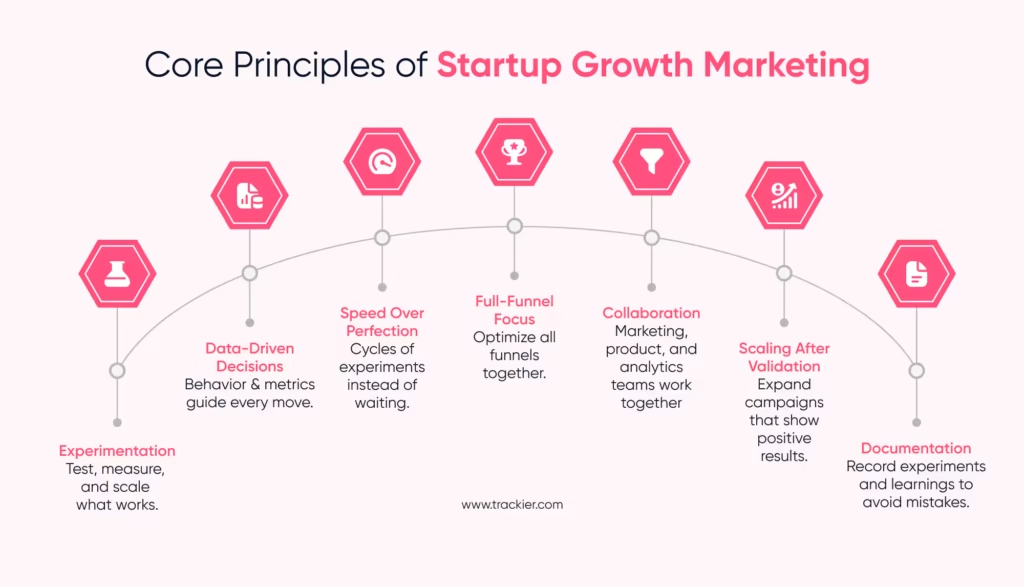
Growth marketing for startups works best when it follows a few clear rules. These principles help teams stay focused, progress faster, and avoid wasting time on limiting methods.
Start Experimenting
Startup growth marketing is based on testing concepts before committing to huge expenses. Instead of assuming what people want, teams do simple tests across channels, messaging, and funnels. Each test is designed to deal with an issue.
Set a Goal for Every Effort
No activity advances without a defined goal in mind. This could refer to sign-ups, activations, retention, or revenue. Metrics hold startups accountable for their marketing efforts and make it easy to figure out what needs additional investment.
Proritization More Than Perfection
Startups benefit from rapid, controlled testing rather than waiting for perfect campaigns. Short testing cycles help teams to learn quickly and change based on real-world user behavior.
Data That Drives Decisions
Growth marketing decisions are based on performance data rather than assumptions. Conversion rates, drop-offs, and engagement patterns help choose what to test next. This reduces guesswork and increases consistency over time.
Optimize The Entire Funnel
Growth marketing for startups focuses on more than just acquisition. Activation, retention, and monetization all get equal importance. Improving one lacking stage often unlocks growth throughout the funnel.
Give Importance to Collaboration
The product, marketing, and analytics departments collaborate closely. Campaign insights drive product modifications, and product upgrades have an impact on marketing performance. This coordination helps startups to move faster.
Scaling After Validation
Successful tests are repeated and refined before they scale. This ensures that growth depends on proven achievements, rather than one-time successes.
These ideas work together to help businesses create structured, adaptive growth strategies based on real-world outcomes.
Growth Marketing Funnel for Startups
The growth marketing funnel helps businesses to understand how users go from discovery to loyalty. It combines growth initiatives and identifies areas for improvement.
Acquisition
This is where users initially come across the startup. Channels can include search, content, paid ads, social media, and partnerships. Instead of stretching efforts too thin, businesses should focus on discovering one or two channels with early momentum.
Activation
Activation determines whether people feel the product’s core value. This could include creating an account, taking the first action, or completing the onboarding procedure. Many startups lose users here due to friction or unclear messaging. Small adjustments in onboarding can lead to major gains.
Retention
Retention shows whether users return following their first engagement. It shows both product value and user happiness. Improving retention usually has a bigger impact on growth than boosting traffic. Tracking usage trends helps understand what keeps people interested.
Revenue
Revenue aims to turn active users into paying clients. Pricing, trials, and upgrade paths all play an important part. Startups should try pricing strategies early on and continuously monitor conversion rates.
Referral
Referrals turn happy clients into a growth channel. This can be accomplished through incentives, built-in sharing, or organic word-of-mouth. While not every startup can rely on recommendations right away, they become highly helpful once the value is established.
The growth marketing for startups funnel is not linear. Teams often shift back and forth between stages to fix problems. Strengthening weaker stages usually results in faster growth than adding additional channels.
Proven Marketing Techniques for Startups
Startups need marketing strategies that are practical, testable, and measurable. Growth marketing for companies depends on learning before expanding.
- Content and SEO: Content enables startups to attract users with intent. SEO-driven blogs and pages generate consistent traffic over time, reducing reliance on sponsored channels.
- Paid Acquisition Tests: Small funded advertisements help to validate demand. Before ramping up, startups should test audiences and messaging on a small budget.
- Email and Lifecycle Marketing: Emails help with onboarding, engagement, and reactivation. Clear, timely messaging increases retention without spending high costs.
- Referral and Partnership Tactics: Referrals work when the product provides clear value. Simple sharing or incentive-based systems can promote organic growth. Partnerships with related brands further expand reach.
- Conversion-Focused Landing Pages: Landing pages have a direct impact on sign-ups. Clear messaging and powerful CTAs increase conversion rates. Small testing often results in quick gains.
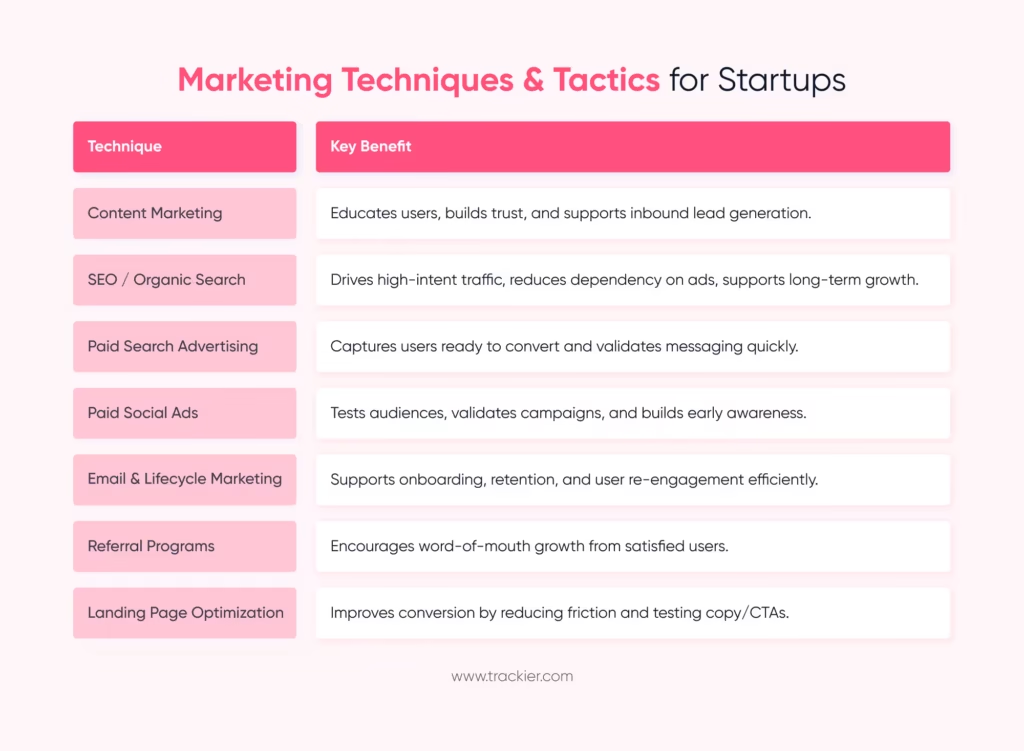
These growth marketing for startups approaches are successful when considered as trials. Growth marketing for startups focuses on what consistently produces results.
Growth Marketing Channels That Work Best for Startups
It is more important to choose the correct growth channels than to use multiple ones. Growth marketing for businesses works best when channels are chosen based on intent, speed of learning, and ease of measurement. Each channel should enable testing, iteration, and clear results.
Organic Search (SEO)
Organic search helps startups attract users who are actively looking for solutions. It is a long-term channel that, when done well, generates steady and high-intent visitors.
Key features:
- Attracts users with strong buy or usage intent
- Provides compounding traffic over time
- Reduces dependence on paid acquisition.
- Supports trust and credibility
Content Marketing
Content marketing supports discovery, education, and early involvement. It works best for information that deals with specific user problems rather than general topics.
Key features:
- Educates users before conversion
- Supports SEO and inbound leads
- Helps nurture users through the funnel
- Reusable on several channels
Paid Search Advertising
Paid search helps startups to take advantage of demand quickly. It is useful for testing offers, prices, and messages that contain obvious intent signals.
Key features:
- Targets users who are ready to take action
- Offers rapid feedback on demand
- Easy to track conversions and ROI
- Effective in controlled experiments
Paid Social Advertising
Paid social helps startups to test audiences and positioning. It is ideal for early-stage discovery and validation, rather than immediate scale.
Key features:
- Test message across different audience categories
- Provides rapid performance insights
- Promotes top and mid-funnel growth
- Scales when conversion pathways are proven
Email Marketing
Email is one of the most affordable development channels. It has an important role in activation, retention, and reengagement.
Key features:
- Improves onboarding and activation
- Promotes repeat usage
- Low cost, high ROI
- Easy to modify and automate
Partnerships and Integrations
Partnerships help startups reach relevant users through reputable platforms. They perform particularly well with B2B and SaaS products.
Key features:
- Access to pre-qualified audiences
- Lower acquisition cost
- Increases credibility through association
- Supports long-term distribution
Community and Social Platforms
Communities help startups to establish direct relationships with users. Engagement here frequently results in crucial input and increased retention.
Key features:
- Direct user interaction
- Early feedback and validation
- Develops trust over time
- Supports organic referrals
Tools and Tech Stack for Startup Growth Marketing
- Analytics tools monitor user behavior, identify drop-offs, and demonstrate which channels result in actual conversions.
- Attribution tools link marketing spend to results, helping businesses to better spend their budget.
- Platforms for A/B testing and experimentation offer quick optimization of landing pages, messaging, and onboarding processes.
- CRM and marketing automation platforms help manage people, deliver timely communications, and trigger campaigns based on activity.
Keeping the tech stack simple offers clarity, faster decision-making, and less complexity for small teams.
Common Growth Marketing Mistakes Startups Make
Startups often make predictable mistakes that hinder growth. Understanding these can help teams save time, money, and effort.
- Focusing just on traffic and ignoring activation, retention, or real conversions.
- Scaling campaigns too soon without knowing which channels or messaging work.
- Targeting vanity metrics such as likes, impressions, or followers rather than measurable business outcomes.
- Neglecting retention while spending extensively on new user acquisition.
- Running campaigns without proper tracking, attribution, or data to support decisions.
- Experiments and iterations are slowed due to overcomplicated tools or technology stacks.
- Ignore user input, behavior, or onboarding friction spots.
- Failure to record experiments can lead to repeated mistakes or lost learning.
How to Choose the Right Growth Marketing Partner
Choosing a partner for growth marketing for startups is a major choice. The right partner helps you to test faster, reduce risk, and focus on what truly drives development. This decision should be based on clarity, alignment, and execution skills, not on promises.
Look for Startup-Focused Experience
Not every agency understands startup limits. A great partner should have prior experience working with businesses in their early stages of growth. They should be able to work with tight budgets, quick iteration, and changing objectives.
Prioritize Outcome-Driven Thinking
The right partner focuses on outcomes rather than activities. They should focus on activation, retention, and income rather than just traffic and impressions. Ask how they define success.
Understand Their Experimentation Process
Your partner should explicitly describe how they create experiments, how long tests take, and how results-based decisions are made. Vague responses are red flags.
Check Alignment With Your Product and Audience
A strong partner takes the time to understand your product, people, and market. They should ask questions before recommending channels or techniques. Strategy without context is rarely effective.
Evaluate Measurement and Reporting
Your partner should clearly explain which metrics they track and how their findings are reported. You should always understand what works and why.
Avoid Rigid or One-Size Plans
Partners who offer set packages or strategies without flexibility often hamper progress. Look for flexibility and a willingness to grow.
Look for Collaboration, Not Dependency
The best growth marketing partners serve as an extension of your team. They work closely with product and internal teams to establish long-term growth capabilities.
Measuring Success in Growth Marketing for Startups
Measuring success helps startups decide whether their growth plans are effective or a waste of resources. Clear analytics help growth marketers stay focused and actionable.
- Track metrics that fit your current growth stage and business objectives.
- Measure acquisition quality, not just the total number of users.
- Monitor activation to understand whether users are experiencing real product value.
- Check retention to see if users return and remain engaged.
- Analyze revenue analytics to understand conversion and monetization.
- Review experiment results on a regular basis and make adjustments based on the data.
- Avoid using vanity metrics that fail to show business impact.
Conclusion
Growth marketing for startups focuses on clarity and consistency throughout all growth initiatives. Each channel, approach, and tool should lead to a specific business goal.
Startups that invest in growth marketing early get a faster understanding of user behavior and demand. This helps teams to spend more wisely, prioritize better, and avoid expanding wasteful efforts.
This guide explained how growth marketing helps companies at every stage of the funnel, from channel selection to success measurement with the appropriate metrics. Strong growth takes place when ideas are tested, mastered rapidly, and improved consistently.
Growth marketing for startups works best when it is targeted and practical. Start small, test frequently, learn from data and expand what produces actual outcomes.
FAQs
What is growth marketing for startups?
Growth marketing for startups focuses on driving measurable growth through testing, data analysis, and full-funnel optimization. It looks beyond traffic and focuses on activation, retention, and revenue. Startups use growth marketing to learn rapidly, validate channels, and grow what works while saving limited resources.
When should a startup start investing in growth marketing?
Startups should start growth marketing as soon as feasible, even before scaling. Early growth efforts help verify demand, understand user behavior, and find potential channels. Starting early reduces risk, reduces wasteful spending, and allows for faster progress toward product-market fit.
How is growth marketing for startups different from traditional marketing for startups?
Traditional marketing frequently focuses on campaigns and awareness. Growth marketing uses a data-driven approach to optimize the entire funnel. For startups, this involves carrying out experiments, measuring results, and continuously improving to achieve goals such as engagement, retention, and revenue.