Cookie stuffing sounds technical. Almost harmless, even. But it is a fraud tactic that can completely ruin your affiliate reporting without you even knowing.
Cookie stuffing is one of the biggest causes of stolen commission. But that is only half the problem. It also corrupts attribution, rewards the wrong traffic source, and pushes marketers to tweak their campaigns with no real direction toward what actually works.
To catch it early, Trackier’s real-time Fraud Prevention tool is your best bet!
How does cookie stuffing work?
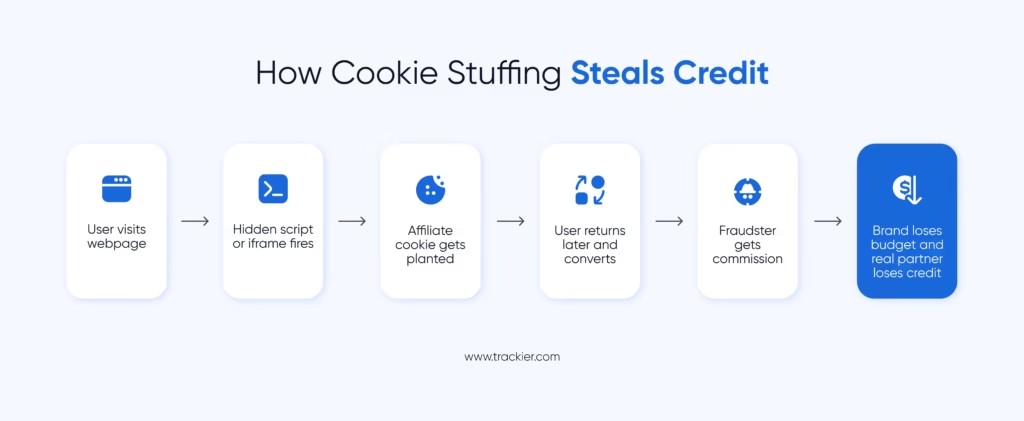
Cookie stuffing works by planting an affiliate cookie on a user’s browser without a real, intentional referral click. So the fraudster gets a chance to claim credit later, even if he did not genuinely influence the user’s decision. This is also what makes cookie stuffing so frustrating for marketers. The conversion may look valid in the dashboard, but the path that led to it is not.
And this is why cookie stuffing is more than just a payout problem. It creates fake influence. Your reports start rewarding the wrong partner, and your team starts trusting data that is not really accurate.
When tracking is tied to stronger click IDs and server-to-server validation, the room for cookie stuffing drops sharply.
Why does cookie stuffing cost more than stolen commissions?
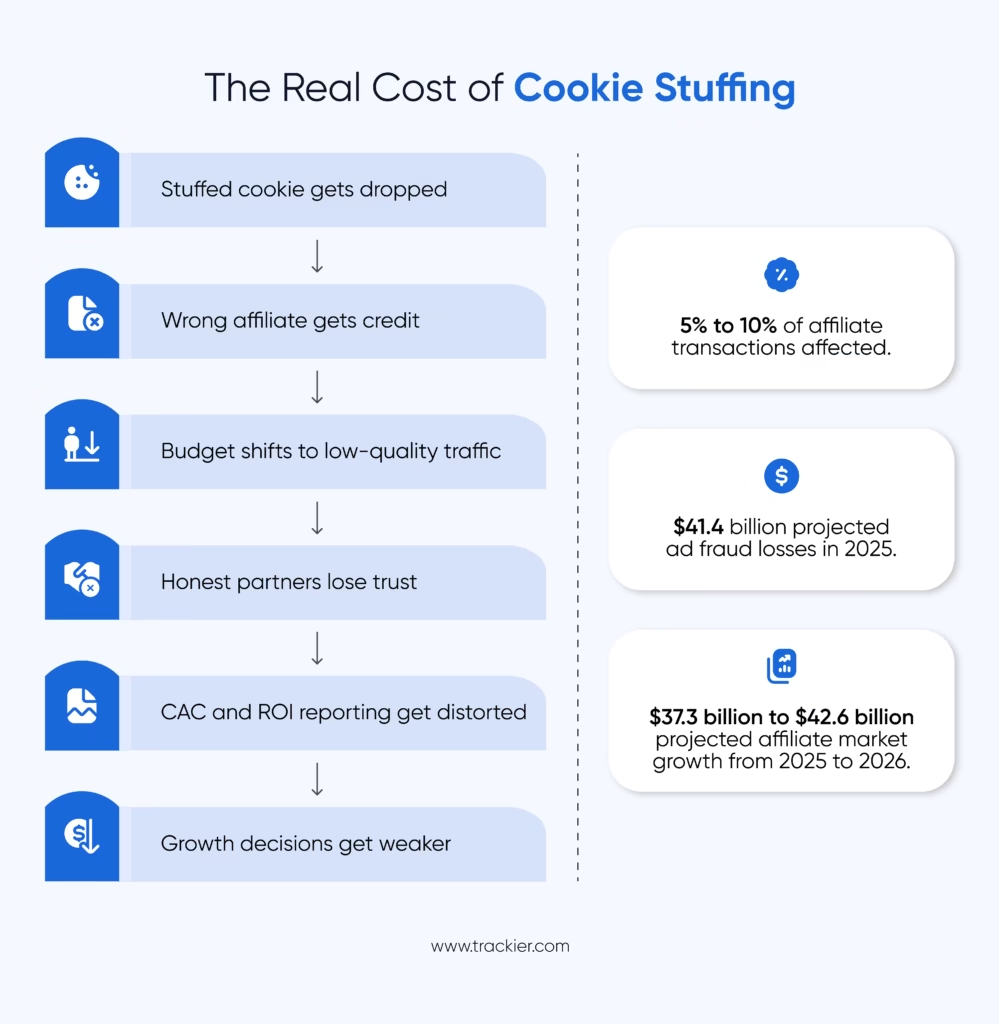
At first glance, cookie stuffing looks like a commission theft problem. And yes, that is a part of it. A fraudulent partner gets paid for a conversion they did not help create. But the deeper damage shows up after that. Cookie stuffing changes the story your data tells you, and once that happens, your team starts making uninformed decisions.
That is why cookie stuffing is more dangerous than it first appears. It does not just skim money off the top. It makes weak traffic look useful, makes real partners look less effective, and quietly pulls budget toward the wrong places. For startups, SaaS teams, agencies, and enterprise brands, that can mean months of wrong optimisation before anyone spots the pattern.
And the market is too large to treat this as a side issue. Affiliate marketing spend is projected to grow from $37.3 billion in 2025 to $42.6 billion in 2026. When the channel is that big, even a small cookie stuffing problem turns expensive very quickly.
Why does bad attribution hurt even when the dashboard looks fine?
This is the trap.
Cookie stuffing often does not crash your reports. It blends in. Conversions still appear. Revenue still gets attributed. Partner numbers still move. So the dashboard looks stable, sometimes even healthy. But the path behind those conversions is false, and your reporting starts rewarding the wrong behaviour.
Once that happens, budget allocation gets weaker. You may pause a real content partner, overpay a low-quality affiliate, or scale a source that never created demand in the first place. Cookie stuffing turns attribution into guesswork, and guesswork is expensive when you are making channel-level decisions every week.
It also affects CAC, ROI, and partner evaluation. If cookie stuffing inserts fake touchpoints into the path, your team may think acquisition is working better than it really is. Or worse, you may think a genuine growth partner has stopped performing when their credit has simply been hijacked.
Why do honest partners lose first?
Because cookie stuffing rewards the partner who cuts into the journey last, not the one who actually helped move the buyer forward.
Say a publisher created the first real interest through content, comparison pages, or a review. Later, a stuffed cookie gets planted in the background through a hidden script, extension, or forced redirect. When the purchase happens, the wrong partner gets the payout. The honest affiliate loses the commission, even though they did the work that mattered.
Over time, that weakens the whole programme. Good partners lose trust. Compliance rules get tighter. Finance teams question payouts. Affiliate managers become more cautious. So cookie stuffing does not just steal from brands. It makes good partnerships harder to grow.
What do the numbers say?
The scale is not minor. Recent industry figures show cookie stuffing affects around 5 to 10% of affiliate marketing transactions. That means the issue is not rare, and it is definitely not theoretical.
Across digital advertising more broadly, losses were projected to hit $41.4 billion in 2025, up from $37.7 billion in 2024. Longer-term projections put global digital ad fraud losses at $172 billion by 2028. Cookie stuffing is only one tactic in that wider fraud picture, but it sits right at the heart of affiliate misattribution.
That matters even more in partner marketing because the channel keeps growing. Bigger budgets bring more opportunity, but they also attract more abuse. So if your affiliate programme is scaling across regions, products, or partner types, cookie stuffing should be treated as a measurement problem, a finance problem, and a partner trust problem all at once.
How can you detect cookie stuffing before it spreads?
Cookie stuffing rarely announces itself. It hides inside normal-looking affiliate reports, and that is what makes it dangerous. You usually spot it through patterns, not a single dramatic signal. So when you review partner performance, these are the five red flags worth watching first.
Red flag 1. Conversions happen with little or no real click intent
This is one of the clearest signs of cookie stuffing.
A user should usually show some real journey before a conversion happens. Maybe they click a content page, browse a product page, compare options, then return later and buy. But with cookie stuffing, you may see conversions that appear after weak, shallow, or invisible touchpoints. In some cases, the affiliate gets credit even though the user never meaningfully engaged with that partner at all.
So if a partner keeps driving conversions without strong landing-page behaviour, without real click depth, or with strangely thin engagement, pause there. That is not proof by itself. But it is a strong first signal that cookie stuffing may be in play.
Red flag 2. One partner keeps winning the last click too often
Cookie stuffing works especially well in systems that rely heavily on last-click attribution. That means the fraudster does not need to create demand. They just need to appear late enough in the path to steal the credit.
So watch for one affiliate suddenly claiming an unusual share of late-stage conversions, especially when that partner does not seem to be driving real discovery or consideration. If they keep showing up right before the purchase, but their traffic quality does not explain that success, cookie stuffing becomes a very realistic possibility.
Red flag 3. Referral paths look hidden, blank, or unnatural
A clean affiliate journey usually leaves a visible path. You can trace where the user came from, what they clicked, and how they reached the conversion point.
Cookie stuffing often breaks that logic. You may see missing or weak referral data, invisible hops, strange redirects, or touchpoints that do not fit the user journey at all. Hidden iframes, injected scripts, image pixels, and browser extensions are common ways stuffed cookies get planted quietly in the background.
So if the attribution trail feels oddly thin or too convenient, trust that instinct. A path you cannot explain clearly is a path worth auditing.
Red flag 4. Conversion spikes do not match traffic quality
This one catches a lot of teams off guard.
You may see a partner send a sudden burst of conversions, but the surrounding traffic tells a different story. Sessions are weak. Engagement is low. User quality is inconsistent. Geography, browser mix, or device patterns may also look strange. In broader affiliate fraud detection, irregular conversion patterns and spikes in suspicious traffic are already treated as early warning signs, and cookie stuffing can sit inside the same pattern.
In simple terms, if performance jumps but the journey quality does not improve with it, do not celebrate too quickly. Cookie stuffing often looks good before it starts looking wrong.
Red flag 5. Honest partners start losing credit they should have won
This is the commercial red flag, and honestly, it is one of the most painful ones.
When cookie stuffing enters a programme, honest partners usually feel the damage first. Content affiliates, review sites, and genuine comparison partners may still create demand, but a stuffed cookie cuts in later and steals the payout. Over time, those real partners appear weaker in your reports even though their role in the journey has not changed.
So if strong partners start losing attributed conversions without any obvious drop in quality, or if complaints about stolen credit begin to rise, take that seriously. Cookie stuffing is not always detected in the dashboard first. Sometimes it shows up in partner trust long before it shows up in a fraud review.
How can you stop cookie stuffing without slowing growth?
The fix is not to shut down your affiliate programme or start distrusting every partner. The fix is to make attribution harder to game.
Start with tighter partner onboarding. Make approval standards clearer. Review where traffic comes from, how users are reached, and what promotional methods are allowed. Cookie stuffing thrives when the rules are vague and enforcement is slow.
Then strengthen validation. Use click-level checks, server-to-server tracking where possible, and fraud rules that flag invisible or low-intent touchpoints. If your system can review click quality, unusual conversion timing, and repeated anomalous partner patterns, cookie stuffing gets much less room to hide.
It also helps to review cookie windows carefully. A cookie period is useful for legitimate attribution, but if the tracking window is too loose and your controls are weak, a stuffed cookie gets more time to steal credit. In affiliate programmes, a cookie duration is simply the period during which a tracked click remains eligible for commission, and many programmes still use around 30 days as a common benchmark.
And finally, talk to your best partners. Honest affiliates usually want the same thing you do, which is clean measurement and fair credit. The faster you treat cookie stuffing as a partner-quality issue and not just a fraud checkbox, the easier it becomes to protect growth without choking the channel.
Hungry for more? Download our free case studies that cover real stories.
Or sign up for the Trackier’s newsletter to get weekly best practices on referral programs and partner marketing.
Frequently Asked Questions
1. Is cookie stuffing legal?
In most real-world affiliate programmes, cookie stuffing is not treated as acceptable behaviour.
It is widely prohibited in programme terms because it inserts tracking cookies without a genuine referral and then steals credit for conversions that belong to another source. In more serious cases, cookie stuffing can move beyond a contractual violation and become a fraud issue.
Recent legal explainers note that it can be prosecuted as wire fraud when someone knowingly uses deceptive online activity to claim commissions they did not earn.
So from a marketer’s point of view, the practical answer is simple. No, cookie stuffing is not something you should view as legally safe or commercially acceptable. Even where enforcement differs by case, cookie stuffing clearly conflicts with transparency and fair attribution standards, which is enough reason for brands to treat it as a serious compliance risk.
2. Is cookie consent mandatory in India?
In India, the answer is not as simple as saying there is one standalone cookie law. What matters is whether the cookie activity involves personal data and whether the user has been given clear, informed, specific consent where required.
So yes, in practice, cookie consent is becoming necessary in India whenever cookies are tied to personal data, profiling, tracking, or targeted experiences. For marketers, the safer approach is to use transparent cookie notices, clear opt-in or opt-out choices where applicable, easy withdrawal mechanisms, and plain-language explanations. That is the direction compliance is moving toward, and brands should not wait for stricter enforcement to clean this up.
3. What is a cookie period in affiliate marketing?
A cookie period, also called cookie duration, is the length of time an affiliate tracking cookie stays active after a user clicks an affiliate link. During that window, if the user comes back and completes the required action, such as a purchase or sign-up, the affiliate can still receive credit. That is why cookie period settings matter so much in affiliate attribution. They decide how long a click remains eligible for commission.
A 7 to 30 day window is commonly used in many affiliate programmes, and 30 days is still widely seen as a standard benchmark, though the right duration depends on the product, sales cycle, and buying journey. Shorter windows reduce exposure to misuse, while longer windows can better reflect real consideration time. The key is balance. If your cookie period is long but your fraud controls are weak, cookie stuffing gets more time to sit inside the attribution path and steal credit.
4. Which tricks are usually used for cookie stuffing?
The most common cookie stuffing methods are hidden iframes, pop-ups, pop-unders, JavaScript injection, image pixels, and browser extensions. They all do the same job in different ways. They try to place tracking cookies quietly, without the user making a real choice to click or visit through an affiliate journey.
A hidden iframe is one of the easiest examples to picture. A user opens a page that looks normal. In the background, the browser also loads an invisible affiliate URL. That one silent action is enough to drop a cookie. The user never sees it. They never intended it. But the fraudster has already entered the attribution chain.
Browser extensions make cookie stuffing even messier. They can run silently while a user browses different sites, injecting tracking data in the background. Pop-ups and JavaScript injections do something similar. Different wrapper, same theft. That is why cookie stuffing is often hard to spot with basic surface-level reporting.
5. Why does last click make cookie stuffing easier?
Because last-click systems are easy to hijack.
If your program gives full credit to the final touchpoint before conversion, then a fraudster only needs to place a cookie at the right moment and wait. They do not need to create demand. They do not need to educate the buyer. They just need to slip into the trail before the purchase happens.
Cookie windows make this even more important. An attribution window defines how long a touchpoint can keep claiming credit for a conversion. If that window is too generous and your validation is weak, cookie stuffing gets more room to operate. In other words, a stuffed cookie can stay dangerous for as long as the rules allow it to.
This does not mean longer windows are bad by default. Some businesses need them. B2B, SaaS, and higher-consideration buying cycles often do. But it does mean your attribution logic, click validation, and fraud checks need to be stronger when the window is longer. Otherwise, cookie stuffing gets to sit in the system and wait for someone else’s conversion.
6. What does a clean journey look like compared to cookie stuffing?
In a clean affiliate journey, the user sees a legitimate promotion, clicks with intent, lands on the advertiser’s page, and later converts. The affiliate gets paid because they truly helped drive the action.
In a cookie stuffing journey, that middle layer is fake. No real referral value exists. The user did not choose the partner in a meaningful way. The cookie was inserted quietly, and the payout was claimed later as if influence had happened. This is exactly why cookie stuffing damages both advertisers and honest affiliates. It rewards the wrong behavior while pushing the real contributor out of the credit path.