
Two entities working together means more outcomes and shared benefits for both parties. This is because working individually these days might mean more of everything. This includes more ad spend, more headcount, and more channels to manage in-house. Additionally. Customer acquisition costs will always be on the rise, organic reach is shrinking, and building all these capabilities is time-consuming. This is something big businesses cannot afford.
With so many things to do on the plate, growth seems like a far-fetched dream. Hence, instead of only going against each other, businesses ranging from early-stage startups to global enterprises have started joining hands with each other. This is exactly what a strategic partnership is. It combines the strengths of two businesses instead of duplicating the effort.
This guide aims to break down strategic partnership in detail, understand its different types, why it matters, and how affiliate and performance marketing partnerships fit into the picture.
What is Strategic Partnership?
A strategic partnership is a formal, yet long-term collaboration between two or more businesses. Through this alliance formation, the businesses combine their resources, expertise, or audiences to reach goals that would otherwise be difficult to achieve alone.
This kind of partnership is hence built around the idea of sharing. Sharing objectives, risks, and rewards. However, it must be noted that the businesses that are a part of this collaboration are rarely direct competitors. In fact, they bring their complementary strengths to the table. If one has a strong product to offer, the other could have a vast distribution network and loyal audience.
When the pieces fit together, both sides start working toward a bigger picture together.
Now, one may wonder: how is strategic partnership different from casual collaboration? The most prominent difference is that of intent and structure.
- Strategic partnership aims to achieve long term business transformation, it goes on for multiple or even indefinite years and involves high risk.
- Casual collaboration, on the other hand, is limited to the execution of a limited task or project. It is short-term and transactional and is hence not that risky either.
Why are Strategic Partnerships More Important than Ever?
There are a few forces that push partnerships up in the priority list for marketing and growth teams –
- Paid acquisition is getting expensive. The rise of auction-based ad platforms also indicates that the cost of traffic is rising. Hence, businesses should be pushed towards channels that have better long-term economics.
- Building trust with a partner from scratch is difficult. Partnering up with an already established business is better because they already hold a certain amount of value and have their own reputation. This means credibility is borrowed here instead of being built from zero.
- A business cannot have it all, and markets are becoming specialised. This is why only a few of the companies can be excellent with product, marketing, logistics and finance simultaneously. Strategic partnerships provide access to those things to a business that they otherwise might not have in-house.
- Performance-based models are proving their return on investment. It is a fact that a business would only want to pay when there is an abundantly positive outcome. Exposure alone is not enough here. This is the logic that partnership is built on. Affiliate marketing is the most prominent example of this as it makes budgets far more predictable.
This does not mean that partnerships do not involve any risks at all. In fact, what they require is –
- Clear agreements
- Ongoing communication
- A way to know whether the relationship is delivering value
When structured well, this lets businesses scale without taking on a toll of expenses at the same time.
Types of Strategic Partnership
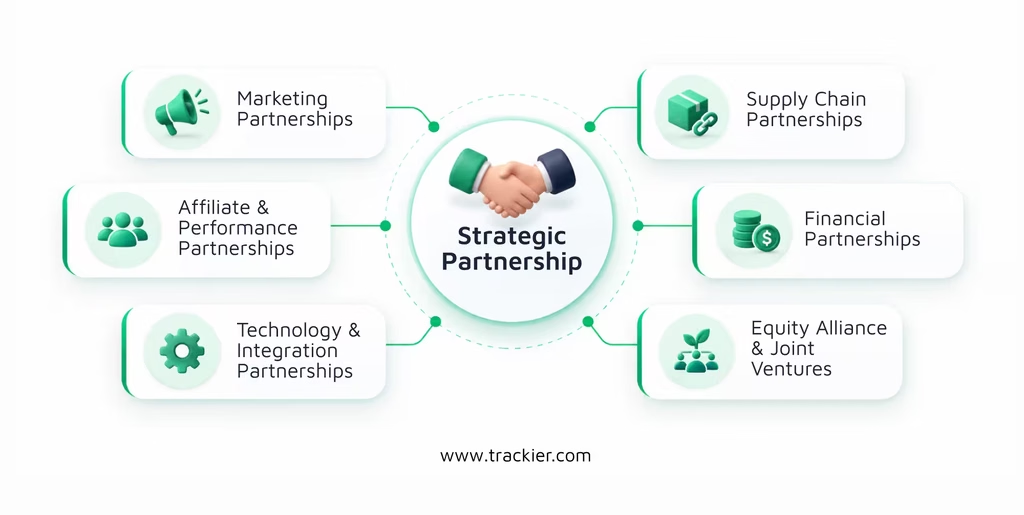
Strategic partnerships are not built in a one-size-fits-all way. The appropriate structure depends on what is being solved. This includes visibility, product gaps, cost, or capital.
Marketing Partnerships
In this type of partnership, two businesses with overlapping audiences but non-competing offerings team up to promote each other. This could be as simple and small as a web design agency and copywriting studios that refer clients to one another. They could also be as big as co-branded campaigns between two consumer brands. The goal is shared exposure without a shared marketing budget.
Affiliate and Performance Marketing Partnerships
This is a specific and results-driven form of marketing where one party, be it an affiliate, publisher, or influencer, promotes another business’s product or service. They then earn a commission for measurable outcomes like clicks, sign-ups, sales, and app installs.
It is one of the most scalable types of strategic partnership because a business can work with several partners simultaneously and pay only when the outcomes are delivered.
Technology and Integration Partnerships
Two software or hardware companies integrate their products so that using one enhances the other. This can be thought of as a project management tool that connects natively with a CRM, or a payments provider that plugs directly into an e-commerce platform. Customers get a more complete solution, and both companies benefit from the other’s user base.
Supply Chain Partnerships
Common in manufacturing and logistics, these partnerships focus on efficiency. This includes –
- Outsourcing part of production
- Shipping
- Fulfillment to a specialised partner
A shipping company might partner with regional carriers to complete last-mile delivery, or a chipmaker might become the exclusive supplier for a major electronics brand. The main draw here is usually cost savings combined with reliability.
Financial Partnerships
These partnerships involve outsourcing financial functions such as accounting, payroll, and forecasting to a specialist firm. This alliance is formed especially to access capital or financial infrastructure.
A business might partner with a payment processor to unlock new markets, or work with an outsourced finance team to get sharper cash-flow visibility than an in-house team could provide individually.
Equity Alliance and Joint Venture
If looked at from a more formal end of the spectrum, some strategic partnerships involve one company taking an equity stake in another, or even two companies forming an entirely new entity together.
Joint ventures pool capital, expertise, and risk to launch something neither party could build solo. This is common in industries like automotive, pharmaceuticals, and telecom.
How Does Affiliate Marketing Fit Into Strategic Partnership
Affiliate marketing deserves a separate spotlight because it has some exceptional strategic advantages that include –
- Capital risk is minimal. The partner is paid only after a valid conversion takes place.
- A single affiliate program can hook the business or brand to thousands of niche creators, major publishers, and platforms instantly.
- Affiliates act as trusted third-party recommenders. Their audiences arrive at the brand’s site with high buying intent.
What makes this a strategic partnership rather than just a marketing tactic is the same thing that defines any strategic alliance:
- Mutual benefit
- Shared goals
- Long-term value on both sides
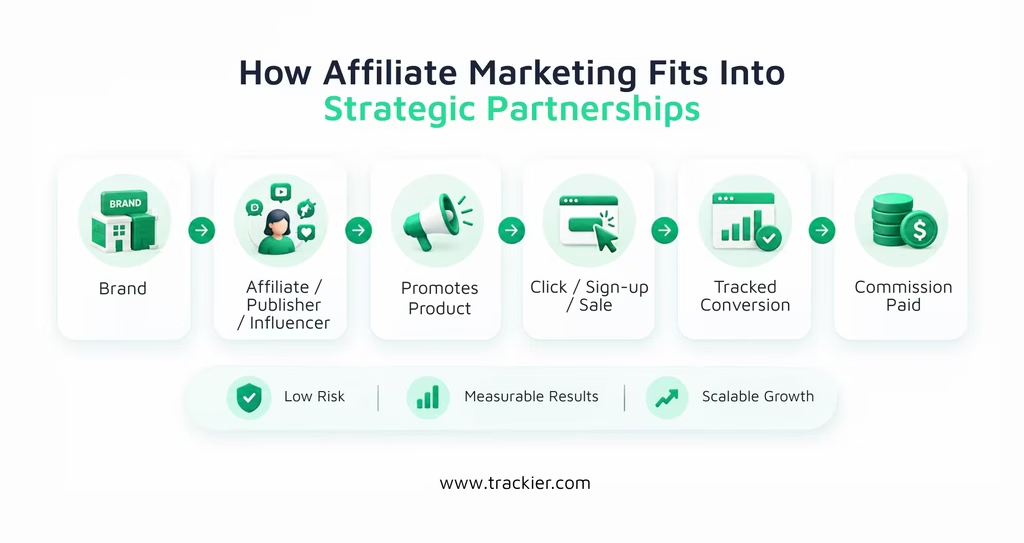
It is a win-win situation for both parties. The affiliates get a revenue stream built on an audience they’ve already earned trust with. The brand, on the other hand, gets low-risk, performance-based customer acquisition.
If this partnership is done well, it can become a symbiotic relationship and not just a mere transaction. But there’s a catch to it. Affiliate partnerships only work if the business can actually see what is happening across the network. This includes –
- Which partner is driving real conversions
- Which clicks are fraudulent
- Which campaign deserves a bigger commission
- Which touchpoints actually influenced the sale
This is exactly the gap platforms like Trackier are built to close. They offer real-time tracking, multi-touch attribution, automated commission payouts, and fraud detection so that affiliate partnerships stay accountable at scale, not just at the level of a handshake deal.
What are the Key Benefits of a Strategic Partnership?
- Access to new audiences: Instead of building an audience from the beginning, it is borrowed from a business that already has one.
- Lower acquisition costs: Performance-based models, especially affiliate partnerships, mean that the business mostly has to pay only when a partner delivers genuine results.
- Shared risk: Costs, effort, and even reputational exposure get distributed across parties instead of sitting entirely on one business.
- Faster market entry: A local or established partner can help businesses enter a new region or vertical far faster than doing it alone.
- Complementary expertise: Businesses gain capabilities, be it technical, financial, logistical, or creative, that would otherwise take years to build.
- Stronger brand credibility: Association with a trusted partner can transfer some of that trust to one’s own brand.
- Scalability: Especially in affiliate and performance partnerships, a single well-managed program can plug a brand into a network of hundreds of partners without a proportional increase in the team size.
Real-World Examples of Strategic Partnership
BMW x Toyota
Two competing automakers rarely share a lab, but hydrogen fuel cell technology is expensive and slow to develop alone. BMW and Toyota pooled their engineering knowledge and R&D budgets to move faster on sustainable powertrains than either could manage independently.
This also proves that even direct rivals will set competition aside when the cost of going it alone outweighs the benefit of staying separate.
Nike x Apple
Beginning with the Series 2, Apple introduced dedicated Apple Watch Nike editions featuring exclusive software watch faces, perforated sports bands, and lightweight designs.
Nike brought fitness credibility and hardware, Apple brought its device ecosystem, and together they created an experience and a reason to buy both products. This is something that neither brand could offer individually.
Starbucks x Pepsico
Starbucks makes great coffee, but getting bottled Frappuccinos and canned cold brews onto shelves in every corner store worldwide can’t be solely the coffee company’s core skill. This skill is more inclined towards logistics and retail distribution.
By teaming up with PepsiCo, Starbucks tapped into a distribution machine built over decades, putting its ready-to-drink beverages in front of customers far beyond what its own café footprint could reach, while PepsiCo added a premium, high-demand brand to its shelf lineup.
Amazon Influencer Programs
High-profile content creators across TikTok, Instagram, and YouTube build curated “Storefronts.” By sharing links to their favorite fashion, beauty, or tech items, they earn direct payouts from Amazon for all qualifying purchases made through their pages.
How to Build a Successful Strategic Partnership?
- Identify the gap first – Before looking for a partner, get honest about where the business is constrained. Is it audience reach, technical capability, geographic presence, or budget?
- Find genuine complementary fit – The strongest partnerships pair businesses with overlapping audiences but non-competing offerings.
- Define the terms clearly – Roles, financial arrangements, performance metrics, and duration should all be documented, even for informal-feeling partnerships.
- Set measurable goals from the first day – Whether it’s referral volume, integration usage, or affiliate-driven revenue, agree on what success looks like before the partnership starts.
- Track performance continuously – This is where most partnerships, especially affiliate and marketing partnerships, either add to the value or quietly stagnate. Without visibility into what’s actually working, it’s hard to know whether to double down, renegotiate, or walk away.
- Keep communication open – Partnerships evolve. Regular check-ins prevent small misalignments from becoming reasons to end the relationship.
Is a Strategic Partnership Right for Your Business?
It is not necessary that every business needs to be in an alliance, and not every partnership is worth pursuing either. The businesses that benefit most are the ones that start by identifying a real constraint –
- A market they cannot reach
- A capability they don’t have
- An acquisition cost that is becoming unsustainable
Then they look for partners whose strengths address their constraints directly. If a business is able to relate to this, then affiliate and performance partnerships are often the lowest-risk place to start. This is because they are measurable from the beginning and do not even require the complexities that come along with joint ventures and equity alliances.
In fact, with affiliate partnerships, businesses can scale from a handful of partners to a full network as you learn what works.
Final Thoughts
Strategic partnership, with all its forms, comes down to a simple principle: two businesses can often achieve more together than either could alone, as long as the incentives are aligned and the results are visible. Marketing tie-ups build awareness, technology integrations build better products, supply chain alliances build efficiency, and affiliate partnerships build a measurable, scalable acquisition engine.
Measurability is what turns a partnership from a nice idea into a genuine growth channel. Whether you’re managing two key partners or two thousand affiliates, the ability to track performance, attribute conversions accurately, and pay out fairly is what keeps the relationship strategic rather than speculative. That’s the problem Trackier was built to solve, helping businesses turn their partner networks into a reliable, transparent, and scalable source of growth.
FAQ
What makes a strategic partnership successful?
A successful strategic partnership combines aligned business objectives, complementary capabilities, clearly defined responsibilities, and measurable outcomes. The strongest partnerships also have a mechanism for regular communication and performance reviews, so both businesses can adjust the relationship as priorities change.
How do you measure the ROI of a strategic partnership?
Strategic partnership ROI should be evaluated against the original objective rather than revenue alone. Depending on the partnership, useful measures can include partnership-generated revenue, customer acquisition, conversion rates, cost savings, market expansion, retention, or the value of capabilities gained through the relationship.
How do you choose the right strategic partner for your business?
Start with the business constraint the partnership needs to solve, such as limited market access, missing expertise, technology gaps, or high acquisition costs. Then evaluate potential partners based on complementary capabilities, audience overlap, strategic alignment, resources, risk, and their ability to deliver measurable value.