By the year 2026, digital marketing is practically the main strategy for small businesses. According to industry estimates, global investments in digital advertising will amount to $781 billion this year, with digital channels making up almost 69 percent of the total advertising budget spent around the world.
However, the main problem is not the acquisition of traffic but the identification of which channels actually generate revenue. A local business may get leads from different sources like Google, Instagram, WhatsApp, or referrals during one customer journey.
This is why successful small brands concentrate on measurable growth. Trackier allows businesses to track clicks, leads, and conversions across different channels, focusing on generating real customers, not impressions.
What is Digital Marketing for Small Businesses?
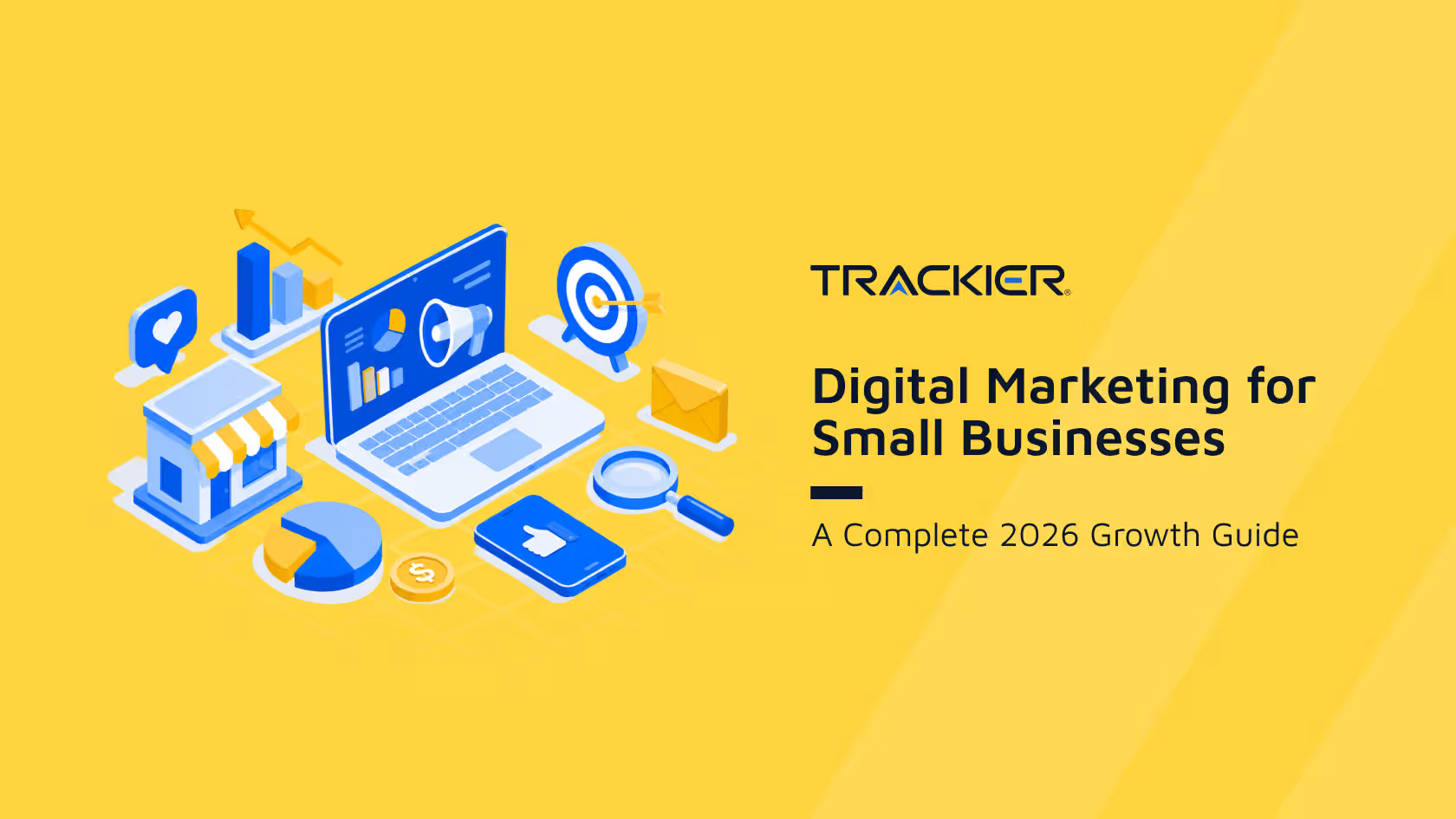
Digital marketing for small businesses means using online channels like websites, search engines, social networks, email, and advertising to get customers and make sales.
Thanks to digital marketing, businesses can reach audiences they had never even thought of approaching, engage with their potential customers in a personalized manner, and monitor marketing results without delay.
Digital marketing is associating products and services with digital channels, such as websites, mobile devices, social networks, or search engines.
While small businesses don’t have to be seen on every platform, it is critical that they create a straightforward system that allows people to find out about the business, trust it, get in touch with it, and purchase from it.
A simple strategy typically includes a mobile-optimized business site, local SEO activities, social media content, communication via email or WhatsApp, and tracking of conversion rates.
Reasons Why Small Businesses Need to Modify Their Marketing Strategies in 2026
Small businesses have relied on many digital marketing technologies in 2023 or even in 2025. As of 2026, however, customers now find products and services through different channels, and purchasers’ tendencies are now impacted by artificial intelligence solutions.
AI Search is Changing the Customer Journey
Google seems to be evolving into more of an answer engine than a conventional search engine. There are statistics to show that in early 2026, 68.01% of the discoveries in the U.S. that were made through Google search engines resulted in no click-through.
Of course, this has led to a critical change for small businesses because previously it would have been enough simply to measure website traffic and views.
Customers Search on Multiple Platforms
A potential customer might find your business on Instagram, check options on Google, view a YouTube Short, and send a WhatsApp message to you before purchasing anything. This means that marketing channels should not be treated in isolation from one another.
Therefore, instead of focusing on achieving dominance on each one of them, small businesses should prioritize:
- One search channel (Google)
- One social channel (Instagram, YouTube, or LinkedIn)
- One conversion channel (WhatsApp, phone calls, or web forms).
2026 Small Business Growth Layout
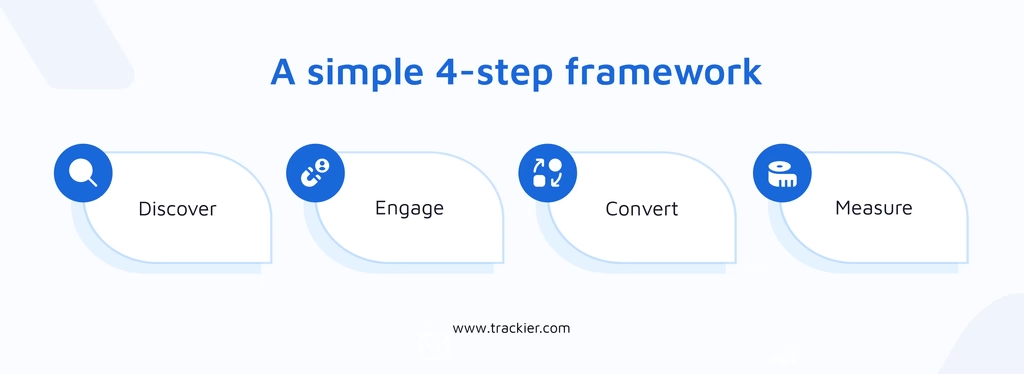
Many small businesses fail because they see digital marketing as a collection of random tasks like posts on Instagram, advertisements, and occasional emails. In 2026, the key to growing your small business is a straightforward” four-step” model:
Add Framework
- Discovery: Utilize SEO, Google Business Profile, and social media to make your business visible
- Engagement: Provide visitors with informative content, video content, reviews, and two-way communication
- Conversion: Utilize WhatsApp, landing pages, forms, and offers for generating action
- Measuring: Learn what channel produces leads, sales, and loyal customers
Create a Strong Digital Foundation
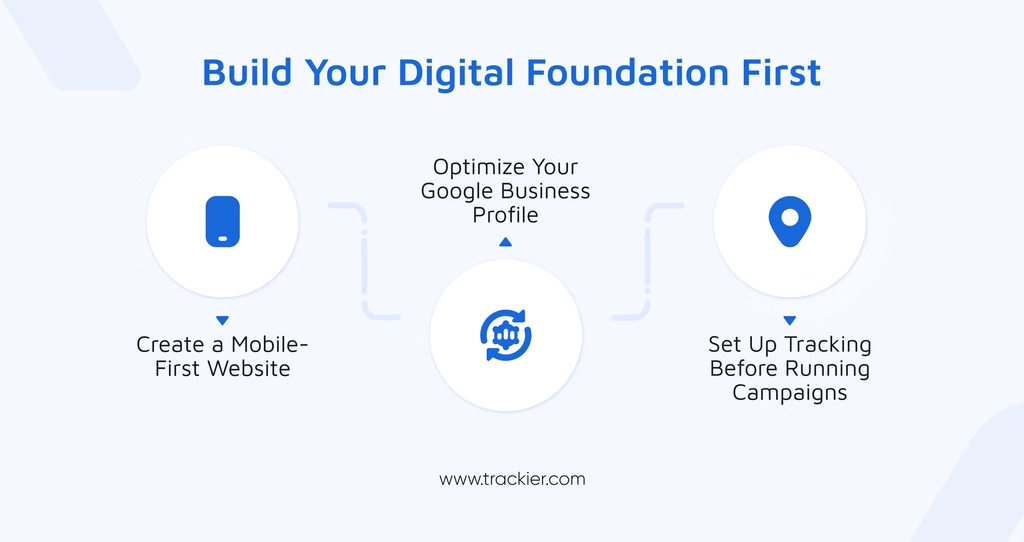
Before investing in SEO, social media, or paid advertisements, ensure that your digital foundation is solid.
Several small businesses waste their budget on marketing while directing customers to a sluggish website, an unfinished Google profile, or a page lacking conversion tracking.
Making these changes can improve the results of your campaign more quickly than starting yet another campaign.
Develop a Mobile-First Website
In 2026, your website will often be the first thing that people experience about your business. Because Google embraces mobile-first indexing, your website’s mobile iteration is going to play a major role in being visible and usable online.
That is why nowadays, your site has to be quick and adaptive to be voted for, not just to be appreciated. Your homepage must answer just three questions in a few seconds:
- What do you provide?
- Who is it intended for?
- What actions do you want the visitor to take?
It is necessary to use clearly defined calls to action such as Call Now, Get a Quote, or Chat on WhatsApp.
It would also be preferable to add elements of trust, for instance, customer reviews, licenses, case studies, or years in business. Even a 5-page website can generate the best leads provided that it is easy and understandable.
Make Your Google Business Profile More Efficient
Google Business Profile is often a more crucial factor for local businesses than the website itself. Customers are able to call or message the business, read the reviews, see the pictures, and find directions through Google Search and Maps.
It is always recommended by Google to ensure the business details are complete and accurate. According to 2026 benchmarks, 84% of views on GBP are taken through discovery searches (searching for the category, not the name of the business).
Completed profiles get 7 times more clicks and 70% more foot traffic compared to incomplete ones. Profiles with more than 100 pictures get an average of 520% more calls. Your profile must consist of the following information:
- Main business category
- Main services/products
- Hours of operation
- Photos
- Posts/updates
- Answers to all reviews
Tracking Before Launching Campaigns
Without the possibility to measure results, results cannot be improved. Ensure that the necessary tracking tools, including Google Analytics 4 and Google Search Console, are installed prior to starting the advertising campaign or creating a lot of content.
GA4 is a tracking tool used to track user activities; for example, submissions, clicks, and purchases. Search Console helps to check how visitors find your website on Google.
In addition, conversion tracking is essential for businesses using various channels such as Google Ads, Meta, WhatsApp, influencers, and affiliates.
The point of conversion tracking is not to track different vanity metrics but rather to understand which marketing channel generates leads.
SEO for Small Enterprises in 2026
As of 2026, SEO does not revolve solely around achieving high ranks in Google. Instead, businesses have to become visible across all platforms potential customers might employ during their search, including new forms of AI experience.
Due to the growing number of queries that do not produce any clicks, small businesses must operate on visibility, credibility, and efficiency of sales. Monitoring your brand mentions and links across AI-driven discovery models requires targeted tracking. Platforms like SE Visible help track where the business appears and how it compares across ChatGPT, Gemini, Perplexity, AI Mode, and AI Overviews.
Focus on targeting terms with a high intention of purchasing, creating invaluable content, leveraging local SEO, and giving straightforward responses to customers’ inquiries. Generate service pages, FAQs, as well as comparison content that answers real queries.
Small enterprises need to monitor their success in SEO not only through clicks but also through other metrics like phone calls, chats, and sales.
Platforms for Generating Leads through Social Media
Social media is no longer merely a tool for creating brand awareness among small businesses. In the year 2026, social networking sites like Instagram, YouTube, LinkedIn, or Facebook have turned into platforms for discovery, conversation, and conversion.
Nowadays, people use short video clips, influencer recommendations, and communication with customers to find products and make a purchasing decision.
Nevertheless, many companies still evaluate their social media performance based on the number of their followers and likes. These indicators may suggest that a brand is visible; however, they do not always result in any business growth.
The key question that should be posed by a social media campaign is whether the content has led to conversation, leads, or sales.
The agenda is to be present in as many social networks as possible. The goal is to select the right channels, prepare the content that can win trust, and monitor the activities that promote profit.
Pick the Proper Medium Instead of Dispersing Yourself All Over
Small businesses have to be careful about spreading themselves too thin across all platforms. With a small budget, such an approach could lead to long-term inconsistencies in posting and result in low engagement rates.
But you could rather find out where your customers are mostly active:
| Business Type | Recommended Platform |
| Local businesses (restaurants, salons, service providers) | Instagram and WhatsApp |
| D2C brands | Instagram Reels and YouTube Shorts |
| B2B businesses | |
| Education and consulting businesses | YouTube and LinkedIn |
| Ecommerce brands | Instagram and creator partnerships |
Create Content That Moves Customers Through the Funnel
The goal of social media content is to achieve. Instead of just posting meaningless updates, business owners should create content tailored to different customer journey stages.
1. Awareness Content
Make people aware of your product or service. Some ideas are:
– Industry topics
– Educational videos
– Behind-the-scenes content
– Issues faced by your customer or their solutions
2. Trust-Building Content
Explain to people why they should choose your company. Some examples of trust-building content are:
– Customer testimonials
– Case studies
– Proven client results
3. Conversion Content
Encourage people to act. For instance:
– Limited-time promotions
– Free consultation offers
– Product launches
– Demo requests
The customer who sees the video, visits your profile, sends a message, and buys your product is better than a customer who just liked your post.
Utilizing Short-Form Video to Gain Attention
Short-form videos are still extremely popular on social media as they provide the possibility for small brands to communicate easily and authentically.
Reels, Shorts, and similar video formats help brands to highlight their products, explain their services, and establish communication with their target audience without being required to make complicated and costly videos.
Small businesses are able to create good videos using simple video formats:
- Problem-solution videos: show how your product is addressing the problem of a customer.
- Behind-the-scenes videos: introduce the people and process behind your business.
- Customer stories: share real-life testimonials as well as results.
- Educational series: create a series of content on a particular topic.
Track Social Media Beyond Likes and Followers
The difference between social media usage and social media marketing is in measurement. Instead of concentrating on metrics such as the number of followers, likes, comments, and reach. Small businesses should measure:
- Website visits driven by social media,
- Leads created,
- The cost of a lead,
- The messages or inquiries received,
- The conversion rate,
- The revenue earned.
Trackier helps to monitor the effectiveness of various marketing channels so that marketers can spend their budget wisely on those strategies that really work.
Paid Advertising on a Tight Budget
This form of publicity does not necessitate a massive financial input to produce benefits. In small enterprises, the key to success is to choose suitable media for advertising, find potentially profitable audiences, and measure the effectiveness of the campaigns when they are completed.
Begin with High-Intent Advertising
Instead of splitting your financial resources among many media, pick those that guarantee the highest conversion rate of your potential customers:
- Google search ads – find customers who are looking for your products or services.
- Meta ads – make potential customers aware of your enterprise and encourage them to place orders via Facebook and Instagram.
- Click-to-WhatsApp ads – communicate with potential purchasers in real-time.
A possible way of spending the budget could look like this:
- Google search ads – 40%
- Meta or WhatsApp ads – 40%
- Retargeting campaigns – 20%
Nevertheless, increasing ad expenditures without monitoring results can lead to unnecessary spending. Metrics like the cost per lead, conversion rate, customer acquisition cost, and return on investment should be kept track of.
If your business is running campaigns over various channels, performance marketing software can be a useful tool that connects clicks, conversions, and revenue information to help you identify which campaigns create growth. Paid advertising aims to acquire customers that bring profit rather than simply increasing traffic.
Email Marketing and First-Party Data
As digital marketing undergoes changes in privacy trends, small businesses must create channels that they can control to promote their products and services.
Email marketing and first-party data enable brands to maintain long-term relationships with clients without relying only on paid advertising or external platform algorithms.
Business owners can utilize the following methods to form their data strategy:
- Website signup forms and newsletters
- Share incentives and other offers
- Customer review questionnaires or surveys
- Use of WhatsApp and email opt-ins
- Loyalty programs
Small brands can send information about their products and services. But success is not measured only by the number of clicks.
Make sure you keep track of metrics like the number of leads, conversions, return clients, and revenue generated with each email campaign.
How to Measure What Actually Works
Many small businesses tend to make a common mistake: they tend to measure the activities rather than the outputs.
Though it may appear really pleasing to see that a post has gained 1,000 likes or an advertisement has got 10,000 impressions, this does not in any way guarantee profits.
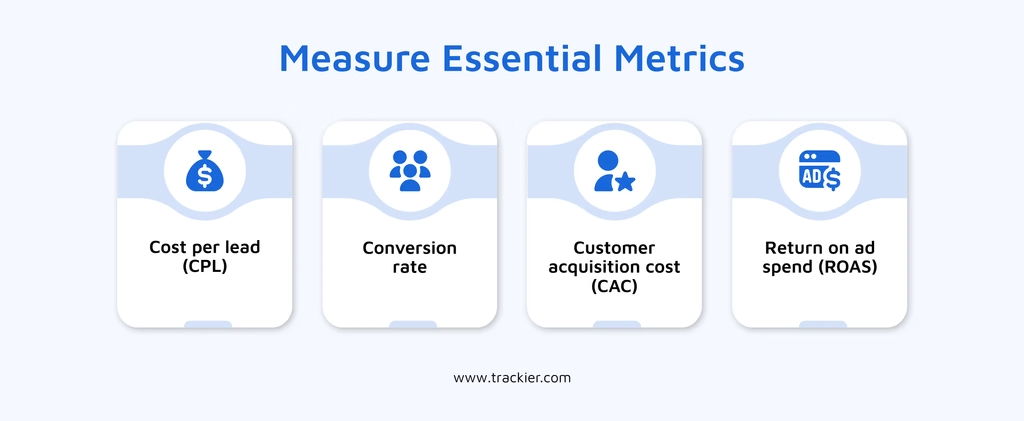
For the majority of small businesses, the following four metrics are especially important:
- Cost per lead (CPL): the money spent per inquiry made.
- Conversion rate: the percentage of prospective customers visiting your site who turn into leads or clients.
- Customer acquisition cost (CAC): the total expenditure on marketing divided by the number of new customers.
- Return on advertising spend (ROAS): the money earned for every rupee spent on advertising.
When you start using Google Ads, Instagram, WhatsApp, influencers, and affiliate marketing, your tracking may get more complicated.
For instance, a customer may learn about your brand on Instagram, follow it up with a Google search, and subsequently make a purchase via WhatsApp.
This is the time when you need proper attribution and conversion tracking techniques. Instead of making assumptions about which channel has contributed to the sales, businesses will be able to find out which campaigns regularly lead customers to buy products and spend more money on them.
30 Day Digital Marketing Strategy for Small Businesses
When starting out, refrain from attempting to create SEO, social media, advertising, email marketing strategies, and analytics tools at once.
The major aim of month one is building a minimal, measurable marketing mechanism that will ensure constant lead generation.
Week 1: Build the foundation
Focus on the essentials:
– Creating or updating your mobile-friendly website
– Adding a clear call-to-action like Call Now, Schedule a demo, or Message on WhatsApp
– Setting up your Google Business Profile, including the proper photos, services, and working hours
– Installing Google Analytics 4, Google Search Console, and Meta Pixel
Do not run ads before tracking is working. Without conversion tracking, it is not possible to determine what channel brings sales.
Week 2: Develop content that solves customers’ questions
Publish:
– 2 service or product pages optimized for local searches
– 4 social media posts (such as educational posts, case studies, behind-the-scenes stories, offers)
– 2 short videos for Instagram Reels or YouTube Shorts
The content must be practical. Every local business needs to respond to questions about costs, deadlines, procedures, and results rather than making pointless motivational content.
Week 3: Hitting traffic targets
Launch:
- A Google Search campaign targeting keywords with high intent.
- An ad Click-to-WhatsApp on Instagram or Facebook.
- A retargeting campaign aimed at visitors of our website.
Week 4: Measure and improve
Assess the following:
- Keywords that brought calls or WhatsApp chats.
- Social post that got the highest engagement rate.
- Ad with the lowest cost per conversion.
- Landing page that generated the highest conversions.
Respond to all assessments, change pages with poor conversions, and allocate budget to campaigns that have converted leads to paying customers. The 30-day plan here gives small businesses a repeatable road towards gradual sustainable growth month after month.
Conclusion
Using only one channel for searching, one for socializing, and one for conversions is a much stronger strategy than trying to use them all at once. Start by building a good website, creating a Google Business Profile, generating good content, and figuring out where your leads come from right away.
Consistency is much more important than complexity. Brands that go after a few measurable channels will have a better ROI than those who try to expand.
Book a demo of Trackier to understand how you can connect all channels of digital marketing for small businesses.
FAQs
Why is Google Business Profile important for local businesses?
Google Business Profile helps customers discover your business on Search and Maps, read reviews, view photos, call you, and get directions. Google also provides performance data such as views, calls, clicks, and other interactions, making it a powerful local marketing and lead-generation channel. Source
What are some practical digital marketing tips for small businesses?
Useful digital marketing tips for small businesses include publishing one helpful post each week, replying to every review, adding a WhatsApp button to your website, using real customer photos, and tracking conversions from every campaign. Small improvements made consistently often outperform complex marketing tactics executed only occasionally.
Is SEO still worth it for small businesses in 2026?
Yes. Even with AI-generated search answers, local and high-intent searches still drive valuable traffic and conversions. Businesses that publish helpful content, optimize service pages, and maintain an active Google Business Profile can improve visibility, calls, and direction requests. SEO remains one of the most cost-effective long-term growth channels.
What are the best digital marketing strategies for small business?
The best digital marketing tips for small businesses combine local SEO, Google Business Profile optimization, short-form video content, WhatsApp marketing, and retargeting ads. Focus on one search channel, one social platform, and one conversion channel first. Consistent tracking and customer follow-up usually produce better results than being active everywhere.
Which digital marketing channel gives the fastest results?
Paid advertising usually delivers the fastest results, especially Google Search Ads and Click-to-WhatsApp campaigns. SEO takes longer but builds sustainable traffic over time. A balanced approach works best: use ads for immediate leads while investing in content and local SEO for long-term visibility and lower acquisition costs.