As we move into 2026, the focus of businesses will not be on spending more; rather, it will be on creating systems that communicate with each other, are smarter than anything we have built before, and can produce results.
Today, more than 94% of marketers are using AI to create content and improve some aspect of their marketing processes. Because of this shift towards automation and data-driven growth, we see an ever-growing number of businesses that will achieve growth through automated means.
However, the increase in the number of channels, data, and tools provides challenges that make growing a business even more complicated. As a result, we’ve seen a lot of companies adopt a unified growth strategy that combines performance marketing, partnership marketing, and automated technologies to create a single system.
And this is exactly where Trackier helps businesses connect channels, track performance, and scale growth without increasing complexity.
In this blog, we’ll identify the most effective business growth strategies and show you how to turn those strategies into scalable revenue.
What are Business Growth Strategies?
Strategies for growing a business are ways a brand can build a revenue stream, reach new customers, and improve its position in the market. This means that brands will invest more into their sales team or run a large-scale ad campaign.
However, as of 2026, it’s not just spending money anymore that helps businesses grow; instead, they depend on their use of metrics, resourcefulness, and technology.
A business growth strategy framework answers ONE basic question: How can you help a company grow without increasing your cost to grow (Heck, who doesn’t want to get bigger with less expense, right)?
The best strategies take the focus away from a single-channel tie to marketing. Companies have now developed multi-channel growth ecosystems that combine:
- Performance-based marketing to measure customer acquisition
- Partner marketing & the use of affiliation, influencers, and B2B for scalable, trust-based growth
- Automating certain functions to help jobs get done faster, with fewer people doing them
- Using data & attribution to help track your business’s smart business decisions
The changing focus from traditional methods to newer methods primarily results from the challenges of traditional methods, including:
1. Rising Costs to Acquire New Customers (CAC) from paid media channels
2. Channel Saturation (Once All Your Competitors Are Using Paid Media To Fund, You Will See Less ROI)
3. Lack of Visibility on What Is Driving Your Conversions.
Modern Business Growth Strategy Framework
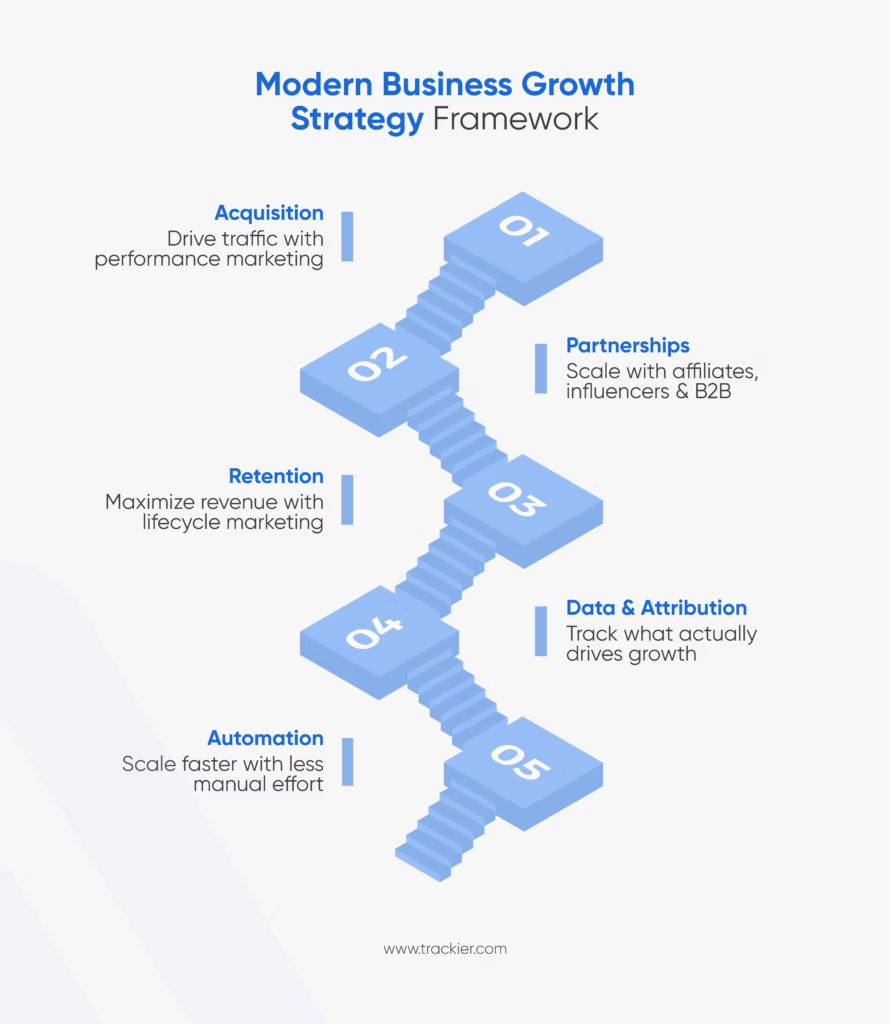
Modern businesses need new structured ways to deliver long-term value, and with the combination of standalone tactics and a new framework.
The framework takes a holistic approach to align the various functions (marketing, partnerships, and data) together into one growth strategy rather than operating independently.
Each layer within the framework works together to allow each company to acquire customers/users, work more efficiently, and maximize revenue.
1. Growth Layer (Performance Marketing)
At the very start of the customer journey, acquisition is where growth starts. Acquisition touches consumers from multiple sources using data-driven performance marketing campaigns to drive new users to your customer funnel via the following channels:
- Paid Search (Google Ads)
- Paid Social Media (Facebook Ads, LinkedIn Ads, Etc.)
- Programmatic And Display Ads
Measurability is the key; each performance marketing campaign resides within its own kpi (key performance indicators) metrics, which will determine if a campaign was successful (performance marketing success) and optimized.
Here are examples of KPIs used for performance marketing campaign measurement:
- Cost Per Acquisition (CPA)
- Return On Ad Spend
- Conversion Rate
2. Partnership Layer (Affiliate Marketing, Influencer Marketing, And B2B Partnerships)
If performance marketing drives reach or exposure, partnerships drive scale (i.e., investment = exposure to the target audience) and credibility/trust (providing evidence based on results). The partnership layer includes the following:
- Affiliate/Performance-Based Marketing
- Influencer Marketing
- B2B Partnership Development
The major advantage of leveraging partnerships is that the cost of working with partnerships is performance-driven; therefore, the business owner will only pay if they earn returns. This is an incredible way to build a low-cost business growth strategy.
3. Your Monetization / Retention Layer
User acquisition is an important part of building your business, but you will generate additional revenues that come after you’ve built your user base by keeping those users engaged through retaining and monetizing.
The monetization/retention section of your user acquisition framework consists of user lifecycle campaigns such as email marketing, retargeting, remarketing, and upselling/cross-selling campaigns.
Your primary goal for this part of your business is to drive up the customer lifetime value (LTV) for new customers, increase their repeat purchase rates, and ultimately increase your overall profit margins.
4. Attribution and Data Layer
Determining what drives growth for businesses today is one of the largest issues they must deal with; therefore, the purpose of this layer is:
- Provide an overall view of multi-touch attribution (tracking through the entirety of user journeys)
- Provide real-time performance and channel/partner-level insights
The areas mentioned above will mitigate the following fears:
- Investing too much in low-performing channels
- Missing out on high-value growth opportunities
5. Automation and Optimization Layer
As businesses grow, having manual processes presents a problem. The key to ensuring speed, efficiency, and consistency as businesses grow is automation.
The key areas of automated operations include campaign optimization, routing, distribution of smart traffic, onboarding, payouts for partners, and preventing and detecting fraudulent activity.
Effective Business Growth Strategies in 2026
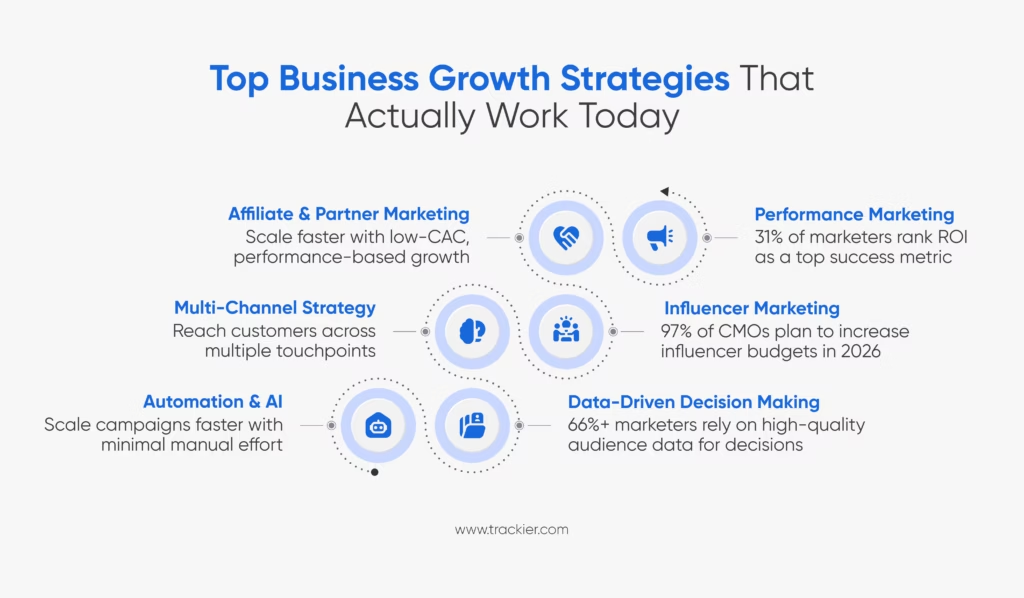
There are many business growth strategies that do not get results today. By 2026, most effective strategies will be performance-driven, scalable, and data-driven.
Let’s take a look at the most popular business growth strategies that highly growing brands are utilizing today.
1. Performance Marketing (on a large scale)
Performance marketing is still and remains one of the best business growth strategy models as it is measurable, and returns on investments (ROI) may be calculated for every dollar spent on a performance marketing campaign.
Companies will continue to spend their money on a marketing campaign, but more importantly, will analyze in real time from their campaign on how much will or has been spent based on:
- Cost to acquire a customer
- Return on ad spend
- Conversion rate
While the overall game has changed over the years, due to more competition for your dollar and rising costs of doing business (i.e., advertising), it is important for each brand to focus on efficiency when spending money in a marketing campaign.
So in the end, performance marketing is still effective, as long as it is measured, attributed, and continuously optimized with the use of data continually available from each campaign of your brand.
2. Low-CAC growth through Affiliate and Partner Marketing
One of the fastest-growing and most successful business growth strategies today. The reason is that you only pay after you get a result. So what does the data show?
- Businesses receive an average of 12:1 return on investment (ROI) from their affiliations,
- Over 80% of brands use affiliate marketing as a means of business expansion
- Affiliate marketing channels made up approximately 16% of all e-commerce sales
So why are they so successful? They offer lower customer acquisition costs than paid ads; they reach new audiences through business partners; and they are able to scale rapidly without increasing the size of internal teams.
3. Influencer-driven growth
Influencer marketing has now transitioned from a brand awareness campaign to a revenue-generating channel for businesses. By 2026, 97% of Chief Marketing Officers (CMO’s) plan to increase their budgets for creator/micro-influencer marketing.
So what is generating the best return on investment now? Transactions being driven through micro-influencers with niche followings, as well as performance-based influencer partnerships such as Cost-Per-Sale and Cost-Per-Action, as well as video-based content, are providing higher levels of engagement.
4. Multi-Channel (Omnichannel) Growth Strategy
There is no longer only one place for customers to convert; today’s journey consists of the following: Ad, Influencer, Review, Website, and then Purchase.
This is the reason why companies are implementing a multi-channel growth strategy. They will use paid advertising to increase reach, affiliate partnerships to convert sales, influencer marketing to build trust, and email marketing to build loyalty.
5. Data-Driven Decision Making and Attribution
In today’s world, one of the largest growth unlocks is knowing what is actually driving conversions. Without proper tracking, you are going to do either of the two things: grossly over-spending on the wrong channels or completely missing out on high-performing partners.
What is interesting is that today’s companies have access to multi-touch attribution, real-time analytics, and channel-level data.
6. Automation to Scale Growth Faster and Smarter
Manual scaling is not a scalable method anymore; today, every company has incorporated automation into its holistic growth strategy. In practice, teams often start by automating repetitive workflows with AI agents for productivity so operational tasks across email, documents, and internal tools do not keep expanding with headcount.
Automation can be used in areas such as optimizing campaigns automatically, distributing traffic intelligently, onboarding partners, processing payments, and preventing fraud.
So why does this matter? It allows companies to reduce operational costs, make decisions faster, and to scale without adding more headcount.
How to Create a Framework for Developing a Company’s Growth Strategy Plan
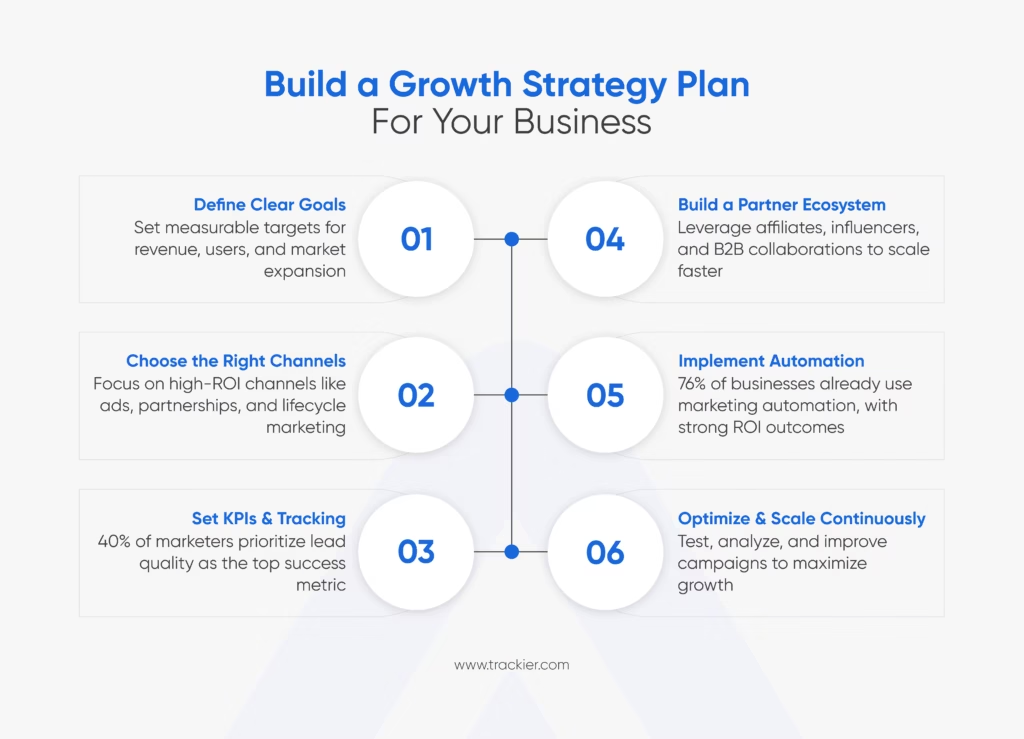
It is essential to develop an organized and systematic growth strategy plan in 2026 by utilizing data to support your decision-making.
Successful companies utilize an organised and consistent system that combines performance marketing, partnership building, and automated processes to effectively grow. Here is how you can accomplish the same:
Step 1: Define Your Goals for Growth.
Every successful growth strategy plan has a clearly defined goal. The following questions will help you begin defining what needs to be achieved to accomplish your objectives:
- What are your goal objectives? (Revenue, users, market share)
- How do you define success? (EX: 6-12 month timelines)
In addition to defining your overall growth objective, you should also establish specific measurable goals. For example:
- Percentage of revenue you would like to see increase
- Number of new customers you wish to acquire
- Level of penetration into the marketplace
The importance of establishing clearly defined goals is that they provide a roadmap for the future success of the growth strategy plan.
Step 2: Identify which channels will best meet business needs.
There isn’t a single channel that works for all businesses; the best approach is to make an announcement about the channels you are considering based on the information below.
The first factor to take into consideration is the type of audience you’re targeting. When determining which channels will work best for your business, it’s also necessary to look at your marketing budget.
Lastly, each of the following business models (SaaS, eCommerce, FinTech, etc.) may require different strategies in order to achieve their respective goals.
Some of the most effective channels currently being used are:
- Performance marketing (advertising)
- Reference and partnership marketing
- Influencers and collaborators
- Lifecycle and email marketing
Step 3: Create Key Performance Indicators and a Measurement System
The ability to quantify will determine the ability to expand. Identify metrics of importance, such as:
- Cost of Acquiring a Customer
- Return on Ad Spend
- Value Over Time of a Customer
- Conversion Rate
Step 4: Develop a Partner Ecosystem to Drive Revenue Growth
One of the biggest shifts in today’s era of growth is the move toward partner-focused versus advertiser-focused growth. In addition to affiliate partners, partnerships that could generate revenue include:
- Influencer Partners
- Buyers of Media/Advertising
- Collaborations with Other B2B Companies
Step 5: Use Automation
The use of manual processes stifles growth. For a company to effectively become larger in size through efficiency, the use of automated tools is essential. Companies will use automation to:
- Optimize Campaigns
- Nurture Leads
- Onboard and Pay Partners
- Provide Reporting and Analytical Data
An automated process can create an average of 5.44 times return on investment for each $1.00 invested in automation for a company.
Step 6: Continuously Optimize and Scale Your Business
A growth strategy for any business is always a fluid process. The highest level businesses engage in:
- Periodic A/B Testing
- Real-time Campaign Optimization
- Shifting Funding from under-producing channels to high-performing channels
- Only Scaling Up What is Working and Stopping What is Not Working
How Trackier Helps in Modern Business Growth Strategies?
Modern business growth strategies involve more than just selecting the appropriate channels; they also include the need to connect, manage, and optimize everything in one system.
That’s where a performance marketing software program is essential. Trackier helps companies bring performance marketing, partnership, and data together with automation into one scalable system. How does that impact your modern-growth business?
1) Combines Performance Marketing, Partnership, and Data
Among the challenges facing businesses today is fragmentation with multiple tools being used for advertising, affiliate, analytics, and reporting. Trackier answers this need by providing one unified platform to:
- Manage your affiliate/influencer/partner programs
- Monitor the performance of your campaigns in multiple channels
- Monitor what your campaigns are generating in terms of revenue/conversion/ROI in real-time
The result is no more wasted time switching from tool to tool to run and manage your growth business; all your data is now located in one place, making it faster and easier to grow.
2) Provides Accurate Performance Tracking and Multi-Touch Attribution
The foundation of growing your business today relies on one element: having clarity of what is working for you. Trackier provides:
End-to-end conversion tracking;
- Attribution for each partner/channel/campaign; and
- Real-time visibility into user journeys.
With this information, you will be able to:
- Determine what partners are driving your business.
- Allocate budgets to high-performing channels; and
- Eliminate guesswork from your decision-making process.
3) Powers Partner-Led Growth at Scale
Partnerships are fundamental to the modern approach toward growing a business, but the manual nature of managing them can be very complicated. We help in simplifying this complexity through our ability to:
– Onboard and manage thousands of affiliates/partners
– Create custom tracking URLs and commission structures
– Track real-time partner performance
Partnerships can now be transformed into a predictable and scalable revenue stream. This means that rather than spend time managing spreadsheets, a business can effortlessly build and scale its partner ecosystem.
Trackier allows brands to discover partners, launch campaigns, and automate their payouts in a single platform.
4) Automate Operations to Enable Scalable Growth
Growth at scale is hindered by the use of manual workflows in most businesses. Automate your important processes like:
– Commission calculations and affiliate payouts
– Optimized campaign management
– Reporting and analytics
– Detection of fraud
This will result in:
– Faster execution
– Reduced operating costs
– Fewer human errors
5) Offer real-time insights for faster decision-making
In marketing strategies, timing matters more, whether it is in performance or affiliate. To tackle this, we offer real-time dashboards, customizable reports (as per your own needs), along with partner and campaign-level insights.
This allows businesses to optimize their campaigns instantly, identify high-performing channels, and top underperforming campaigns quickly.
6) Ensures Growth with Fraud Prevention and Data Transparency
As your businesses continue to scale, fraud with data inaccuracies becomes a major challenge. So, to help with this, Trackier offers built-in fraud detection, transparent reporting, and secure tracking.
These features help to ensure that you only pay for genuine conversions, your data remains safe, and your growth is sustainable.
Final thoughts: make your revenue strategy also your growth plan
The current space does not describe growth as an increase in building more channels or requiring larger budgets. Growth now describes the establishment of a single source for your automated systems that allows you to scale without much effort.
The shift from distribution methods is already occurring. Data indicates that 76% of brands now utilize marketing automation and are growing.
Hence, the conclusion is that companies interested in systematic innovation will prevail.
However, only having effective strategies will not achieve results. Having an effective platform will help eliminate the risk of delivery failure, continue the siloedness of chemical production, and underutilization of partners, and growth will be maximized going forward.
This is where Trackier is most valuable in its ability to significantly reduce CAC, create scalable partnerships, and build measurable ROI through effective business growth plans into a reliable and scalable business plan through demo request.
FAQs
1. What tools are needed to manage business growth effectively?
Businesses need tools that support tracking, attribution, partner management, and automation. A unified platform like Trackier helps manage all growth activities in one platform, enabling real-time insights, efficient operations, and scalable partner-led growth without relying on multiple disconnected tools.
2. How do data and attribution impact growth strategies?
Data and attribution help businesses identify which channels and partners drive results. Without proper tracking, companies risk wasting budget on underperforming channels. Accurate attribution enables smarter decisions, better optimization, and higher ROI, making it a critical component of any modern business growth strategy plan.
3. What KPIs should businesses track for growth?
Key performance indicators (KPIs) include Customer Acquisition Cost (CAC), Return on Ad Spend (ROAS), Customer Lifetime Value (LTV), and conversion rates. Tracking these metrics helps businesses understand what’s working, optimize campaigns, and allocate budgets more effectively for better growth outcomes.
4. Why is multi-channel growth important today?
Modern customer journeys involve multiple touchpoints before conversion. Relying on a single channel increases risk and limits growth. A multi-channel strategy, combining ads, affiliates, influencers, and email, ensures better reach, improved engagement, and higher conversion rates across different stages of the funnel.
5. How long does it take to see results from a business growth strategy plan?
The timeline depends on channels and execution. Performance marketing can deliver results within weeks, while partnerships and SEO take longer. Businesses using automation and data-driven strategies often accelerate results, with many seeing measurable improvements in leads and conversions within the first 3–6 months.