Most high-growth brands are currently subsidizing inefficiency. In the 2026 fiscal environment, a “growth at all costs” strategy isn’t just outdated, it’s a balance sheet liability. When your Cost Per Acquisition (CAC) begins to climb in tandem with your scaling efforts, the solution isn’t to inject more capital; it’s to fix the plumbing. Marketing budget optimization is no longer about saving pennies; it is the strategic act of re-engineering your spend to ensure that every dollar invested outpaces the rising cost of market noise.
Optimizing a budget isn’t a one-time “set it and forget it” task. It is a continuous cycle of auditing, testing, and reallocating resources to ensure that every dollar works harder than the last.
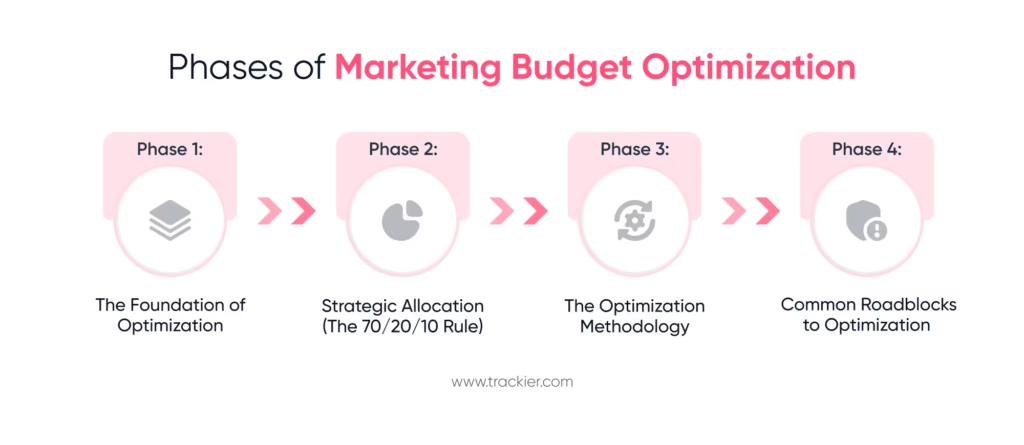
Phase 1: The Foundation of Marketing Budget Optimization
Before shifting a single dollar between channels, high-growth brands must establish a Single Source of Truth. Without clean, unified, and trustworthy data, optimization quickly becomes educated guesswork. At scale, even small inaccuracies compound into seven-figure mistakes.
This phase is not about squeezing marginal gains. It is about building the infrastructure that makes every future optimization credible, repeatable, and defensible.
1. Unified Data Integration
Modern marketing ecosystems are fragmented by design. Spend, clicks, impressions, postbacks, CRM events, and revenue data live across Meta, Google, TikTok, LinkedIn, programmatic networks, analytics tools, and backend systems.
Optimization begins by centralizing these disparate data streams into a single warehouse and enforcing consistent definitions across platforms.
Key elements of effective data unification include:
- Standardize attribution logic across all channels to avoid platform bias.
- Consistent event naming and taxonomy, ensuring “conversion” means the same thing everywhere.
- Real-time or near real-time syncing, allowing teams to react to performance shifts quickly.
- CRM and product data integration, so marketing is tied to actual revenue, retention, and expansion.
Eliminate silos and surface cross-channel influence. For example, understanding how a LinkedIn impression on Monday assists a YouTube view on Wednesday, which then drives a branded search conversion on Friday. True optimization happens when channels are evaluated as a system, not in isolation.
2. Defining High-Growth KPIs
Brands in scale mode cannot optimize around surface-level metrics. Click-through rates, impressions, or even cost per click offer limited insight once budgets increase. High-growth optimization demands economic and behavioral KPIs that reflect long-term value.
The most critical metrics include:
Customer Lifetime Value (LTV) to CAC Ratio
This metric defines the ceiling of sustainable growth. A healthy benchmark is 3:1 or higher, but elite brands often push beyond that by improving retention, upsells, and cross-sells rather than simply lowering acquisition costs. LTV must be cohort-based and tied to real customer behavior, not projected averages.
Payback Period
Payback answers a simple but powerful question: How long does it take to recover the cost of acquiring a customer?
Shorter payback periods improve cash flow, reduce risk, and allow faster reinvestment into growth. This metric is especially critical for subscription and high-volume eCommerce brands operating on thin margins.
Incrementality
Incrementality separates true growth drivers from attribution illusions. Not all conversions credited to a channel are genuinely incremental. Some users would have converted regardless of exposure.
High-growth teams actively test:
- Holdout experiments
- Geo-based lift tests
- Media blackout periods
The objective is to determine whether a channel is creating demand or merely capturing existing intent. At scale, this insight often leads to budget reallocation away from “high ROAS” channels that lack incremental impact.
3. Establishing a Measurement Baseline
Before optimization can occur, brands must lock in a performance baseline. This baseline serves as the reference point for every future experiment, bid change, or creative iteration.
A strong baseline includes:
- Channel-level contribution to revenue, not just conversions
- Performance by cohort, geography, and customer type
- Variance ranges that define what “normal” performance looks like
Without a baseline, teams risk mistaking natural fluctuations for meaningful improvements.
4. Aligning Teams Around Data Trust
Data is only powerful when it is trusted. In high-growth organizations, misalignment between marketing, finance, and product teams often leads to conflicting numbers and stalled decisions.
Phase 1 requires:
- Clear ownership of metrics and dashboards
- Agreed-upon definitions for revenue, CAC, and conversions
- Shared visibility across teams to prevent narrative-driven decision-making
When everyone operates from the same source of truth, optimization becomes a strategic process rather than a political one.
Optimization without a foundation scales inefficiency faster. Phase 1 ensures that every dollar shifted, paused, or doubled down is guided by reality, not assumptions. Brands that invest deeply here move faster in later phases because they are no longer debating numbers, only decisions.
Phase 2: Strategic Allocation (The 70/20/10 Rule)
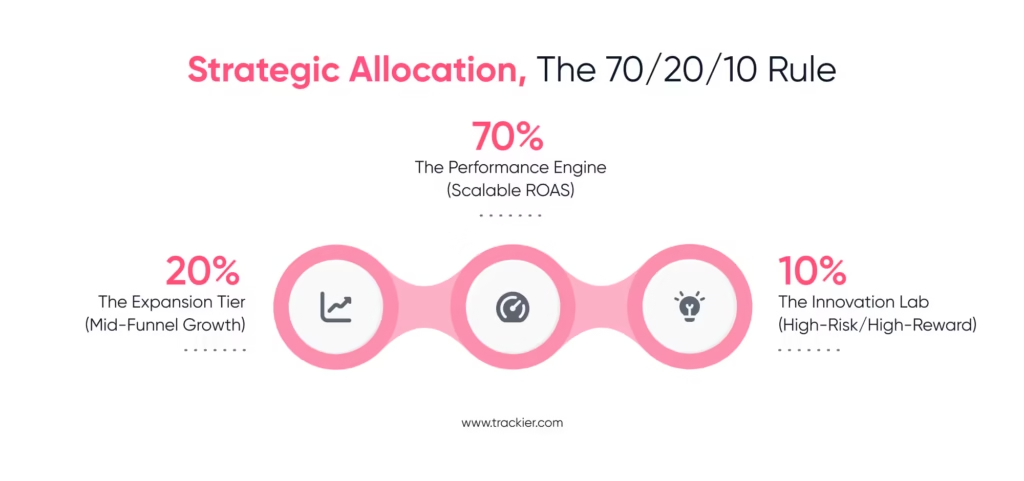
High-growth brands often fall into the trap of over-optimizing for the short term, leading to “brand decay.” We recommend a balanced distribution:
70% – The Performance Engine (Scalable ROAS)
This portion of the budget forms the backbone of predictable growth. These are mature, well-understood channels where performance can be forecasted with reasonable accuracy and scaled without breaking efficiency targets.
The focus here remains on Search Engine Marketing (SEM), retargeting, and high-intent social ads, where user intent is already established. These channels excel at capturing demand rather than creating it, making them ideal for revenue consistency.
Optimization at this level is less about creative experimentation and more about system-level efficiency. AI-driven automated bidding models should be used to dynamically adjust bids based on real-time signals such as intent strength, device behavior, geo-performance, and historical conversion probability. The objective is to protect target ROAS while continuously expanding volume.
At scale, brands should also:
- Segment campaigns by profit tiers rather than blended ROAS.
- Optimize toward contribution margin, not just top-line revenue.
- Actively suppress low-quality inventory that inflates conversions but depresses LTV.
This 70% is where discipline matters most. Any inefficiency here compounds quickly, but when managed correctly, it becomes the engine that funds experimentation elsewhere.
20% – The Expansion Tier (Mid-Funnel Growth)
The expansion tier exists to bridge the gap between demand creation and demand capture. This budget is explicitly designed for testing with the intent to scale, not for immediate profitability.
Channels like influencer partnerships, content marketing, creator-led media, and video-first platforms play a critical role in shaping perception, educating prospects, and warming audiences before they ever show explicit intent.
Direct ROAS often underrepresents the value of this tier. Instead, optimization should focus on assisted conversions, view-through impact, time-to-conversion reduction, and lift in branded search or direct traffic. These signals reveal how mid-funnel investments influence downstream performance in the 70% performance engine.
High-growth brands use this tier to:
- Identify creators or formats that consistently lift conversion rates elsewhere.
- Test messaging angles that later migrate into paid performance ads.
- Expand into new audience segments without destabilizing core efficiency.
The success of the 20% tier is measured by its ability to lower acquisition costs and improve conversion velocity across the entire funnel, not by last-click attribution alone.
10% – The Innovation Lab (High-Risk/High-Reward)
The innovation lab is not about chasing trends. It exists to future-proof growth and reduce dependence on any single platform or algorithm.
This budget is reserved for experimental channels and formats, such as AI-generated media, immersive experiences, new ad placements, or hyper-niche community sponsorships where traditional benchmarks do not yet exist.
Optimization in this tier requires a different mindset. Rather than judging success by revenue, brands should define leading indicators upfront, such as:
- Engagement depth
- Content retention
- Community participation
- Cost-efficient reach within a highly specific audience
A clear failure threshold must be established. If an initiative does not demonstrate a meaningful signal within 30 days, spend should be reallocated without hesitation. This discipline ensures innovation remains structured rather than speculative.
When innovation succeeds, the upside is asymmetric. What begins in the 10% tier often graduates into the 20% expansion bucket and, eventually, becomes part of the 70% performance engine.
Phase 3: The Marketing Budget Optimization Methodology
To achieve a “Complete Roadmap,” follow these four technical pillars of optimization.
Pillar 1: Predictive Attribution Modeling
With the sunsetting of traditional cookies, high-growth brands have moved toward Marketing Mix Modeling (MMM) and Media Lift Studies.
- How it works: Instead of tracking an individual user, MMM uses statistical analysis to determine how fluctuations in spend across different channels correlate with total sales.
- Action: Run a “Hold-out Test” where you turn off ads in a specific geographic region for two weeks to see the true impact on organic sales.
Pillar 2: Creative Optimization at Scale
In 2026, “the creative is the new targeting.” Algorithms prioritize ads with high engagement.
- Optimization Tactic: Use Dynamic Creative Optimization (DCO) to test hundreds of iterations of a single ad (different headlines, hooks, and CTA buttons) simultaneously.
- The Rule: Double down on the top 5% of creatives and “kill” the bottom 50% every week.
Pillar 3: Reducing “The Leak” (Conversion Rate Optimization)
There is no point in optimizing your ad spend if your landing page is a sieve.
- The Math: If you spend $10,000 to get 1,000 visitors at a 1% conversion rate, your cost per acquisition is $100. If you optimize the page to a 2% conversion rate, your CPA drops to $50 without changing a single ad.
- Action: Allocate 10% of your total marketing budget specifically to CRO (A/B testing, heatmapping, and site speed).
Pillar 4: Funnel Rebalancing
Optimization often reveals that a brand is “too heavy” at the bottom of the funnel. If you only bid on people ready to buy now, you will eventually run out of audience.
- Action: If your CAC is rising while your ROAS is stagnant, shift 15% of your bottom-funnel budget to top-of-funnel brand awareness to “re-fill” the pool of potential customers.
Phase 4: Common Roadblocks to Marketing Budget Optimization
The “Sunk Cost” Fallacy
One of the most common enemies of marketing budget optimization is emotional attachment to legacy channels. Teams continue investing in certain platforms, partnerships, or tactics simply because they once worked or because significant effort and budget have already been committed.
The reality is that past investment has no bearing on future returns. Markets evolve, audiences shift, and platforms decay. What delivered strong results two years ago may now be absorbing budget that could be generating far greater impact elsewhere.
High-growth brands counter this by:
- Forcing channels to re-earn budget every quarter.
- Evaluating performance against current benchmarks, not historical peaks.
- Separating decision-making from ownership to avoid bias.
Marketing budget optimization requires ruthless objectivity. The willingness to shut down a familiar but underperforming channel is often the difference between incremental growth and real scale.
Short-Termism
Short-term optimization feels productive but often creates long-term damage. Excessive focus on immediate ROAS, weekly sales spikes, or end-of-month targets can quietly erode brand equity, audience trust, and future demand.
Examples of short-termism include:
- Over-reliance on retargeting at the expense of prospecting.
- Aggressive discounting that trains customers to wait for offers.
- Creative fatigue caused by repeating “what converts” without refreshing messaging.
True optimization balances today’s efficiency with tomorrow’s demand. High-performing brands deliberately protect budgets for mid- and upper-funnel initiatives, even when short-term numbers look less attractive. They understand that brand strength lowers CAC over time and improves every downstream performance metric.
In other words, marketing budget optimization is not about winning this week. It is about compounding the advantage over multiple quarters.
Data Overload
More data does not equal better decisions. In fact, excessive dashboards often slow teams down, create conflicting narratives, and lead to analysis paralysis.
When every team is tracking dozens of metrics, focus is lost. Marketing budget optimization suffers because no one can clearly answer the most important question: What actually drives growth?
High-growth organizations intentionally limit visibility to 3–5 core metrics that align with executive goals, such as:
- LTV to CAC ratio
- Payback period
- Incremental revenue by channel
- Contribution margin
- Retention or repeat purchase rate
Supporting metrics still exist, but they serve diagnostics, not decision-making. This clarity ensures marketing, finance, and leadership stay aligned and prevents optimization from becoming a reporting exercise instead of a growth lever.
These issues rarely show up in dashboards, but they silently dictate outcomes. Optimization fails not because teams lack tools or data, but because they fail to challenge assumptions, balance time horizons, or simplify decision frameworks.
Brands that actively address these roadblocks move faster, reallocate smarter, and build growth systems that endure platform changes rather than react to them.
The Optimization Checklist
| Frequency | Action Item | Goal |
| Weekly | Creative Refresh & Micro-bidding | Maintain high CTR and low CPM |
| Monthly | Channel Performance Review | Reallocate budget from underperformers to winners |
| Quarterly | Incrementality & Lift Testing | Verify that ads are driving new revenue |
| Annually | Strategy & Tech Stack Audit | Ensure your tools and goals align with market shifts |
The Era of the Efficient Marketer
There was a time when budget optimization felt like an extra layer. That time is gone. For fast-growing brands, it has become a basic requirement to stay competitive. Costs are rising, platforms are crowded, and simply spending more money is no longer a reliable way to grow.
What separates strong teams from struggling ones is how intentionally they treat their budget. The best marketers are not chasing every new channel or reacting to weekly performance swings. They are building systems that help them understand what is actually working, where their money creates real impact, and when it is time to change course.
When performance marketing, brand building, and experimentation work together, growth feels less chaotic. Decisions become clearer. Teams stop arguing over numbers and start focusing on outcomes. Over time, this balance leads to healthier margins, stronger customer relationships, and more predictable growth.
The brands that will win in 2026 are not the ones with the biggest budgets. They are the ones that treat their marketing spend like an investment they actively manage, test, and refine. In this new era, being efficient is not about cutting costs. It is about making every dollar count and knowing why it matters.
FAQs
What is Marketing Budget Optimization and why is it critical for high-growth brands?
Marketing Budget Optimization is the strategic process of allocating, testing, and reallocating marketing spend to maximize incremental revenue and long-term profitability. For high-growth brands, it is critical because rising CAC, platform saturation, and tighter capital environments make “growth at all costs” unsustainable. Effective optimization ensures every dollar spent contributes to measurable business outcomes rather than vanity metrics.
How does Marketing Budget Optimization reduce CAC without slowing growth?
Marketing Budget Optimization reduces CAC by shifting focus from surface-level metrics to deeper performance indicators such as LTV, payback period, and incrementality. By improving data accuracy, reallocating spend toward high-impact channels, optimizing creative performance, and fixing conversion leaks, brands can scale efficiently without injecting additional capital or sacrificing growth velocity.
What metrics matter most for effective Marketing Budget Optimization?
The most important metrics for Marketing Budget Optimization include the LTV-to-CAC ratio, payback period, incremental revenue by channel, contribution margin, and retention rates. These metrics move beyond last-click attribution and help brands understand which investments create sustainable, long-term value rather than short-term performance spikes.
How often should brands revisit their Marketing Budget Optimization strategy?
Marketing Budget Optimization should be treated as a continuous process, not a one-time exercise. High-growth brands typically review creative and bidding performance weekly, reallocate budgets monthly, validate incrementality quarterly, and conduct a full strategy and tech stack audit annually. This cadence ensures optimization keeps pace with market shifts, platform changes, and evolving customer behavior.