A press release can announce a collaboration, product launch, funding update, or company milestone. But it cannot carry the full story of a brand on its own.
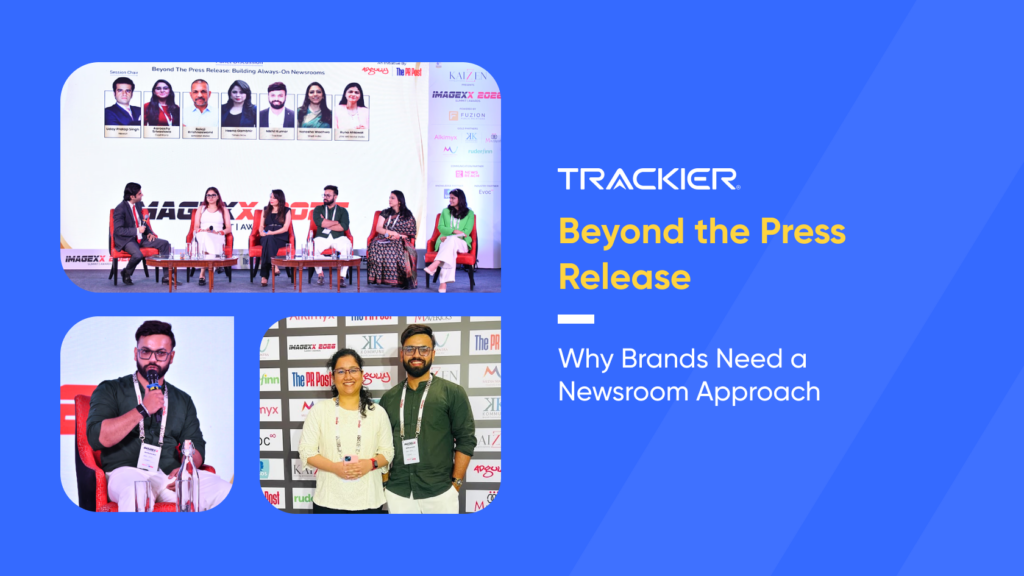
That idea came through clearly at IMAGEXX Summit & Awards 2026, organised by Adgully on 3rd June at Sheraton Hotel, New Delhi. The event theme, “PR Beyond Vanity: Trust, Growth & Speed,” raised a practical question: how do companies stay relevant when their audience is forming opinions every day, not just when an announcement goes live?
Trackier was represented by Nikhil Kumar, Brand Marketing Manager, in the panel discussion “Beyond the Press Release: Building always-on newsrooms,” chaired by Uday Pratap Singh, Senior Editor, NewsX.
Moving beyond announcements
Corporate PR was once built largely around formal announcements. The press release was controlled, polished, and tied to a specific moment. That worked when information moved slowly and audiences had fewer places to form an opinion.
That environment has changed.
Customers, partners, investors, journalists, employees, and industry observers now pick up signals from many places: LinkedIn posts, interviews, product updates, webinars, customer stories, media comments, newsletters, blogs, and leadership conversations.
A company may publish a press release and still lose relevance. In categories where platforms, regulations, buyer expectations, and market narratives move quickly, silence creates distance.
The better question for PR teams is not only, “What do we announce?” It is: what should the market understand about us before we ask for attention?
What an Always-On Newsroom Really Means
An always-on newsroom does not mean publishing every day, chasing every trend, or reacting to every conversation.
It means building a system that helps a brand stay prepared, consistent, and useful.
That system can include thought leadership articles, expert comments, product explainers, media responses, customer stories, executive viewpoints, newsletters, social content, and industry POVs. The format can change. The purpose should not.
The goal is not volume. It is relevance.
A strong newsroom function helps a company explain its category, respond to meaningful changes, simplify complex topics, and maintain a steady voice in the market.
This matters in SaaS, where the product is often not immediately obvious. Performance marketing, affiliate tracking, partner attribution, fraud prevention, campaign intelligence, and payout validation all need explanation. Buyers may not be ready for a demo until they first understand the problem, the risk, and the impact.
Speed Needs Judgment
The IMAGEXX theme brought together three words that matter deeply in PR: trust, growth, and speed.
Speed matters because conversations move without waiting for internal approvals. A platform change, regulatory update, market concern, or category debate can quickly create a moment where people look for a clear point of view.
But speed without judgment can be risky. A quick response that lacks context can create more confusion than clarity. Strong brands are not always the first to speak. They are often the ones that explain the issue best.
Preparation makes the difference. When a newsroom function is connected to the business, teams already know the key narratives, subject experts, customer concerns, and brand position. That is how speed becomes responsible rather than reactive.
Buyers Need Education Before Evaluation
B2B does not happen in a straight line. A buyer may read an article, attend a webinar, compare platforms, speak to peers and return to the same brand weeks or months later.
That makes PR and content part of the buying journey, not just part of brand awareness.
A performance marketing manager may want to understand partner attribution. An affiliate network may need clarity on fraud signals. A growth team may want to compare tracking approaches. A business leader may want to know how campaign intelligence improves ROI.
Ads and landing pages cannot answer these questions fully. Explainers, interviews, opinion pieces, practical articles, and informed media commentary help fill the gap.
For Trackier, this connects directly with the space it operates in. Performance marketing and partner marketing are built around measurable outcomes, but the mechanics behind those outcomes are layered. Attribution models, tracking links, conversion validation, payout accuracy, fraud signals, and partner performance often need explanation before they can influence buying decisions.
When a brand explains these areas clearly, it builds confidence before the sales conversation begins.
Strong PR Needs Internal Inputs
A newsroom cannot work well if it sits away from the business.
Strong communication needs inputs from product, sales, customer success, marketing, leadership, and support. Sales teams hear buyer objections. Product teams understand technical changes. Customer success teams know where users struggle. Marketing teams see which topics attract engagement. Leadership connects all of it to the broader direction of the company.
When these inputs come together, the brand stops producing generic content and starts responding to real business signals.
If sales teams keep hearing questions about partner fraud, the newsroom can build content around fraud prevention. If customers ask about payout accuracy, the brand can explain commission logic and validation. If privacy becomes a market concern, the company can share a practical point of view on responsible tracking and data clarity.
Presence Should Have a Point
PR should not be reduced to appearing everywhere. Visibility helps, but scattered visibility does not build authority.
A brand can collect mentions and still fail to create meaning. Another brand can show up less often but with sharper thinking, clearer explanations, and more useful commentary. The second brand is usually the one people remember.
Newsroom-led companies understand this distinction. They do not speak only about themselves. They speak about customer challenges, industry movement, and the decisions buyers are trying to make.
For Trackier, this approach fits naturally into the performance marketing ecosystem. The company works with businesses that want better partner visibility, cleaner campaign measurement, stronger fraud prevention, and more confident growth decisions.
These are product conversations, but they are also business conversations.
Conclusion: Show Up Before You Have News
The panel at IMAGEXX Summit & Awards 2026 pointed to a simple reality: PR teams need to move from announcement planning to communication readiness.
That requires better listening, stronger internal alignment, and a clearer sense of what the brand should be known for. It also requires teams to treat content, media commentary, executive voice, and market education as connected parts of the same system.
The brands that build long-term credibility will not be the ones that speak only when they have something to announce. They will be the ones that show up consistently with clarity, perspective, and purpose.
At Trackier, this thinking connects with a broader belief: better information leads to better business decisions. Whether the conversation is around partner visibility, campaign intelligence, fraud prevention, or performance tracking, clarity makes growth easier to understand and easier to act on.
Explore how Trackier helps businesses build stronger performance marketing ecosystems through better tracking, partner visibility, and campaign intelligence.