Gaining new customers is rarely the biggest hurdle to growth, but retaining them over the long term is the one.
Customer churn rate tracks this exact challenge by measuring the percentage of existing customers who stop buying from or subscribing to your business during a specific period of time.
If the customer loss rate is high, then it is a warning sign. A low number means customers like the product and are sticking around. This glossary explains what customer churn rate means, how to calculate it, and how businesses can reduce it.
What Is Customer Churn Rate?
Customer churn rate is the percentage of a business’s current customers who stop buying within a set timeframe, like a month or a year. Say you start with 100 customers at the start of the month, but 5 leave during the month; your rate is 5%.
You might wonder why this percentage deserves attention. The answer is that keeping old customers is cheaper than finding new ones. When many existing customers stop buying the product or services, then the business has to spend more on marketing campaigns just to stay the same size.
It also varies depending on the sector. According to Recurly’s July 2026 data, based on an annual research data set, SaaS companies have the lowest median customer loss rate at 3.22%, whilst education has the highest at 4.99%.
Again, what counts as a good customer loss rate depends on the sector. Comparing your company’s historical churn will provide the most accurate assessment of your performance.
How Is Customer Churn Rate Calculated
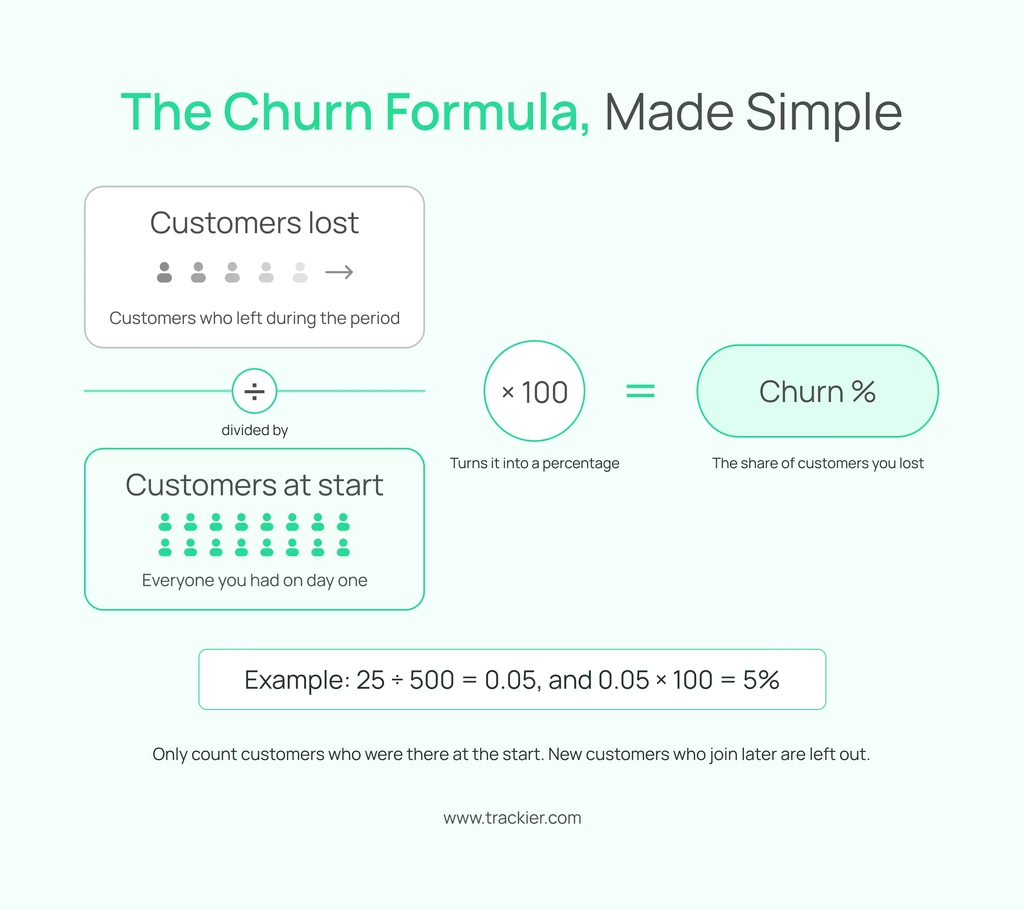
The customer loss rate formula is simple and easy to understand. You just need two numbers: how many customers you had at the start of the period and how many you lost by the end.
Divide the customers lost by the customers you had at the start and multiply it by 100.
Remember that only the customers who were at the start of the period are included, not the customers who joined during the period.
For example, A software company has 500 customers on 1st January. By 31 January, 25 of them have left.
Now let’s work out the customer churn rate. Take the number of customers who left during the period, divide it by the number of customers you had at the start, and multiply the result by 100.
25/500*100 = 5%. So the company here lost 5% of its customers during January.
Customer Churn Vs. Churn Rate Vs. Retention Rate
These three terms look the same, but all of them give answers to different questions.
- Customer churn is the number of patrons who left by the end of a specific period. As seen in the example above, the number of customers lost by the company was 25.
- Churn rate shows what portion of your customers walked away during a given timeframe. As seen in the example above, losing 25 out of 500 customers gives 5% as the customer churn rate.
- Retention rate measures the number of people who stick with your brand, as a percentage, instead of choosing an alternative. Subtract the percentage of customers who left during the period from 100%, which represents everyone you had at the start. So, 100% – 5% = 95% in the same example.
In short, churn is how many customers left. The rate shows how serious the loss is for your business as a whole, while retention shows how many customers you held on to. The significance of losing customers depends on the size of the starting customer base and the business’s economics. Knowing these three terms correctly helps you to read reports correctly and make the right decision.
How To Reduce Customer Churn Rate
Sometimes customers leave due to external factors like finances or other requirements that are not in the hands of the business to fix. This is called involuntary churn.
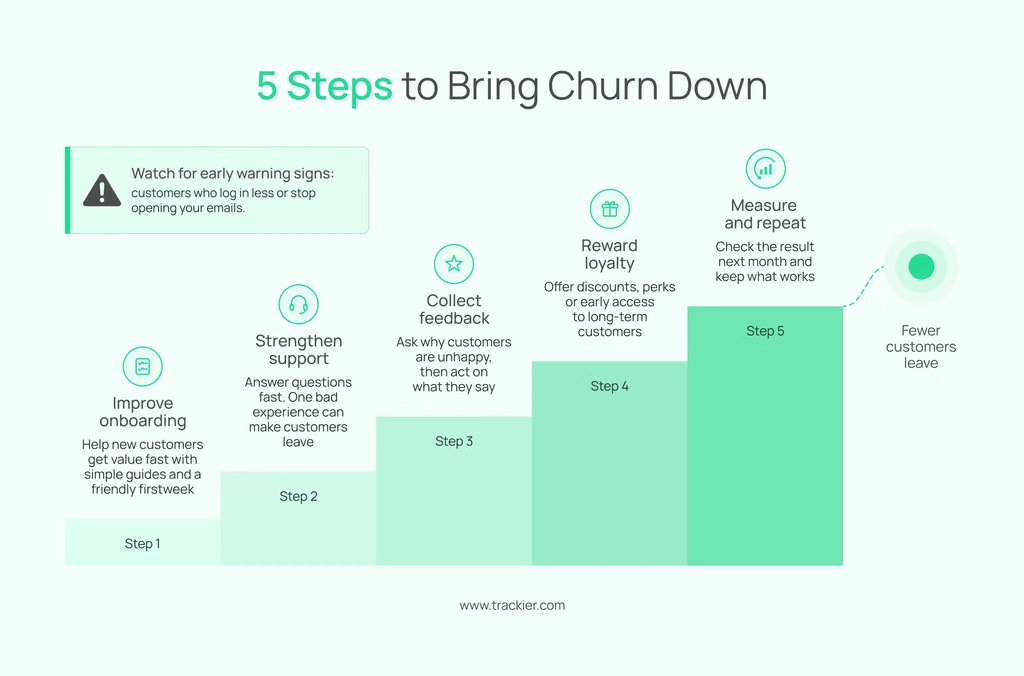
However, most customers leave because of internal factors, such as a weak onboarding experience or slow support, that can be fixed by the business. This is called voluntary churn. Below are the techniques to reduce customer churn.
- Improve onboarding – The first few weeks after the customer joins are very critical as the initial impression of the product or service makes the customers to stay for long. Show them how to get value with simple guides and easy-to-understand tutorials.
- Strengthen support – Many customers leave because of no reply in time. Fast and helpful answers build trust. Offer easy ways to get help, like 24/7 AI chat support for small issues and human call support for bigger issues.
- Collect feedback – Do not just guess why customers are unhappy. Ask them through surveys, quick calls, emails, etc to know why they left. This shows you care about your customers, which can help you get the lost customers back.
- Reward loyalty – Customers who stayed for a long time should feel valued. Offer them special discounts, perks, and early access to new products and services.
Why Customer Churn Rate Matters In Performance Marketing
In performance marketing, you pay to bring customers through different channels. But not every channel gives you valuable customers.
One partner brings a lot of customers who leave after 1 month, and another partner brings a few selected customers who stay for a long period of time.
Tracking churn by channels helps you analyze which partner brings more real and valuable customers and which one just sends the sign-ups.
Keep The Customers You Worked Hard to Win
Customer Churn rate tells you whether your customers are satisfied with your products and services or not. Measure it and compare it with your past results to act on what it shows.
Trackier helps businesses track customer actions and campaign performance in one place. It helps you analyze which channel brought you the most valuable customers so that you can plan your campaigns and budget allocation accordingly.
Why does Customer Churn Rate Matter, and How Is It Calculated?
Take the number of people who have left and divide it by the original number of people. Again, only include those who were present originally. If 25 people left from an initial figure of 500 during January, then the customer exit rate is 5%.
What is the difference between churn and retention?
While churn represents the number of people leaving, as a proportion, this is shown in the customer churn rate. People who remain are represented by the ‘retention’ rate. This is just 100% minus the customer exit rate – 5% churn would thus equate to 95% retention. Businesses with 100 customers are adversely affected by customer losses to a much greater extent than those with 5,000.
What is an acceptable churn rate?
This will again vary according to industry. Recurly’s July 2026 statistics show that SaaS has the lowest median customer loss rate at 3.22% and education has the highest at 4.99%. Consequently, the best way to assess your customer loss rate is to analyse it in relation to your historical data.
How can a company lower churn?
Initially address controllable factors. Enhance the customer experience during onboarding by providing basic instructions. Offer effective customer service, including quick response times and continued support until problems are resolved. Then use questionnaires and interviews to obtain customer views. Further, incentivise repeat business by offering benefits such as special deals, added services, and priority access. Although some reasons for churn are beyond a company’s control, most factors can be addressed.
What is the difference between voluntary and involuntary customer churn?
Customers can voluntarily churn for many reasons, including poor onboarding, inadequate customer service, or financial considerations. Customers may involuntarily churn when a payment cannot be processed or a card has expired. To reduce voluntary churn, good value and customer service should be provided. For involuntary churn, payment retrieval should be improved.