Customer acquisition has never been more competitive, or more expensive. As digital channels become saturated and advertising costs continue to rise, businesses are under increasing pressure to acquire customers efficiently while maintaining profitability.
In fact, recent industry research shows that customer acquisition costs have increased by more than 60% over the past decade, with many B2B companies experiencing a similar surge in the last five years.
Another obstacle to acquiring customers is the lack of predictability in marketing performance. There are significant challenges related to changes in the privacy policy, fragmentation of customer journeys, and competition for paid media.
Due to all this ambiguity, brands have spent a lot of money on marketing, but they don’t necessarily know which campaigns delivered conversions for them.
This blog discusses several strategies that brands can use to reduce customer acquisition cost by optimizing marketing funnels, using partner marketing programs, and improving attribution tracking systems using Trackier.
What is Customer Acquisition Cost?
Customer acquisition cost (CAC) represents how much a company invests in sales and marketing efforts to gain a single new customer. Customer acquisition cost accounts for all of the expenses associated with attracting prospects, engaging with those prospects, and converting them into paying customers.
CAC is also an important KPI for marketers to use when analyzing the effectiveness of their marketing strategy budget towards generating customers and revenue for the business. CAC can be calculated using the following formula:
- CAC = Total Marketing + Sales Expenses / Number of New Customers Acquired
For example, if a business invests $50,000 on marketing and sales and acquires 50 new customers, CAC would be $1,000.
Why High CAC is a Problem for Businesses?
An elevated CAC impacts a company’s profits significantly and the long-term growth thereof. If businesses are spending excessive amounts on acquiring each customer, it will decrease their profit margins while creating difficulty in justifying marketing expenditures.
The most notable outcome of high CAC is decreased profitability. If the rate of customer acquisition price rises more quickly than revenues earned from the customers, then it will be challenging for businesses to achieve and sustain growth.
As the competition continues to escalate in the digital space, this problem is not only prevalent; rather, it is becoming more frequent. Studies reveal that retention is the hidden profit center; a 5% improvement in retention drives 25–95% profit increases.
The second major outcome of increased CAC is that businesses often misdirect their marketing budgets by targeting ineffective audiences with their marketing campaigns.
Another problem associated with high CAC is that businesses may spend their marketing budget on ineffective channels.
If businesses allocate marketing dollars to channels that generate traffic but do not convert that traffic into actual customers, then their CAC will continuously increase.
Key Factors That Increase Customer Acquisition Cost (CAC)
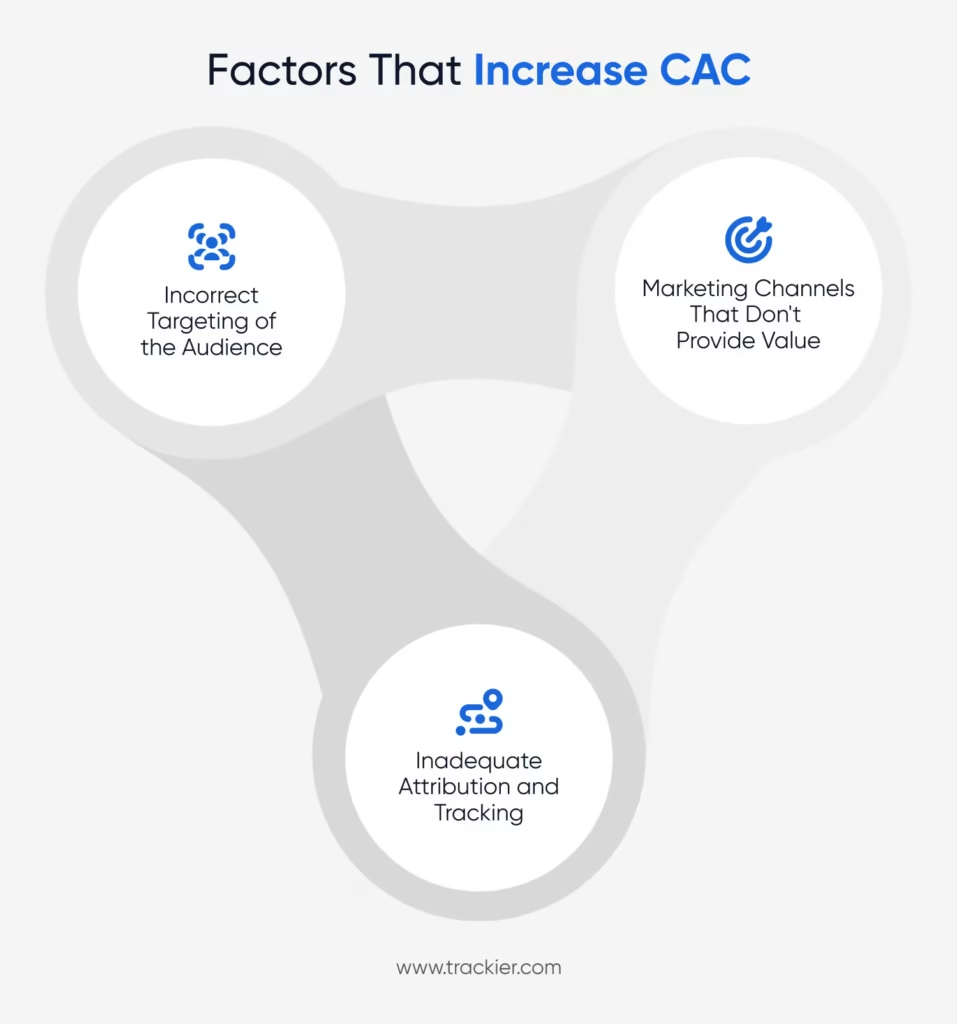
Customer acquisition cost does not rise overnight. It usually increases because of inefficiencies in marketing strategies, rising competition, or poor optimization across the customer journey.
In recent years, many businesses have seen acquisition costs grow significantly as digital advertising becomes more competitive and customer behavior changes.
By understanding what drives these costs, businesses can identify areas that may be causing inefficiencies and create more sustainable acquisition strategies.
1. Incorrect Targeting of the Audience
Incorrect targeting of the wrong audiences can be one of the major contributing factors to your business having a higher CAC. You are wasting your marketing dollars when your campaigns are delivering impressions or clicks to users that aren’t likely to convert into sales and generate very little revenue.
Some companies target broadly in their advertising campaigns with no clearly identified customer profile (ICP). This leads to too many marketing dollars being spent on generating the same number of customers, resulting in lower engagement rates and a higher customer acquisition cost.
Many modern marketing platforms rely on data-driven, specific targeting. For example, lookalike audience models use up to 80% accuracy to match potential customer profiles with your customer profile, enabling you to reduce wasted advertising dollars.
2. Marketing Channels That Don’t Provide Value
Not all marketing channels are created equal when it comes to returning your investment. Businesses often increase their customer acquisition cost by pouring money into marketing channels that generate large amounts of web traffic but do not convert those visitors into paying customers.
Based on studies, B2B companies will spend approximately $802 for each new customer captured through paid search, and as high as $982 for the same customer acquired through a paid social advertising campaign on LinkedIn.
There are many reasons for the increased costs of these marketing channels:
- More businesses are competing for limited ad space.
- The increase in cost-per-click (CPC) through search and social networks.
- Changes in algorithms by social media networks and search engines.
- Increased privacy restrictions are making it more difficult for advertisers to accurately target users.
Finally, there has been a greater than 5% increase in the cost of digital advertising across all markets in recent years, which has significantly added to the cost of acquiring new customers.
As a result of not regularly assessing the performance of different marketing channels, many businesses continue to invest heavily in marketing channels that are not producing results; this results in wasted marketing expenses and higher CAC.
3. Inadequate Attribution and Tracking
Poor marketing attribution leads to high CAC’s. Businesses may spend millions of dollars on various marketing channels, strategies, partnerships, and campaigns without knowing which one produced the desired results.
Brands frequently utilize their last-click attribution models to determine the source of the conversion, but by only acknowledging the last interaction before the purchase, they ignore the entire customer journey leading up to that conversion and underrate the channels, such as content marketing, influencer partnerships, or affiliate campaigns, that are important to generating conversions.
Trackier offer accurate marketing attribution by tracking each click, every interaction, and each conversion across all channels, providing click-level tracking across devices, real-time analytics, and the ability to understand how different interactions contribute to a conversion.
With real-time reporting and multi-channel attribution, marketing teams can:
- Identify which sources of traffic produce the best quality users.
- Allocate budget to campaigns producing the highest ROI.
- Identify fraudulent or invalid traffic that inflates their average CAC.
- Track the entire customer journey from web, mobile, or partner channels.
Proven Strategies to Reduce Customer Acquisition Cost
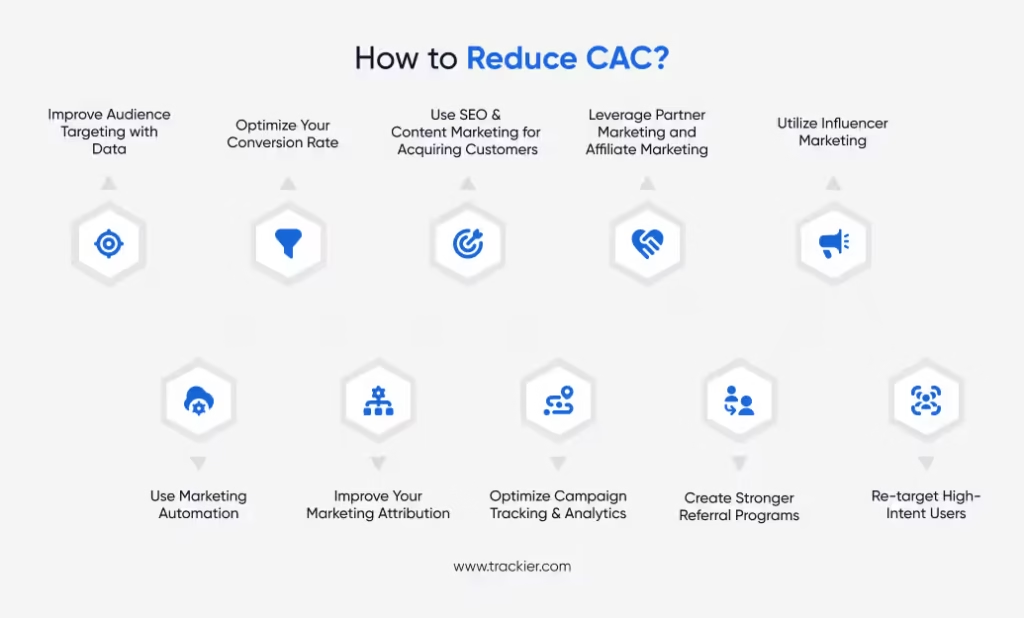
Customer acquisition costs are rising across industries, making efficient marketing strategies essential for sustainable growth.
For example, CAC for many D2C brands has increased significantly in recent years due to rising ad competition and declining ROI from generic campaigns.
The following proven strategies help businesses optimize their acquisition efforts, reduce wasted spend, and improve marketing efficiency.
1. Improve Audience Targeting with Data
You can reduce CAC by enhancing your audience targeting. Marketing campaigns aimed at users who are more likely to convert will lead to higher conversion rates and a lower amount of ad spend wasted.
Companies using first-party data strategies have found that they can reduce CAC by 30–50% due to their focus on users with a higher purchase intent.
You can start with first-party data from measurable sources: website activity, customer relationship management (CRM) data, and history of past purchases.
This provides marketers with an opportunity to better understand consumer preferences and the buying process throughout time. They can then create comprehensive audience portraits that illustrate various aspects such as demographics, behaviours, goals, and struggles.
Another effective way to enhance conversion rates is by utilizing lookalike audiences. Platforms such as Meta and Google leverage AI to identify potential new customers who are similar to your current customers. This enhances the accuracy of the targeting of your advertising and the effectiveness of the campaigns.
Finally, high purchase intent users can be retargeted through advertising. For example, retargeting users who visit a product detail page on your site or adding items to their shopping cart but do not purchase will increase conversion rates significantly.
The reason for this is that users who have returned to your site are likely to have a greater chance of converting than users who are just visiting for the first time.
2. Optimize Your Conversion Rate
Reducing your CAC isn’t just about getting more traffic; it’s also about converting that traffic into sales. Conversion rate optimization is what helps you do this by increasing the number of users who take the desired action(s) (e.g., sign up, purchase).
Improving how your landing page looks is the best way to get more people to complete your desired action (higher conversion rates). Clear value propositions, better graphics, and strong CTA can result in higher conversion rates.
Another effective way to reduce your CAC with CRO is by reducing the friction of signing up (have as few fields as possible in your signup forms) and simplifying the user experience/journey.
One method of optimizing for higher conversion rates is to use A/B testing on CTAs, headlines, and page layouts to determine what users like best. Studies have shown that A/B testing can reduce CACs by 20-40% by identifying the best creative elements.
Page speed is important too. The more users abandon a website due to slow loading speeds, the higher businesses’ CACs become since they pay for traffic that does not convert to revenue. Therefore, better loading speeds provide a better user experience and increase conversion rates.
3. Use SEO and Content Marketing for Acquiring Customers Inexpensively
The rate of increase in the cost of paid advertising is outpacing the rate of increase in revenue that companies receive from acquiring customers through paid means, making the ability to acquire customers through organic (free) means increasingly valuable.
Through content marketing, by producing blog posts, guides, case studies, and educational materials, brands are able to generate organic traffic to their website without spending money on each click.
Although SEO takes longer to achieve your desired results than paid advertising, it will provide you with a more sustainable method for acquiring customers over the long term.
Depending on the specific industry that you operate within, your company’s CAC from organic search can often be substantially lower than your CAC from your paid channels due to the ongoing nature of the traffic generated from your company’s content.
Also, inbound marketing increases a brand’s authority and trust in the marketplace, which leads to improved conversion rates, thereby decreasing the dependence a brand has on expensive paid advertisement campaigns.
4. Make Use of Partner Marketing and Affiliate Marketing
Partner marketing and affiliate marketing are generally regarded as low-cost channels for acquiring new customers because they work under a performance-based model; you only pay for advertisements after you’ve gotten a sale from them.
By reducing the risk of losing money on advertisements, you can also partner with other trusted businesses (publishers, influencers, etc.) to reach more customers. Partner and affiliate networks allow your business access to new audiences that you wouldn’t normally have through traditional media buying.
Since referral and affiliate channels typically have a lower customer acquisition cost than traditional advertising methods, they are based primarily on the recommendations of others and how much you want to reward them per successful sale.
5. Utilize Influencer Marketing
Influencer marketing is one of the fastest-growing channels for acquiring customers because it offers the added benefit of social proof and targeted outreach. Influencer recommendations are usually trusted more than traditional forms of marketing because of the connection that you have with them as a result of following their content.
The majority of brands are beginning to partner with micro-influencers, or those that have a smaller number of highly-engaged followers, because of the fact that they generally create better engagement rates and have much lower costs associated with running their campaigns than celebrity endorsements.
A well-executed influencer marketing campaign can drive a significant volume of high-quality traffic to your website and increase your conversion rate, which will enable you to acquire customers at a lower cost.
6. Marketing Automation Implementation
Marketing automation tools help businesses nurture leads more efficiently while reducing manual effort.
Automated email campaigns, CRM workflows, and lead scoring systems ensure that prospects receive the right message at the right time.
Automation allows businesses to grow their marketing capabilities without an increase in team size.
7. Marketing Attribution Improvement
Many businesses experience high CAC due to a lack of accurate accountability of which channels actually lead to a conversion. If businesses do not have accurate channel attribution, they may allocate their budgets towards under-performing campaigns.
Using multi-touch attribution methods, marketers can produce a full understanding of their customers’ journey, which will allow them to identify the channels that are generating the best ROI, and, in turn, will allow them to reduce spending on low-ROI channels and to invest more in the channels that are producing revenue growth.
8. Re-targeting High-Intent Users
Re-targeting provides the lowest acquisition costs by targeting users who have previously shown Interest in your products and are therefore already aware of your brand.
A staggering 98% of a website’s visitors do not convert on their first visit; therefore, re-targeting campaigns allow you to capture all the missed opportunities and generate revenue from these lost opportunities.
Additionally, re-targeting advertisements tend to cost 30-60% less than “cold” or new campaigns and often produce significantly higher ROI.
Using more personalized messages, such as reminding users about abandoned carts or providing customers with a limited-time discount, can increase conversions.
9. Building Stronger Referral Programs
Referral programs utilize the existing customer base to convert into loyal customers for your brand. Referrals tend to convert much quicker due to people’s trust in friend and co-worker referrals over advertising.
By offering incentives (discounts, rewards, or credits) to existing customers for recommending your product, you can not only save on the acquisition costs associated with getting new customers through referral programs, but you can also improve the quality of customers being brought on board through referral programs and improve customer retention via referral programs.
10. Optimize Campaign Tracking and Analytics
To reduce CAC, continual tracking and optimizing of your marketing campaigns are essential. Businesses must track KPIs in real time to find out which of their marketing campaigns produce profitable conversions.
Advanced analytics tools allow marketers to detect fraud, identify underperforming channels, and optimize partner performance. By eliminating invalid traffic and redistributing budgets to high-performing campaigns, businesses can improve acquisition efficiency and create sustainable growth.
How does Performance Marketing Software Help Reduce CAC?
Performance marketing software helps marketers to have a better perspective of how their overall campaigns, channels, partners, etc., convert (become customers), thus enabling marketers to better reduce CAC. By tracking every touch point as an accurate data point, marketers can easily budget the highest-performing sources of acquisition.
- Brands can track campaign information (clicks, impressions, and conversions) across multiple channels from one dashboard. Having this visibility on all channels allows marketers to see which campaigns deliver results and which waste budgets.
- Through advanced attribution modeling, marketers can see how different marketing touch points influence a customer’s purchase decision. Multi-touch attribution can provide insight into the effectiveness of a variety of channels along the customer journey as opposed to relying on last click attribution, thus allowing teams to allocate their marketing budgets more effectively, reducing wasted budgets.
- Trackier also provides marketers insight into how their partners (affiliates, influencers, media partners, etc.) perform based on actual conversion data. This will allow marketers to better direct their marketing spend toward those partners who are consistently able to drive quality traffic.
- Fraud prevention tools allow marketers to identify invalid traffic, click fraud, and suspicious activity that inflate acquisition costs.
Conclusion
Reducing CAC doesn’t necessarily mean budget cuts; it means making more intelligent, evidence-based decisions when it comes to allocating your advertising spend. By understanding which channels, campaigns, and partners lead to conversions, marketers can more effectively allocate their budgets and scale those activities that produce results.
Marketing attribution and performance marketing software enable marketers to identify the highest-ROI channels, optimize their campaigns, and eliminate wasted dollars spent on non-effective channels, improving overall marketing ROI and lowering customer acquisition costs.
To successfully scale your marketing efforts while lowering your CAC, you need to gain complete insight into your performance data. Trackier provides brands with an all-in-one platform for tracking campaigns, accurately attributing conversions, identifying fraud, and optimizing partner performance.
Book a demo to turn your marketing dollars into quantifiable and sustainable growth today!
FAQs
1. How does conversion rate optimization (CRO) help reduce CAC?
CRO increases the number of visitors purchasing from you, which lowers the cost per customer. The simplest way to do this is via improved website traffic to sales conversion (landing pages), as well as reducing the number of forms (and how complicated they are) that potential customers must fill out. Even small gains in the percentage of prospects purchasing from you can lead to reductions in total sales acquisition cost.
2. How does customer retention impact CAC?
Retaining customers increases the cost-effectiveness of acquiring those customers. If a customer remains for a longer time and makes more purchases during their relationship with you, their overall lifetime value increases, making them more cost-effective to acquire. Retained customers also create referrals (to other prospective customers) and repeat transactions, reducing your need to acquire new customers repeatedly.
3. What are the common mistakes businesses make when calculating CAC?
Most businesses consider only the total advertising spend when calculating CAC. In addition to ad spending, costs associated with acquiring customers include the following: salaries for sales staff; costs associated with marketing tools; costs for producing marketing collateral; agency fees related to producing collateral; and other expenses, such as costs associated with bringing the new customer. Failure to include any of these expenses can result in inaccurate CAC, which can lead to developing ineffective marketing strategies.
4. How can businesses identify high-CAC marketing channels?
Brands can assess the cost of acquiring customers through marketing efforts by examining their marketing efforts’ performance metrics, such as campaign performance, conversion rates, and return on investment (ROI). Additionally, by segmenting CAC into specific marketing channels, brands will know what type of campaigns yield profitable customers and which campaigns spend money without producing substantial results.
5. Can automation and analytics tools help reduce CAC?
Yes, utilizing automation and analytics tools assists brands in determining their marketing automation and analytics results through reporting and real-time data reporting. Once data has been collected, marketers will be able to quickly recognize which marketing efforts/automated campaigns are not performing to expectation and focus on higher-performing channels, resulting in lower costs per acquisition.