Promo codes are not just to provide discounts anymore; they have now become one of the most efficient ways to obtain customers, improve conversions, and evaluate marketing success. In fact, 64% of online shoppers look for promo codes prior to making their purchases, which makes promotional codes an essential part of the purchasing process.
Nonetheless, it is not enough to generate a promo code and share it via the marketing channels. Successful campaigns require proper targeting, personalization, timing, and performance measurement to achieve maximum ROI.
Performance marketing software, such as Trackier, enables marketers to go beyond merely redistributing discount coupons. By connecting promo code tracking with attribution, affiliate management, and campaign analytics, brands can identify the promotional payment that leads to the additional income, rather than just the decrease in sales.
In this blog post, you will get to know what promo codes are, what their functions are, what the current promo code trends are in 2026, how to effectively enhance campaign performance, and real-life cases of brands using promo codes successfully.
What is a Promo Code?
A promo code is a digital coupon code that customers enter during checkout, either online or at a point-of-sale system, to receive a discount or special offer.
Promo codes come with different benefits, including:
- Discounts in percentages.
- Discounts in fixed amounts.
- Free items with every purchase.
- Free shipping.
- Special offers for a limited time.
Choosing the promo code depends on the target audience, advertisement goals, and the type of advertisement to be conducted.
In the year 2026, the percentage of usage of coupon codes within online shopping transactions is expected to reach 38%, which is an increase of 6% from the 32% in 2024.
Some companies may use multiple promo codes to find out which promo generates a higher conversion rate. Other companies tend to switch promo codes since the customers may get used to the same promotion after some time.
It is important to note that promo codes must be limited in time to be effective. When promo codes are limited in time, the customer will take urgent action since they will be aware that the offer will not be available for a long period of time.
How Does a Promo Code Work?
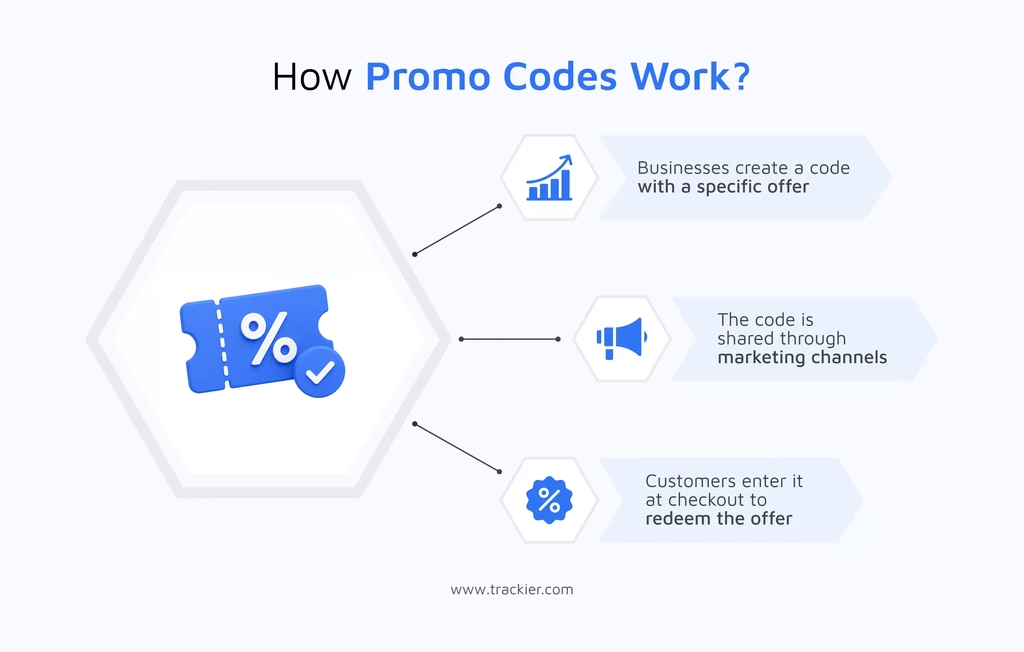
After understanding what is a coupon code, the next step is learning how it actually works in real marketing scenarios. Promo codes can be used in multiple ways to highlight your most generous offers. They can appear:
- On homepage banners
- In header or footer sections
- On product pages
- In email marketing campaigns
- Across different stages of the user journey
Promo codes can support every stage of your marketing funnel, from awareness to conversion and retention. Once you understand the promo code, you can position it strategically instead of treating it as just a discount tool.
The State of Promo Codes in 2026: Key Data and Trends
Before diving into strategy, it’s critical to understand the current industry. The promo code market has experienced significant transformation, with impressive statistics presenting the situation.
1. Market Size and Growth
The international digital coupon market will hit $12.55 billion in 2026 (the value of 2025 being estimated at $10.6 billion), exhibiting an 18.33% CAGR that will lead us to the figure of $34.43 billion by 2032.
At the same time, the overall mobile coupon industry had generated $727.3 billion in 2024, with the expectation of growth up to $1.6 trillion by 2030.
2. Consumer Behavior Stats
62% of customers are looking for promo codes on the web prior to making their purchases. 48% of people do not buy from brands that do not provide coupons and discounts. 70% of customers buy unplanned items while being inspired by discounts and coupons.
3. Redemption and Channel Data
93.5% of customers who prefer digital coupons redeem them through smartphones. 59% of consumers go to Google to find discount codes, making the search engine number one.
6 Strategies to Make Promo Codes Convert in 2026
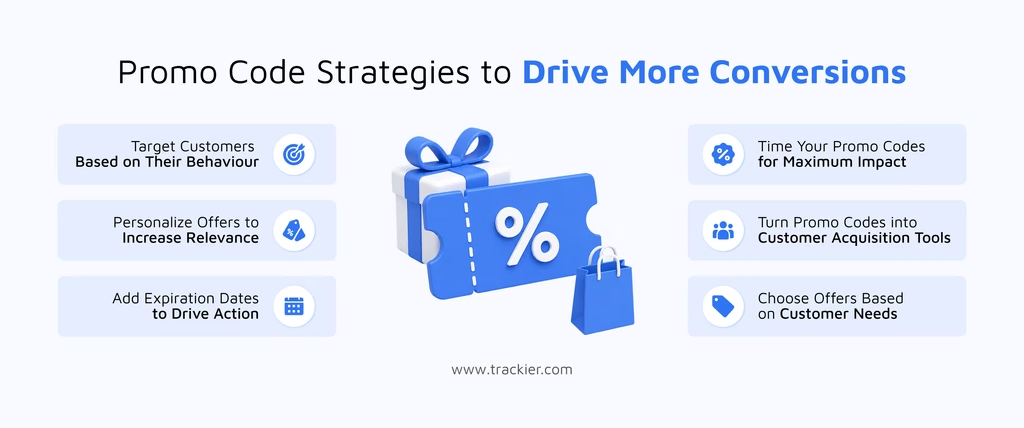
The promo code industry has changed dramatically. The brands winning in 2026 aren’t issuing more codes. They’re issuing smarter ones, backed by behavioral data, precise timing, and personalized targeting.
Below are six strategies to make your promo codes actually convert in an environment where attention is scarce and expectations are high.
1. Set Smart Targets Using Customer Behaviour
Before introducing your promo code campaign, it is wise to adopt customer behavior analytics and segmentation.
For instance, you can permit promo code redemption only when customers meet a specific cart amount. This is effective at enticing them to add more items and enhance average order value.
However, keeping impractical spending objectives can backfire. The gap between increasing average order value and creating a loss in sales is small. It is necessary to utilize analytics for achieving the right mix in line with shopper spending patterns.
Due to the fact that shops are already employing, on average, 8.4 various coupon codes at one time (compared to 6.2 in the whole year of 2024), your promo code redemption minimums should be based on data.
2. Target the Right Customers with Personalized Offers
Many marketers still overlook personalization and segmentation. Using email marketing automation tools, you can segment customers based on:
- Demographics
- Geography
- Transaction history
- Purchase behavior
Once segmented, you can send tailored promo codes.
For example, customers celebrating birthdays can receive a special discount code. You can also analyze past purchases and offer promo codes on related items to encourage upselling and cross-selling.
Personalized coupons can achieve much higher redemption than generic offers, and by 2026, over 90% of coupon platforms are expected to use AI-driven personalization. That means failing to segment is no longer a minor optimization issue; it’s a competitive disadvantage.
3. Use Expiration Dates to Create Urgency
Consumers want to get their hands on a good deal right away. You have to take advantage of this to nudge consumers into making up their minds quickly.
You can try using expressions like “Limited Time Offer” or “Sold Out Soon.” You may even wish to add a timer for your promo code.
In fact, Research indicates that as many as 82% of shoppers redeem their online coupons within a week and around 30% do so within 24 hours.
4. Timing Matters When Sending Promo Codes
It’s all about the timing. Sending the right offer at the right time is crucial. During slow seasons, discount-based promo codes can increase demand.
During holidays or peak periods, strategic offers can help you stand out from competitors. You can also set up automated triggers. For example:
- Cart abandonment emails with a promo code
- Welcome discounts for new subscribers
- Re-engagement codes for inactive customers
These automated workflows ensure your promo codes reach customers when they are most likely to convert.
5. Use Promo Codes to Attract New Customers
Promo codes can be highly effective in attracting new customers, along with building the email list, apart from retaining existing clients and compelling return business.
You can encourage referrals by offering promo codes when customers invite friends. You can also provide first-purchase discounts to new email subscribers to reduce friction and motivate action.
This helps grow your email list and increase new customer conversions. This helps grow your email list and increase new customer conversions.
First-order coupons typically outperform repeat-customer offers, and new-customer acquisition through coupons can increase ROI when lifetime value supports the discount.
6. Send the Right Type of Offer
We’ve discussed above how to send the right promo code to the right customer at the right time. However, we haven’t yet talked about the right kind of offer. As a marketer, you should be aware that though all clients like discounts, some want free delivery or other things.
Experiment with various types of offers to see which one resonates best with your target audience. The result should be enough to determine the right next step.
Promo codes that offer discounts or freebies to clients are not always likely to convert into sales or even purchases.
You have to strategize your promo code just as you would with any other marketing strategy. Remember, promo codes are part of your overall marketing strategy. They require planning, testing, and performance tracking to drive meaningful results.
Real-Life Instances of Successful Promo Code Marketing
Promo codes achieve maximum effectiveness as part of a comprehensive marketing campaign rather than merely as a price cut. Brands that make promo codes successful in generating sales also utilize exclusive offers, personalization, and timing.
Below are two successful cases of brands that benefited from using promo codes.
1. Polysleep: Creating Demand with Exclusive Promo Codes
Polysleep, a Canadian mattress manufacturing company, successfully used promo codes while acquiring new customers as well as retaining the current ones.
Instead of offering discounts to everyone, Polysleep made an offer to its customers to subscribe to the mailing list and get access to special promotions, limited-time sales, and discount codes exclusively for subscribers.
Alongside these targeted promotions, Polysleep used automated email flows to educate customers and deliver relevant promotional offers during the buying journey. Combined with its e-commerce strategy, the company achieved:
- 3× growth in net revenue since 2020
- 900% growth in organic website traffic
- Expansion into international markets while operating with a team of fewer than 15 people
While these results weren’t driven by promo codes alone, exclusive promotional offers played an important role in increasing customer engagement and improving conversion opportunities throughout the sales funnel.
2. Caraway: Using Exclusive Promotional Offers to Acquire New Customers
Premium cookware brand Caraway partnered with Shopify’s Shop Campaigns to attract first-time buyers using exclusive promotional offers rather than broad, sitewide discounts.
The campaign rewarded eligible shoppers with enhanced Shop Cash incentives, making the offer feel personalized and exclusive while helping Caraway maintain its premium brand positioning.
The results were impressive:
- Over $1 million in attributed revenue
- Customer acquisition costs remained stable despite rising advertising costs
- Successfully scaled new customer acquisition without relying on aggressive blanket discounts
Caraway’s campaign demonstrates that promo strategies don’t always require deeper discounts. By offering incentives only to the right audience at the right stage of the customer journey, brands can acquire new customers while protecting their margins.
Conclusion
Promo codes are only the first step towards getting yourself accustomed to them. To make the most of it, you should not simply use it randomly. You should plan to use it wisely, choose the exact time to launch your offer, choose the type of offer that corresponds to your audience’s needs, and all that time keep track of its performance.
When running a promo code campaign today, you cannot be lazy and send the exact same discount to all customers in one go; that outdated spray-and-pray approach no longer works. You must first segment your audience using accumulated customer data, deliver exclusive, personalized pushes to different groups, and also be able to trace origins accurately.
Every redemption of a promo code must be able to correspond to the conversion brought by which specific step of promotion it was originally from. Supported by these solid practices, the campaign can operate healthily.
If you can sort out and manage the entire logic of promo codes properly, merchants can gain many tangible benefits: not only can you attract first-time customers who have never spent money to place orders in your store, but you can also increase the average spending per order, retain existing customers who have made purchases before and keep them willing to make repeat purchases, and even maximize the return on every cent spent on marketing.
There is an even more critical matter than these: you cannot judge whether a campaign is successful merely by counting how many coupons have been redeemed. You must judge by tracking the core statistical metrics that directly impact business growth, and the metrics to track include:
Redemption Rate, used to assess whether the offer you are promoting itself is attractive to customers and whether the campaign actually works.
Conversion Rate, used to measure how promo codes influence customers’ final decision to place an order and spend money.
Average Order Value (AOV), used to evaluate whether the offer has led customers to add more items to their orders and spend more in total.
Customer Acquisition Cost (CAC), used to evaluate whether the efficiency of acquiring new customers via promo codes is high and whether the money spent is reasonable.
Return on Investment (ROI), used to measure the profitability of the entire promo campaign from start to finish.
Repeat Purchase Rate, used to assess whether promo codes can help you retain customers and cultivate loyal long-term repeat buyers who are willing to spend money repeatedly.
FAQs
How do promo codes increase average order value?
After understanding what a promo code is, the next question is how it impacts average order value. Promo codes often require a minimum purchase amount before they can be applied. This encourages customers to add more products to their cart to qualify for the discount. As a result, businesses increase their average order value while still providing an incentive to complete the purchase.
Are promo codes effective for customer acquisition?
Yes. Promo codes reduce purchase hesitation for first-time buyers. Offering a welcome discount or referral-based promo code can encourage new customers to try your products or services. When used strategically, promo codes help lower customer acquisition costs.
Should promo codes always have an expiry date?
Yes, in most cases. Expiry dates create urgency and prevent customers from postponing purchases. Limited-time offers increase conversion rates because customers feel they might miss out. Without expiration, promo codes lose their effectiveness over time.
Are promo codes still effective in 2026?
Yes, promo codes remain an effective marketing tool when used strategically. Modern brands combine promo codes with affiliate marketing, influencer partnerships, personalization, and advanced tracking to drive measurable customer acquisition and revenue growth.
How can businesses prevent promo code fraud?
Businesses can reduce promo code fraud by setting usage limits, restricting codes to specific customers or regions, monitoring suspicious redemption patterns, preventing coupon abuse, and using fraud detection and attribution solutions.