Businesses use various marketing attribution models to make better budget decisions, optimize campaign strategies, and measure the return on investment (ROI) of their marketing campaigns.
However, if you are wondering how to improve your budget allocation and understand exactly how customers enter your funnel, the first-touch attribution is the answer. This model assigns 100% of the conversion credit to a customer’s very first interaction with your brand.
In this glossary, you will learn how the first-touch model works, where it falls short, and how to decide whether it is the right fit for your campaigns.
How does first-touch attribution work?
Think of first-touch attribution like introducing a new customer to your business. The main goal is to identify what brought that person to your brand for the first time.
When the potential customer discovers your brand for the first time, whether by clicking on a Facebook ad, searching on Google, or tapping on some link, website tracking tools record that moment.
Even if that customer sees 20 more ads or visits your site five times before making the final purchase, 100% of the credit will be given to the very first interaction that was recorded by the website tracking tools. Any type of interaction after that will get zero credit if you’re using this type of attribution modelling.
Let’s understand it with the help of a simple example:
- Step 1: Sarah sees an ad for running shoes on Instagram and clicks it to browse your website, but she leaves without buying anything
- Step 2: After two days, she watches another creator’s video on YouTube and clicks on the link and adds the shoes to the cart provided but still doesn’t purchase.
- Step 3: Finally, on the fifth day, she visits the website and finally purchases the shoes with the help of the YouTube creator’s link.
Under the first-touch model:
Instagram Ads from Creator 1: Receives 100% of the credit because it was her very first channel of interaction with your brand.
YouTube Ads from Creator 2: Receives 0% credit, even though he helped her to further move and finally purchase the product.
Benefits of first touch attribution
If there are multiple types of attribution modeling, why would someone choose to use the first-touch model? At this stage, that’s a valid question to ask. Let’s understand by reviewing the most crucial benefits.
- Shows what brought customers:
It shows the exact channels that first introduced the customers, so that you know which marketing channels are getting people to the brand and can make budget allocation decisions accordingly to increase the efficiency of your campaigns.
- Rewards brand awareness:
Top-of-funnel marketing—like social media ads or blogs—brings potential customers to your brand for the first time. First-touch attribution ensures these early awareness channels get full credit for discovering and bringing in new customers. - Improves audience targeting:
By revealing where your actual buyers originally came from, it helps you build better customer profiles. You can see which specific demographics or platforms bring in traffic that eventually converts, allowing you to refine your ad targeting. - Short sales cycle:
For industries like e-commerce or mobile apps, customers often make decisions quickly, so the first interaction here can be very influential. In such cases, first-touch attribution may provide more accurate results of what drove the conversion.
Limitations of first-touch attribution
If there are multiple benefits of why someone would choose first-touch attribution, then there are also some reasons why it is avoided. Let’s understand by reviewing the limitations of first-touch attribution.
- Ignores the rest of the journey:
After the new person enters the funnel, they need to be followed through emails and sales calls so that they reach the final purchase of the product, but here they do not get any credit: all the credit is given to the first touch. According to Marketing LTB’s 2026 statistics, around only 19% of marketers use first-touch attribution, while 28% rely on last-touch attribution. This is why first-touch attribution should not be the only way you measure your campaigns, as it ignores the contribution of all the other channels. - Ignores the involvement of offline touchpoints:
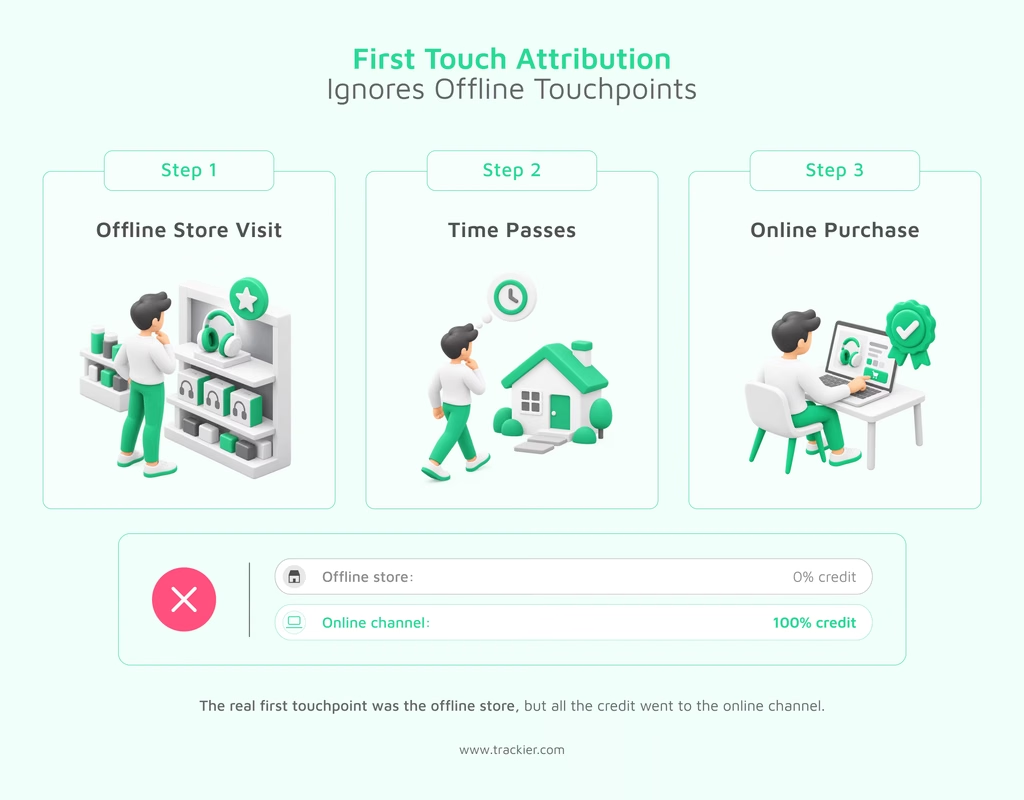
Sometimes the customer first enquires about a product in the offline stores, and then if they get convinced, they get to the brand through any online channel. In such a situation, the offline stores are ignored, and the credit is directed to the online source. - Unsuitable for complex journeys:
For businesses with long and complex sales cycles, relying just on the first touch can be of no use. There are many marketing channels involved in the successful conversion. Tracking only the first conversion will lead to no idea of which channel made the most effective impact on the sales. In such cases, a first-touch attribution model works better as one view of the journey than as the only view.
First-touch vs last-touch attribution
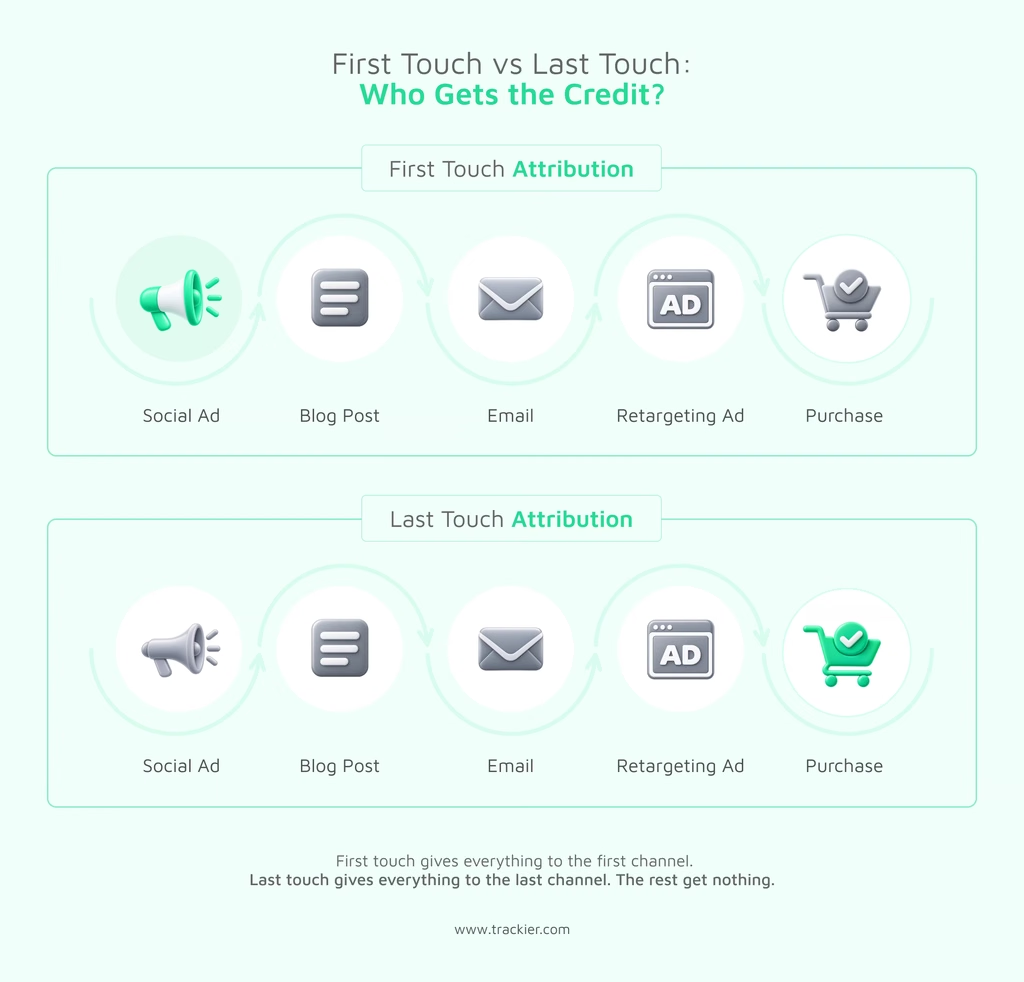
The difference between the first-touch and last-touch attribution comes down to which moment gets the credit. The first-touch attribution model credits the touch that introduced the consumer. The last-touch attribution model credits the final touch that happened just before the purchase.
A person clicks on a creator’s link, opens emails, and then finally purchases the product through a blog post. The first model rewards the creator for introducing the customer, and the last model rewards the blog post for closing the deal. Both pictures are true, but each tells half the story.
The first touch is best for learning about which channel creates demand, and the last touch is best for learning what closes it.
| First Touch | Last Touch | |
| Credit goes to | The first interaction | The final interaction |
| Answers | Where did the customer come from? | What made them convert? |
| Best for | Awareness and discovery | Conversion and closing |
| Weakness | Ignores later touches | Ignores earlier touches |
| Examples | A creator’s link gets all the credit. | A blog post gets all the credit. |
Who should use first touch-attribution?
This model works best when you want to know which channel drives customers to the brand for the first time. It is a good fit for:
- Brand awareness builders:
If you are a new company aiming to build brand awareness, then you can use the first-touch method to identify which initial touchpoints attract potential customers. - TOFU-focused businesses:
If you’re focused on top-of-funnel activities such as content marketing or social media engagement, then first-touch attribution can help attract new leads. - Budget-conscious Companies:
For companies with low marketing budgets. First touch can be best as it helps identify the most effective marketing efforts very quickly. A first-touch attribution model is also very simple to set up, which reduces the complexity of setup.
Key takeaways:
First-touch attribution only credits the channel that makes the customer interact with the brand for the first time. It is easy and simple to set up, and great for awareness if you are running a new business.
As it ignores all the interaction after the first touch, it can miss the full journey. It also suits short funnels. Review your data at every time period. Good performance marketing software makes it easier to track sources and act on the results.
If we compare first-touch vs. last-touch attribution, then we can see first-touch credits the first channel of interaction and last-touch credits the channel that closes the sale.
FAQs:
1. What is the best first touch attribution model?
There is no best one. First touch gives all the credit to the first interaction, so the best setup is the one that tracks that source cleanly. Use consistent tracking links and store the source in your CRM or platform. Compare it with other views to avoid blind spots.
2. Is last touch or first touch attribution better?
Neither is better in every case. First touch works well when you want to know where customers come from, and last touch works well when you want to know what closes the sale. Many teams use both together, so they can see how demand starts and how it converts.
3. What are two types of touchpoints?
The two common types are online and offline touchpoints. Online ones happen on digital channels, like ads, emails, and social posts. Offline ones happen in the real world, like store visits, events, and phone calls. Both can influence a customer before they buy.
4. What is attribution used for?
Attribution shows which marketing channels, campaigns, or partners helped bring in a sale or sign-up. Teams use it to see what is working, decide where to spend budget, and pay partners fairly. Without it, you would be guessing which efforts deserve more money and which ones should be dropped.
5. What are some examples of touchpoints?
A touchpoint is any moment a customer interacts with your brand. Examples include a social media post, a Google ad, a blog article, an email, a referral link, a store visit, a customer support chat, and a product demo. Each one can shape how the customer feels about your brand.
